
Updating The Misery Index (Global Version)

Email this post Print this post
By Barry Ritholtz - December 19th, 2009, 11:00AM

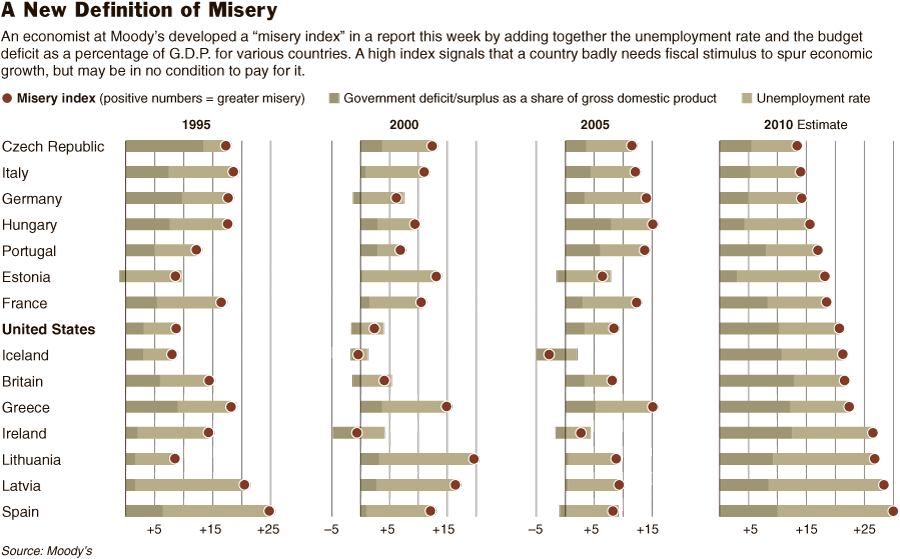
Via Floyd Norris, we get this updated version of the Misery Index, applied internationally. Its the work of Pierre Cailleteau, an economist/sovereign risk analyst at Moody’s.

“The index adds together a country’s budget deficit, as a percentage of gross domestic product, and its unemployment rate. It captures the current conundrum for many countries: their economies need stimulus, but their budgets may not be able to afford it.

The unfortunate leader in that misery index among the countries cited by Moody’s is Spain, with an index of 30, thanks to an unemployment rate of 20 percent and a deficit of 10 percent of G.D.P. The figures are Moody’s estimates for 2010.”

The original Misery Index was much simpler: Developed by Arthur Okun, an economist and adviser to President Lyndon Johnson in the 1960′s. Okun merely added the unemployment rate to the inflation rate. The theory was that any combination of rising inflation and increasing unemployment reflected a nation’s worsening economic performance.

Not coincidentally, the reporting of both Employment and Inflation have slowly been altered since the Misery Index was created. The gradual erosion of data accuracy, the softening of various metrics, and — WTF let’s just say it — the systematic under-reporting of both Employment and Inflation is the net result.

Hence, if you cannot make the economy less miserable, you can at least make the components appear less miserable.

Anyway, here’s a look at the new global version:
>

click for larger graphic
1219-biz-webCHARTS
chart courtesy of NYT
>

Source:
These Days, Countries in Misery Have Lots of Company
FLOYD NORRIS
NYT, December 18, 2009

http://www.nytimes.com/2009/12/19/business/economy/19charts.html

Comments

Please use the comments to demonstrate your own ignorance, unfamiliarity with empirical data, ability to repeat discredited memes, and lack of respect for scientific knowledge. Also, be sure to create straw men and argue against things I have neither said nor even implied. Any irrelevancies you can mention will also be appreciated. Lastly, kindly forgo all civility in your discourse . . . you are, after all, anonymous.

16 Responses to “Updating The Misery Index (Global Version)”

  1. torrie-amos Says:

    one thing pops out, we should put off global warming concerns, iceland blew up yet it’s misery index is lower than many others, can only be that cold temperatures make folks focus on the cold verses financial misery

    we are the world is finally upon, wese all in dis together

  2. jdmckay Says:

    Not coincidentally, the reporting of both Employment and Inflation have slowly been altered since the Misery Index was created.

    Kind’a like US accounting industry. And ratings agencies. And “off book” asset valuations. And…

    The gradual erosion of data accuracy, the softening of various metrics, and — WTF let’s just say it — the systematic under-reporting of both Employment and Inflation is the net result.

    Geez… we can’t even reliably know how miserable we are?

  3. Mark E Hoffer Says:

    like jdmckay,

    w/this: “Not coincidentally, the reporting of both Employment and Inflation have slowly been altered since the Misery Index was created. The gradual erosion of data accuracy, the softening of various metrics, and — WTF let’s just say it — the systematic under-reporting of both Employment and Inflation is the net result.

    Hence, if you cannot make the economy less miserable, you can at least make the components appear less miserable.”-BR, above

    BR, it doesn’t get any more Straightforward than that.

    We are, systematically, Lied to, and, many of us, are Rewarding for believing/repeating the Lies.

    Good thing that some of us bother to discern the difference. It is a Difference that Pays, in more ways than one, and in a unit that, even, the FedRes can’t Fabricate.
    http://www.thefreedictionary.com/fabrication
    http://www.thefreedictionary.com/straightforward

  4. johnborchers Says:

    I think really US should be at the top of the list. Things here aren’t bad. They always say misery loves company. Something is way wrong. I think I just located the perfect short but who knows.
    http://finance.yahoo.com/q/bc?s=JNK
    How in the heck could junk bonds be only down a little over 10% from May 08? Also the Russell 2000 is motoring up without earnings potential if you compare S&P500 to it. Why do no earnings stocks get higher valuation than earnings stocks? Looks like the right play is long S&P500 and short Russell 2000 over the next few years. But who knows. It appears there are no smart people who understand how to properly value stocks anymore. They go through periods of both extreme overvaluation followed by extreme undervaluation.

  5. Mannwich Says:

    @jb: B, b, but, markets are “efficient” dammit!! It hasn’t been about proper “valuations” for years now. It’s all one giant g@mbling parlor with the feds in on the action to screw the taxpayer.

  6. johnborchers Says:

    Man, I’d argue there are a few stocks in the market near fairly valued. Darden, Yumm, Ross for examples.

  7. Tom Hickey Says:

    Every sovereign government that is the monopoly provider of a non-convertible floating rate currency of issue is not financially constrained. Arguments to the contrary are similar to saying that a scoreboard can run out of points, limiting the game. It’s ridiculous on the face of it. The only constraint on the such governments is real. If nominal aggregate demand exceeds the real potential of the economy to produce goods and services for purchase then inflation will result. Otherwise not. This means that when an economy is experiencing a output gap and high unemployment, the government can always increase nominal aggregate demand to close the output gap and reduce unemployment through fiscal policy. This is not economic theory. It is simply national accounting. See L. Randall Wray, Understanding Modern Money (1998), available online at Google Books.

  8. Mannwich Says:

    @jb: I would agree but for the solid companies that likely have fairly valued underlying stocks there are many, many junk stocks out there that are absurdly valued at this point based solely on dollar carry trade (e.g. Ben bucks) coupled with “extend & pretend” strategies.

  9. constantnormal Says:

    Pretty impressive that the US is right up there with Iceland, Latvia, Greece, UK, Spain, Lithuania and Irland — all with this reshaped “misery index” at upwards of 20. Interesting that none of the nations with indices lower than 20 are considered candidates for default, while a fair number of them above 20 have either already defaulted or are on Default’s Doorstep.

    In addition to making the point that a high misery index indicates “… their economies need stimulus, but their budgets may not be able to afford it.”, it also may indicate that their economies are so indebted that they need more revenue to manage their debt load, but due to unemployment, they cannot obtain it.

  10. SS Says:

    MISPLACED CONCERNS?

    The polo clubs of Connecticut remain well subscribed. Is there a better indicator of well being?

    Tally ho!

    SS

  11. franklin411 Says:

    There must be some mistake. How can people in socialist countries like Germany and France be less miserable than those in more capitalistic countries like Britain and the United States? This is all so confusing…

  12. constantnormal Says:

    I wonder … are all of the unemployment metrics comparable? Or are we mixing U3- vs U6-style measures here?

    If we were to replace the U3 circa-10% unemployment component with the U6 circa-17% number, our national “misery index” would jump to be right up there with Latvia and Spain.

    Given the variation in ways that money supply is calculated from nation to nation, it seems reasonable to suspect that there are a variety of different ways to slice and dice unemployment statistics for each nation, especially given than unemployment numbers are going to be a lot more of a political hot potato than wonkish stuff like money supply metrics.

    The cloud of imprecision around stuff like this is bound to be considerable. But then, this is a presentation only intended for infotainment purposes …

  13. rcogen Says:

    I might also add in ratio of private debt to GDP as a proxy for wage and profit stress.

  14. bsneath Says:

    Italy?

  15. Linkage is Good for You: We’re All Going to Die Edition | In Mala Fide Says:

    [...] Barry Ritholtz – “Updating the Misery Index (Global Version)” [...]

  16. LLouis Says:

    I understand that is a misery measure of the governments not of individuals.
    The data use in these index are always from a few years back. And it can come from different time periods from one country to another. Also since the media more and more uses government data and statistics to rate the performance of that government in power, ways are devised to dope data, make it more sexy. Statistic standards differs from one country to another.

    The misery index recalls me the Human Development Index:
    http://en.wikipedia.org/wiki/List_of_countries_by_Human_Development_Index

    I also found these quality of life indexes:
    http://www1.internationalliving.com/qofl2010/
    http://www.economist.com/media/pdf/QUALITY_OF_LIFE.PDF
    http://www.happyplanetindex.org/

69 queries. 0.387 seconds.