
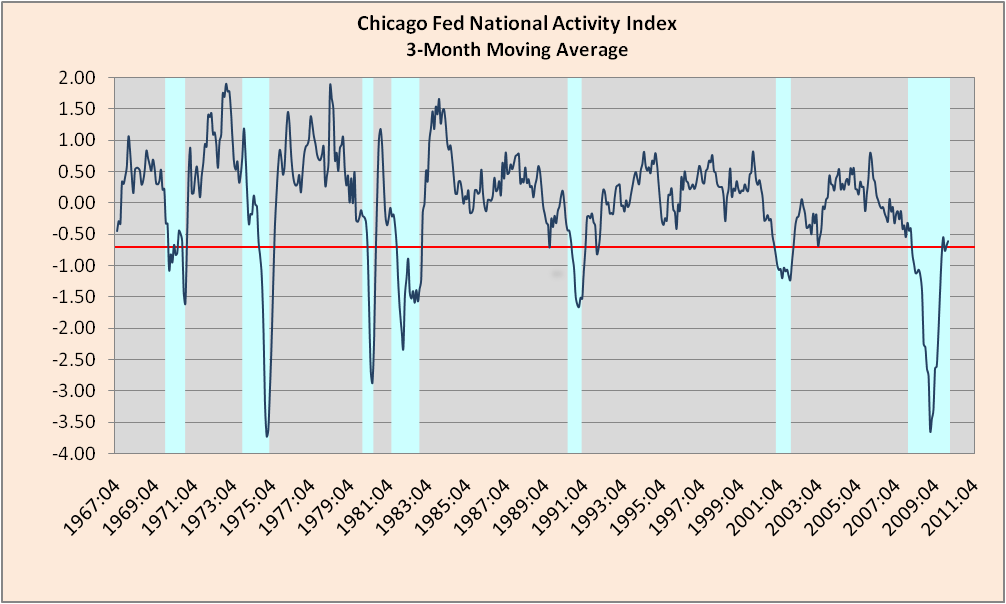
While everyone awaits GDP data this morning, why don’t we look at the best economic gauge you have never heard of:

It doesn’t appear on any economic calendars that I’m aware of. It flies under just about everyone’s radar.  Technically, it’s not a data point itself but a weighted amalgam of 85 other distinct economic data points, an all-in-one look at the United States economy.

And it does an excellent job of tracking the economy’s health.

It’s the Chicago Fed’s National Activity Index (CFNAI), and it just printed for December.

Say the folks in Chicago:

The CFNAI is a weighted average of 85 existing monthly indicators(pdf) of national economic activity. It is constructed to have an average value of zero and a standard deviation of one. Since economic activity tends toward trend growth rate over time, a positive index reading corresponds to growth above trend and a negative index reading corresponds to growth below trend.

The 85 economic indicators that are included in the CFNAI are drawn from four broad categories of data: production and income; employment, unemployment, and hours; personal consumption and housing; and sales, orders, and inventories. Each of these data series measures some aspect of overall macroeconomic activity. The derived index provides a single, summary measure of a factor common to these national economic data.

Additionally, they advise us to focus on the three month moving average:

Month-to-month movements can be volatile, so the index’s three-month moving average, the CFNAI-MA3, provides a more consistent picture of national economic growth.

When the CFNAI-MA3 value moves below –0.70 following a period of economic expansion, there is an increasing likelihood that a recession has begun.

When the CFNAI-MA3 value moves above +0.70 more than two years into an economic expansion, there is an increasing likelihood that a period of sustained increasing inflation has begun.

That said, here’s the chart:
Source: Chicago Fed

>

The MA3 has stalled since hitting -0.54 in September, recording -0.76, -0.68, and now -0.61 since then.  We’ve gotten the bungee bounce off the economic and market lows of almost one year ago. The question now — as I’ve been opining for quite some time — is to sustainability. We’re clearly faltering, with nary a green shoot in sight (witness the just-released Durable Goods orders and weekly Unemployment Claims, which were both weaker than expected). Lots of interesting numbers coming out over the next week, culminating with Friday’s jobs report. The stock market is, perhaps, starting to recognize the loss of momentum.

Interesting times . . .

Category: Data Analysis, Economy, Markets

Please use the comments to demonstrate your own ignorance, unfamiliarity with empirical data and lack of respect for scientific knowledge. Be sure to create straw men and argue against things I have neither said nor implied. If you could repeat previously discredited memes or steer the conversation into irrelevant, off topic discussions, it would be appreciated. Lastly, kindly forgo all civility in your discourse . . . you are, after all, anonymous.

13 Responses to “Best Economic Gauge You’ve Never Heard Of”

  1. dsawy says:

    What is more interesting is that we’ve never regained the high levels of activity of the 70′s in this dataset. After the recession of the early 80′s, the new “good” level of economic activity is more contained in the 0.00 to 0.50 area, never again hitting 1.0.

    It also appears to my eyes that a long term linear regression trend line drawn through the 1983:q1 datapoint (ie, after coming out of the early 80′s recession) until 2007 has a negative slope, meaning that in the long term, we have a decline in economic conditions as measured by this index.

  2. [...] The best economic gauge you've never heard of.  (TBP) [...]

  3. olephart says:

    I have been following this indicator for some time. If you examine the graph carefully you’ll note that coming out of each recession the MA3 has a value of about -0.7 and continues on an overall positive trend. The previous two weak recoveries corresponded to below trend growth for some time after the recessions ended. What would be interesting would be a correlation between job growth and this MA3 plot. As was noted this time the MA3 has stalled at the cusp of recovery. This time is different.

    Also, the New York Fed and the Philadelphia Fed indices have been oscillating in positive territory for some months.

  4. Transor Z says:

    Interesting. The weighting is interesting — heavy industrial focus. Initial claims, weekly hours, and personal consumption weighted 0.00. However, from 1990-present, “normal/non-recessionary” has included the -0.50 to 0.00 range.

    Just visually, the “bungee bounce” from the early 2009 low has barely cracked the line I assume marks -0.70.

    But back to the industrial focus of the underlying indicators — IMO “sustainability” or whether there is “fuel” to propel activity back into positive territory has a lot to do with how leveraged the consumer is right now and how hard it is for even healthy small businesses to get credit. Further, anecdotally I can tell you that what has caused my firm to make conservative choices and turn away some cases we would have happily taken on contingency a few years ago (meaning we front the bulk of costs and collect only at settlement/judgment) is not so much unavailability of credit but sentiment that “the other shoe might drop” on this economy. So I think sentiment plays heavily into your question about sustainability or what I think of as “fuel” to propel us out of this hole.

    Thanks!

  5. Transor Z says:

    Sorry, s/b:

    Initial claims, weekly hours, and personal consumption indicators weighted ~33% to 50% of industrials.

  6. Invictus says:

    @TZ

    Yes, I drew the line at -0.70. However, since we already know we’re in a recession, I probably should have drawn it at +0.20:

    A CFNAI-MA3 value below –0.70 following a period of economic expansion indicates an increasing likelihood that a recession has begun. A CFNAI-MA3 value above +0.20 following a period of economic contraction indicates a significant likelihood that a recession has ended.

    I’ve maintained that chart for so damn long that it never dawned on me — until now — that I should redraw the line from “entering” recession (-0.70) to “exiting” recession (+0.20). Guess I’ll fix that now. Thanks for the heads up.

  7. Moss says:

    Looks like the inflationary indicator is NOT in play.

    I believe that is the most debated aspect of all existing Fed policy choices.

  8. ashpelham2 says:

    Interesting point Transor. I wonder what percent of companies, small and large, believe that there is another negative leg down in this economy, and are holding off on expansion or business plans due just to that fact? So, it’s not so much that credit is not available (though I know that it is a smaller amount), but more just the fact that no one knows what happens next.

    When does this sentiment change? Does it take 12-18 months of positive data to change that opinion? I wonder if the difference between consumer sentiment and small business sentiment grows larger? Seems like they would correlate closely, but consumer sentiment is dictated by things like American Idol and the Super Bowl, whereas small business actually looks at data and what bankers are up to….

  9. David Merkel says:

    My personal favorite is state tax receipts — much closer to the pain felt by the average guy without a printing press.

  10. Patrick Neid says:

    Interesting that another chart resonates depth wise with 1973-75 as do on going stock chart comparisons.

    http://dshort.com/charts/bears/road-to-recovery-large.gif

  11. inthewoods says:

    Interesting that it never really showed inflation being a factor until December of 2005 and then showed a steady falloff from there. So it makes me wonder if housing and energy are factored into this, or whether or not the other indicators that it summarizes are taking it out.

  12. [...] The best economic gauge you’ve never heard of.  (Big Picture) [...]

  13. morton2002 says:

    Here’s an interactive visualization of the data that shows how much weight is given to various types and sources of the indicators:
    http://public.tableausoftware.com/views/ChicagoFedNationalActivityIndex/ChicagoFedNationalActivityIndex?:embed=yes&:toolbar=yes