Comparing Global House Prices
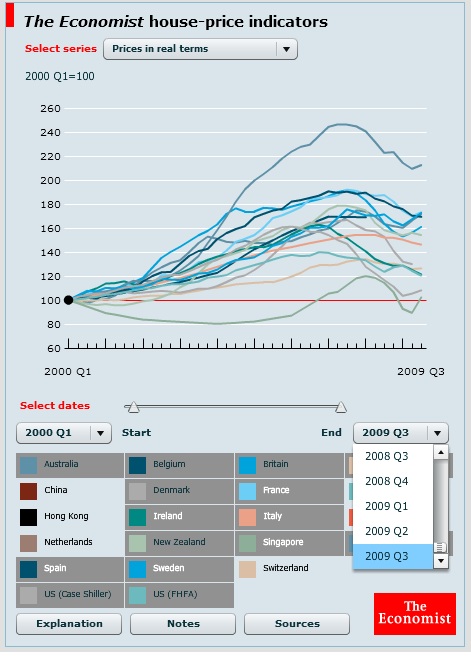
Great interactive chart from the Economist, comparing Houses prices in 21 countries. Looks like the Housing Boom & Bust was mostly global (Canada being one of the notable exceptions).
>
>
Hat tip: Chartporn.org

Great interactive chart from the Economist, comparing Houses prices in 21 countries. Looks like the Housing Boom & Bust was mostly global (Canada being one of the notable exceptions).
>
>
Hat tip: Chartporn.org

Please use the comments to demonstrate your own ignorance, unfamiliarity with empirical data, ability to repeat discredited memes, and lack of respect for scientific knowledge. Also, be sure to create straw men and argue against things I have neither said nor even implied. Any irrelevancies you can mention will also be appreciated. Lastly, kindly forgo all civility in your discourse . . . you are, after all, anonymous.
January 11th, 2010 at 11:57 am
So it seems like a lot of places have much higher home prices than we do… and I believe they also have lower incomes with higher taxes from what I understand. How do people afford homes in those countries? Do they have different mechanisms for purchases than the typical US 15 year or 30 year mortgage? Typically lower interest rates?
January 11th, 2010 at 12:35 pm
Of course, Rosenberg says that Canada is currently in a housing bubble…
January 11th, 2010 at 12:46 pm
Mystic,
Keep in mind there is little comparison between solid-stone co-op buildings in France when compared with stick-built termite meals built in the US. Our housing stock is intended to last 20-30 years, maybe 40 at most. I lived in a house in Germany that was built in 1850 and it was one of the “newer” buildings on the block.
This graph does not reflect quality, however it does adjust only for inflation. So, the graph is meant to show relative price growth, not absolute measurements of value. That should in theory strip out all of the noise factors. Some areas are in higher demand, which can distort the view… compare Iowa with London’s toniest areas, and there’s bound to be some distortion.
Still, the Economist recognizes that fundamental underpinning to housing. You cannot deviate for long from the concept of income to price. Unless incomes go up a lot, you cannot have prices go up.
I’d like to see a comparison of Hyderabad, India compared with this list. You’d see a really strong growth relatively.
Chuck
January 11th, 2010 at 12:47 pm
Canada isn’t that different, they have a few markets that are right up with the worst in the U.S. One blogger did a comparison.
http://edmontonhousingbust.blogspot.com/2009/04/april-showers.html
January 11th, 2010 at 12:49 pm
There is no comparison between the US and Canadian Housing market (at least yet)
Peak to trough, the national US market fell almost 40% — Canada has fallen less than 10% (132-122) and has given up less than 2 years gains. The US has lost 7 years of housing price increases.
January 11th, 2010 at 1:00 pm
The bottom is not in yet. I’m spending the winter in Florida and by the looks of things here it’s still scary. Brand new houses laying empty but they are still building more. Crazy.
January 11th, 2010 at 1:42 pm
I agree Canada is not as far along the cycle as the US, Canada is a couple or three years behind. The bust had just gotten started when the zero interest rates hit and it really spurred the market. Five years from now it will be a very different story though.
January 11th, 2010 at 1:49 pm
Well hey. Housing prices are still dropping. And will continue to drop.
There’s no 100% mortgage prop. Duh.
It’s not about new construction cost, which is rocketing thanks to gov costs: permits, licenses, inspections, …
The sheeple are going to find a way to survive living in fewer more densely packed houses.
I remember living in a really upscale DC neighborhood, where there was one house with eight cars in front.
Housing prices will drop a lot. Stupid. The reos in this area are numerous. Not on the market yet. Lots of luck with that.
Stay tuned.
January 11th, 2010 at 2:09 pm
I like “House Hunters International”, we have very cheap home prices per square footage too almost everywhere else, plus the amenities. My take away is they spend alot more for alot less, period.
January 11th, 2010 at 2:26 pm
Is there a barcode database for a product for if it has filed Chapter Bankruptcy? Do we want a trackback to waste and wasters?
I got this xmas present from a sib of prepackaged Smores .. I see it started at $7.99 then dropped on box to $5.99 .. never asked if it got 50% at the register .. but was built around a origami like finely cut box* with 2 chocolate bars a half bag of marshmellows and a sm bag of 1″ graham crackers that would have been more interesting and tastey if they were Barnums animal crackers.
http://en.wikipedia.org/wiki/File:Animalcrackers_lg.jpg
Anyways .. our last TresSec Paulson mentioned (not exact quote) “once something is built its too late” .. I got that statement .. like above story once the object is built its either real value or someones** mess.
That fact I can’t get through my thickhead is this salesjob. Just make it. That action will create jobs by you trying. Your attempt is heralded even if it fails. Flipside point of the story .. this is a wasteful/messy way of getting/giving people jobs.
* did you know that the graphics industry is sale tax*** exempt and the photos industry is not (in IL)
** with our bankruptcy sop / who cleans up the mess .. Private Profits / Public Losses
*** and this year I Must file online .. get this’en .. Now I must be Data Entry Clerk to pay my taxes (I know we’re broke)
ps – if remembered correctly I belittled the gift as wasteful to the room of sibs .. it sucks to be me
January 11th, 2010 at 2:52 pm
“Canada being one of the notable exceptions”
Vancouver Canada’s real estate market is one of the most inflated in the world. Consider this graphic showing the run-up. To be consistent with the graph produced by The Economist, Vancouver is now at “360″ if a reference of “100″ is used for year 1990.
http://www.vancouverreflections.com/wp-content/uploads/2009/12/avggraph.jpg
January 11th, 2010 at 4:10 pm
Clarification on my last post:
Vancouver is now at “360″ when you look at The Economist’s graph with “House-price Index” not “Prices in Real Terms” selected. That makes Vancouver rival Australia’s housing bubble.
January 11th, 2010 at 4:39 pm
Canada did not escape. It is all a matter of how high the prices were at the start. This starts in 1990 from the main page and that was pretty much the top of an earlier Canadian bubble.
January 11th, 2010 at 4:57 pm
Fantastic interactive graphic. Well done to whoever is responsible!
January 11th, 2010 at 7:21 pm
Few countries escaped. If they did, they also escaped the associated GDP growth. There’s a global pool of money looking for returns. Eastern europeans were gobbling up mortgages from Austria, Italy, etc. Heck, even Kazakhstan, which has a fairly sophisticated financial sector, was syndicating syndicated loans. People who never had access to credit were levering up like crazy, jacking up prices, just like everywhere else. Would you believe you could buy an (nice) 2BR/2BA apartment place in Almaty, Kazakhstan for $500K. Is that oil money? No. It’s credit availability tied to poor mortgage risk analysis.
January 14th, 2010 at 2:31 pm
[...] Monday, I showed a chart via The Economist magazine that hugely made doing global comparisons of real [...]