
Sentiment and Liquidity Review
American Association of Individual Investors (AAII)
Equity Allocations, Deviation versus 21-Year Mean
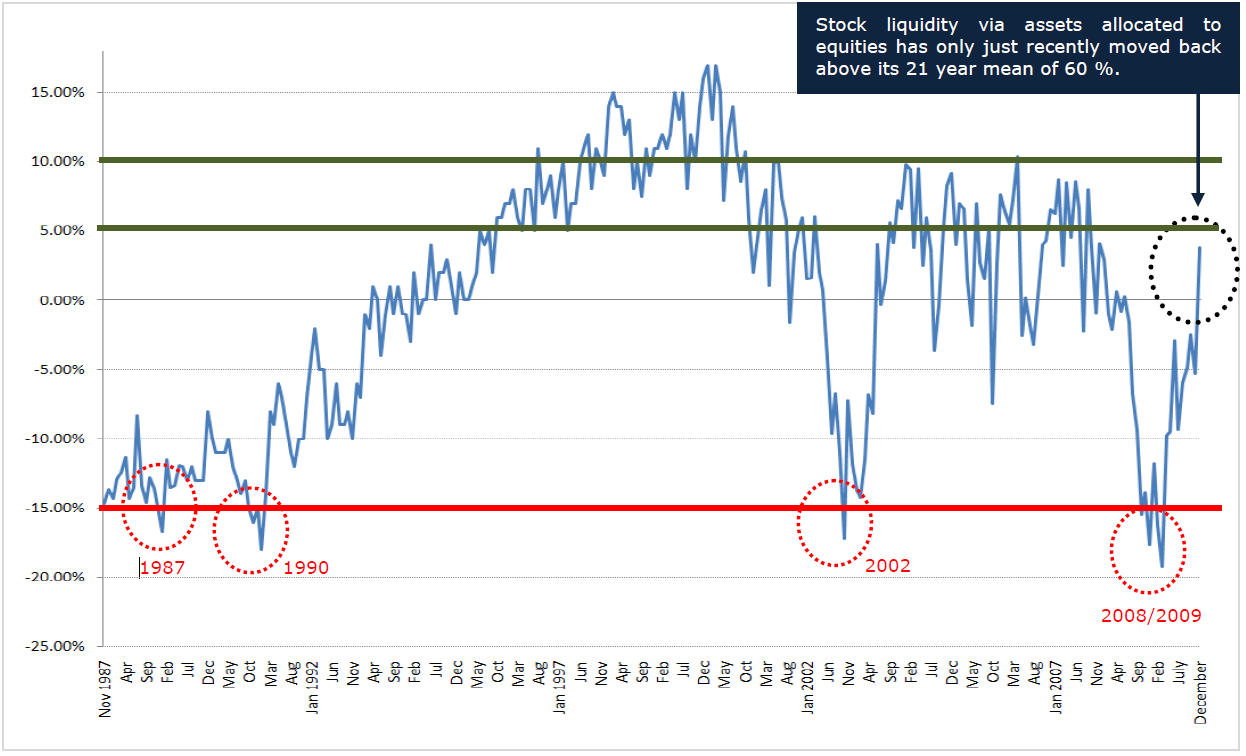
chart courtesy of Fusion Analytics
>
Here’s my partner, Kevin Lane:
“As seen above in the chart above individual investor allocations to equities has only recently moved back above its 21 year mean allocation of 60%. The massive under allocation to equities in late 2008 into the 2009 low was one of the major reasons we became so bullish on stocks since it suggested that selling was washed out of the market and that massive liquidity (aka – buying power) was built up ready to buy back into stocks.
That said we have seen assets rotate back to equities over the last 10 months and the market, being a liquidity driven animal, has responded accordingly. Currently investors have only a slight overweight to equities at 4.00 % above the 21-year mean or stated another way investors are now 64.00 % allocated to equities versus the 21-year mean of 60.00 %.
This is one reason why we continue to believe that after a bit of a correction stocks can move higher as investor liquidity is still not tapped out yet.
While not as ample as near the lows buying power still remains adequate to power/move stocks higher and keep corrections fairly well contained.
-Fusion Analytics
~~~
UPDATE: As the title suggests, this is a Sentiment Review. It is based on a survey that AAII does, and we track changes as the oscillate around a historical mean.
There are two things to understand about this: When it reaches an extreme, it is a warning of an impending reversal; Second,it generally trends from one extreme towards the other.


Tweet
Facebook
Reddit
Digg this!


January 28th, 2010 at 12:37 pm
Good stuff Barry, your the man!
January 28th, 2010 at 1:06 pm
Using 21 years as a guideline could be fraught with danger because the last 21 years have been golden years for equities because it was the era of credit expansion from the Fed. Money supply M2 is now heading down. Besides the remaining 250 Billion from the Fed QE program, what is going to step the economy wide deleeraging.
January 28th, 2010 at 1:08 pm
Sorry, but this interpretation still defies logic like every time when you bring up the graph.
When stock prices fall, the relative allocation of stocks versus cash decreases and vice versa. I doesn’t mean at all that the “individual investors” had “massive” liquidity available at the bottom. Neither it is possible to conclude anything about liquidity available at the current point from this graph.
Since I am too lazy to write the same again and again I simply refer to a previous comment by me to this chart:
http://www.ritholtz.com/blog/2009/04/sentiment-review-40909/#comment-161357
I haven’t seen any refutation so far of what I have had to say about it.
rc
January 28th, 2010 at 1:09 pm
There is no doubt that some percentage of the change in exposure has to do with the decrease or increase in asset prices — BUT:
1) This is not a liquidity argument, its a sentiment measure. And, its based on historical data, and its oscillations between over and under exposure to equities.
What we care about are the extremes, and the change of direction in betweent hose extremes.
2) We also know that retail investors did some selling, on the way down. We further know that bottoms are made when they puke out stock — its called capitulation, and its often mom & pop “making the pain stop” near the lows.
January 28th, 2010 at 1:19 pm
BR, are you assuming no negative trend in equity allocations over time? And is that a fair assumption? The chart could be read to suggest that we have already peaked.
January 28th, 2010 at 1:24 pm
i think you are missing something here. the low equity proportion result in large part because the stock market went down so much. now its up and, of course, the equity proportion is much higher.
~~~
BR: That might be a part of this, if it were a metric that was objectively measured.
But since its a sentiment measure based on a survey, it does not matter
January 28th, 2010 at 1:24 pm
Interesting theory, but I think it’s still another magic chart.
The S&P has been essentially flat since about 11-1-09, excepting a little January blip that was probably caused by HFT pumping. The market is back to and maybe a little below the 11-09 flat spot.
If buyers were jumping in then prices would be going up. If cash is coming off the sidelines and the market is essentially flat, that means the sucker money is entering at the top. Earnings don’t support another jump in equity prices at this time. It’s a sucker market now for buyers.
January 28th, 2010 at 1:31 pm
rootless_cosmopolitan,
Excellent observation. This graph also goes up if prices rise, holding new cash constant. The last upward jag at the end is probably sucker money since prices are now constant.
January 28th, 2010 at 1:36 pm
Agree 100% with rootless_cosmopolitan (and I find myself making the point regularly too), this analysis makes no sense at all. I’m surprised Barry (who is in general a very sharp observer) would invoke simple fallacies like “money on the sidelines”.
The only way this graph would be of any use with respect to analyzing “buying power” or “movements” of assets would be to compare it to similar graphs for other classes of investor (pension funds, hedge funds, etc) and comment on who had increased or decreased their allocation of stock shares (vs stock prices) relative to other classes of buyer. Otherwise this graph only tells you to what level investors have bid stocks relative to an almost-constant aggregate cash level. (Buying and selling stocks doesn’t destroy the money, it just changes hands!)
January 28th, 2010 at 1:47 pm
This is a subtle distinction — its not about cash on the sidelines;
Rather, this is about % equity exposure relative to historic averages as reported by investors themselves.
I did not put Sentiment in the title for shits & giggles !
January 28th, 2010 at 1:58 pm
Barry Ritholtz Says:
January 28th, 2010 at 1:47 pm
This is a subtle distinction — its not about cash on the sidelines;
Rather, this is about % equity exposure relative to historic averages.
reply: How is that measured?
~~~
BR: Survey by AAII.
Thats why I call this a sentiment measure (data goes back to 1987).
January 28th, 2010 at 2:09 pm
BTW, the market is going down and the rate on the 10 year is rising.
Could this be the start of normal, as defined in economics books, as opposed to the constant 10 year rate buy downs due to QE1?
Everything going to Hell would be a normal expectation due to lackluster profits, an over extended stock market, sick real estate, and trillion dollar deficits for the next few years that all need to be funded with new debt. QE1 only has about $100B in MBS buying power left, from $1.25T.
What’s next?
January 28th, 2010 at 2:16 pm
Barry, knowing you like the psychology of markets, do you think there will be a lower peak percentage allocation to stocks (in the coming decade) because of the crashes we have had in the last decade? Looking at the chart, the peak during the 2000′s was less than the peak for the 1990′s. Do you think the peak will be less for the 2010′s? Thanks.
January 28th, 2010 at 2:46 pm
you go Barry-
and that 21 year mean- excellent- why mess with 20 year or 25 year or 50 year- when you got 21 years- although I was thinking 19.5 years might best- well not really- I just pulled that out of my ass- but the 21 year- yeah that speaks volumes- but maybe that’s all the data AAII has-
and remember- what’s going on right now is just your typical recession- NOT A DEPRESSION- so all past nonsense- I mean stats apply-
excuse me while my head explodes
January 28th, 2010 at 2:47 pm
Feel free to ignore any tools I suggest or any metrics we use. You have no obligation to learn anything.
For those who want to learn something, these are not randomly selected numbers — when using an oscillating data series, you pick a median length that generates good signals. Too short a time period and you get lots of false positives; too long and you miss signals.
We’ve been using this data for years, and while it doesn’t generate a lot of buy signals, the iones it has have been enormously profitible.
Those who think this is voodoo — dont bother with it!
January 28th, 2010 at 2:49 pm
I wonder what weighting should be given to the suggestion that individual investors are moving into a secular “bond fund” trend people like David Rosenberg have been suggesting.
Even if the argument regarding the percentage of equities is rising in the individual portfolio stands, the trend towards bonds would suggest that this time, perhaps, the limit that individuals are willing to allocate to equities has dropped and therefore the historical mean is not as valid a marker as it usually would be because individuals are not as keen to hold equties as they have been since 1990. (rohangt spoke tothis as well)
Just a thought, I think this an interesting and productive discussion.
January 28th, 2010 at 2:51 pm
Ahab,
You obviously don’t understand the mathematics of using this data
You are embarrassing yourself
There is a very specific median that generates a usable output. This is basic data usage — take a class
January 28th, 2010 at 2:52 pm
Barry,
“Rather, this is about % equity exposure relative to historic averages.”
Extreme example, but, I guess, some people will have experienced this: Starting with stocks 90%, cash 10%. If the stocks in my portfolio become worthless due to a stock market crash w/o me selling anything my equity exposure will be Zero, cash will be 100% afterward. I still don’t have any more cash than before. How can you conclude I have “massive” cash available now to buy stocks? But this is the fallacious conclusion presented by you guys.
rc
January 28th, 2010 at 2:53 pm
If that was how most people behaved, your criticism would be valid. Howver, its not how the vast majority of mom and pops run their money. And as I said, some of this is appreciation/depreciation of stock values.
But you are missing the point ITS A SURVEY. No one actually measures these accounts; its what investors say in response to questions!
Capice?
January 28th, 2010 at 3:17 pm
I really belive this graph is just another tool used by brokers to convince Joe and Jane that is still a good time to buy stocks, so the house can finish to sell its own position. In case you can use it not as a selling tool but as a sentiment indicator, Barry you should look that the 2008 crash ocurred with the allocation level quite lower than in 2000, so I can conclude that you can not expect individuals to allocate as much part of their capital as in the past before the the stock market crashes again, even more than the last chrash is fresh in many investors memories.
~~~
BR: (Sell side) Brokers don’t use this; It is a tool used by (some) money managers — not salespeople
And, if you look at the 2007-08 period, equity exposure was above historic norms . . .
January 28th, 2010 at 3:34 pm
Here is a sentiment chart by Investors Intelligence measuring the sentiment among financial newsletter writers:
http://www.market-harmonics.com/free-charts/sentiment/investors_intelligence.htm
The description:
http://www.market-harmonics.com/free-charts/descriptions/investors_intelligenc_survey.htm
According to this chart, sentiment has reached levels of high bullishness and low bearishness not seen since 2007 before the crash.
rc
January 28th, 2010 at 4:10 pm
Hey Barry, fyi, the ICI came out with their year end numbers this afternoon. Stock mutual funds cash is at 3.6% of assets. I’m working from memory on this, but that’s within basis points of all time lows. The correlation between low cash levels and market tops, and high cash levels and market bottoms, is predictably high.
January 28th, 2010 at 4:13 pm
“Debt ceiling raised to 14.3 trillion. All is well. And remember, we love you.”
- message from your overlords in Davos.
January 28th, 2010 at 6:01 pm
The data set chosen is an important consideration. In 1987 I believe you were starting to approach the peak earning years of the leading edge of the boomer generation. We are now are in the leading edge of the retirement of the boomer generation that has largely made nothing on their investments for a long time. It seems a dangerous assumption that the future will repeat the past as relates to willingness to allocate to equities. Additionally, until the last 10 years it would have been impossible for the average investor to achieve anything resembling a diversified international portfolio. That is no longer the case. I can assemble a fairly diversified international portfolio down to the sector level. In the absence of another international financial collapse (where all correlations change to 1.0) I believe we may see a progressive decoupling of the developing markets from the better run G-20 markets (think non ‘ring of fire’ economies) and emerging markets. David Kotok’s shop offers an all etf international multiasset strategy. I would be interested in a commentary from his prospective on this observation.
~~~
BR: 1987 was when AAII began tracking this . . .
January 28th, 2010 at 6:11 pm
In the mad dash to be heard, many of you are overlooking BR’s point that this is a measure of sentiment. Sentiment indeed was at a pessimistic extreme in march 09, and since has gotten a bit more happy.
January 28th, 2010 at 6:36 pm
RC – I definately agree with your main point… and I make the point often myself. This is flows = prices is classic over-simplified thinking and its simply a mistake.
That said, lets play your game. You have 10% cash and 90% stocks. Stocks go down 99%. You then have 90% cash and 10% stock… but you can buy 10x as many shares with your cash. If stocks “went to zero” as in your example. You could buy the entire market.
This becomes more reasonable at 50×50 mix. It also becomes amplified if we assume “cash savings” grows steadily. Now with 50% downturns in the stock market over 24-months, with 10% annual additions… we go to 60 units cash / 30 units stock.
Say there are only 2 types of investors, both who experienced the above. Type “A” is a pessimist and is willing to transact at the new 50% lower equity price in unlimited quantity. Type “B” is an optimist and wants to increase his exposure to stocks.
If “B” is willing to have only $30/cash or about 25% cash… he can now buy the entire other half of the stock market from “A”. This despite the fact that total asset value has only declined 10% each for the 2 year downturn.
January 28th, 2010 at 6:41 pm
Course the chart shown is “just the chart”. Its power as an indicator isnt based on perfect logic but whether its capturing something that is helpful in predicting the future.
My issue might be that the note keys on “average” but the chart doesnt really seem to have any steady “average”. It was way below avg in the 80s bull and bear markets. And way above avg for many of the great 90s years. It does seem to bottom at key pessimistic lows, but that seems to be the only indicator.
January 28th, 2010 at 7:15 pm
Alternative view:
The small investor was, as always, the last to re-enter the quity markets at the top of a rally. The next easy way for Wall Street to make money is on the downside.
Anybody have any more information about the HUGE bet on the VIX by GS just before the “Correction” started?
January 28th, 2010 at 7:26 pm
ok cognos-
you have $1,000,000 in stock and $100,000 in cash. Stock market crashes 99%. You now have $10,000 invested in the stock market and a 10 to 1 ratio- cash to stock-
so on the face of it- it appears plenty of liquidity to buy stock-
but from a psychological point of view- how quickly will that money be reinvested in equities- considering a 99% loss of $990,000?
January 28th, 2010 at 8:09 pm
So, first of all these 90% down of 99% down cases are silly. And if anything they only accentuate that on big moves down ANY small part of the market that is risk-positive could then acquire the WHOLE market.
Second, starting from 90/10 is silly. Classic institutional framework is 60% equitys / 40% bonds. Bogel wrote a great editorial piece at the end of 2008 saying, since he follows the old adage “invest your age in bonds” he was either slightly positive or only down 1-2-3% in 2008.
Third, savings continues to accrue… both through interest accrual and earnings/savings. Remember only 5-10% of people lost their jobs. The other 95% of people are still working and probably spending much less! I think Fidelity said total 401k balance holdings hit new peaks in Sept 2009. So basically this means even though S&P stocks were down about 20%… between fixed income perf, interest, dividends and savings additions… balances were back to highs in about 1-yr.
January 28th, 2010 at 8:15 pm
” between fixed income perf, interest, dividends and savings additions . . … balances were back to highs in about 1-yr.”
yeah- I know what you mean- that .25% interest adds up- lol
January 28th, 2010 at 8:45 pm
Stocks pay 2-3% divs.
Corps pay 3-5%.
HY pays 6-10% (and price rec’d over last 1yr)
Term it out a bit. 3yr swap was 3.5% in Sep 08… by Sep 09 it rolled to a 2yr swap at 1.9%. Total return was approx 3.5% carry, +3.2% roll = 6.7% (from 3yr swap risk!).
Since Aug 29, 2008 PIMCO total return bond fund earned 17.5% or 12.2% annualized. S&P500 lost 11.5%.
January 29th, 2010 at 7:00 am
Never try to teach a pig to sing.
It wastes your time, and annoys the pig . . .
January 29th, 2010 at 9:20 am
Here’s my partner, Kevin Lane:
This is one reason why we continue to believe that after a bit of a correction stocks can move higher as investor liquidity is still not tapped out yet.
Translation:
——————-
“People buy stocks because they still have money, in our opinion. Based on a sentiment index assembled by an investor’s trade group , we think there is still cash available. Thus, the stock market will rise because there is still money on the table. Economic explanations aren’t relevant. Just available cash since, we believe, people live to buy stocks. Stocks will rise, based on the Lemming Effect. No math is involved and is completely ignored.”
(WTF … AAII?? Where do they hold club meetings? Is this like the steel workers union or teamsters union, except it’s for for stock investors?)
January 29th, 2010 at 12:22 pm
[...] A historical review of equity allocations. (Big Picture) [...]
January 29th, 2010 at 1:58 pm
I wonder what this chart would have looked like in 1932? Good thing it only goes back to the start of a huge asset mania!
January 30th, 2010 at 9:52 am
Barry has the patience of Job in responding to some of the nonsensical comments on this board. It’s obvious that many investors prefer to invest by the seat of their pants rather than use logical points of reference when making allocation decisions. This AAII survey is just one of dozens of available tools providing an idea of the level of panic and despair or elation and greed by the investing public.