The Decennial Pattern – Years ending in 0

Email this post Print this post
By Barry Ritholtz - January 6th, 2010, 12:30PM

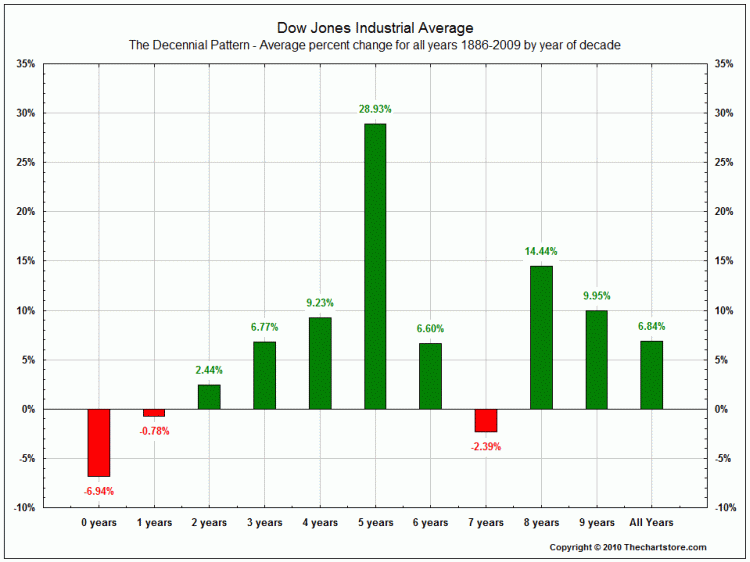
Fascinating pair of charts from The Chart Store looking at market performance based upon years ending number — 1s, 2s, 3s, etc.

Not that I am a believer in this, but the zeros have not fared particularly well:

>

By Year Ending
>

Years Ending in Zero

Comments

Please use the comments to demonstrate your own ignorance, unfamiliarity with empirical data, ability to repeat discredited memes, and lack of respect for scientific knowledge. Also, be sure to create straw men and argue against things I have neither said nor even implied. Any irrelevancies you can mention will also be appreciated. Lastly, kindly forgo all civility in your discourse . . . you are, after all, anonymous.

12 Responses to “The Decennial Pattern – Years ending in 0”

  1. JustinTheSkeptic Says:

    What does it look like since the PPT has been put in place? Lately the market only gets follow-through only on the upside. And don’t tell me it is because the economy looks super strong. It appears to me that the market does what big money tells it to do. This is not a free market!

  2. Steve Barry Says:

    Justin:

    The PPT, if it exists, ;), was formed after the 1987 crash…probably took them a few years to ramp…then in the 1990s, even till today, all previous metrics for P/E and dividend yield seem to have been suspended. Dividend yields are at 2% today, vs. past lows of 3%…normalized P/E today is higher than any pre-1995 level except for the 1929 crash per Hussman AND VERY FEW BAT AN EYE AT THAT.

  3. Steve Barry Says:

    I guess if more people batted an eye at it, it wouldn’t be possible. It’s a testament to the lack of financial acumen that has allowed these bubbles to form…if the American people understood what was going on, they would not have fallen prey to it. But they are due another ass-whacking and I believe that this time they will be quite vengeful. It will be the fourth crash since 1987.

  4. Paul S Says:

    Now I have another reason to love Bowie’s song “5 Years”.

  5. dussasr Says:

    Barry, I’m glad you mentioned that you aren’t a believer in this. I see “studies” like this all the time that have no statistical signifcance – just a bunch of noise. Why republish it at all unless to discredit it?

  6. Steve Barry Says:

    Dussasr:

    I guess you don’t follow the Super Bowl Indicator.

  7. JustinTheSkeptic Says:

    dussasr, it makes more sense than the FED Minutes. They are a bunch of Ivory Tower boys playing head games with the masses. “Gee, lets tell’em it is deflation, but throw in that some of us think inflation.” Bottom line is that they really don’t want to tip their hat at all. “Kick the can down the road for as long as we can boys,” is what they say to each other.

  8. How the Common Man Sees It Says:

    probably took them a few years to ramp

    Didn’t get serious use until Clinton IMO. Reagan created it for ‘emergencies’. Clinton got the market into the perpetual fire truck mode

    Once these guys discovered they could make more money off volatility then they could off more rational markets they let ‘er rip. Similar to the oft heard boast that financiers make more money from one year of war than they do from ten of peace

  9. bonerici Says:

    this is straight up correlated to politicians trying to help the economy so they can get re-elected. nobody gets re-elected in the ’00s, so the economy is allowed to take a dump, or rather the normal business cycle is allowed to retrench in the 00′s.

  10. DiggidyDan Says:

    http://uspolitics.about.com/od/elections/tp/2010_congressional_election.htm

    DOH!

  11. JoWriter Says:

    Just to get in here before franklin411 — it’s clear from both charts that the green years were ones where Democrats were in control and the red years were ones where Republicans were. This is why red was chosen by the TV networks to represent Republicans election wins.

  12. The Big Picture » Blog Archive » Putting the 2000-2009 Market Decade into Perspective Says:

    [...] yesterday’s look at performance by years, Eric Willer in our Dallas office sent me these charts — they are quite instructive as to how [...]

63 queries. 0.336 seconds.

