
The Economy’s Lost Decade

Email this post Print this post
By Barry Ritholtz - January 3rd, 2010, 7:30PM

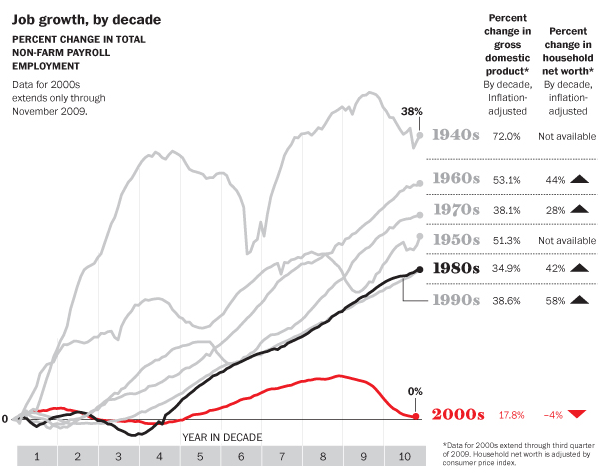
To hell with Japan, we have already had our lost decade — or at least so says the Washington Post. And, it was more than just the stock market that lost ground over the past 10 years:

• Job growth was essentially zero;
• Economic output (GDP) was weak.
• Household net worth (inflation adjusted) fell as stock prices stagnated;
• Home prices declined in the second half of the decade
• Consumer debt skyrocketed.

Here is how the 2000′s compared with a few other decades:

click for larger graphic
>

Source:
The lost decade for the economy
NEIL IRWIN, CRISTINA RIVERO AND TODD LINDEMAN
Washington Post, January 1, 2010

http://www.washingtonpost.com/wp-dyn/content/graphic/2010/01/01/GR2010010101478.html

Aughts were a lost decade for U.S. economy, workers
Neil Irwin
Washington Post, January 2, 2010

http://www.washingtonpost.com/wp-dyn/content/article/2010/01/01/AR2010010101196.html

Comments

Please use the comments to demonstrate your own ignorance, unfamiliarity with empirical data, ability to repeat discredited memes, and lack of respect for scientific knowledge. Also, be sure to create straw men and argue against things I have neither said nor even implied. Any irrelevancies you can mention will also be appreciated. Lastly, kindly forgo all civility in your discourse . . . you are, after all, anonymous.

33 Responses to “The Economy’s Lost Decade”

  1. Steve Barry Says:

    Given the debt we still face, declining demographics and disadvantages competing globally, 2010-2019 will make the 2000′s look like the good old days.

  2. willid3 Says:

    I am thinking this goes with this
    http://www.businessinsider.com/best-economic-chart-of-the-decade-2009-12

  3. km4 Says:

    > Steve Barry Says: Given the debt we still face, declining demographics and disadvantages competing globally, 2010-2019 will make the 2000’s look like the good old days.

    Yup. I think more Americans sense further erosion of their standard of living in 2010 so what is poltroon Ben Bernanke going to do ? Take zero responsibility for being a _______ and print more dollars to try and keep the ‘extend and pretend’ ruse going for Obama.

    Pathetic !

  4. Blurtman Says:

    Bush/Cheney rock! Trickle down finally vindicated.

  5. CTX Says:

    2010 probably will be more of the same, more injections of cash, liqudity galore…Unless sovergn debt and bond maket gets smacked hard

    BR- what is your guess for 2010? in one short sentence

  6. Tarkus Says:

    We’ve got a longer period to scuttle into the “lost” bin coming. Why? Because none of the big names that committed this massive fraud have been jailed. They corrupted the ratings system, making sure the CDO’s were mis-priced at inception. Without purging the system of those guilty of stealing the wealth of the country, no one will participate and the market will languish. China has wised-up and will never allow their destiny to be controlled by Wall St. They are not fulfilling on derivative contracts now, telling their counterparties to kiss-off. They will pull all levers to transfer the world’s wealth to themselves (or at least their ruling elite) now. Does Hank Paulson visit China with the frequency he once did to try and convince them to make their economy more like the U.S.? Wall Street could have just kept collecting golden eggs, but in the last decade the “smartest guys in the room” decided they wanted goose for dinner. “Smarmiest guys in the room” whose actions resemble terrorism on the country more than anything else.

  7. km4 Says:

    Good post Tarkus

    Case in point…..Citi’s Creator, Alone With His Regrets

    http://www.nytimes.com/2010/01/03/business/economy/03weill.html
    Mr. Weill built his wealth, status and power by creating what was once the world’s largest bank. Now, as Citi struggles to regain its footing, Mr. Weill’s legacy has taken on a darker hue. Though he was once viewed as a brilliant dealmaker, some critics now cast him as the architect of a shoddily constructed, unmanageable financial supermarket whose troubles have sideswiped investors, employees and average citizens nationwide.

    Net Net: The rats are now leaving the stage since systemic damage has already been inflicted !
    Paul Volcker weighs in
    http://www.businessweek.com/magazine/content/10_02/b4162011026995.htm?chan=magazine+channel_the+week+in+business

    The American political process is about as broken as the financial system. Therefore, one has to be a bit skeptical. Just to give you one little example, one unrelated to the financial crisis. Here we are on Dec. 29, almost a year after the Inauguration, and there is no Under Secretary of the Treasury. That should be an important position. How can we run a government in the middle of a financial crisis without doing the ordinary, garden-variety administrative work of filling the relevant agencies? The Treasury is an outstanding example of a broken system, but it’s not the only one…..

    25 yrs ( since 1980′s ) of deficits don’t matter, asset bubbles, faux GDP growth, ponzi schemes, increasing debt that’s becoming enormous ( over next decade US publicly held debt is forecast to more than double to 85 per cent of gross domestic product – the highest rate since the second world war ) and people think this past decade of some pain was a lost decade ?

    Stay tuned….

  8. CTX Says:

    but km4- this is capitalism..this is what we advocating to all countries that are still getting out of the middle ages..Only in America

  9. km4 Says:

    CTX…..Obama ‘the messiah’ could have done the “right” thing in the first place but he and his administration elected to keep crony capitalism and the gigantic ponzi scheme of US economy going rather than investing $12 Trillion in infrastructure, education, health care, manufacturing and REAL wealth creating endeavors for Main St economic recovery !

    http://www.calculatedriskblog.com/2009/09/stiglitz-banking-problems-worse-than-in.html
    “The question then is who is going to finance the U.S. government,” Stiglitz said.

    Yikes !

  10. Blurtman Says:

    @Tarkus:
    Right on! The USA had a Treaury Secretary recently who sold fraudulently rated securities. He should be in jail.
    Good for China to tell Wall Street to kiss off on the on derivative contracts. Oddly enough, this is not causing the end of the world as not bailing out AIG was promised to cause. How can that be???? Were we lied to by our current Treasury Secretary?

  11. CTX Says:

    good points km4- i dont think he could be referred to as a messiah, maybe before, when the cult of personality was kicking in, im thinking bond market and sovereign wealth fund failures wreck havoc on the economy soon- that may be what shuts bubblevision up for good

  12. Pete from CA Says:

    Home prices declined?! That is horrible! Another tragic news is that the prices of electronics have declined as well! How will we make progress if stuff just keeps getting cheaper?!?

    I hope the next decade will be better. With some luck by 2020 we’ll see a person having to work at least a full day to earn the price of a loaf of bread!

  13. franklin411 Says:

    Interesting…so as political conservatism has gained strength, the average American has seen progressively anemic economic growth.

    The 1940s and the 1960s were the heyday of New Deal and Great Society Liberalism. Americans prospered.

    The 1950s and the 1970s were the heyday of Modern Republicanism, which accepted New Deal and Great Society liberal programs as valuable but poorly administered. Americans prospered.

    The 1980s and 1990s were the decades of Reaganism and Clinton’s New Democrats, which accepted the idea that the people should not work together through their government to achieve progress. Americans suffered.

    The 2000s were the decade of Conservatism, which rejected the idea that government should govern at all. America was nearly destroyed.

  14. Tarkus Says:

    Let’s face it – A crooked “bank’s” highest aspiration is to become a loan shark operation, being predatory and leeching usury fees from it’s client/victims.
    A hedge fund/bank’s highest aspiration is to gamble big, pass the losses as OPM, but pocket the winnings.

    There is talk of investors not doing enough due diligence on the (ratings-fee corrupted) CDO’s they purchased, but what about the lack of due diligence of firms AIG owed money to? By the same logic, those firms didn’t do the due diligence to verify that their insurer (AIG), who would potentially be liable for huge sums, had enough money to pay off. Funny how the argument is usually used only one-way.

  15. Damien Hoffman Says:

    NAFTA was awesome for the US. No doubt about it. LOL.

  16. beaufou Says:

    Growth over progress, keep believing in it and die.

  17. FT Alphaville » Further reading Says:

    [...] – “To hell with Japan, we have already had our lost decade.” [...]

  18. wunsacon Says:

    franklin411,

    I, too, would like to read into that history the way you do. However, consider what I (unfortunately) think to be better explanations.

    Up through the mid-70′s:
    - The rest of the world’s factories were destroyed in the 1940′s. The US’s wasn’t. We sold the rest of the world goods. Sometimes on long credit terms.
    - The US enjoyed increasing oil production until the early 1970′s. Peak oil occurred in the bottom 48. (Another peak occurred later that decade, when Prudhoe maxxed out.) Cheap energy = luxury.
    - Up until the early 1970′s, the US continued expanding its use of other available natural resources as well.

    Starting in the 1980′s:
    - Cheap oil ran out. We turned to imports. We import 75% of it now.
    - The balance of payments started shifting. Instead of people paying us, we now pay them.
    - Reversion to mean accelerated: the rest of the world rebuilt their factories. Not only were they supplying their own markets. Now they started invading our domestic markets.

    (Of course, in the past 20 years, we get into familiar territory about “free” trade vs “fair” trade, offshoring, computer automation and the like. I’m sure we agree there about a lot.)

  19. Michael M Says:

    The Nikkei 225 stands today at 10655, the same level as in 1984. It peaked at 38957 intra-day high on 29 dec 1989. So that’s at least two lost decades so far in Japanese stocks no matter how you slice it.

    Despite quantitative easing, ultra-low interest rates and endless stimulus.

    Same story applies to Japanese real estate.

    If the Nikkei 225 grows a very healthy 10% annually for the next 14 years that will take it to 40462. That seems to me to be the best case scenario. That’s nearly 3.5 lost decades or you could call it a third of a century lost.

    If it grows only 5% annually for the next 27 years that will take it to 39980. That’s almost half a century lost (not counting dividends and inflation or comparing with bonds).

    Japan’s lost decade is a broken cliché. Sadly, it needs updating.

  20. scm0330 Says:

    f411 – You are the unchallenged king of spurious correlations. As an educator, you are a very, very dangerous young man. If you want a valid correlation, look no further than the states and cities that have enjoyed unfettered big government progressivism. Places like NY, and NJ, and your stomping grounds in CA. Conservatives wrecked those places? Taxes aren’t high enough? Cities like Newark, and Detroit, and Washington DC. Those places all are exquisite, real-time laboratories for your socialist fantasies.

  21. How the Common Man Sees It Says:

    Interesting…so as political conservatism has gained strength, the average American has seen progressively anemic economic growth.

    That was just plain stupid. It doesn’t matter what the government did politically because fiscally it was liberal (borrow and spend, not living within your means). You write some pretty dumb things sometimes for a teacher

  22. mathman Says:

    IMO, the “constant progress” idea of capitalism (combined with its short-term thinking paradigms) are the problem. The world is operating on borrowed time due to over capacity and diminishing resources of all kinds.
    We, as a species, didn’t learn the big lessons and will continue to pay the price for our lack of stewardship, relentless greed and continued spawning of our kind while driving other species to extinction. There is no way out now since we failed on climate change. The planet will rid itself of the cancer of humanity (or bring it down to acceptible levels over time – where we can’t influence the planet’s balance via our pollution and way of life). All the political and economic distraction is missing the point.

  23. mathman Says:

    sorry, i forgot this link: http://www.bearishnews.com/

  24. Mark E Hoffer Says:

    wunsa-

    you need to understand the dynamics involved with the Petro$, our post-’71 unit of account..

    and, the idea that “Prudhoe maxxed out” is beyond the pale..

    that North Slope field is, still, flowing Artesianally.

    KISS: put down the ‘Peak Oil’-agitprop..

  25. Init4good Says:

    I think we should nickname it the “Ayn Rand/ Greenspan Shrugged” decade….

  26. OverMan Says:

    Its going to take us more than a decade just to bring the jobs back, not including all the manufacturing we have lost.

  27. Mannwich Says:

    Good to see that “global free trade” was indeed a miracle panacea for jobs in this country. We’re still waiting for all those new and higher paying jobs to arrive, as per our modern day astrologers’ (economists) edict. Waiting for Godot part deux.

    I’ve said it before and I’ll say it again, there have been many cons foisted upon the Sheeple throughout history, but this one may have been, and continues to be, the biggest one. The elites are making out just dandy though.

  28. ancientone Says:

    What a pathetic pile of partisan misinformation from several directions. Inflation in the seventies was from the price of oil, not the miniscule deficits of the federal government; the deficits were much bigger in the eighties and inflation was much lower because oil was much cheaper. The price of oil exploded in the seventies because Nixon took the dollar off the gold standard so his wealthy business tycoon backers could export more because of our weaker currency. He was warned before hand by the oil producing states that they would not tolerate the value of their commodity dropping along with the dollar (as it was priced in dollars), and they made good on their threat. It does help to know history before making causative assertions.

  29. Marc P Says:

    The chart uses two measures synonymously with economic health, and both of them are misleading: job growth and GDP.

    The figures would have to be corrected for the increase in the population. Clearly as the baby boomers became both consumers and employees, the number of jobs increased. Likewise, as most families went from single wage earner to double wage earner status, the employment increased. Finally, the measure is for nonfarm payroll. The period of 1943 to 2010 has seen a tremendous shift of workers from the farm to the cities as mechanization lead to fewer farmworkers. If the figures were corrected for all of these things it would begin to be representative.

    As for GDP, since 1982 GDP is hardly representative of the overall economy. GDP is a measure of spending, and so long as personal, corporate, and governmental debt has been used to artificially inflate GDP figures, then the figures for the period 1982 through 2010 are not comparable to the figures from the 1940s and 1950s. I would like to see a corrected graph showing true GDP growth.

  30. wunsacon Says:

    >> and, the idea that “Prudhoe maxxed out” is beyond the pale..

    Er, loose language. Yes, Prudhoe is still going. But, US peak oil production (that is, for all 50 states) peaked — reached its maximum — in the late 70s.

    http://en.wikipedia.org/wiki/File:US_Oil_Production_and_Imports_1920_to_2005.png

  31. wunsacon Says:

    ancientone, I don’t disagree with what you’re saying. If you’re referring to my original post (among others), possibly it’s my writing at 3am last night that left too much interpretation to the reader… Your factors are factors as well, items I would include in an overall explanation of America’s post-WWII rise and…um…undulating plateau of greatness!

    MEH, actually, the “that North Slope field is, still, flowing Artesianally” statement doesn’t negate the fact that US production peaked and headed down, while we kept importing and importing more. I’ll assume my loose language regarding Prudhoe sounds like “agitprop” (nonsense).

  32. The Lost Decade | Austrian Economics Blog Says:

    [...] Here is a beautiful illustration, with a visual that originated in the Washington Post – the newspaper of the city that generated the false boom that ended in devastation: [...]

  33. Roundup – New Year’s Afterbirth « The Heat Death Hour Says:

    [...] The Economy’s Lost Decade [The Big Picture] [...]

87 queries. 0.399 seconds.