The State of The Internet

Email this post Print this post
By Barry Ritholtz - February 28th, 2010, 4:42PM

Nice set of data:

JESS3 / The State of The Internet from Jesse Thomas on Vimeo.

February’s Most Popular Books on TBP

Email this post Print this post
By Barry Ritholtz - February 28th, 2010, 3:00PM

One of the cool things about Amazon is the ability to track what gets purchased when referred from the site. For privacy reasons, I only know what was purchased, not by who — so whoever bought Ginger Lynn’s The Pleasure Hunt video, your secret is safe).

I find it intriguing to see which books were most purchased by TBP readers, in both physical and kindle forms. Note some of the book are from Part I of the list of Apprenticed Investor books.

Not counting Bailout Nation, here are TBP’s most popular books:

Top 15 Most Popular

1. Stock Market Wizards: Interviews with America’s Top Stock Traders
2. How We Know What Isn’t So: The Fallibility of Human Reason in Everyday Life
3. Bull: A History of the Boom and Bust, 1982-2004
4. How I Trade and Invest in Stocks and Bonds
5. The Art of Contrary Thinking
(Tie) 6-7. This Time is Different: Eight Centuries of Financial Folly
6-7. Reminiscences of a Stock Operator
(Tie) 8-9. The Investor’s Anthology; Original Ideas From the Industry’s Greatest Minds
8.-9 The Holy Grail of Macroeconomics: Lessons from Japan’s Great Recession (Koo)
10. The New Market Wizards: Conversations with America’s Top Traders
(Tie) 11-15. Too Big to Fail
11-15. The Winner’s Curse: Paradoxes and Anomalies of Economic Life
11-15. Comeback America: Turning the Country Around and Restoring Fiscal Responsibility
11-15. Business Model Generation: A Handbook for Visionaries, Game Changers, and Challengers
11-15. Drive: The Surprising Truth About What Motivates Us

Standouts on Kindle were Reminiscences of a Stock Operator, followed by New Market Wizards. Every other book was too limited in sales numbers to differentiate.

To the Shareholders of Berkshire Hathaway:

Email this post Print this post
By Barry Ritholtz - February 28th, 2010, 11:15AM

Berkshire Letter 2009ltr

Berkshire Hathaway Letter to Shareholders

Email this post Print this post
By Barry Ritholtz - February 28th, 2010, 11:00AM

This years Berkshire Hathaway Letter to Shareholders (PDF) is a fascinating reads, filled with all sorts of gems:

“Selecting the S&P 500 as our bogey was an easy choice because our shareholders, at virtually no cost, can match its performance by holding an index fund. Why should they pay us for merely duplicating that result?

A more difficult decision for us was how to measure the progress of Berkshire versus the S&P. There are good arguments for simply using the change in our stock price. Over an extended period of time, in fact, that is the best test. But year-to-year market prices can be extraordinarily erratic. Even evaluations covering as long as a decade can be greatly distorted by foolishly high or low prices at the beginning or end of the measurement period. Steve Ballmer, of Microsoft, and Jeff Immelt, of GE, can tell you about that problem, suffering as they do from the nosebleed prices at which their stocks traded when they were handed the managerial baton.”

I have never been a Buffett cheerleader — he supped at Uncle Sam’s teat during the crisis — but I have always appreciated his blunt forthrightness. Its hard to imagine many other CEOs writing words to this effect:

“The big minus is that our performance advantage has shrunk dramatically as our size has grown, an unpleasant trend that is certain to continue. To be sure, Berkshire has many outstanding businesses and a cadre of truly great managers, operating within an unusual corporate culture that lets them maximize their talents. Charlie and I believe these factors will continue to produce better-than-average results over time. But huge sums forge their own anchor and our future advantage, if any, will be a small fraction of our historical edge.

And it gets better from there. There is no love lost between Berkshire (like Google) and Wall Street:

“We make no attempt to woo Wall Street. Investors who buy and sell based upon media or analyst commentary are not for us. Instead we want partners who join us at Berkshire because they wish to make a long-term investment in a business they themselves understand and because it’s one that follows policies with which they concur. If Charlie and I were to go into a small venture with a few partners, we would seek individuals in sync with us, knowing that common goals and a shared destiny make for a happy business “marriage” between owners and managers. Scaling up to giant size doesn’t change that truth.”

And lastly, this:

“At 86 and 79, Charlie and I remain lucky beyond our dreams. We were born in America; had terrific parents who saw that we got good educations; have enjoyed wonderful families and great health; and came equipped with a “business” gene that allows us to prosper in a manner hugely disproportionate to that experienced by many people who contribute as much or more to our society’s well-being. Moreover, we have long had jobs that we love, in which we are helped in countless ways by talented and cheerful associates. Indeed, over the years, our work has become ever more fascinating; no wonder we tap-dance to work. If pushed, we would gladly pay substantial sums to have our jobs (but don’t tell the Comp Committee).”

Good Sunday reading . . .

~~~

UPDATE February 28, 20120 11:15 am

A few of you have emailed to say you cannot open the PDF. Perhaps its the traffic, as the letter was released today. I’ll see if I can embed the letter.

UPDATE II

Done! Embedded version here

Banking System Remains in Perilous Health

Email this post Print this post
By Barry Ritholtz - February 28th, 2010, 9:00AM

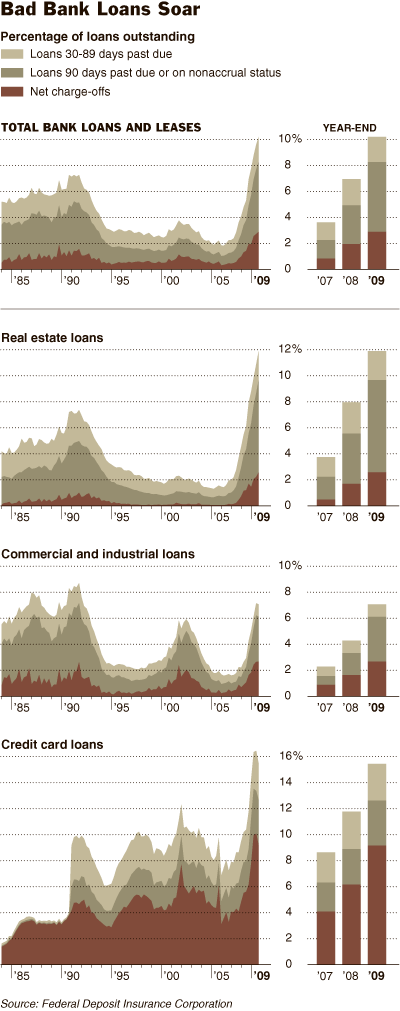
Starting off this terrific article from Floyd Norris is this simply astounding statistic:

More than $1 in every $10 that American banks have outstanding in loans is lent to a troubled borrower, a ratio far higher than previously seen in the quarter-century that such numbers have been compiled.

The problems are greatest in construction loans for single-family homes, where nearly 40 percent of the loans either are delinquent or have been written off as uncollectible. But they are also high in mortgage loans for single-family homes, where $1 in every $8 of loans is troubled.

Amazing . . .

That is what happens when we elected to go Japanese rather than Swedish on the financial sector — We saved the Banks, but sacrificed the Banking System.

>

Previously:
Time to Get Swedish (January 23rd, 2009) 
http://www.ritholtz.com/blog/2009/01/time-to-get-swedish/

The New N Word: Nationalization (February 25th, 2009) 
http://www.ritholtz.com/blog/2009/02/nationalization-the-new-n-word/

Why Aren’t Banks Lending? They Are Being Rational (December 23rd, 2009)
http://www.ritholtz.com/blog/2009/12/why-arent-banks-lending-they-are-being-rational/

Source:
Banks Out of the Woods? Maybe Not
FLOYD NORRIS
NYT, February 26, 2010
http://www.nytimes.com/2010/02/27/business/27charts.html

Words from the Investment Wise 2.28.10

Email this post Print this post
By Prieur du Plessis - February 28th, 2010, 8:15AM

Words from the (investment) wise for the week that was (February 22–28, 2010)

As investors vacillated about the impact of developments in Greece, together with the uncertainty of strong fourth-quarter economic data possibly not carrying over to the first quarter, stock markets experienced two sharp sell-offs and two rebound rallies, limping to small gains on Friday but ending the week modestly down.

Renewed fears over Greece’s debt woes, disappointing German business confidence statistics and lower-than-expected US consumer confidence data tempered investor optimism for risky assts, triggering haven demand for government bonds and the Japanese yen.

Fed Chairman Ben Bernanke provided some support for stock markets on Wednesday by indicating in his testimony to the US House Financial Services Committee that the fed fund rate will remain at exceptionally low levels for an extended period. However, the flip side of the coin is his gloomy picture of the economy still battling high unemployment and a weak housing sector.

“Greece hasn’t gotten so much press since 146 BC when the Romans took over,” said Paul Kasriel (Northern Trust). In news after the close of the markets, the Financial Times reported: “Germany’s biggest banks are looking at a rescue plan for Greece under which they would buy Greek debt backed by financial guarantees from Berlin. One senior German bank official said serious thought was being given to a plan for the German government, working through KfW, its development bank, to issue guarantees to banks that bought Greek debt.”

28-02-10-01

Source: Patrick Blower, Guardian

The past week’s performance of the major asset classes is summarized in the chart below – a set of numbers indicating that a degree of risk aversion has crept back into financial markets. Interestingly, unlike equities, both investment-grade and high-yield corporate bonds ended the week in the black. “We believe investors can capture attractive yields and excess spread in the high-yield market with relatively low default risk,” Andrew Jessop, high-yield portfolio manager at Pimco, said in a note on the company’s website (via MoneyNews).

28-02-10-02

Source: StockCharts.com

A summary of the movements of major global stock markets for the past week and various other measurement periods is given in the table below.

It was essentially a flat week, with the MSCI World Index declining by 0.1%, but the MSCI Emerging Markets Index managing to eke out a positive return of 0.3%. With the Chinese returning from the lunar holiday, Hong Kong (+3.6%) put in one of the better performances among important markets, whereas mainland China (+1.1%) also closed the week in the black.

Notwithstanding the huge rally since the March lows, only the Chile Stock Market General Index has been able to reclaim its 2007 pre-crisis peak and is now trading 9.4% higher. Mexico could be the next country to eliminate the bear market losses.

Click here or on the table below for a larger image.

28-02-10-031

Top performers among stock markets this week were Ukraine (+4.5%), Greece (+3.7%), Hong Kong (+3.6%), Cyprus (+3.2%) and Thailand (+3.0%). At the bottom end of the performance rankings, countries included Turkey (‑6.8%), Malta (-5.7%), Austria (-5.2%), Argentina (-4.9%) and Latvia (-4.2%). Turkey suffered from tensions between the government and the military. Debt-ridden European countries such as Italy (-3.2%), Spain (-3.2%), Ireland (-3.2%) and Portugal (-2.1%) featured strongly at the bottom end of the performance ranking.

Of the 96 stock markets I keep on my radar screen, 33% recorded gains, 60% showed losses and 7% remained unchanged. The performance map below tells the past week’s somewhat bearish story.

Emerginvest world markets heat map

28-02-10-04

Source: Emerginvest (Click here to access a complete list of global stock market movements.)

Eight of the ten economic sectors of the S&P 500 Index closed lower for the week, with Financials and Consumer Discretionary the only two sectors not under water. (Who would have guessed the Conference Board’s Consumer Confidence Index would fall to its lowest level since July 2009 on Tuesday?)

28-02-10-05

Source: US Global Investors – Weekly Investor Alert, February 26, 2010.

John Nyaradi (Wall Street Sector Selector) reports that as far as exchange-traded funds (ETFs) are concerned, the winners for the week included Vanguard Extended Duration Treasury (EDV) (+4.3%), iShares MSCI Thailand (THD) (+3.9%) and CurrencyShares Japanese Yen (FXY) (+3.1%).

At the bottom end of the performance rankings, ETFs included iShares MSCI Turkey (TUR) (-8.8%), Claymore/MAC Global Solar Energy (TAN) (-7.2%) and United States Natural Gas (UNG) (down 5.1%).

Referring to a regulatory report released on Tuesday by the Federal Deposit Insurance Corp (FDIC), the quote du jour this week comes from Addison Wiggin, co-author of Financial Reckoning Day Fallout and The New Empire of Debt. He said in a column on The Daily Reckoning site: “The FDIC is even more broke than it was three months ago. The fund the FDIC uses to ‘insure’ your bank account went $20.9 billion in the red during the fourth quarter of 2009. That’s more than twice the deficit reported when the fund first entered negative territory in the previous quarter. Incredibly, the FDIC is still trying to reassure us that all is well because it’s collecting three years of advance payments on the annual assessments paid by its member banks. The fees total $45 billion – barely twice the amount of the current deficit. Yeah, we feel better.

“On top of that, the FDIC’s list of ‘problem banks’ grew during the fourth quarter from 552 to 702. That’s the highest number since 1993 (when, we presume, more independently owned banks were around, so it’s worse than it sounds). Hmmm, let’s see. The number grew 27% in just one quarter. At this pace, every bank in the country will be on the problem list by the fourth quarter of 2012. Another tidbit from the FDIC’s report: Bank lending last year dropped at the biggest clip since 1942. Of course, in that year, the entire economy was shifting to a war footing. So it’s safe to say what we’re seeing now is another unprecedented postwar occurrence.”

Read the rest of this entry »

10 things you didn’t know about orgasm

Email this post Print this post
By Barry Ritholtz - February 27th, 2010, 6:00PM

Saturday LinkFest!

Email this post Print this post
By Barry Ritholtz - February 27th, 2010, 3:30PM

I always end up with a ton of stuff to read on the weekends — bookmarks, things I hadn’t gotten to all week, new materials. Here is what I will be perusing for the rest of the weekend:

• Preparing for the Inevitable Bursting Bubble (NYT)
Barron’s cover story: GM Is Back! (Barron’s)
• Grantham’s ‘Horrifically Early’ Calls Challenge GMO (BusinessWeek)
• Steve Cohen (SAC) Trades Secrecy for Golf With Investors Lured by 30% Gains (Bloomberg)
• Martin Wolf: How unruly economists can agree (FT)
• How To IPO Your House (Forbes)
Oh, goodie, another Housing Bottom Caller! Buffett Says U.S. Housing Market to Recover in ‘Year or So’ (Bloomberg)
• Billions of Songs, Billions of Apps, Not Much Profit (All Things Digital)
• Compressed sensing: The fascinating mathematics of Sparsity (Wired)
• Vast Antarctic iceberg breaks free (BBC Video) see also New evidence on Antarctic warming (BBC)
• Relieve Wall Street stress and downward-facing dog your way to relaxation (Bing)


What are you reading?

Charlie Munger on The Current Economic Crisis

Email this post Print this post
By Barry Ritholtz - February 27th, 2010, 1:30PM

Charles T. Munger, the Vice-Chairman of Berkshire Hathaway Corporation, discusses the current economic crisis with Professor Joseph A. Grundfest

Debasing & Defacing the Dollar

Email this post Print this post
By Barry Ritholtz - February 27th, 2010, 12:00PM

Heh heh: Not what you Dollar Bears thought!

These are a half dozen of my favorites from 30 Bizarre Examples of Defacing Money from the aptly named site, MONEY MUMBO JUMBO:

Sparta!

iPod

Head shot

Alice in Wonderland

Moth Eaten:

And even though I was never a big Kiss fan, this one still tickles me:

Kiss

Source: Money Mumbo Jumbo

Hat tip boingboing

~~~

UPDATE:

One last bill from this flickr pool:

43 queries. 1.074 seconds.