
Why No Canadian Housing Bubble?

Email this post Print this post
By Barry Ritholtz - February 9th, 2010, 7:15AM

Yesterday’s WSJ had an article about Canada’s Housing market. (Housing Rebound in Canada Spurs Talk of a New Bubble). The article noted that “Average home prices in Canada have risen 23% from their trough in January 2009. Home-sales volumes are up 70% over the same period . . . Canada’s housing recovery has been so rapid that some here are worrying about a bubble.

But to call it a rebound misses the point. As the Cleveland Fed pointed out, Canada’s housing market never went bust — there was a sales dip, but nothing like the US. And prices have continued to go higher to the point where the Journal is now discussing them in terms of bubbliciousness.

Why is that?

There are a variety of reasons why Canada’s market held up better than that of the US, but I boil it down to the big four:

1) Lending Standards were increasingly non-existent in the US from 2001-07. On the other hand, Canada never had the non-bank lenders that abdicated these standards en masse. There was no “Lend-to-Securitize” business model in Canada.

2) Mortgage Insurance: Mortgages with less than 20% down payment are considered a high LTV ratio (This was 25% previously), and in these purchases, mortgage insurance is required. Over 80% of Canada’s homes have what is commonly known as PMI in the US.

3) Full Recourse Mortgages — you can walk away from the house, but not the mortgage debt. Makes quite a difference in the way borrowers behave.

4) Single Regulator, Lack of Regulatory Capture: The hodge-podge of Federal and State regulators encourages forum shopping; it also masks much of the massive lobbying effort by US banks and investment houses. Lobbying dollars don’t seem to be nearly as pernicious or corrupting North of the border.

The Cleveland Fed also noted that subprime mortgages accounted for a fifth of all US mortgages originated between 2004–2006. In Canada, the subprime market share was roughly 5% percent in 2006—compared to 22% percent in the U.S. And the Canadians never expanded significantly into the wackier exotic mortgage products — IOs, Neg Ams, Piggy Backs, etc. (interest-only and negative-amortizations grew rapidly in the U.S. from 2003 to 2006).

Hence, with a subprime market less than a quarter the size of the US (percentage wise), and homeowners who were on the hook for their own bad purchases, its no surprise that Canada’s housing market is far less boom & bust prone than the US RE market has been.

>

US vs Canada Delinquency Rates
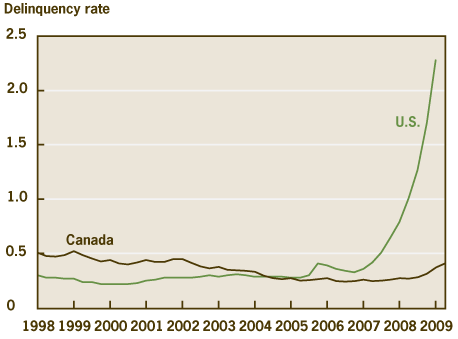
US vs Canada Home Prices

>

Sources:

Housing Rebound in Canada Spurs Talk of a New Bubble
PHRED DVORAK 
WSJ, Feb 8, 2010
http://online.wsj.com/article/SB10001424052748703808904575025100730017666.html

Why Didn’t Canada’s Housing Market Go Bust?
James MacGee  
The Federal Reserve Bank of Cleveland 12.02.09
http://www.clevelandfed.org/research/commentary/2009/0909.cfm

What Toronto can teach New York and London
Chrystia Freeland
FT, January 29 2010 
http://www.ft.com/cms/s/2/db2b340a-0a1b-11df-8b23-00144feabdc0.html

Additional Sources:
Banks urge Ottawa to tighten mortgage rules
Boyd Erman and Tara PerkinsFrom Globe and Mail Feb. 06, 2010
http://www.theglobeandmail.com/report-on-business/banks-urge-ottawa-to-tighten-mortgage-rules/article1458585/

Nobody’s saviour
TARA PERKINS 
The Globe and Mail, Apr. 20, 2009  
http://www.theglobeandmail.com/report-on-business/article1138040.ece

Homeownership Rate Falls Back to Pre-Boom Level (Economix)
http://economix.blogs.nytimes.com/2010/02/02/homeownership-rate-falls-back-to-pre-boom-level/

Jumbo Mortgage ‘Serious Delinquencies’ Rise to 9.6%
Jody Shenn
Bloomberg, Feb. 8 2010
http://www.bloomberg.com/apps/news?pid=20601110&sid=at0fpRHaUHhE

Comments

Please use the comments to demonstrate your own ignorance, unfamiliarity with empirical data, ability to repeat discredited memes, and lack of respect for scientific knowledge. Also, be sure to create straw men and argue against things I have neither said nor even implied. Any irrelevancies you can mention will also be appreciated. Lastly, kindly forgo all civility in your discourse . . . you are, after all, anonymous.

33 Responses to “Why No Canadian Housing Bubble?”

  1. jwilliamstephens Says:

    hi Barry – love the site. I would also add, at least for Vancouver and Toronto, that Chinese money has continued to flow into the market, which I think has been a long term structural theme in Canadian property.

  2. Doc at the Radar Station Says:

    It would be interesting to see some house price charts that are in $/sq. ft over this time period overlaid with the usual ones we see. I think the effect of low interest rates would be the biggest culprit here-you can afford a much larger house for the same payment – all else equal.

  3. Doc at the Radar Station Says:

    Oh yeah, I forgot to mention that if your mortgage payment stays the same and your house shrooms up 30% in size, so does the price for the most part. So, just price is somewhat misleading.

  4. torrie-amos Says:

    Canada oh Canada, imho, good regulations, good jobs and job market, plus, them canucks are not too mobile, meaning they don’t move to the groove wherever, they tend to stay near where they were born, you add in demographics, and there you go.

  5. Mark E Hoffer Says:

    BR,

    this type of “Canada v. U.S.”-comparo is interesting, to a degree..though, predictable, in many of the ways you lay out..

    But, why not follow-up on where these ‘Assets’, ultimately, landed (namely, Pension Funds), who bought them, and how they were paid??

    “…The issue of corruption at public funds is a sensitive subject — not only for the millions of public workers whose retirement benefits are at stake, but also for people who earn their living in the public pension fund industry. In Institutional Investor’s October cover story, “Shadow Lands,” Ed Leefeldt and I spent six months looking into the problems of corruption at public funds across the U.S. It is clear from our reporting that the apparent issues in New York represent just one — an extreme one, to be sure — example of a national problem. We argue that the reforms being proposed by Cuomo and the U.S. Securities and Exchange Commission, whose comment period for proposed rules designed to reform the process of manager selection in the $2.2-trillion pension system ended this week, fail to address the problem…”
    http://www.iimagazine.com/article.aspx?articleID=2313297
    http://www.institutionalinvestor.com/

    how the rip-off could have been avoided, is one thing..how the rip-off played out, is another..the higher Taxes(rip-off) to pay for the effects of the rip-off is a facet, of this Jewel, that is, hardly, touched on..

  6. How the Common Man Sees It Says:

    we also can’t deduct mortgage payment unless you do some financial gymnastics. That was one less fish the politicians threw our banks in years past.

    Also, up until a few years ago our CB was being run by a CBer who was targeting the inflation rate and not asset prices. Now, since we brought in (pause for dramatic effect with a dun dun dunnnn on the organ)….the goldman guy……to run our CB we have started on the path to a housing bubble ourselves

  7. galton Says:

    I think the key article you need to link to is this: http://www.theglobeandmail.com/report-on-business/banks-urge-ottawa-to-tighten-mortgage-rules/article1458585/

    Big difference, summarized in another article in today’s Globe: ‘Some bankers have privately urged the government to cool the market by tightening the rules for mortgages.’

    There are two ways of looking at this: one, Canada’s big banks have realised that regulation is not bad for them (some would say it’s been too good for them). Or put differently, because the banks are keeping a large amount of mortgages on their balance sheets, it is not in their interest (long-term anyway) to have the market get out of control. And between the Big Six, they have enough commonality of interest to speak together.

    Now, I’m not saying to interpret this as a denial of a bubble in Canada – up until fall last year/spring this year, I most adamantly did not agree. The Canadian housing market is different than in the U.S. Now, even though it is still different, prices are above long-term trend.

    But Canadian regulators are not afraid of regulation, and they will use those tools – hence the U.S. pattern of ‘disfeasance’ (if I remember Barry’s word properly) is less likely.

    The wild card is the current (minority) government, which holds some of those tools directly (not the regulators), and can be ideological. The necessary steps would be somewhat unpopular, and the opposition parties would pounce on anything they can find (in this case, would probably be shooting themselves in the foot, but they’re not exactly a deep well of political wisdom or tactics – or they would’ve trounced the current lot in the last election).

    My best guess is government/regulators will tighten the rules a bit but announce much more severe rules will come into effect a few quarters from now. That will send enough signals to the significant market players to slow things down (and either produce a correction or stagnant prices for years).

  8. Growthstock Says:

    Update on Canadian Credit – Not Good News
    Posted on 8:38 AM by Jonathan

    According to the latest release by the Bank of Canada, the outstanding balances of various credit types held by Chartered Banks (only) have expanded by the following amounts during the period of February 2008 – November 2009 (1 year, 9 months):

    personal loans have increased 19%
    balances on credit cards have increased 14%
    ‘other’ types of loans have expanded by 14%.
    personal lines of credit have grown 39%

    In the period of April 2008-October 2009 (1 year , 6 months)

    NHA securtized loans (government insured and securitized mortgages) has increased by 67%. total household credit (consumer credit and residential mortgages) grew 14% or by $165 billion.

    -SNIP-
    continued here

    ~~~~

    http://americacanada.blogspot.com

    good source of info on Canada. Don’t believe what the govt and newspapers say about the Cdn financial system. The financial system controls the media as it is a disproportionate size of the economy.

  9. EDITOR Says:

    Note: Please dont cut & paste entire articles/blog posts — it make’s their authors very angry . . .

  10. wally Says:

    On the flip side of the argument: if China stops buying commodities due to a slowdown of construction, Canada goes down hard and, whatever the mortgage standards might be, people have less money to pay the mortgage.

  11. Durrman Says:

    There are a few other differences between the US and Canada housing markets. A big one is our Mortgages. I have a 25 year amortization on my mortgage, but the term is only 5 years. Any terms longer than 5 years are uncommon, and have some steep interest rates (compared to variable rates). So, we can’t lock in out interest rates/payments for 30 years. In 5 years, I’ll be refinancing my mortgage at the new current rates. The effect is that all mortgages in Canada are basically adjustable rate mortgages.

    Also, any mortgage with less then 20% down requires CMHC mortage insurance. CMHC is a crown corporation, so in effect, all mortgages with < 20% down payments are already guarnateed by the government. CMHC has a potential liability of over $600B (if all CMHC mortgages defaulted, and the house was forclosed and sold for $0).

  12. The Curmudgeon Says:

    Here’s another significant difference: Canada’s loonie does not enjoy the same international status as the world’s reserve currency as does the dollar, so it is not within the purview of the Canadians to pursue the same monetary hijinks as the US has to manipulate its currency to achieve domestic economic goals. Yet, with hardly a military to speak of, the Canadiens have virtually no security concerns by dint of the nuclear umbrella of America and three oceans between them and danger.

    To say that it results from a different regulatory regime is to see the effects w/out getting at the causes.

  13. Mark E Hoffer Says:

    Curm,

    past the EZ comment of: “You know how People love to hate themselves some Bastiat..”
    http://bastiat.org/en/twisatwins.html

    note the Source of the underlying, WSJ, tie it to Dudley’s, of the FedRes, recent ‘commentary’ about ‘small & medium-sized ‘banks’ “still having problems”, and the long-sought goal of a “Macro-Prudential”-Regulator…

    this (Canadian-style Regulation is ‘Superior’, and it’s, concomitant, Universe of a ‘handful’ of ‘Banks’)is, yet, more Agitprop..
    ~~
    http://clusty.com/search?input-form=clusty-simple&v%3Asources=webplus&query=macroprudential+regulator
    ~~
    “By Michael S. Derby
    Dow Jones Newswires
    The U.S. financial system is in “much better shape,” although small and medium-sized financial institutions are under pressure, which will put a damper on credit availability in the U.S. economy, a top Federal Reserve official said Monday.

    “The capital markets are generally open for business–with the important exception of some securitization markets–and the major securities dealers that survived the crisis have seen a sharp recovery in profitability,” Federal Reserve Bank of New York President William Dudley said.

    But, “many smaller and medium-sized banks remain under significant pressure,” he noted. “Loan losses in commercial real estate and consumer and mortgage loans seem likely to continue to pressure smaller banks for some time to come,” which means “credit availability to households and small businesses will still be curtailed.”

    Dudley’s comments came from the text of a speech given at an event held by the Reserve Bank of Australia in Sydney. The gathering is closed to the press…”
    http://www.foxbusiness.com/story/markets/industries/finance/feds-dudley-financial-better-shape/?utm_source=feedburner&utm_medium=feed&utm_campaign=Feed%3A+foxnews%2Fbusiness+%28Text+-+Business%29

  14. jtylermcclendon Says:

    BR, if the four factors you mentioned being absent from the Canadian market are the reason Canada did not melt down on pace with the US, then must it not also follow that these four factors did not contribute to rising prices in either market?

    ~~~

    BR: Not necessarily . . .

  15. MarketSavant Says:

    The problem with the Canadian housing market is low interest rates. The US financial crisis has helped keep Canadian rates extremely low; yet the economy is not in as bad shape. This is equivalent to giving one very sick brother strong medicine and then also giving it to his brother who just has a cold. The result is the not so sick brother is over medicated.

    Today’s result is too low rates in Canada (sound familiar) that are leading to investing speculation and new buyers that have no business buying, save for low payments (for now). If interest rates go up…watch out.

    So, a bubble is a departure from fundamentals. I would argue that artificially low rates in Canada are leading to a departure from fundamentals (sound familiar?).

  16. CrisisMaven Says:

    Thanks for these charts, I wasn’t very informed about the Canadian market. That also meansthat the Canadian government has less to fear. Will use a reference to your post to contrast with the US framework in my analysis of looming government defaults.

  17. Patrick Neid Says:

    There are other measuring benchmarks that suggest Canadian, like Australian, home prices are in the stratosphere namely income vs price. My essential point being that you cannot regulate prevention of bubbles. Yes, you can regulate the same bubble from happening again but given time the herd will be the herd. If I told you the richest country bankrupted itself on a flower you would not believe it. Yeah sure you know about it in hindsight but what if you were living at the time.

    When people go nuts there is absolutely nothing you can do about it. It’s like the war on drugs–guaranteed to fail. So regulate away but the next bubble will still sneak in under the door. With that as backdrop that’s why there are a few of us who say do absolutely nothing when bubbles burst. That is the best regulation/preventive going forward.

    But no worries, as long as there are simians/politicians pretending to walk on two legs, with votes at stake, there will always be interventions until the money runs out—well, the ink anyway.

  18. How the Common Man Sees It Says:

    Hey folks the Olympics has just come to the left coast. You all sit back and watch because we are about to teach the world how to party :mrgreen:

  19. Short Man Says:

    While there are significant structural differences between the Canadian and US markets, there have certainly been changes over the past several years that has allowed the current bubble to continue even as unemployment rises. 5% down payments and extending amortizations to 30 and 35 years as noted in the Globe and Mail article, on top of the generational low interest rates has definitely allowed a large number of less qualified buyers into the market. As Durman pointed out, virtually all mortgages in Canada are a form of 5-year ARM so if we do get an interest rate shock in the next couple of years, look for some serious hurt in the Canadian markets given the large number of transactions in the last few years.

    In terms of anecdotal evidence, I can tell you I know a large number of friends, acquaintances and co-workers who are fairly stretched financially just to be able to afford a house/condo in the Toronto market. I myself was looking to buy a larger home in 2007 and as a BP reader I had a pretty good feeling that the financial markets were going to be in turmoil so we held off. During the crisis, real estate prices only came down fractionally (maybe 5%) so we ended up just buying a larger condo than our existing one (paid $375/sq ft for a 2 bedroom downtown condo with parking). Short term anyways, I regret buying small and not going for the larger home as the housing market has rocketed off again. I think I will hold off to see if there is a second shock or interest rate event. Currently, wartime era (or earlier) homes in neighborhoods near downtown Toronto are typically in the $600k-$750k range for a 3 bedroom, 1500 sq ft home likely requiring $25k to $50k of renovations.

    On the other hand, if you want to move out say to the an outer suburb like Oshawa (40 miles east) where GM is a major employer, you can buy a 2,000 sq ft detached home for $200k or less.

    Short Man

  20. Grindstone Financial Says:

    I can’t speak to the entire Canadian housing market – it seems like there are some pretty bubbly areas out west – but I have a pretty unique vantage point as I can see Canada from my living room. My 4 bdrm, 2 bth, 2500 sq ft home in NYS was appraised last month for about 65% of what a comparable home would cost me on the other side of the St. Lawrence River (not exactly apples to apples – Kingston is a small city of 120k people and 2 colleges – we have maybe 3k people but geographically we’re identical). There may be job opportunities coming our way that might entice us to move across the border, but housing costs are a significant issue we’d have to consider.

  21. mad Albanian Says:

    The last standing myth about Canadian banks is about to be broken. Canadian government is the biggest subprime lender in the world right now. Anyone who has gone to a Canadian bank for a mortgage knows that they don’t care if you are creditworthy or not, all that matters is that you qualify for CHMC insurance (CHMC being a government insurer). This will not end well for Canada. There is no way to short the Canadian housing market other than to bet for a severe correction in the exchange rate of CAD. I live near the border in BC and I see no reason that the same house cost 2 to 3 times more here than the house just across the street but on the other side of the border. Smth has to give, prices go down here or CAD goes to 60 cents. But what do I know?

    http://tinyurl.com/yhty6gj

  22. The Curmudgeon Says:

    @MEH:

    Belief in the efficacy of regulation is a curious psychological affliction of those that assume we are better collectively than we are individually.

    Always, the best regulation for the darker of man’s impulses is the regulation that comes from failure in the marketplace. When money is free, there is no failure. Now w/ TBTF in the US, not only is the money free, but failure (if such a thing is even possible with free money) is without consequence.

    Had the Canadiens instituted such a regime as ours during the aughts, we’d be talking of Canada as we do today of Las Vegas, no matter under what regulatory regime it operated. Which brings up the obvious question about the purported bubble now–isn’t it taking place under the same regulatory regime, except, perhaps, that of the price and supply of money?

  23. GG Says:

    Barry, you really need to consider:

    1. Poor Fundamentals – Price to rent, Price to income, Price to trendline growth, Total debt to GDP. At the peak of the U.S. housing bubble, prices to income ratio was 5. Vancouver has a price to income ratio of 9.3 – the highest in the world!

    2. Excessively generous lending terms thanks to CHMC – Canada’s own Fannie Mae/Freddie Mac. CHMC (backed by the taxpayer) provides default protection to the banks, which allowed the banks to issue mortgages with 0% down, 40 year amortizations. Over 90% of mortgages are securitized in mortgage backed securities.

    3. The over 20% increase in Vancouver home prices in 2009 alone was fuelled by emergency interest rates. The majority of these recent buyers refinance in 2012 and 2014 at much higher interest rates. Ticking time bomb.

  24. Gatsby Says:

    GG:

    You are relying far to heavily on Vancouver for your logic to work. Vancouver is one city in Canada and from a real-estate perspective has been the outlier for years. Your analysis is the same as if I used California as an analogy for the entire U.S. Not to mention Vancouver has had the Olympics and Asian money inflows unique to that city

    I think the key point is that yes, Canada did have a run at 0% down forty year mortgages for a very very brief time (measured in months not years). They key difference was a regulatory body, and banks whose motivations prevented them from self destructing.

  25. ivanhoff Says:

    An interesting read on the relation between consumer leverage and the increase in housing prices around the world:
    http://www.frbsf.org/publications/economics/letter/2010/el2010-01.html

  26. bobopapal Says:

    Barry – I wonder what the effect of Chinese money is on the Canadian real estate market. I know several wealthy southern Chinese who have one foot in Canada and one in China. They love real estate and usually purchase with 100% cash, usually in Vancouver and Toronto. With Chinese real estate gone wild they are looking for deals in Canada where many have citizenship. They probably don’t amount to a large percentage of the total market, but on margins they may add to the buoyancy of Canadian real estate.

  27. Darkness Says:

    The Recourse loans are good on the upside of the bubble (IF consumers actually grasp what that means. Clearly the Brits were incapable of that. I frankly don’t think the Canadians are truly any smarter than the Brits. They think they are, certainly.) but on the downside it means that household balance sheets get repaired only over a decade’s long slog, and the consumers disappear from the economy, which just piles on the pain. Mass foreclosures do have this upside of getting consumers back into the game. Growthstock’s numbers back up my personal observations of friends in Toronto and Edmonton. The downturn is being masked by consumers dipping into personal credit, hard. I don’t see a path out of this without some serious pain if not turmoil.

    So, put me down on the ticking time bomb column. It’s 3-4 years from now, inflation takes off, mortgage payments soar, the consumer, already deeply in debt from keeping up their hip, urban standard of living for the previous 5 years, can no longer make their payments. But they are still on the hook. The Chinese, smarting from their own bubble bursting, cease pumping in new money. The government insurance ends up bailing out the market, and the consumers withdraw to the workhouses or the mines. Or whatever the Canadians do with people who will need 50 years to pay off their debts.

  28. Growthstock Says:

    great article from globe on a sample of Toronto, I know its a small sample set. I live in TO and its actually quite accurate.

    http://www.theglobeandmail.com/report-on-business/rob-magazine/how-much-do-your-neighbours-owe-on-their-mortgage/article1445137/?cid=art-rail-economy

    good site on Cdn real estate http://www.greaterfool.ca

  29. eurostoxx Says:

    it will be interesting how the BoC plays it hand with the housing bubble or non bubble. Over-valued housing really only hurts new buyers, and is a big boost to aging baby boomers who have little saved for retirement. I think its a policy goal to keep real estate price high. The game of never ending rising prices can be played for a long time as long as leverage is low, forced selling is minimal and there are enough new buyers. Lending standards are OK in Canada, as a result of the cautious nature of banking here. Rich immigrants love to come to Canada, despite the crappy weather. Comparatively speaking Canada is still cheaper than Asia, Europe and expensive cities in the US like NYC, LA. And most importantly you can be confident that if there ever was a bust and the accompanying rise in foreclosures (due to a rise in interest rates most likely), you would not have the same type of cascading lower prices as seen in the US, as CMHC is the national mortgage insurer and not in the business of propagating a panic. From anecdotal evidence, CMHC doesnt give any good deals and they are likely to sit on foreclosed properties.

    I think Canada, and other over valued places like Auz, are likely to see prolonged periods of flat housing prices, which would eventually get income/price ratios back in line.

    This is how it usually worked and why S&P and the other rating agencies were confident that home prices ‘never’ go down. … they just adjust in real terms, not nominally.

  30. Eric K Says:

    The contrast between Vancouver and Seattle for price-to-rent and price-to-income ratios is striking. Just as investors and creative financing fueled the bubble in the USA, Chinese investors and rock-bottom rates are fueling prices in Vancouver.

    Ultimately that is good news for anyone who wants to live in Vancouver and is smart enough not to get caught up in the buying frenzy — there are a lot of great units that will be rented out.

  31. Boo-urns Says:

    Barry, interesting post. However, I’d argue that as far as the first 2 points, you’re looking at symptomatic differences, rather than structural ones. Why was there better underwriting in Canada? Why were there generally lower LTV loans (with or without mortgages)? A related question: why have mortgages with similar LTVs performed better in Canada than the US?

    Both the US and Canada saw an explosive growth in securitized mortgages from the mid 1990s- 2000s. The major difference between the two was that US securitization growth was concentrated in a new private process (with most growth starting around 2001 or 2002), whereas Canadian growth was concentrated in their CHMC (essentially a FHA/Ginnie type model, as I understand it, with growth starting in the 1990s). Canada has basically no private securitization.

    This gives additional credence to the view that the cause of the crisis was deteriorating lending standards in PLS pipeline mortgages (due to lack of regulation, poorly designed process, misaligned incentives, overly optimistic investor confidence, etc. etc. etc.).

  32. Why Canadian housing didn’t collapse, but USA’s did | Jay Bookman Says:

    [...] analyst Barry Ritholz, at his Big Picture blog, cites a Wall Street Journal story reporting that Canadian housing prices are actually up 23 [...]

  33. cape_royds Says:

    Half the people in Canada live in a handful of metropolitan areas.

    Among those major cities, Vancouver, Toronto, Edmonton, and Calgary are all
    in full-scale Stupid Bubble Mode.

    So then, you could say that roughly one-third of the Canadian population
    live in a Bubbleland. This overall situation is quite similar to that of the USA
    a few years ago.

    The home-equity loans, the instant-approval car and consumer loans, the
    long amortizations, the burgeoning student loan debts etc. are all similar as well.

    Canada took part in the Great Developed Liberal World Financial Deregulation Mania.
    Our “reforms” were perhaps more modest, but were similar in general nature to those
    in the USA (indeed modelled upon the USA’s).

    Canada has enjoyed strong commodity exports which have saved our
    economy from experiencing as severe a recession as the USA–so far.

    Nevertheless, the Canadian government still bought about $100 billion Cdn.
    of shaky mortgages in 2008-09. As in the USA, the tasxpayers have effectively
    been made the co-signors on a huge amount of private debt.

    Our prime minister has spent a lot of time boasting about Canada’s record being
    better than that of other G8 countries. Please bear in mind that Dear Leader has an
    unstable minority in Parliament, so he’s doing his best to talk up some
    sunshine. Also bear in mind that back during the 1990′s our PM’s boasted of
    how fast they were deregulating everything, i.e. they say whatever they think
    will get our little country some more brownie points in the world financial media.

98 queries. 0.426 seconds.