
Forecasting with a Grain of Salt
Bloomberg News is out with its latest monthly survey of economists’ forecasts and, according to those polled, the U.S. economy “will grow 3 percent this year and next, more than anticipated a month ago.”
Good news, right?
Well, maybe not. If you go back and look at how the experts have fared when forecasting the pace of growth for any given quarter, let alone for the year ahead, their tea leaf reading skills have left a lot to be desired.
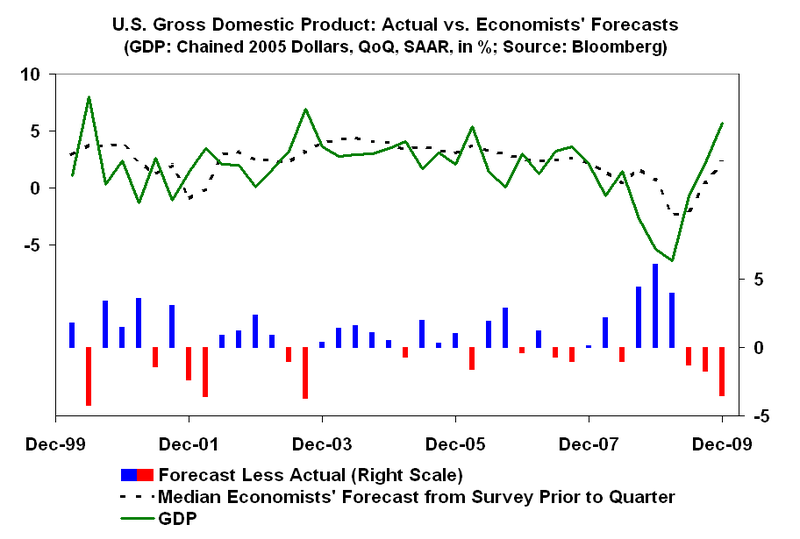
Based on an analysis of Bloomberg monthly surveys published just prior to or at the beginning of each quarter over the course of the past decade, the professional prognosticators as a group have rarely been close to the mark.
Except for the last quarter of 2007, when the economists’ prediction (published in September) came within 5 percent of the reported result, the differences in percentage points between their estimates and the actual readings have been in the double digits — at a minimum.
In fact, on three occasions — the first quarter of 2000, the fourth quarter of 2002, and the third quarter of 2006 — the economists overestimated the pace of quarterly GDP by 1,133 percent, 2,400 percent, and 2,900 percent, respectively.
Aside from the fact that many of the so-called experts still haven’t quite figured out that what the economy has been going through is anything but a garden-variety downturn, their history of poor calls on the near-term outlook suggest their longer-term forecasts should be taken with a grain of salt.
~~~
http://www.financialarmageddon.com/2010/02/grain-of-salt-forecasting.html



Tweet
Facebook
Reddit
Digg this!


February 14th, 2010 at 1:18 pm
“…their history of poor calls on the near-term outlook suggest their longer-term forecasts should be taken with a grain of salt…” Or maybe, take forecasts with this:
http://www.utah.com/playgrounds/bonneville_salt.htm
February 14th, 2010 at 1:27 pm
Bah – This article is an embarassment.
The forecasters record actually looks OK. And it is reasonably unbiased… that is, they miss low about the same amount that they miss high. Notably… the “forecast” has been low for 3 consequtive Qs.
Yet, somehow the writer makes the lame unsupported statement that forecasters, “have yet to figure out that this is anything but a garden variety downturn”.
What? That makes no sense what-so-ever. Recovery has much much stronger than forecast for the last 9 months, right?
February 14th, 2010 at 2:06 pm
http://www.longbets.org/
February 14th, 2010 at 2:41 pm
@ Venn:
Only an idiot bets on the destruction of earth by a certain date…even if you are right, you’ll never collect.
February 14th, 2010 at 5:54 pm
SB,
“… even if you are right, you’ll never collect.”
But on paper , you’ll be filthy rich. They’re simply operating under the old maxim : “He who dies with the most toys ( or ,equivalently, $ ) , WINS ! ”
I , like you , subscribe to the wisdom behind the classic rebuttal : ” Yeah , but he’s still f**cking DEAD ! “
February 14th, 2010 at 6:48 pm
“In fact, on three occasions — the first quarter of 2000, the fourth quarter of 2002, and the third quarter of 2006 — the economists overestimated the pace of quarterly GDP by 1,133 percent, 2,400 percent, and 2,900 percent, respectively.”
That’s an odd way to state the misses. Just use forecast minus actual in percentage points.
February 14th, 2010 at 7:39 pm
And how much is this 3% GDP “estimate” costing us?
February 14th, 2010 at 10:47 pm
I’m always amazed with these types of forecasts that there’s never a reporting of the standard deviation of the predicted average, nor is there ever a reference to past accuracy. For an occupation that regards itself as so mathematically rigorous, they have lax approach to statistical analysis and even less interest in seeing whether they are ver right about their predictions.
February 15th, 2010 at 3:24 am
Another forecast: http://blogs.wsj.com/deals/2010/02/10/corporate-america-is-more-pessimistic-than-you-know/
February 15th, 2010 at 3:32 am
[...] The Big Picture: Forecasting with a grain of salt [...]
February 15th, 2010 at 9:28 am
Knowing the “standard deviation” or “avg accuracy/bias” of the forecast is not particularly helpful.
If we had a nuclear bomb go off… the forecasts would miss. They miss the Q of 9/11. The miss the Q following the Lehman bankruptcy. Thus a “miss” can happen in 2 way — dramatic event / change in conditions OR basic accuracy.
My point is… the forecast is obviously for “normal foreseen conditions”. Say for the last 10-yrs the forecast missed during 2 “event” Qs by +4% (for a total of +8% too high in forecast). And then for the other 39 Qs… the forecast was .2% too low (roughly -8%). We have a roughly unbiased forecast. However… during any normal circumstance (95% of the time) this forecast is too low.
And then (OF COURSE) the economist cannot predict 9/11 or Lehman failure. Neither can anyone else. They really shouldnt get a hard time for these misses.
February 15th, 2010 at 1:17 pm
The thing that is most interesting about the “forecast” is how closely it trails the actual economic data. They are obviously designing a roadmap by looking out the rear window.
It is not a matter of shifting the forecast up or down, so much as shifting it three months to the left that would make it more accurate.
Alternately, they could try using some other word besides “forecast”.