
S&P500 Swing Analog: 1938, 1974, 2003

Email this post Print this post
By Barry Ritholtz - February 16th, 2010, 12:00PM

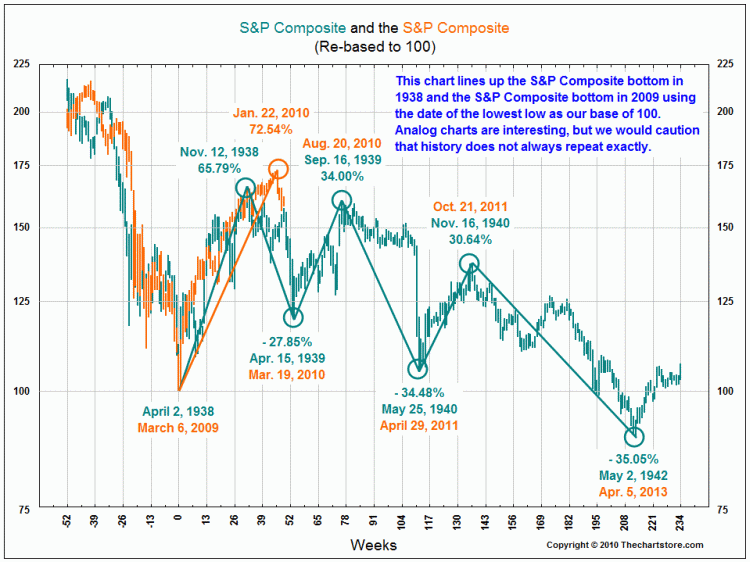
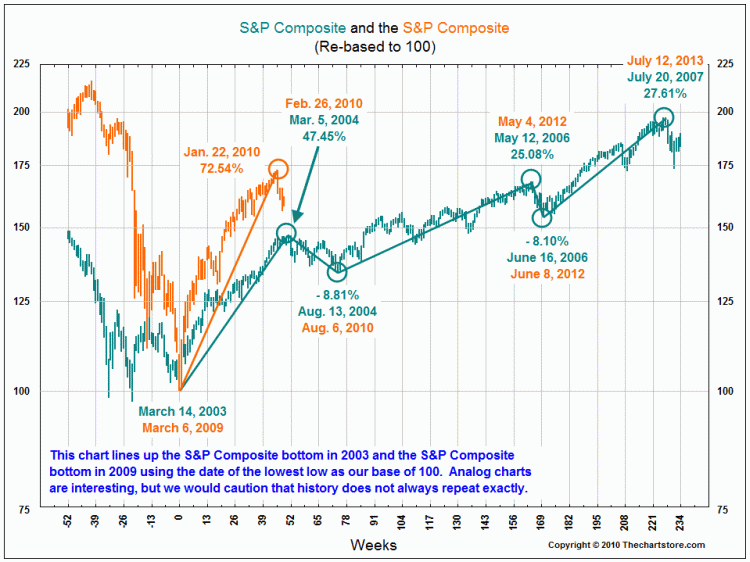
Ron Griess of The Chart Store looks to history for some analogies to the current market. He looked at 1938, 1942, 1974, 1982 and 2003. He rebalanced them to the same starting point, and noted highs and lows.

Here are 3 leading candidates — as I have said previously, my money is on 1974:
>

1938-45 vs 2008-10 Comparison

>

1973-78 vs 2008-10 Comparison

>

2003-07 vs 2008-10 Comparison
Comments

Please use the comments to demonstrate your own ignorance, unfamiliarity with empirical data, ability to repeat discredited memes, and lack of respect for scientific knowledge. Also, be sure to create straw men and argue against things I have neither said nor even implied. Any irrelevancies you can mention will also be appreciated. Lastly, kindly forgo all civility in your discourse . . . you are, after all, anonymous.

15 Responses to “S&P500 Swing Analog: 1938, 1974, 2003”

  1. constantnormal Says:

    I’m curious as to why you would pick 1974 over the others, the driving shock to the economy in 1974 was the quadrupling of oil prices, and we have had nothing similar thus far.

    The housing and employment situation in the late 1930s is closer to today’s than any of the others (in terms of the severity — the breadth and duration of unemployment, not just the U3 metric), and the states and municipalities are hurting today in a manner similar to that of the 30s.

    But of course the stock market is not the economy … but the underlying motive forces still shine through. I suppose that in the late 1930s, we were operating under a fresh set of regulatory strictures, with everyone warily watching the corporate world for any sign of corruption, where as today is closer to the early 2000s in our apathy toward such things.

  2. Dow Says:

    1974 – we should only be so lucky.

  3. constantnormal Says:

    One additional thing that might be an interesting addition to the 1938-1945 chart — a shaded region depicting the onset of WWII (the start of the war, not our entry into it) and the end of that war.

    An analogous (hypothetical) war in our future (invasion of Iran?) might well take place at almost the same relative point … which might be in mid-to-late 2012, a distraction heading into the 2012 elections.

    (I know, we never have military campaigns that have political motivations)

  4. torrie-amos Says:

    ROFLMAO, was working on the same thing this morning, projecting out 4 years based on 3 different scenarios

  5. tCA Says:

    These charts look like the dshort.com stuff like this one:

    http://dshort.com/charts/mega-bear-comparisons.html?mega-bear-quartet

    dshort has been all over this stuff for awhile and it’s a pretty good starting point for some of these historical overlays. The only thing these charts really add is what those actual dates would be for tops or bottoms.

  6. Steve Barry Says:

    Have we ever had 43 out of 50 states in dire straits before? I’ts easy to get similar charts if you align known bottoms. Truth is, we have 1929-level price to normalized earnings per Hussman, with a backdrop of an economy that needs powerful steroids to keep it in a zombie-like state. Meanwhile, global debt crises are popping up on a regular basis.

    My tagline is still:

    “You will be lucky to avoid a massive stock crash in 2010.”

  7. dead hobo Says:

    The 1974 track would be the Bernanke Put selection, aka “the L shaped recovery.”

    Upon reconsideration, count me in.

    The government and Fed will continue to use stimulus to prevent the economy from falling, but will probably take a break after the current Fed LT debt buyback ends 3-31 and house rebates end. This plus China’s cutbacks and EU bailouts will complete this drive down to S&P 900. The Bernanke put will then be engaged to prop up the market again to boost the wealth effect. It will likely involve monetization of UST debt like the last $300b boost, but will probably be smaller. Properly managed, it will drive the S&P back by HFT and sustain the wealth effect.

    Organic growth still isn’t powerful enough to sustain a recovery that includes an unpumped market.

  8. taylorhr Says:

    Why isn’t this downturn seen as started in 2000?

  9. dead hobo Says:

    tCA Says:
    February 16th, 2010 at 2:15 pm

    These charts look like the dshort.com stuff like this one:

    reply:
    ————–
    Japan has an artificial economy and managed stock market. The Japanese graph is a pretty good analog for the US over the next decade or two or three. Organic growth will be difficult with the massive $1t annual new debt issues for the coming decade. Debt service as a part of the federal budget and GDP will be gigantic and growing. But rates will be managed low to make debt service as affordable as possible, so private spending will be weak. Housing prices will continue low as all credit will go for deficit servicing. The printing press will maintain the stock market. Commodities will probably rise and complete the consumer squeeze because regulators will be ineffective in removing long only interest from inflating values. Hot money will chase hot money and the flipping of paper to greater fools will be the only place to make money.

  10. franklin411 Says:

    “we would caution that history does not always repeat exactly.”

    As a historian, I would revise that to read: “history NEVER repeats exactly.”

  11. Patrick Neid Says:

    38 vs 73, the bears vs the bulls……..

  12. Thor Says:

    Franklin – you are a history teacher, not a historian. Please don’t confuse the two.

  13. Seattle Chill Says:

    The most obvious historical comparison is obscured by the fact that, until 1933, the exchange value of the US dollar was fixed to a constant quantity of gold.

  14. Eric Davis Says:

    Anyone ever realize that … besides a Rorschach of:

    “both charts have an X and Y Axis” and
    x = Time

    They never actually match up.

    Then Statisticly +/- 25-50%… these are defiantly charts.

  15. How the Common Man Sees It Says:

    As a historian, I would revise that to read: “history NEVER repeats exactly.”

    Isn’t that what people always say?……….DOH!

    I guess it does repeat in some areas ;)

74 queries. 0.428 seconds.
