
One of my favorite bizarre twists on the credit crisis and housing collapse has been the concept of Strategic Non-Foreclosures. I usually mention this when speaking to groups to see the reactions people have — they tend to be stunned at the banking opposite of Walkaways (Strategic Defaults).

But now, under the guise of new bank experiments, the Strategic Non-Foreclosure is becoming official policy. First, we get friendlier terms such as “Soft foreclosure” or “Deed for Lease.” And, it appears to offer numerous benefits for both parties (though more for the banks then the borrower):

• Delinquent Borrowers get to stay in their homes for longer periods of time;

• Lenders get to avoid paying utilities, homeowner association fees, and providing maintenance costs such as snow shoveling and lawn cutting;

• RE Tax obligations remain in the name of the borrower;

• Banks do not have to take an immediate right down of a bad loan;

• Other properties in the same neighborhood where the lender may have exposure delay suffering the negative price impact of a foreclosure;

Here’s the Washington Post:

Seeking alternatives to the nation’s struggling foreclosure prevention efforts, federal and mortgage industry officials increasingly are looking for ways to get distressed borrowers to leave their homes voluntarily, without going through the expensive foreclosure process or a messy eviction.

Citigroup, for instance, plans to announce a pilot program on Thursday that would allow delinquent borrowers who don’t qualify for or decline mortgage relief the opportunity to stay in their homes without making payments for up to six months before turning over the keys, in return for keeping the property in good condition. The bank estimates that up to 20,000 borrowers in Texas, Florida, Illinois, Michigan, New Jersey and Ohio could be eligible.

The program is just the latest amid a growing acknowledgment that foreclosure prevention efforts will fail to reach millions of borrowers over the next few years.”

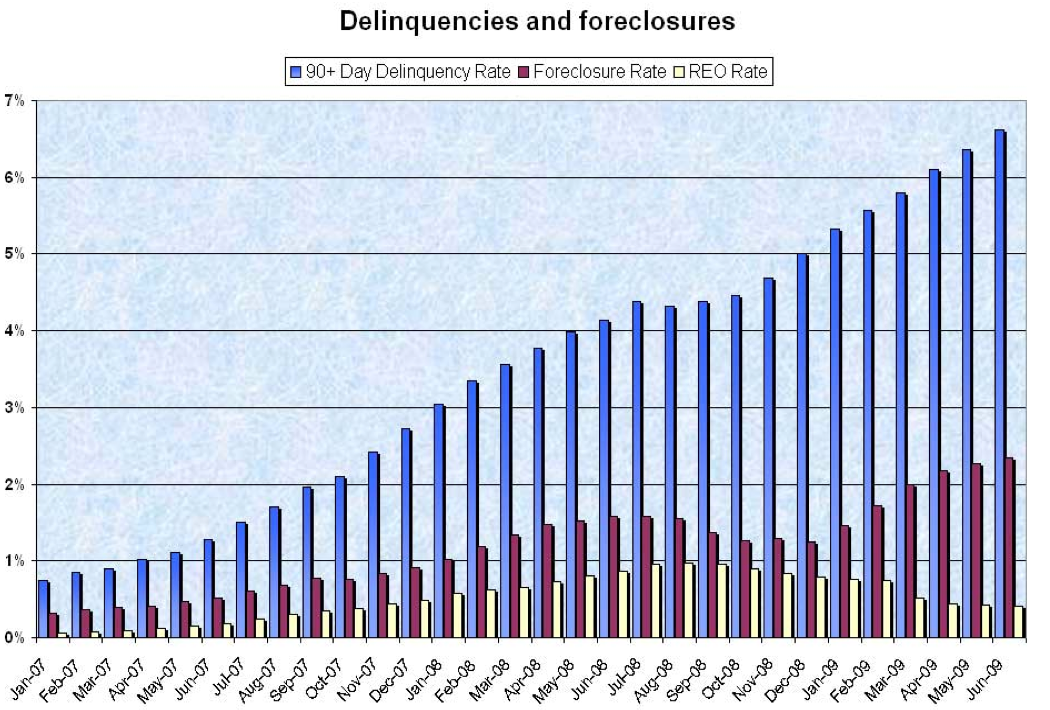
As you can see by the Credit Suisse chart below, the policies might have become official recently, but the gap between delinquencies and foreclosures has been expanding for quite some time . .

click for larger chart
>

Previously:
Strategic Non-Foreclosure (October 28th, 2009)
http://www.ritholtz.com/blog/2009/10/strategic-non-foreclosure/

Strategic Defaults in Florida
http://www.ritholtz.com/blog/2009/10/strategic-defaults-in-florida/

Source:
Mortgage officials try exits softer than foreclosures
Renae Merle
Washington Post, February 11, 2010
http://www.washingtonpost.com/wp-dyn/content/article/2010/02/11/AR2010021100010.html

Category: Bailouts, Credit, Real Estate

Please use the comments to demonstrate your own ignorance, unfamiliarity with empirical data and lack of respect for scientific knowledge. Be sure to create straw men and argue against things I have neither said nor implied. If you could repeat previously discredited memes or steer the conversation into irrelevant, off topic discussions, it would be appreciated. Lastly, kindly forgo all civility in your discourse . . . you are, after all, anonymous.

20 Responses to “Strategic Non-Foreclosure Becomes Official Policy”

  1. rktbrkr says:

    Brilliant! Another way for banks to keep toxic assets on their books without writing them down, another form of extend & pretend.

    Sounds like the banks are offering them noting for something. The banks really can’t get these people out within 6 months in many circumstances anyway so why should the homeower pay anything other than utes?

    Homeowers should be very, very careful not to sign anything that expands the banks recourse rights. I’m sure the banks are shoving all kinds of docs under the homeowers nose trying to get them to sign. JUST SAY NO!

  2. “”If the American people ever allow private banks to control the issue of their money,
    first by inflation and then by deflation, the banks and corporations that willgrow up around them (around the banks),
    will deprive the people of their property until their children will wake up homeless
    on the continent their fathers conquered.”
    http://quotes.liberty-tree.ca/quote_blog/Thomas.Jefferson.Quote.CA94

    Status: This quotation is at least partly spurious; see comments below.

    Comments: This quotation is often cited as being in an 1802 letter to Secretary of the Treasury Albert Gallatin, and/or “later published in The Debate Over the Recharter of the Bank Bill (1809).”

    The first part of the quotation (“If the American people ever allow private banks to control the issue of their currency, first by inflation, then by deflation, the banks and corporations that will grow up around them will deprive the people of all property until their children wake up homeless on the continent their Fathers conquered”) has not been found anywhere in Thomas Jefferson’s writings, to Albert Gallatin or otherwise. It is identified in Respectfully Quoted as spurious, and the editor further points out that the words “inflation” and “deflation” did not come into use until 1864 and 1920, respectively.[3]
    http://wiki.monticello.org/mediawiki/index.php/Private_Banks_%28Quotation%29
    ~~
    “…Sorry Adam B., but the Federal Reserve is a PRIVATE CENTRAL BANK. And yes, it does make huge profits by charging interest on every dollar it lends to the U.S. Treasury. Where do you think our national debt comes from? We don’t only borrow money from China.

    It is difficult researching who the investors of the Fed are, because the Federal Reserve Bank is not a publicly traded corporation and is therefore not required by the Securities and Exchange Commission to publish a list of its major shareholders. Corporate Banks such as Chase Manhattan and Citigroup, both Rothschild interests, are considered major shareholders in the Fed, however, a direct correlation can not be made without a full audit of the Central Bank, which has never been done. Naysayers will claim that the GAO audits the Fed often, but these audits are normally of Banks CONNECTED to the Fed, not the Federal Reserve board itself.

    The Government Accounting Office does not have complete access to all aspects of the Federal Reserve System. The Federal Banking Agency Audit Act stipulates the following areas are to be excluded from GAO inspections: …”
    http://answers.yahoo.com/question/index?qid=20080415222537AAJ32TA

  3. rktbrkr says:

    During the time the borrower is still in the home, they must continue to pay utilities, but in some cases, the bank may help cover some of the taxes, insurance or homeowner association fees. The borrower would also be eligible for transition counseling to help find a new home, and a minimum of $1,000 to help offset moving costs.

    If there is significant demand for the program, Citigroup will expand it, Das said. “There might be complications that we haven’t thought about,” he said. “What happens if they don’t turn over the keys after six months or they don’t maintain their house like we would like them to maintain their house?”

    Obviously the homeowers have the banks by the shorthairs. Why would the homeower do anything more than pay the utes since he has no equity (or emotional) interest in the home. The banks will probably try to get these people to post bonds to get them to be non destructive and leave on time but the bnks are trying to get blood from stones.

  4. KidDynamite says:

    ditto rktbrkr’s first words: extend and pretend. isn’t this all the evidence we need that we have not seen the bottom in housing yet? it’s uber rational by the banks though – they know there’s no market, so why foreclose? close your eyes and pray that home values come back…

  5. Bokolis says:

    Ummm…where practical considerations allow, they’d probably do just as well by giving the houses to employees.

    If they wanted to have some fun with it, they’d make all the mooks that started this mess maintain the upkeep of the houses.

    If they REALLY wanted to shoot for poetic justice, they’d give out the houses as bonus to the execs…and, I mean give them like 50 or so- marked at purchase price, of course- and have the execs worry about offloading them.

  6. jjay says:

    A good portion of the retail housing stock has been de facto nationalized.
    The banks are all insolvent, some of the banks are already offering foreclosed homeowners a “New” mortgage that reflects the market value of the house. The Federal government through Fannie, Freddie, FHA, GNMA, etc will hold the old unpayable mortgages.
    If you have any significent money to lose, not a good idea to buy a house in a former bubble area.
    God knows what houses will be worth when this all plays out over the course of time.

  7. alfred e says:

    Once again evidence the can is still being kicked down the road.

    The inevitable …..

  8. jjay says:

    I forgot to add, if you have nothing in the bank and can get a 3% down FHA loan on a house you can’t afford, by all mean go for it. If you’re broke you really can’t lose in this environment!

  9. The Curmudgeon says:

    To me the phrase that best sums up the residential real estate market, and by extension, most of the rest of the economy, but particularly including the financial system:

    “Orwellian Fraud”

    There is nothing real here. Everything, but everything, is a government-induced illusion.

  10. And all those people who did the right thing —————->SUCKERS!

    This has got to be setting off more moral hazard fireworks than a fourth of July celebration. Once this gets out to the public what is to stop more of them, already underwater, from doing the exact same thing?!

    What about all those people who have been foreclosed on and kicked out of their homes? How can they not take those new pampering forms to a lawyer and sue the banks for discrimination as well as pain and suffering etc. etc. etc?!!

    MEH has been pushing Bastiat, well this should open a huge can of Bastiat on these clowns.

    The last time I heard something so stupid someone said Thain was hired again. Oh wait, that was only two days ago!

  11. November is going to be interesting. This will be the first time since the implosion that voters will really get the chance for revenge. I think they are going to speak very loud.

    One quote that always intrigued me was when they were interviewing on why they decided to give Obama the prize before he had really done anything and the guy said something like, “If we had waited another three years it would have been too late.”

    I think we are seeing now why he said that. He knew where we were heading (or more likely where they were steering us)

  12. [...] Strategic non-foreclosure has become official policy.  (Big Picture) [...]

  13. torrie-amos says:

    well, there you go, the banks are trying to save every friggin penney they can

    either ben won’t be able to keep rates low all year, for arm resets, or when you got 3.5 million foreclosures up on board, saving every penney by extending and pretending becomes, well, rationale

    quant easing ends march, homebuyers cash ends april, ohhhhhh, the drama

  14. denigod says:

    This should be a huge red flag for anyone looking to buy a condo. This will really tie the HOA’s hands. They can no longer really place a lein against the property, because the homeowner who is clearly incapable of handling a financial burden is still the registered owner. So effectively the HOA loses the only real leverage they had to begin with. And I don’t know if this state can even be reflected in a resale certificate or the financials of the HOA, because the unit should show as non-delinquent, as the homeowners is supposed to stay current on their dues.

  15. changnao says:

    What the frig. I do that already and you know what that’s called? RENTING! I’m tired of this subsidizing crap that renters are basically paying for these delinquents who were too stupid to realize they couldn’t afford the house they bought.

    I knew that and I decided to rent instead. Looks like I could’ve just bought and got free house and rent instead. What utter BS.

  16. [...] the banksters need to deal with people. Take a look at this chart which is cited in a post over at The Big Picture and illustrates the growing wedge between defaults and [...]

  17. [...] left with lame programs, like this one announced yesterday by CitiMortgage. The so-called “strategic non-foreclosure” continues the “extend and pretend” policy that bank lenders have pursued over [...]

  18. [...] Barry Ritholz over at the Big Picture provides us with some insight explaining why all those delinquent homeowners that should be foreclosed remain in their homes. This brief post includes a fascinating chart showing just how much inventory the banks have yet to realize losses on (and the real estate market has yet to absorb). [...]

  19. [...] Strategic Non-Foreclosure Becomes Official Policy [...]

  20. [...] left with lame programs, like this one announced yesterday by CitiMortgage. The so-called “strategic non-foreclosure” continues the “extend and pretend” policy that bank lenders have pursued over [...]