US Economic Cycle Research Institute (LEIs)

Email this post Print this post
By Barry Ritholtz - February 19th, 2010, 12:05PM

Time to look at he LEIs again:

>

ECRI leading indicator starting to decline rapidly
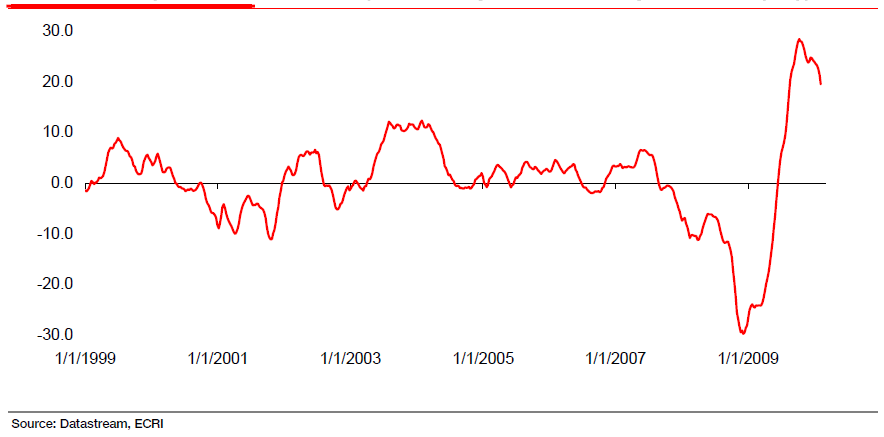

Chart courtesy of Société Générale

Comments

Please use the comments to demonstrate your own ignorance, unfamiliarity with empirical data, ability to repeat discredited memes, and lack of respect for scientific knowledge. Also, be sure to create straw men and argue against things I have neither said nor even implied. Any irrelevancies you can mention will also be appreciated. Lastly, kindly forgo all civility in your discourse . . . you are, after all, anonymous.

30 Responses to “US Economic Cycle Research Institute (LEIs)”

  1. cognos Says:

    Yeah… BUT:

    - Some portion of leading indicators is the stock market. So thats already >50% back and just happened to bottom into month end.

    - Same thing on yield curve slope, which is back up (I think) on 2s/10s steepness.

    - Looking back on this limited chart. LEI moved back down into 2003 and 2005. But never really went negative. Maybe that is more key?

    It would be interesting to see this chart going back to 1980.

  2. Friday links: a tightening cycle Abnormal Returns Says:

    [...] Where the LEI goes the economy usually follows.  (EconomPic Data also Big Picture) [...]

  3. Chart Junkie: Leading Indicators | Wall St. Cheat Sheet Says:

    [...] (Source: The Big Picture) [...]

  4. 4horsemen Says:

    You can take the chart back to 1970 if you want – same results. This is about regression to the mean. Did we have a massive “recovery” (if you want to call it that) last year? Yes. But just as the slop of the LEI was sharp and the ascent rapid, so does the regression need to be. One should be concerned at the extremes – the negative LEI was at an extreme from Sept ’08 to March ’09, but the reversion overshoot has taken the positive LEI to an extreme that was first hit back in September. The market has really done nothing since.

    Also, it doesn’t matter if the LEI “turns negative.” What is important here and in most things is the delta, or the rate of change, and the directionality of the indicators. Listen, if we choose to buy into, or reward, the economy for “green shoots” on the way up, the same needs to apply in the other direction. You will find that if you correlate this index with the stock market (somewhat erroneous given the stock mkt is part of the LEI), you will find a >90-95% correlation. That means that changes in the LEI are reflected in changes in the market. So regardless if the absolute level in negative or positive, if the LEI is shrinking, so must the market.

  5. cognos Says:

    4horseman — close mouth.

    - “you will find a 90-95% correlation”

    - please look up the word “correlation”, compare the chart to stock market, repeat.

    A bunch of other similar poor statements in your post.

  6. Invictus Says:

    “Real average hourly earnings fell 0.6 percent, seasonally adjusted, from January 2009 to January 2010.

    A 0.9 percent decline in average weekly hours combined with the decrease in real average hourly

    earnings resulted in a 1.5 percent decrease in real average weekly earnings during this period.”

  7. call me ahab Says:

    cognos-

    strong correlation from your comments that you are douche bag-

    how’s that?

    also- a little image for you-

    http://s17.photobucket.com/albums/b63/Danpt2000/STFU_Noob.jpg

  8. rootless_cosmopolitan Says:

    Barry, 4horsemen, cognos,

    The chart doesn’t show the LEI. It shows the year-over-year percentage growth rate of the LEI. The y-o-y LEI change hasn’t turned negative, only the first derivative of it (and the second derivative of the LEI itself), according to the chart. No information on the m-o-m change of the LEI in the chart, though.

    See http://www.businesscycle.com/resources/

    rc

  9. The Curmudgeon Says:

    Ah well, at least we needn’t worry about inflation (snark), since the seventies really never happened (high inflation, stagnating wages, low growth or even contraction).

  10. phb Says:

    @ Ahab – I laughed out loud at that! Thank you!

  11. wally Says:

    Coming soon to a neighborhood near you…

  12. cognos Says:

    That comment was awful (mine).

    But what he said — “>90-95% correlation” — is just non-sense of the highest order. The speaking of non-sense (see Glen Beck, Birthers, Truthers, “Bush is a Nazi” liberals, Michael Moore, etc) might be the biggest problem in the USA. Facts matter.

    Just ran S&P500 vs Nasdaq. Correlation = 0.93.

    The S&P500 correlation to the chart above is <0.50 and my best guess might be 0.

  13. Scott Says:

    rootless cosmopolitan is correct.

    the chart is not the LEI, but the growth rate of the leading economic indicators. all the chart shows is that were previously, the LEI had been growing at a 30% rate, they are now “only” growing at a 20% rate.

    The report from SocGen seems to compare actual LEIs from different countries to the growth rate in ECRI’s LEIs. It’s comparing levels to rates of change which doesn’t make sense.

  14. franklin411 Says:

    @Curmudgeon
    We don’t have a Nixon dumping liquidity into an already-overheated economy because he wanted to get reelected in `72. We don’t have like Arthur Burns trying to figure out how to manage fiat currency. And we don’t have commodity shocks like the two Arab oil embargoes that preceded both the mid and late 70s stagflationary periods.

    So yes, the `70s happened, but stagflation was a unique episode in American economic history due to an unfortunate confluence of exogenous causes.

  15. rootless_cosmopolitan Says:

    cognos,

    Again. The data in the chart ARE NOT the LEI. You didn’t calculate the correlation coefficient between the LEI and S&P 500. Instead, you calculated the coefficient between the y-o-y change of the LEI and the S&P 500.

    So, what is the correlation coefficient between the actual LEI and S&P 500? Or between the y-o-y change of the LEI and the y-o-y change of S&P 500?

    rc

  16. PipDog Says:

    Coefficients…Correlations….OK, whatever. I can tell you that when I sold out of the market in 7/07, I used a different indicator than this chart to convince me to do so, but, this chart does match up well with this decision. That turned out to be a good move. Also, this chart indicated a ‘Buy’ at the beginning of 2009. I wish I’d done that….as that also would of been a good move.

    Based upon those 2 point correlations, it looks to me that this chart may be indicating another ‘Sell’.

    Oh…Cognos, you deserve all the grief you’re getting for your comment…

  17. franklin420d Says:

    Ahab – Thank you I often wondered what the fabled “douche bag” was.

    And after reading many of Cognos’ posts, it is easy to see the correlation.

  18. torrie-amos Says:

    it’s inventory restocking period end of story

    going back too 1975 inventory was approximate 35% of yearly sales

    we whittled that down too 10% by 2000, during the boom it got up too 12%, 2007 and staid there till q2 2008, then it bottomed around 8%, you can’t operate a bizz at that level, you lose customers because your no longer just in time, your ehhhhhhh we gotta put you on a list, they find someone esle who’s been trying too sell to them

    we’re back about a little over 10%

    yet, going from 8-10 is a 25% jump

    steel away, steel pricing is weakening again, many regions back below year ago prices in some specialties

  19. ashpelham2 Says:

    Construction, as it relates to steel pricing, just seems like it’s never going to come back to pre-crash levels. Probably shouldn’t. It’s an industry that will not forever shrink, and it might expand again, but from a much smaller number, to a much smaller high.

  20. cvienne Says:

    @f411

    It seems destined that the 2009-2010 time period is destined to go down in history, ALSO, as an exogenous and unique episode in America, due to the sudden appearance of THIS STRANGE BIRD which, curiously was never able to fly because it only possessed one teeny tiny left wing, with nothing else left to give it lift but a FAT UNDERBELLY…

  21. leftback Says:

    INVENTORIES INVENTORIES INVENTORIES… Thank you torrie !!!!
    sometime this stuff is so fcuking obvious.

    THE DOUBLE DIP HAS BEGUN, because the hole in the bucket is wider than the fire hose used to refill it, and the FED is starting to have trouble getting Timmy to pay the water bills.

  22. cognos Says:

    leftback says — “the double dip has begun”

    6-9 months later than predicted.

    oh, and it still wont happen… but keep clinging to the idea. you’ll be the next Roubini when we have a “double dip” in 2013.

  23. rootless_cosmopolitan Says:

    cognos,

    “Double dip” refers to the business cycle. Who predicted a “double dip” for May to Aug 2009? Now, you are just making things up, aren’t you?

    rc

  24. The Curmudgeon Says:

    @franklin411:

    yeah, yeah, yeah…I get it, this time its different, because, well, you see, you’re here now and will shape the world anew according to your will. Watching kids mature into adults, as the realities of life wipe their sanguine attitudes from their faces, is so much fun. Come tell me in forty years when I’m in the nursing home about how “things were different this time”.

    That is hilarious, though, to reach all the way back to the feckless Nixon administration as the “but-for” cause for all the travails that followed in the seventies. I’m sure Carter had nothing to do with any of it. And for oil shocks–they were self-induced crisis brought about by refusing to allow the market to set the price of gasoline. I know, I know…you don’t believe in markets, either, but still. And the dollar crisis of the late seventies early eighties had absolutely nothing to do with our failure to respond to an attack on our sovereign soil (the American Embassy in Iran) because currency fluctuates completely independent of political considerations. Yeah, Franklin, I get it.

  25. owen b Says:

    How many of you remember your doubts voiced in the comments of this post on the same subject back in July 2009?

    Here’s the link: http://www.ritholtz.com/blog/2009/07/synchronized-surge-strengthens-since-april/

    Excerpt:

    “…the cyclical improvement in the economy is proceeding in a textbook sequence, from long leading indicators to short leading indicators to coincident indicators.” In fact, “there are now pronounced, pervasive and persistent upturns in a succession of leading indexes of economic revival.”

  26. wunsacon Says:

    Curmudgeon, “kings are [often] slaves to history”. And especially Presidents during their first term. Just as a 6-year fraudulent bubble leads to several years of bust, forces in large systems can take years to build up and then expend their energy. So, I do agree with F411′s narrative in the case of Carter.

    >> failure to respond to an attack on our sovereign soil (the American Embassy in Iran)

    That’s interesting. What are your thoughts on these separate issues:
    - US military-dictatorship-by-proxy (the Shah) over Iran for 20 years leading up to that event?
    - Carter’s decision to authorize a military rescue operation? Did you forget about that? It wasn’t Carter’s fault that a Vietnam-War-depleted military couldn’t pull off a mission in the desert.

  27. cognos Says:

    OwenB – Nice history lesson. All the same comments… in July 09. Krugman, Roubini, Rosenberg forecasting a eminent “double dip”. The crazy comments about “the debt levels”. I have a feeling the echo keeps repeating for quite some time.

    “This time its different” — Its funny because people just manipulate this meaningless phrase to fit their purposes. The “business cycle” looks intact (recession >> recovery >> rec >> rec >> re >> re)… but otherwise things are always somewhat different.

  28. cognos Says:

    RootlessC –

    Wierd comments. All my statements on correlation apply to ANY version of the above chart (absolute levels, chgs, etc). No indicator series is .9 correlated with the stock market. .5 is actually pretty good. And that indicator series has OFTEN been falling when the market was rising (see my first comment, and ref to 2003 and 2005).

    Even more disagreeable comments on “no one was calling for a double dip back in May-Aug 2009″. Disagree 100%. NO ONE who is calling for it now, WAS NOT calling for it back in May-Aug 09. Krugman, Roubini, Rosenberg, El Erian, Faber… all were saying the same thing 6-12 months ago. No one meant… eventually, in a few years… we’ll have a “double dip”. They meant 3 months out… they still mean 3 months out. Some will cling to “double dip”… and be saying the same thing next year.

  29. rootless_cosmopolitan Says:

    cognos,

    The absolute level in the chart isn’t the LEI. The absolute level in the chart is already the y-o-y change of the LEI. Any derivative is the change of the change, or the change of the change of the change, etc. Well, since you make claims about the correlations, please give me the actual LEI-data, so I can calculate the correlation coefficients for myself. Where did you get the data from?

    As for calling of the double dip. You said,

    “leftback says — ‘the double dip has begun’

    6-9 months later than predicted.”

    Here you clearly claim that the double dip was predicted to occur 6 to 9 months ago, not that someone made a prediction 6 to 9 months ago that a double dip was going to occur. Apparently, you are trying to fool the audience now by re-interpreting your own statement.

    I doubt that any of the guys you mentioned even believed 6 to 9 month ago that the recession already had ended.

    Well, I am calling you out to provide the evidence for your claims.

    rc

  30. yosull Says:

    Barry,

    On top of the chart, you say, “Time to look at the LEIs again”….just because it’s heading lower?

    I remember posts here that really questioned their recovery call. I’d say they were spot on.

    Owen B is right…a hefty plate of smoked crow for Roubini and Krugman!! Ha!

82 queries. 0.229 seconds.