
Where’s the Bubble: Stocks or Bonds?
Kate Welling does great interviews. (I spoke with her in June of 2009). A few weeks ago, she interviewed Michael Belkin, who is not well known to the public, but is widely respected by the institutional side. To understand why, see our Quote of the Day from July 29th, 2008.
Belkin points out that, despite what so many people claim, following the freefall last year, the bubble is not in stocks. And as we have shown previously, after major secular bear markets, you should expect a substantial bounce.
The bubble, Belkin argues persuasively, is in bonds. QE policies driving rates to zero percent, and despite the low rates, investors have poured cash into bonds.
Here’s a brief excerpt:
Where my views are probably different than what some of the higher profile names are currently saying is that I’m not pointing to the equity market now as the source of a bubble or of malinvestment, in Austrian terms.
If not the stock market, where are you pointing?
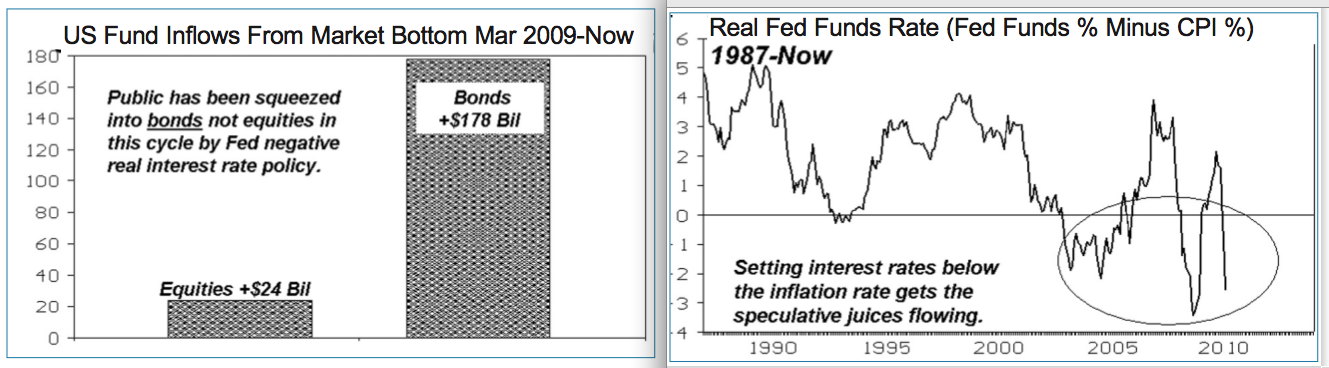
At the bond market. Specifically, since the March 20, 2009 turning point in the equities market, if you look at the AMG weekly data on inflows into ETFs and mutual funds,bond fund flows have been positive every week and have averaged $4 billion a week. There hasn’t been a single down week. But meanwhile, for equities funds, there’s been a completely different pattern. They’ve been down two weeks, up one week, then down, up four weeks, down five weeks —and the average inflow is only $500 million a week.
Just barely positive?
Yes, at last count only $24 billion had gone into all kinds of equities funds over this entire
recovery rally, versus $178 billion into bond funds. I’ve been looking at this for quite a while
and sort of scratching my head and wondering what was going on. But finally it just occurred
to me. They’re buying bonds. It’s rather obvious. I think what has happened is that the thepublic in previous cycles bought emerging market funds or internet stocks or whatever, when the Fed would lower interest rates to an artificially low level, thereby penalizing people on their savings. So right now, for instance, I have friends who inherited a lot of money and I’m an informal advisor to them, not a paid advisor. They keep asking me, what do I do now? They were investing in CDs, that were parceled out to a lot of different banks on which they were making 2, 3, 4%. But now they’re maturing and the banks are offering, like, nothing. So they are asking, what do we do, what do we do? They need the yield; they need income; they don’t want to lose the nominal principal. What to do? What to do?
Belkin’s time series regression analysis analysis is not only data driven, but he is alsoaware of historical predecessors. I find his argument that Bonds are at greater risk than stocks to bevery counter-intuitive, contrary — and compelling.
>
US Fund Inflows From Market Bottom Mar 2009-Now
>
Source:
Still Bullish
listeningin VOLUME 12, ISSUE 2
Weedon@Welling, JANUARY 22, 2010
http://welling.weedenco.com/



February 1st, 2010 at 9:35 am
the recent, relative, trend of investing in Bonds v. Stocks is good to note..
though, this ‘chasing yield’-Story has “Stupid.”, written all over it..
esp. w/ this: “They need the yield; they need income; they don’t want to lose the nominal principal.”–caveat thrown in..
what about: “If you want Yield, you get Risk with that”, haven’t We, yet, learned?
People could make this whole ‘hunt for Yield’-thing, a whole lot, easier, if they bothered to Understand what Buy-Writes/Covered Call-writing was, and that it, too, applies, beyond Equities, to Bonds, and, even, other Commodities..
http://clusty.com/search?input-form=clusty-simple&v%3Asources=webplus&query=Covered+Call+writing+for+Income
It, just, ain’t that difficult..saying nothing, of course, of those Bond-holders, in Muni-land/High-Yield-ville, that are fixin’ to get their Faces ripped-off..
February 1st, 2010 at 9:35 am
Your average baby boomer is 55. Where do you think she is going to stick her retirement money?
February 1st, 2010 at 9:39 am
given how the street is carry trading their way out of this mess, jumping on a extremely positive carry trade built on fed guarantees of everything really, this is not too surprising. A contrary call, absolutely but one blogs have been discussing for months now, including mine at urbandigs and Mish recently had a piece on this after I think CAPLERS talked about investing in high yield bonds.
Just take a look at HYG and LQD for an etf viewpoint of how high yield and investment grade bonds have fared in the past 11 months. HY especially. All in the search for yield! The carry trade works until it doesnt anymore and the road to perdition is full of positive carry! One more reason why a dollar rally might happen, even in the face of everyone bearish on the greenback. One could argue we saw hints of this 2 weeks ago with dollar rallying, equities tumbling, vix flying and selling volume surging…
The risk is getting to be way too high to find that great yield lately!
February 1st, 2010 at 9:42 am
“Your average baby boomer is 55. Where do you think she is going to stick her retirement money?”
after bonds collapse? I say cash, stocks, part gold, and real estate
February 1st, 2010 at 9:51 am
If the financial politics (Japanese style face-saving for Banks) we’re getting from the toxic axis of evil betwixt FED and Congress can be considered a BS storm or SStorm, then Cash is the only refuge since there is no real way to make it. They are printing it to fill the Bank Black Holes but not fast enough and the Banks are using it for spackle on their hulls; ’till then it’s Deflation and All being net short Cash from a credit-starved non-Quality manufacturing base economy and beached-whale financial services industry product. Bubble-protection/sail-trimming includes the starvation wages earned by getting We- ZIRP’d ….so short duration the only safe space. The Banksters making the guaranteed ZIRP spread will lose again of course as everything they do is wrong while living a lie, but then they are too-big-to-FAIL and so on.
The Obaminator is talking small business tax credits, but that probably will include a business flipping outsourced junk soon to cycle to landfills, which counts for squat. So we wait for the shine to wear off.
February 1st, 2010 at 10:04 am
I agree with Tradeking13. The “stocks for the long run” is over for the boomers, I see it with all my friends who are boomers. This is a secular trend, and it will be here for a while. Maybe a long while.
February 1st, 2010 at 10:17 am
I am third in line of the opinion that this a long term trend of rotating out of equities and into fixed income. Individual investors are under weight bonds at about 7% of total asset allocation. The risk of high future rates is confirmed by the forward curve, but this risk can be mitigated with a properly laddered portfolio duration and real return bonds. Demographics and the understated risk of equities will portend this reallocation as a negative for equities.
February 1st, 2010 at 10:19 am
i have several friends who have been advised by ‘experts’ to buy preferred stocks and junk bonds to get the yield. no mention of risk. i agree 100% that this is a bubble and not a way to preserve capital. they are all retired.
February 1st, 2010 at 10:39 am
Is Belkin still maintaining his outright bullish posture towards stocks over the intermediate term?
February 1st, 2010 at 10:41 am
But diversified bonds wont “lose principal”… they seldom do over any medium term periods.
PIMCO total return fund made ~5% in 2008 and 15% in 2009 and was positive the prior few years.
What they will do is grind into 2-6% returns versus larger returns elsewhere.
Bonds “lose” by forgoing upside.
February 1st, 2010 at 10:54 am
There certainly is a lot of enthusiasm for bonds, except for Treasuries, which are currently the most despised asset on the planet.
February 1st, 2010 at 11:17 am
I think the more appropriate question is to back up further and ask where is the bubble in the American economy. It is the financial sector. That includes stocks, bonds, money management, hedge funds, insurance, derivatives, employment, etc, etc, etc.
Fair value for stocks is 400-450 on the S&P. Fund flows doesn’t reflect this. But reality does. The financial sector is headed for a major employment shakeout. And so is government which is in collusion with the financial sector in maintaining the bubble for its own personal gain.
February 1st, 2010 at 11:27 am
As long as we’re discussing asset allocation, viz bonds vs. stocks, nothing’s changed. Seems I remember a bond bonanza in 2007 as well, when even junk was yielding near nothing over treasuries (junk over junk, suppose). The more things change…
February 1st, 2010 at 11:42 am
My understanding is that investors over the last 10 years have been overweight stocks and underweight bonds. The increase in bond investment is likely a rebalancing, especially with people looking at retirement and the need to preserve capital.
If people are buying decent quality bonds (not ETFs), they won’t lose their principal. Sure, there could be a mark-to-market hit, but the principal will be there when they go to roll over the bond. And they will have collected the interest.
February 1st, 2010 at 11:44 am
BDG – How is “fair value” on stocks in SPX 425? I think they paid $22 in divs last year. Have paid $100 in 4 years. SPX will pay closer to $30 this year. Why should stocks pay 7% dividends? Plus growing cash on bal sht, eps, cash flow, etc.
What the fair value on bad investment advice?
February 1st, 2010 at 11:45 am
““Your average baby boomer is 55. Where do you think she is going to stick her retirement money?”
after bonds collapse? I say cash, stocks, part gold, and real estate”
Really? I would say nowhere. Someone else will have it.
rc
February 1st, 2010 at 11:53 am
Mike M,
“There certainly is a lot of enthusiasm for bonds, except for Treasuries, which are currently the most despised asset on the planet.”
The yield on Treasuries says something else. I wonder why so many buy them, if they are as despised as you paint them.
rc
February 1st, 2010 at 11:53 am
Here is an average Joe’s perspective. I work for a major corporation. I had for 20+ years put half my 401K in stable funds, which are mostly bonds I assume and the other half in a Top 500 index fund. After 20+ years in March or April of 2008 when things started to teeter but not fall, I had slightly more money in the Stable than I did the Top 500 index fund.
That was all I needed to see. I moved it all to stable and avoided all the losses and will never ever go back into the stocks at all. It would be pretty much impossible to convince me to buy and hold stocks for retirement.
Las Vegas may be a better bet than the stock market.
February 1st, 2010 at 12:25 pm
It’s probably not just the “QE” that’s driven people into bonds. The move into bonds by the public could be simply the result of risk aversion in the wake of the bear market in stocks.
The large amounts of money that have moved into bonds and bond funds may be not just a contrary indicator for bonds (yields are going higher), but may also portend higher commodity prices.
February 1st, 2010 at 12:46 pm
[...] Where’s the bubble: bonds or equities? (Big Picture) [...]
February 1st, 2010 at 12:49 pm
Here’s another reason, as Concerned American points out, and why the SPX should be trading much lower: Stocks can go to zero. Not all of them, all at the same time, probably, but anything that can happen, eventually will happen. They very nearly all scraped zero during the GD. Bonds, however, have a priority claim on assets in liquidation, which makes their financial Armageddon valuation presumably worth something greater than zero.
Aside from that, where’s the SPX trading relative to ten years ago? Exactly. Why not just get something more or less guaranteed, and quit trying to play at this rigged game?
February 1st, 2010 at 12:52 pm
Hmm… “any that can happen… eventually will happen”.
Good luck.
Nothing could be further from truth.
February 1st, 2010 at 12:59 pm
Its pretty funny to go through the counter-points:
- a super model could sleep with you?
- your wife could cheat on you?
- you could find that your old slapshot translates in a Tiger-esque golf game (see Happy Gilmour)
- you could win the lottery
- USD inflation could go to 10%
One of these is 10x to 100x more likely than all the others. Which one is it?
February 1st, 2010 at 1:12 pm
“Housing prices in the United States never go down.”
There you have the whole false premise behind the last little turn at financial armageddon. Couldn’t happen, could it? Then it did. And it sparked a free fall in everything, including equities, even equities that have only an attenuated relationship to housing.
Here’s one for you: GM stock was trading in the $20’s as recently as about 2007. Now, how much are those old warrants worth? If you answered “zero”, well you’d be pretty close. Just one example of anything that can happen, well, actually happening. I imagine all those GM stockholders are not now as sanguine about things that can happen, not happening, just because.
I’d say objectivity is not your strong suit, cognos. Notwithstanding your handle, you have some cognitive dissonance issues.
February 1st, 2010 at 1:18 pm
Curmudgeon @ 12:49
“Why not just get something more or less guaranteed, and quit trying to play at this rigged game?”
Tell that to someone who held bonds during the 1970’s.
February 1st, 2010 at 1:30 pm
“Tell that to someone who held bonds during the 1970’s.”
I’d tell them you can buy TIPS now, which didn’t exist back then.
February 1st, 2010 at 1:46 pm
BOTH.
Leverage and HUGE numbers of hedge funds playing the markets at 2:1 – 8:1 leverage have increased the ability to purchase everything many times over. LEVERAGE. It is the enemy of anyone that wants to INVEST. It is the enemy of anyone that ISN’T ALREADY in “the club” and owns everything out there. Not to mention the FED buying out all the MBS and trillions of bonds – again creating artificial demand.
This WHOLE RALLY – and ALL ASSET PRICES are WAAAAAAAY high. And yeah – they can remain that way for a long time. Or not. Hence – “THE CASINO” moniker which is entirely accurate. Anyone trading in the market at these price levels has NO CLUE as to how weak the ice is underneath their feet. I feel sorry for them.
February 1st, 2010 at 1:56 pm
maynardGkeynes,
Yeah, TIPS will be better than nothing, if commodity prices start to rise.
But, as we routinely discussed during the summer of 2008, the government likes to play games with the inflation numbers.
February 1st, 2010 at 2:08 pm
The other thing about stocks versus bonds is taxes. Cap gains taxes can be deferred; taxes on interest payments cannot.
If Obama wins re-election, taxes on capital may rise significantly.
February 1st, 2010 at 2:18 pm
DL, true regarding bonds/inflation, but the inflation-adjusted gains for the stock market during the seventies were? How ’bout the 00’s?
February 1st, 2010 at 2:29 pm
Curmudgeon,
Gains on stocks during the 70’s were horrible, I agree.
The issue, as I see it, is that of bonds versus stocks versus commodities (one could also throw currencies into the mix, I suppose).
For example, if one were to hold equal amounts of GDX and OIH for the next 5-10 years, I think it would likely outperform TLT.
(And with GDX/OIH, one would have the option of deciding when to realize cap gains for tax purposes).
February 1st, 2010 at 2:50 pm
“- a super model could sleep with you?”
Funny, that was the first thing that popped into my head too.
February 1st, 2010 at 3:21 pm
cognos,
What about, things that have regularly happened before will very likely be happening again given similar circumstances?
Would you agree with this?
I have a couple of examples:
1. Price/normalized-10-year-reported-earning ratios had had to reach values of 7 to 10 in previous secular bear markets before a new secular bull market started. Currently, this ratio is at about 20, i.e., at valuations in the range of the peaks of previous bull markets, except during the last decade with its valuation extremes.[1] What does this imply for the likelihood of the future direction of the stock market in US?
2. Before the year 1990, dividend yield regularly went down to 3 to 4% in bull markets and up to about 6% or even higher in bear markets. Currently, dividend yield is about 2%.[2] What does this imply for the likelihood of the future direction of the stock market in US?
[1] http://www.multpl.com/
[2] http://www.multpl.com/s-p-500-dividend-yield/
rc
February 1st, 2010 at 3:33 pm
rootless_cosmopolitan
One should be open to the possibility that dividend payouts (in the aggregate) are partly a function of the tax rates imposed on dividends.
I highly doubt we’ll ever see a 6% yield on the S&P in the future.
February 1st, 2010 at 4:21 pm
DL,
I don’t know. What is the functional relationship between the two? Is there any significant difference between the tax rates imposed on dividends and the tax rates imposed on capital gains from realized stock price appreciation?
If I have several choices to invest, and the yield over the long term on other investments, e.g. bonds is about 5 to 6%, a lower dividend yield on stocks only makes sense, if the low dividend yield is being offset by cash flow from realized stock price appreciation. And stocks are even more risky than bonds. So I would like to my cash flow also includes a premium for the added risk. If stock prices don’t fulfill these expectations anymore, for which investors piled into the stock market during the bubble decades, neglecting low dividend yields, why shouldn’t I expect the dividend yields to go back to pre-bubble historically normal levels over the coming years?
rc
February 1st, 2010 at 4:28 pm
the Dow industrials first crossed 10K back in March of 1999. I don’t see how equities can be in a bubble when they are at the same levels 11 years later. Nasdaq 5000 – that was a bubble.
I say throw all the valuation metrics out the window at this point. How do you know what anything is worth when the Fed has taken base money from $800B to $2.3T in about a year? A dollar isn’t the same anymore.
Bonds might not be in a bubble, but they are definitely going to get slaughtered.
February 1st, 2010 at 4:59 pm
rootless_cosmopolitan,
I’m not arguing that taxes are the dominant factor. But one to consider.
On an after-tax basis, there are various benefits to capital gains, rather than dividends. One is that if you wait long enough, a tax-cutting president will come along. (Even Clinton lowered some taxes). Another is that capital gains on one investment can be offset with capital losses on another. Another benefit, for long-term holders of assets, is that in transferring assets to heirs, there is a “stepped up basis cost”. The same principle applies in the case of charitable donations.
I don’t think that one can readily prove that higher dividend taxes result in lower dividend payouts on the SP500. But neither can one prove, based on the historical evidence, that it is not a factor.
February 1st, 2010 at 5:52 pm
Hmm… Rootless Cosmopolitan:
I said there was no sense in the argument… “anything that can happen… eventually will happen.”
I made a number of specific (farsical) counterpoints.
You countered with – “house prices will not go down”.
This do not fit the pattern at all. First, saying very basic things “cannot” happen is quite agreed to be a mistake. I agree. Markets go up and down. Fade the last 5-10yr bubble (like housing). But this is much different then saying… “the end is nigh”. People have been saying that for millennium. They have yet to be right.
February 1st, 2010 at 6:15 pm
RC -
The problems with your market analysis is that PEs, Earnings Yield, and Div Yield all need to be seen in relationship to the RFR and yield curve.
Therefore PEs of 7 or 10x in the early 80s corresponded with interest rates of 10-20%. The low print on PE actually was in a ~15% interest rate environment.
The economically connects through companies ability to equity or debt finance and similarly through M&A of levered buyout. Notice the big uptick in M&A over late 2009? This is because large conglomerate companies can finance at 2-3-4% pre-tax and are quite willing to buy growing EPS streams at 20-25x PE or 4-5% post-tax. Especially when they see this as a trough in the business cycle.
We do believe in the “business cycle”, dont we?
February 1st, 2010 at 7:00 pm
cognos,
I wasn’t the one who countered your statement with “house prices will not go down”. You confuse me with someone else.
As for your assertion, that a P/E ratio of 7-10 relates to an interest environment of about 15%. Again, you make the mistake to deduce an alleged relationship from only one case. That P/E ratios of 7-10 were being observed when interest rates were very high was true for the early 80s. Isn’t this alleged inverse relationship between stock prices and interest rates (10 year treasuries) the so-called Fed-model, or do I confuse this? However, for the other instances when the P/E ratio hit 7-10 at the end of bear markets, the interest rates were much lower, partly even lower than today.[1] So I don’t see in the data what you claim.
As for the business cycle. Do you believe we are just in a cyclical trough in the business cycle, and after we will have got out of it things will go back to business-as-usual as it was in the previous expansion phase with respect to economic growth, profit expansion of companies, and stock market prices? I ask because I don’t see where this economic expansion is going to come from this time, after growth in the expansion phases of the business cycle has been essentially fueled by a doubling of private credit per 10 years over the last three decades, and I don’t really see that households and private businesses (w/o financial institutions) will increase their debt load by another 25 trillion US-dollars over the next 10 years.
[1] http://www.multpl.com/interest-rate/
rc
February 1st, 2010 at 9:31 pm
Hey, good point RC. Sorry for connect that argument to you. It was a mistake, and it makes sense bc I have tended to enjoy your posts in the past.
That said, I think you are confused by this debt fallacy. Debt has not risen in any way materially differently 60s, 70s, 80s, 90s. Debt is a natural consequence of “wealth” as saving and debt balance. Sure this looks exponential… so does our GDP and our total net worth. Debt is just recycled savings. There is also a move away from cash and toward credit/rate based money supply. This is the natural consequence of modern technology and good monetary policy. Neither is to be feared. The economy will grow 3% real, and hopefully +2-3% inflation. I think our main problem is a deflation problem.
February 1st, 2010 at 10:27 pm
cognos and concerned american, “stable value” funds and many bond funds didn’t “plummet” because the government backed them in full, even beyond pre-existing guarantees/insurance.
Will they do it again next time, when the debt-to-GDP is even higher? Possibly.
If they do, will you be able to buy much with your currency? Possibly.
That might be the smart move next time, too. But, only if it’s favored again by government intervention.
February 1st, 2010 at 10:34 pm
>> government backed them in full, even beyond pre-existing guarantees/insurance
I don’t just mean the bond funds that held Fannie/Freddie debt. (In 2008, I found no UST bond funds that didn’t also hold at least 7% of their portfolio in F/F.) Consider that government bailouts prevented many companies from bankruptcy, where your bonds would’ve taken a haircut. Government also explicitly guaranteed money markets.
Take away government supports? “Stable value” funds would’ve been anything but.
February 7th, 2010 at 4:06 pm
While arguing with peeple like Belkin (and you, since u had a post recently about small investors under-allocation to equity) shure sounds like a fool’s errand, but i’ll try. I even registered for this, while i follow your site for a quite a long time, reading RRS is really convinient.
My problem with this argument is good old Benjamin Graham. I guess u have read the intelligent investor, original 1949 edition? remeber those wild passages about what is a good yield on a decent corporate bond and an appropriate multiples and dividend yields for comon stocks? I read this book like in 2005 and a was thinking to myself – gee, the investment community was kind of nut at that time! Then i started reserching the Fed model and similar valuation metrics, while doing my CFA charter and stumbled upon this paper, which was linking multiples and prior realized volatilities, it was back tested on 150+ years of DOW and SPX data(lost the link and can not find it with quick search on the web).
The basic result was quite obviuous in hindsight. The equity valuations for an average guy is really not only a function of interest rates but also of past realized volatility. The bumpier the ride before, the riskier the the asset is considered to be. It’s perfectly in line with the anchoring and other investor’s cognitive biases.
This effect should be fading by now since we have a lot of pros managing other people’s money but, for the average mom and pop investor i think this should be true still.
Given all that, in my view, there is a very good cahnce that this bonds over stocks mentality is not a bubble, but rather a secular shift. I am not willing to bet the farm on that, but for what it’s worth…
Sorry for a terrible english, i am a russian native and moscow resident.
February 8th, 2010 at 11:32 am
[...] Last week, we discussed the issue of where there was a greater chance of a bubble: Stocks or Bonds? [...]