
1994: SEC Budget Debate

Email this post Print this post
By Barry Ritholtz - March 19th, 2010, 6:54AM

Apparently, Congress screwing around with SEC defunding goes back 20 years, if not further.

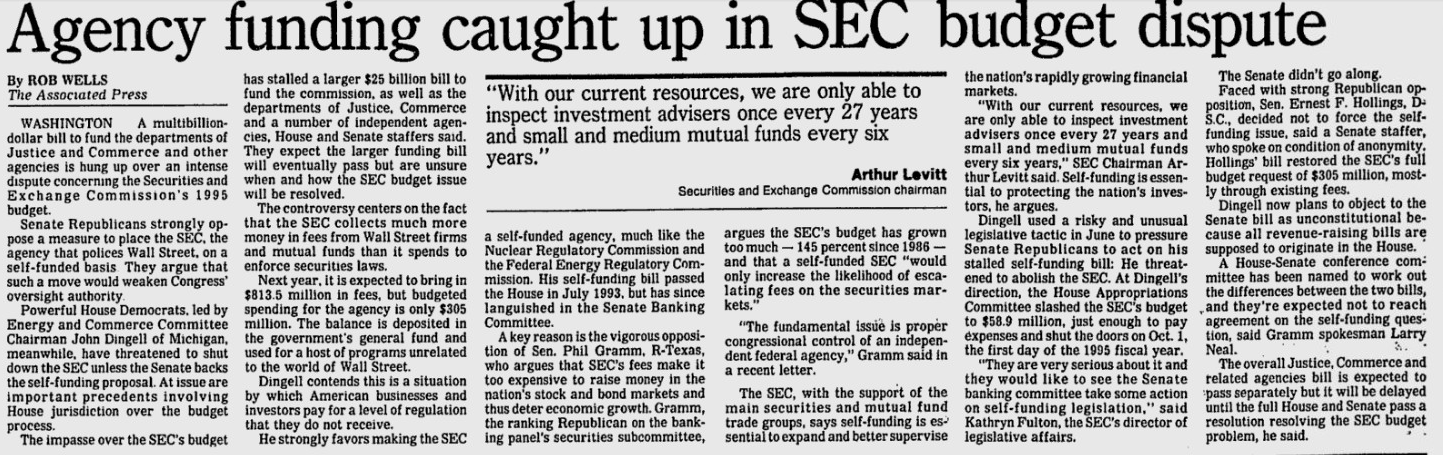
The villain of the discussion is (of course!) Phil Gramm, the intellectually bankrupt Texas Senator whose economic arguments  are invariably proven to be wrong, with grave economic consequences. Gramm argued in 1994 that SEC fees “made it too expensive to raise money in the capital markets, and thus deterred growth.”

As per usual, Gramm had it precisely backwards at exactly the wrong time:>

click for larger image
Hat tip Dan B, who adds:

“The post on the SEC and staffing levels today reminded me of the fight over SEC budgets for 1995. Congress has its fingerprints all over this. They bring people in and berate them under lights and in front of cameras. They cast their failings onto others.”

>

Source:
Agency Funding Caught Up in SEC Budget Dispute
Rob Wells
Associated Press, August 15 1994
http://news.google.com/newspapers?nid=1957&dat=19940815&id=wXchAAAAIBAJ&sjid=kokFAAAAIBAJ&pg=1427,3574721

Comments

Please use the comments to demonstrate your own ignorance, unfamiliarity with empirical data, ability to repeat discredited memes, and lack of respect for scientific knowledge. Also, be sure to create straw men and argue against things I have neither said nor even implied. Any irrelevancies you can mention will also be appreciated. Lastly, kindly forgo all civility in your discourse . . . you are, after all, anonymous.

23 Responses to “1994: SEC Budget Debate”

  1. Dennis Says:

    How can these guys gut an agency, then complain oversight doesn’t work?

    Its absurd . . .

  2. tawm Says:

    Why limit the outrage to Greenspan (earlier post) and now Phil Gramm? What administration was also setting policy in 1995?

  3. Barry Ritholtz Says:

    Here is a long overdue and desperately needed lesson to you (tawm) on context and relevancy.

    When Alan Greenspan makes a broad statement in a written document attempting to duck in part his own resposibility for the crisis, I discuss and critique that. You will note I avoid chatting about race cars, floral arrangements, or igneous rock formations, as they are not relevant to this specific discussion. (This is a pattern you might note in other written works).

    When I approach a broader discussion — such as Bailout Nation — I engage in a wider overview of 100 years of policy. In that work, which you should read (but likely won’t understand), nearly everyone comes in for criticism. And to answer your specific but irrelevant troll-like question about 1995, I strongly criticize Clinton, Summers and Rubin in it.

    However, this particular post was about a 1994 article, and Phil Gramm is one of the main quotes in it. (He is also excoriated in Bailout Nation too).

    The public school system has obviously failed you, as your comments reflect a general poor reading comprehension and other problems with general understanding of information communicated in the written form. You should have yourself checked out for Dyslexia — or has a recent blunt head trauma impacted your cognitive functions?

    Either way, wipe the drool off your chin and get yourself checked out.

  4. Aramis Says:

    Why do you waste your time on assholes like that?

    He is obviously a hack troll. Just delete his idiotic bullshit and be done with it.

  5. torrie-amos Says:

    imho, alot is the problem of appointing heads with a new admin, what usually happens is the person appointed see’s it as a stepping stone, so whereas they try and do something sometimes, imho, i’ts fifty fifty, for every schapiro u get a cox, yet, the real issue is both of these see it as a stepping stone, so, there bottom line is, do there best which is always personal and move on

    this works out okay most of the time, like your local DMV, yeah, we complain, yet, they do there job, some of there tech stuff might be behind, yet, we are talking a sticker

    when in times of major transitions, u end up behind the eight ball for years, a vicious circle, u get good people, yet, good people want out because it’s so far behind cutting edge, and or mission oriented, etc. there is no emotional gain beyond a paycheck

  6. David S Says:

    Either way, wipe the drool off your chin and get yourself checked out.

    Dude, that is hysterical

  7. Moss Says:

    It all boils down to the ideology of either the party, a power broker or the prevailing general consensus. Mix in some lobbyists a few spin doctors and anything can be justified. Gramm will never admit any of his ideas were misguided regardless of the facts , just like Rubin will not and Summers will not.

    To my knowledge only Greenspan (partially) and Clinton (tangentially) have come close to admitting mistakes and taken some responsibility. The problem of course, especially with Gramm is that he would be labeled a heretic by his ‘team’ if he admitted anything was mistaken.

  8. Barry Ritholtz Says:

    Greenspan gets props in my book for coming more or less clean. He issued a mea culpa.

    This latest exercise seems to be his back-pedalling a bit . . .

  9. VennData Says:

    What about Hillary’s futures contracts? Why don’t you talk about that? or Monica Lewinsky? I’m sure she had some retirement money that was blown away by the Obama stock market crash?

    I agree with yawn… er… a… tawn… unless your’e parroting back GOP media machine taking points, it’s not a discussion I’m able to get riled up about.

  10. liberal Says:

    OT:

    Amazing catch by some commenter at Balloon Juice which makes Michael Lewis look like a total moron, and which makes the attention his book is getting totally unjust:
    Davos Is for Wimps, Ninnies, Pointless Skeptics

    Excerpt:

    Derivatives seem to be this year’s case in point. Davos had hardly been up and groaning about the dangers of being alive before Bloomberg News reported what appears to be the general Davosian view: “The surging demand for derivatives is making financial markets more vulnerable to any slowdown in the global economy.” … But the most striking thing about the growing derivatives markets is the stability that has come with them. … And if they really believe the markets mispriced risk, or were about to adjust, they must also believe they could make vast sums of money if they quit their day jobs and opened a hedge fund to take the other side of stupid trades. But they don’t really believe that, or at least some of them would be off doing it, rather than spilling the beans to Bloomberg News.

  11. bondjel Says:

    Cripes! You ideologues are a stitch. VennData: Hillary’s futures contracts and Monica did NOT set long term financial policy for the nation. Gramm and his wife Wendy, as head of the Com Futs Trdg Comm, (when she wasn’t on the Enron board) have set major policy affecting all of us for years.

    You all remember Phil Gramm, John McCain’s primary economic adviser (!!!!!) until he announced in 2008 that we were all just a nation of whiners because economic times were never better.

  12. number2son Says:

    Phil Gramm, the Perfect Asshole.

  13. crankitto11 Says:

    Combining this with Gramm’s role in taking down Glass-Steagall and completely deregulating futures contracts (i.e. derivatives) should win him the Ignoble Prize for Dogmatic Economic Stupidity. No other government official bears as much responsibility as Gramm for the Crash of 2008.

  14. VennData Says:

    Forgive me if I didn’t make the sarcasm clear.

    Here’s another way to think about it: Do right wingers every think that they “Hollywood bias” they see is a function of the fact that more than half of Hollywood revenues come from offshore and those people haven’t had their emotive sensations twisted beyond belief by the GOP media machine?

  15. wunsacon Says:

    tawm, it’s a BLOG. Not a book. Not an encyclopedia. Barry’s not going to repeat every criticism of every financial reengineering jerk with every post. That just doesn’t work in blog format.

    You read blogs. You’ve posted here before. Don’t you know how this works?

  16. Mannwich Says:

    Our “best and brightest” hard “at work”.

  17. TakBak04 Says:

    Speaking of Phil Gramm. What ever happened to this?

    ———

    Robert Scheer: UBS Scandal may Ensnare Phil Gramm
    26th August 2009

    Pasadena News
    08/23/2009

    IN recent days, yet another wealthy private customer of the Swiss-based banking conglomerate UBS admitted to criminal fraud in a growing parade of perp walks that could extend into the thousands.

    It is a case that threatens to ensnare former Sen. Phil Gramm, the Texas Republican who is vice chairman of UBS’ investment banking business. Given the widespread involvement of UBS in what the Justice Department alleges were systematic efforts to violate U.S. tax laws, it must be asked: Did Gramm as a top executive have no inkling about what was going on?

    Perhaps, but for Gramm this has to be a moment that at the very least tests his ideological commitment to the radical deregulation of banking that he championed during his 24 years in Congress. He joined UBS soon after the bank acquired Enron, a company that had gone bankrupt after jumping through the “Enron loophole” in the Commodity Futures Modernization Act, which Gramm had pushed though Congress.

    Gramm’s wife, Wendy, had been an Enron board member and head of its audit committee but failed to sound the alarm before the Houston-based company collapsed.

    More at….
    http://www.pasadenastarnews.com/ci_13187409

  18. Barry Ritholtz Says:

    SEC Didn’t Expand Upon Stock-Abuse Settlement
    http://online.wsj.com/article/SB20001424052748703523204575130142329796632.html

    The Securities and Exchange Commission has failed to turn key parts of a landmark stock-research settlement into industrywide rules, a move that threatens to gut pieces of the pact.

    The 2003 accord, reached with a dozen large Wall Street firms, sought to prevent Wall Street research analysts from improperly touting stocks to help their firms’ investment bankers win business from corporate clients. Besides not following through with additional rules, the SEC proposed to a New York federal court that parts of the settlement be stripped away.

    In a ruling Monday, U.S. District Judge William H. Pauley III in New York approved several changes that weakened that enforcement action. Though it keeps a firewall that forbids stock analysts and investment bankers from talking without a rules-compliance officer present, the decision essentially eased other restrictions involving the dealings between investment bankers and analysts, including a clear separation between analysts and the firms’ investment-banking operations.

    The judge’s ruling comes at a key time for the SEC. It illustrates that the agency didn’t put in place broader rules to cover some key parts of the enforcement settlement, much of which was open to review after five years. It was that review process that led to the ruling by Judge Pauley.

  19. TakBak04 Says:

    And…to Barry’s “Heads on Pikes” from an earlier post. Some of the reason for deregulation and thwarting of investigation is due to the “Big$$$$$$$,s” that are funded privately by some players who’ve been working on it for years. We might need to “follow the money” and ideology to understand the deregulation push plus lack of funding for Fed and State agency for several decades to get to the bottom of why there is so little interest in anyone being held accountable. Media Contol by some of these folks mentioned in article, also.

    ———-

    By Jim Hightower

    Hightower: Two Right-Wing Billionaire Brothers Are Remaking America for Their Own Benefit
    How billionaires’ money took over Washington — and created the mobs who rant against reform.
    March 19, 2010 |

    Despite a constant racket from the forces of the far-out right (Fox television’s yackety-yackers, just-say-no GOP know-nothings, tea-bag howlers, Sarah Palinistas, et al.), the great majority of Americans support a bold progressive agenda for our country, ranging from Medicare for all to the decentralization and re-regulation of Wall Street. Indeed, in the elections of 2006 and 2008, people voted for a fundamental break from Washington’s 30-year push to enthrone a corporate kleptocracy.

    Yet the economic and political thievery continues, as the White House, Congress, both parties, the courts, the media, much of academia, and other national institutions that shape our public policies reflexively shy away from any structural change. Instead, the first instinct of these entities is to soothe the fevered brow of corporate power by insisting that corporate primacy be the starting point of any “reform.” Thus, when Washington began its widely ballyhooed effort last year to reform our health-care system, step number one was to announce publicly that the monopolistic, bureaucratic insurance behemoths that cost us so much and deliver so little would retain their controlling position in the structure. Likewise, Wall Street barons who crashed America’s financial system were allowed to oversee the system’s remake–and (Big Surprise!) the same top-heavy structure and shaky practices that caused the crash are being kept in place.

    http://www.alternet.org/investigations/146094/hightower%3A_two_right-wing_billionaire_brothers_are_remaking_america_for_their_own_benefit

  20. NotQuiteSo Says:

    These discussions of budget machinations in the
    90s are interesting, and explain something. I’m just
    not sure what they explain in light of the fact
    that the SEC’s budget has tripled since 2000.
    Let’s say that again – the SEC has been flooded
    with resources in the last 10 years, has tended to
    obscure that fact in recent Congressional
    testimony to argue for more, and yet remains
    unaccountable for its own massive failures while
    principals there have walked through a golden
    revolving door to Wall Street. The issue is
    considerably more complex than budget. A
    discussion of those complexities in this very
    widely-read forum might shed light on the
    agency’s failures, but from what I can tell looking
    at the numbers, it ain’t about money. That seems
    true unless the SEC says it needs a 100% or
    200% boost to do its job. But Schapiro’s asked
    for 12%. Is that enough? Presumably so. Though
    as I wrote earlier, the SEC got an average 12%
    boost every year from 2000-2008 and was a
    disaster. So I conclude something else important, or
    something important in addition, is wrong.

  21. TakBak04 Says:

    @NotQuiteSo Says:
    March 19th, 2010 at 8:18 pm

    These discussions of budget machinations in the
    90s are interesting, and explain something. I’m just
    not sure what they explain in light of the fact
    that the SEC’s budget has tripled since 2000.
    Let’s say that again – the SEC has been flooded
    with resources in the last 10 years, has tended to
    obscure that fact in recent Congressional
    testimony to argue for more, and yet remains
    unaccountable for its own massive failures while
    principals there have walked through a golden
    revolving door to Wall Street. The issue is
    considerably more complex than budget. A
    discussion of those complexities in this very
    widely-read forum might shed light on the
    agency’s failures, but from what I can tell looking
    at the numbers, it ain’t about money. That seems
    true unless the SEC says it needs a 100% or
    200% boost to do its job. But Schapiro’s asked
    for 12%. Is that enough? Presumably so. Though
    as I wrote earlier, the SEC got an average 12%
    boost every year from 2000-2008 and was a
    disaster. So I conclude something else important, or
    something important in addition, is wrong.

    ————-

    FOLLOW THE MONEY..that DID the DEREGULATION…and those in CONGRESS who got the BUCKS…

    The MONEY is the KEY!

  22. philipat Says:

    I don’t disagree with this but resourcing alone does not explain away problems at SEC. I would add to the list:

    1. Incompetence (Think Madoff)
    2. Revolving doors with Wall Street.
    3. Probably because of 2, above, a suggestion of a lack of will to seriously go after any major player(s)

  23. alfred e Says:

    @takbak: The SEC is just another gov fraud. Sham. Cover for grand theft.

74 queries. 0.413 seconds.