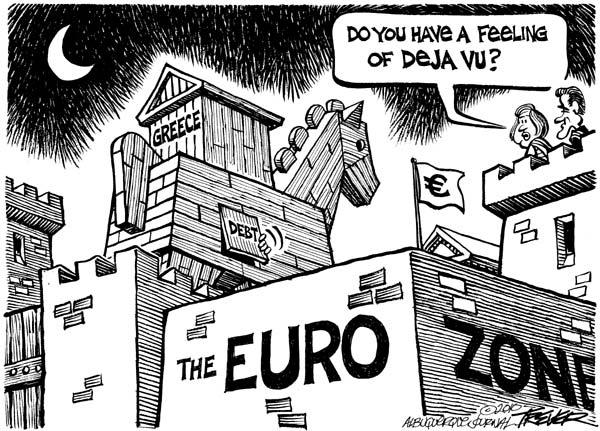
Déjà vu

Email this post Print this post
By Barry Ritholtz - March 18th, 2010, 5:15PM

Amusing Cartoon — I suspect the worst of the Greek scare is behind us, and push comes to shove, the ECB and the EU wont let the European Union spin a part:

>
Comments

Please use the comments to demonstrate your own ignorance, unfamiliarity with empirical data, ability to repeat discredited memes, and lack of respect for scientific knowledge. Also, be sure to create straw men and argue against things I have neither said nor even implied. Any irrelevancies you can mention will also be appreciated. Lastly, kindly forgo all civility in your discourse . . . you are, after all, anonymous.

12 Responses to “Déjà vu”

  1. thrassakos Says:

    Rumours spread like wildfire that the former Greek National Mint was frantically printing drachma banknotes as the country would supposedly leave the Eurozone by Easter. I think it most likely is a bad joke, to put it mildly, but if we go down (for it will be down) that way, I think we should name it the papandrachma.

    So, just in case, beware of Greeks printing papandrachmas…

  2. RW Says:

    Debt is a Trojan Horse? How delightfully antedeluvian (and pre-fiat currency too of course). Try putting a “surplus” label on that horse and see what happens; e.g., http://tinyurl.com/yj63j8j

    It comes to something very nearly the same end but with a twist: Greece leaving the EU wouldn’t mean much one way or the other but the EU would probably be better off as an organized economic entity if Germany did in fact leave, I mean all the way out.

    Careful with the knee-jerk reaction there, drop the ideological blinders, read Wolf’s article (linked above) and think about it: Surplus countries such as Germany and China are the other half of the global balance problem and they are very far from being paragons of virtue; in fact they may be closer to the heart of the problem than nations in their debt (profligate and foolish as the latter may be).

  3. Mr.E. Says:

    I always chuckle at the notion of a “European Union”. In reality there is little that is unified other than a central bank, a currency, and some agreements on fiscal and trade measures. Europe remains a continent deeply divided at the national level, and for the most part they love to hate each other to the point it is a sport.

  4. philipat Says:

    Like the US, the Greeks need to get their own house in order. Tax collection is the lowest in the EUro block as a percentage to GDP and tax evasion is the national sport. Given that, why should ordinary Germans be expected to bail them out?

    For the Euro to work effectively, all the participants need to have economic convergence, which was never the case. The UK would be a greater pressure on the Euro if it had not had the good sense to remain outside and retain control of its own monetary policy.

  5. How the Common Man Sees It Says:

    The more things change…….

  6. benesposito Says:

    An article i read today makes me think you are wrong about greece Barry. If you look at the debt servicing costs for Greece at current rates (without any increases, which seems unlikely going forward), and look at the amount of their debt held by foreign interests, the % gdp that will be leaving the country is greater than germany’s ww1 war reparations (repayment rate as a % gdp), or the % gdp paid prior to the latin american debt crisis.

    In fact I challenge anyone reading this to workout the numbers and find an example in history where a country paid that % of gdp for any sustained period of time without eventually defaulting.

  7. philipat Says:

    They were forced to borrow?

  8. highside Says:

    Having read the FT for 30 odd years I have to say the Martin Wolfe is something of a apologist for Anglo US policies and certainly not a quality independant analyst. Whether this is down to FT editorial policy or Mr Wolfe’s desire for a knighthood to match Sir Samuel Brittan I know not.

    Germany is the highest wage payer in the EU, if you travel in Germany it has a new car fleet with a strong high end bias, well maintained roads, well maintained housing stock. European holiday resorts tend to be dominated by free spending Germans, the difference in tipping culture somtimes disguises this.

    Overall the idea this is an economy engaged in similar mercantilist policies to China is completely false. They make goods the world wants, often at the higher end of the price range because people are prepared to pay for the quality. The idea that they can save Europe by leveraging up consumption is propounded as a justification for deficit countries putting off adjustment. This doesnt mean that Germany wont suffer badly in a contraction of demand in the EU.

    Wow it feels odd defending the Germans after 50 years of war movies but this crap dont fly.

    I undertand that the opinion poles in Germany are very very hostile to a Greek bail out. The Eurocrats will do everything to get one but the local German politician will be worrying about reelection.

    There is a strong argument that one of the reasons Japan did not follow the policies the Mr Bernanke would have had them follow is that the voters made it entirely clear to the politicians that they would not stand it. As a nation of savers they were not supportive of policies that risked inflation.

  9. RW Says:

    Setting aside ad hominem comments regarding “Wolfe” (sic) and the FT’s motivations and focusing instead on Wolf’s actual argument, the central issue is not mercantilism — clearly China has such a policy whereas Germany probably does not but will do anything to avoid even a whiff of inflation — the issue is the impact of surplus economic policy and Wolf’s analysis is spot-on here: The net result of Germany’s policy is effectively the same as China-s (and other large surplus countries); deflation.

    The question of whether a deflationary stance is somehow intrinsically more moral than an inflationary stance is doubtless of philosophical interest as is the question of how a nation culturally oriented to saving adjusts to conditions in which saving domestically becomes problematic but the real-world question Wolf attempts to address has to do with the facts on the ground: Surplus countries such as China and Germany are exporting deflation to the rest of the world during a time of global economic crisis and the argument that they could be the real Trojan Horse under these circumstances stands intact.

  10. RW Says:

    Last phrase in the first para should have ended with “; deflation, for others rather than themselves.”

  11. philipat Says:

    I don’t see how it can be argued that Germany is exporting deflation? The until recently very strong EUro resulted in very high prices for German goods, as anyone who has bought a German car recently will know. Neither could this be defined in any way as mercantilism.

    I would have thought that the issue is, within a currency zone such as the Euro, given the Maastricht terms, it is a natural consequence that if some economies run surpluses, others must run defecits. Hence Government stimulus of domestic spending in surplus countries would help reduce defecits in the peripheral countries.

    That said, the Greeks have never had any fiscal discipline and can no longer devalue their way out of the problem, as was always done in the past. Either get Government spending in line or leave the Euro and devalue again. The average German would welcome the latter so that they and other Europeans might again return to those wonderful cheap Greek Island holidays!!

    As a final thought, why should the IMF help bailout a Nation in trouble because the Euro zone cannot enforce its own rules? Surely from a macro perspectivem the Eurozone must find a way to manage and enforce its membership criteria?

  12. marketsandbeyond Says:

    The one-fits-all does not work without a loss of sovereignty over fiscal and social policies. Over-indebtedness hid this flawed construction of Europe (Euro) since its inception. The Euro, via its criteria, was meant to foster convergence: it did not; no tough decision was mad by policy makers to improve competitiveness. They have been able to finance their sins at artificially low interest rates thanks to the diluted responsibility within the Euro, and thanks to Germany efforts. If Germany was back to the DM (and the Dutch would peg to the DM), the Euro would be in free fall.

    During the early 2000s, France and the European Commission criticized Ireland and Austria because they had budget substantial surpluses, and France (together with other countries – Italy, Belgium among others) did not abide by Maastricht criteria with no sanction. Germany made effort when its budget was above 3% (France did not) and Germany did not ask anybody for help whilst the reunification cost a couple of hundred of billions DM (do you remember the politically motivated 2:1 1 East DM / West DM, when the Bundesbank advised a 3:1 ratio).

    Comparing German trade surpluses to China ones is beyond understanding: China has inundating the world with no added value products due to its low cost producing base. Germany, which has a much higher cost producing base, is selling high quality added value products that the world wants, despite a strong currency (DM and then Euro – Euro at least for the time being and compared to the USD).

    There is no reason why Germany should bailout Greeks, beyond political manoeuvrings (which is costly to tax payers). it is understandable that French are pushing for a eurozone solution, since after Spain and Portugal (and possibly Belgium), France is next in line…

64 queries. 0.343 seconds.

