
Fed’s Flow Of Funds. A Quick Recap.

Email this post Print this post
By Invictus - March 11th, 2010, 4:00PM

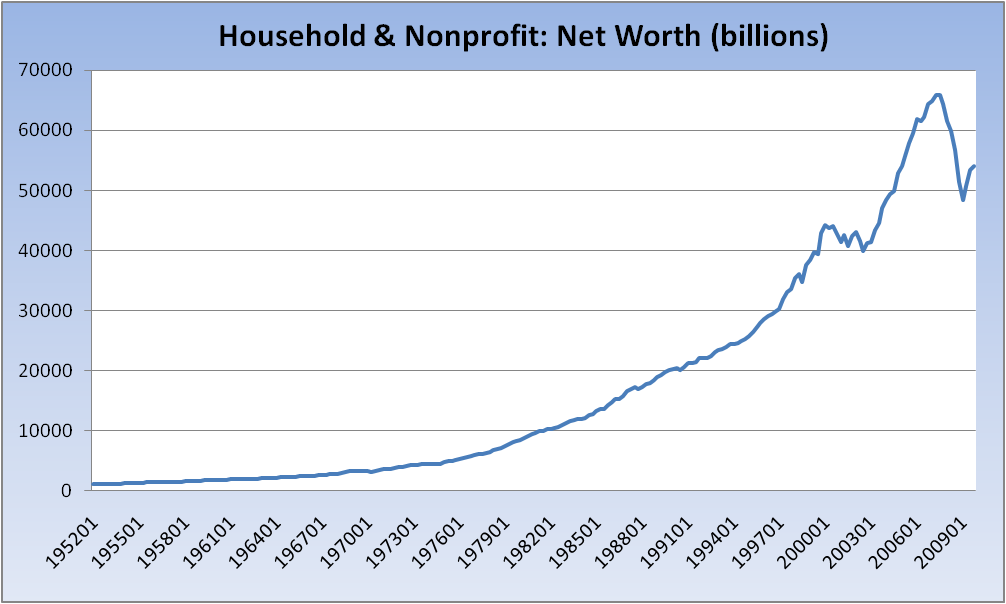
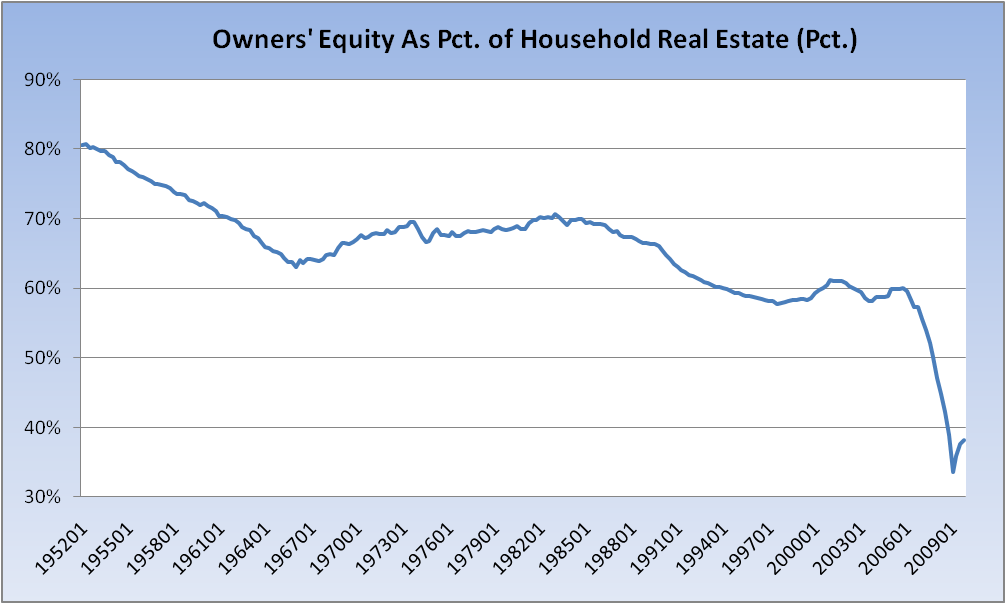
The Fed’s Flow of Funds report was released at noon, and showed a continuing healing of the household balance sheet:  Assets grew, liabilities shrank, so Net Worth improved.  Debt-to-income continued to decline (now 127%) from a peak of 136% (still much work to do here).  Even Owners’ Equity as Percentage of Household Real Estate continued its rebound off a hideous 34% bottom about one year ago.  (That chart, to my eye, really encapsulates all that went wrong; it’s a picture that really is worth 1,000 words.)

Here’s the down and dirty:

>
The trendline for Debt-to-Income is at about 114% which, absent rising Personal Disposable Income, implies a need to shed an additional $1.5 trillion in liabilities.
 

A (bullish) wirehouse has come out with some observations, among them this troubling nugget:

Household assets rose 1.0%, or $657 billion, to $68.2 trillion. The rise in assets was driven entirely by financial assets – the continued recovery in the equity market. Household equity assets rose 4.6%, or $534 billion, to $12.1 trillion. Meanwhile, in a sign that the recovery in home prices may have run out of steam, the value of real estate assets fell 0.3% to $18.2 trillion.

I do not find it at all heartening that the “rise in assets was driven entirely by financial assets,” as it goes without saying that leaving our collective fate to the whim of the markets can prove a bit problematic (see: 2008).  It’s also disheartening — though certainly no surprise — that “the recovery in home prices may have run out of steam.”  And that’s coming from bulls!

If time allows, I’ll take a deeper dive into the report.  It is always chock full of goodies and among my favorites to dig into.

Comments

Please use the comments to demonstrate your own ignorance, unfamiliarity with empirical data, ability to repeat discredited memes, and lack of respect for scientific knowledge. Also, be sure to create straw men and argue against things I have neither said nor even implied. Any irrelevancies you can mention will also be appreciated. Lastly, kindly forgo all civility in your discourse . . . you are, after all, anonymous.

18 Responses to “Fed’s Flow Of Funds. A Quick Recap.”

  1. tagyoureit Says:

    Would something like debt to income simply ‘overshoot’ the trendline, or does it really need to be somewhere, say, between 80% and 100% to be in a ‘good’ place with respect to the ratio? I’m guessing income will continue to drop, but will the related debt drop fast enough?

  2. Casual Observer Says:

    I’m guessing income will continue to drop, but will the related debt drop fast enough?

    If income continues to drop, there’s less money to service the debt so the debt has to either be defaulted on or unwind slowly over time.

  3. farmera1 Says:

    Most of the credit card debt is being written off not paid off according to this link. I would assume with all the bankruptcies/walkaways/foreclosures there is also a lot of real estate debt is being written off also. I don’t understand how that is a good thing for the economy. It might be a necessary process but in the end there is an unpaid marker somewhere, at least until it gets to the gov. and then I think the future generations end up holding the marker.

    http://www.marketwatch.com/story/write-offs-are-driving-decline-in-credit-card-debt-2010-03-09?siteid=YAHOOB

    CHICAGO (MarketWatch) — Credit-card debt has been falling for 16 straight months but consumers aren’t paying off their financial obligations as much you might think. Instead, they’re walking away from the debt, forcing credit-card issuers to write off as much as 90% of that reported drop, according to a new report by CardHub.com.

  4. Mysticdog Says:

    “I do not find it at all heartening that the “rise in assets was driven entirely by financial assets,” ”

    Ignoring market volatility, it is also horrible because most of the country doesn’t have “financial assets” worth mentioning. The recovery is only occuring for the investor class. People who actually do stuff and make things aren’t doing so well.

  5. crunched Says:

    Barry, I’ve noticed over the past couple of weeks you’ve been trying to hedge yourself and sprinkle in some bullish mumbo-jumbo with your posts… No need to do that. If you need a refresher course on where we TRULY are in this cycle, may I recommend ‘The Fourth Turning.” An outstanding book, maybe one of the most eye-opening and influential book I’ve ever read. Check Amazon.

  6. Invictus Says:

    @crunched

    Okay. You’ve drawn the short straw. All the posts here have bylines. Mine is on this one. If I had a buck for every time a commenter disregarded the byline and referred to me as Barry, I’d be neck and neck with Carlos Slim. So, to you, Mr. Crunched, and others who read this thread, please start reading the bylines. I am happy to take the credit/blame for everything I post. /rant mode

    That said, I don’t know what’s bullish about my post. It’s simply an observation of some of the things I look at in the Flow of Funds report. Debt-to-income is still too high. Owners’ equity in real estate is woefully low. The entire gain in net worth came from financial assets. That’s bullish???

  7. The Window Washer Says:

    @ tagyoureit

    Income isn’t dropping.

    http://www.bea.gov/newsreleases/national/pi/pinewsrelease.htm

  8. Invictus Says:

    @Window Washer

    It may not be dropping, but it sure as heck doesn’t seem to be rising. Flatlining, at best.

  9. alfred e Says:

    Well duh.

    Why do you think they have allowed GS and others to pump the market? For free.

    Why do you think they have to go such lengths to inflate RRE?

    GDP requires consumption. Poorer people scale back consumption.

    And fed tax revenues? Remember BR’s chart of a few days ago?

    And about state and municipal revenues? As MEH would say: x2.

    Bottom Line: Every little guy knows : financial assets are not going to get us through this.

    Jobs above the poverty line might. Maybe.

    Well, it’s the only hope. In spite of all the BS self-serving political rhetoric.

  10. flipspiceland Says:

    @ tagyoureit

    Yeah, and boy no one could fudge those numbers.

  11. Invictus Says:

    @farmera1

    It’s far from a certainty that consumers will be pay down their liabilities to the extent necessary. Indeed, much of it might be written off by financial institutions. In either case it will be extinguished — either by pay-down (consumer) or write-down (bank). Reversion to the mean is a funny thing — you generally get there one way or the other.

  12. constantnormal Says:

    When I look at the first two charts, the thing that springs into my mind is “where’s the downside overshoot?”

  13. The Window Washer Says:

    Invictus
    I knew someone would comment. Yeah feels like shit, but that’s what 1-2% growth feels like. Tag seems a bit new so I just jibed him a bit for not getting half of a two part equation right.

    @ farmera1

    Type in a search on Deflation and start reading

  14. The Window Washer Says:

    Also Invictus

    Thank You
    Thank You
    Thank You, for this post.
    I love fed flow of funds and having someone do a post like this is strait up porn. You even did it in pictures so I only have to look at it and grunt.

  15. Clem Stone Says:

    “The rise in assets was driven entirely by financial assets – the continued recovery in the equity market. Household equity assets rose 4.6% ”

    4.6%….was this for all of ’09? If so, no wonder they’re depressed. Might be time to find a new money manager.

  16. lalaland Says:

    how did people in the 50′s have any self esteem when their net worth was like 1 billion dollars? and is that why kids today seem so spoiled?

  17. farmera1 Says:

    Deflation, yes that’s what it looks like to me with the write downs of CC debt and real estate. With the Federal government pumping big time to off set the write downs. When the total debt (reached 350% or so of GDP) it was just a matter of time before the whole system came crashing down (on the other hand Greenspan said in his book THE AGE OF TURBULENCE, the whole system is built on ever increasing amounts of debt).

    What I don’t see is a way out (at least a painful way out). We basically have two choices:

    -go through a hell bent for leather deflation as in the 1930s
    -go through a inflation to pay off all those debts (including China’s holdings) in cheap dollars

    No easy answers, do I see. Pimco (those of the slow growth, new normal beliefs) has said move at least 60% of your assets off shore including bonds. The problem I have is where to. Most of the industrialized world (much of Europe, Japan) has tremendous debt problems also.

    Canada and some of the Northern European countries seem to be in better shape as far as debt and the health of the economy. South America (including Brazil, Argentina, etc) have a long history of defaulting on debt. Probably not a good option. Maybe some of the frontier/emerging markets offer better odds.

    I’m looking for a few countries to take my assets.

    Any ideas on where to park money and to stay away from all that nasty excessive debt???????

  18. Well, Maybe, Or Maybe The Underlying Trend is the Problem « The Angry Future Expat Says:

    [...] in Deflation, banksters, debt by angryfutureexpat on March 13, 2010 Over at the Big Picture, Invictus threw up a few charts from the Fed’s Flow of Funds report.  What really jumped out at me was this [...]

68 queries. 0.386 seconds.