
How Typical is the Current Rally in Terms of Age or Duration ?
Chart of the Day takes a broad — perhaps over broad– look at trading rallies. They found that major rallies (73%) result in a gains ranging from 30% to 150%. Typically, they last between 200 and 800 trading days.
Based on this data, you can conclude that the present rally is still young, and potentially has a long way to run.
That might be a premature assumption.
As we’ve discussed before, there are huge differences between cyclical and secular markets. I have been describing the current short sharp run as a cyclical bull within a longer, secular bear.
If we were to look at the duration and intensity of rallies between 1929-38 or 1966-82, or 2000-09, I suspect we would find they are both shorter, sharper. By definition, cyclical bulls are of smaller duration than secular bull markets.
Here’s your daily chart porn:
>
Age and Duration of Rallies
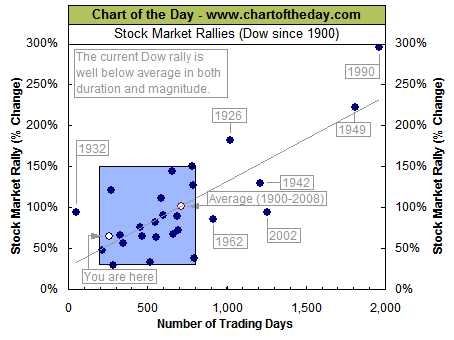
Source: Chart of the Day


Tweet
Facebook
Reddit
Digg this!


March 19th, 2010 at 11:20 am
So according to this graph, the current market rally could run anywhere from 1 to about 1500 more days?
March 19th, 2010 at 12:25 pm
I ran some approximate numbers earlier, measuring magnitude and duration of all cyclical bulls within a secular bear for the Dow and the Nikkei. Avg. magnitude = ~58% and duration= ~14.5 months. If you only use Dow data the values rise a bit…71% and 17.5 months.
http://www.mkcglobal.com
March 19th, 2010 at 12:37 pm
Thor … Things I wish I said. Nice one.
March 19th, 2010 at 12:43 pm
Anyone have the numbers on the duration and magnitude of the Cyclical Bulls within Barry’s three noted Secular Bears? Would be of more pertinent value would think.
March 19th, 2010 at 12:56 pm
The broadest the look, the less sense it makes.
1. My new Palm (and Palm stock) failed to live up to my expectations, I feel bad about it for a few weeks.
2. I lose my job and my home.
Hey Mr 2! Why don’t you just have a positive attitude like Mr 1 ?
March 19th, 2010 at 12:58 pm
Pretty useless chart if you ask me.
March 19th, 2010 at 1:00 pm
rileyx67 Says:
March 19th, 2010 at 12:43 pm
Anyone have the numbers on the duration and magnitude of the Cyclical Bulls within Barry’s three noted Secular Bears? Would be of more pertinent value would think.
reply:
—————
BR is the master of magic charts. I doubt he ever saw a magic chart that didn’t draw an unwarranted assumption from. Just my opinion based on stuff like this.
The fallacy here is that rallies are a function of time. The implication is that people are drones and their actions are driven by time and not caused by more direct factors. The availability of fuel powering the rally is one such ignored factor. Even BR has noted that ZIRP is a better explanation for this rally. Yet this magic chart claims the passage of time is a ctitical factor in the scope and duration of the rally. By inference, the passage of time controls future events and we are all just passively along for the ride and subject to a predestined fate.
March 19th, 2010 at 2:01 pm
@dead hobo
Hear, hear! One can extend that thought a bit more, recognizing that excess liquidity is the major driving force in this rally (certainly not economic vitality or improving business activity), and say that when the Fed is no longer able to goose the economy, either due to fiscal concerns (which might come about when we begin to have difficulty managing the interest on All That Debt) or political concerns (the sheeple rise up and start throwing spendthrift pols out of office), then the party will be over.
Of course, that might take a while. Thor’s “1 to 1500 days” pretty much brackets the event.
March 19th, 2010 at 2:22 pm
Barry,
I’m not at all sure which markets you are considering “secular bear markets”, I suppose 1929-32 qualifies,but which others? In order to make an evaluation of your contention that this is (or might be) a secular bear I need to know which ones in the past you consider examples of same. Then we could take a look at what rallies look like during secular bull markets vs. secular bear markets.
E.g., I don’t know what you’d call 73 to 82. It would be difficult to call the whole period a secular bear market because the S&P made a new all-time high in 81 before the bottom in 82.
March 19th, 2010 at 2:33 pm
bondjel, run a chart of the DOW, not from ’73, but from ’66 to 8/82…then another from 8/82 to 2000…that’s what Secular Bears and Bulls look like, with ample cyclical opportunities within, but not for the Buy and Hold Index Funds “investor”.
March 19th, 2010 at 2:42 pm
Rileyx67 — The “dow” is a pretty narrow look at “the market”. Its 30 stocks, highly weighted by stock price (meaningless?). If you look at S&P500… like the man says, it makes a new all-time high in 1981.
Broaden out from the “dow” and I think you’ll see what the man is saying.
March 19th, 2010 at 3:30 pm
We’re through a worm hole on this one (unprecedented levels of private an public debt, unemployment, P/E ratios all fucked up, globalization, obvious cronyism, criminality, and chicanery). I don’t think we’re operating under the same laws or principles (financial, or physical/structural) as we have in the past.
Scotty will be unable to beam us up.
March 19th, 2010 at 4:26 pm
rileyx67, I’m with cognos on this: 1) the Dow is much narrower than the S&P and 2) even the Dow essentially went sideways from 66 to 82; I’m not sure that would meet my criteria for a secular bear market. I think that’s what we would need here: solid criteria for determining when one is going to label a move a secular bear market; part of the criteria would have to say something about which market averages one is going to use and why. Here’s a picture of the Dow for over a hundred years:
http://stockcharts.com/charts/historical/djia1900.html
I might be tempted to call the period from late 1909 to mid 1914 a secular bear. See blowups of particular periods, like 1900-1920:
http://stockcharts.com/charts/historical/djia19001920.html
March 19th, 2010 at 5:09 pm
@Marcus Aurelius 3:30 pm
I believe that there is a cartographer’s tradition for this sort of thing …
“Here there be Dragons” — a classic inscription denoting the unknown and probably dangerous.
March 20th, 2010 at 12:58 am
The chart is interesting. I just don’t know enough about every one of those past data points to draw conclusions.
Judging from people’s reactions, maybe the chart is a Horshack test. Er, Rohrschack test. (Not sure of the spelling. I missed Mr. Kotter’s lecture that day.)
March 20th, 2010 at 8:50 am
[...] Chart of the Day AKPC_IDS += [...]
March 20th, 2010 at 9:39 am
Valid points re. the DOW being a pretty “narrow look” in determining if a “Secular” Bear Market. Here are some S&P numbers of highs and lows during the 16.5 years from ’65 to mid ’82.10/65: 92.3, 7/68: 102.67, 4/70: 72.72, 4/72: 107.14, 10/74:68.56, 1/81: 136 (yes, “new high”, but 4/82: 109.61! Buy and Hold the S&P during that entire period gives an annualized return of 1.05%, plus dividends, and minus inflation. Pretty frustrating, can tell from personal experience. Many, including Barry believe we are in a similar Secular Bear market with several more years to go???
March 20th, 2010 at 1:08 pm
rileyx67 –
That post is strange. What are you assuming? Buy all at the high in ’65, sell all at the lows in ’82? That’s moronic.
It looks like in that “secular bear market” you get an easy (your skewed numbers) double from 1970 to 1981. AND your not counting dividends! Which gets you another 5% for 12% annualized over 11 years.
Oh, and then the big move up begins.
Plus, the current economic period looks NOTHING like the 1970s. Rates, earnings, leading indicators, global issues, inflation, etc. If anything… the last 10 years look alot like the 70s. Today looks like 1983, 1985. We are coming out of a credit crunch / bank failure cycle… thats classic 1985 / 1995 part of the business cycle. Where were the bank failures in the late 60s, mid 70s? Didnt happen. Poor analysis.
March 21st, 2010 at 6:00 pm
[...] Very interesting graph provided by Barry Ritholz at The Big Picture: [...]