
Is There Excess Bullishness or Malaise (or both)?
I am having a hard time reconciling the claims of excess sentiment with lots of other data and anecdotal evidence. Consider for example this Bloomberg article, with the telling title Americans Say They Missed 73% Rise in S&P 500 as Economy Surged.
O
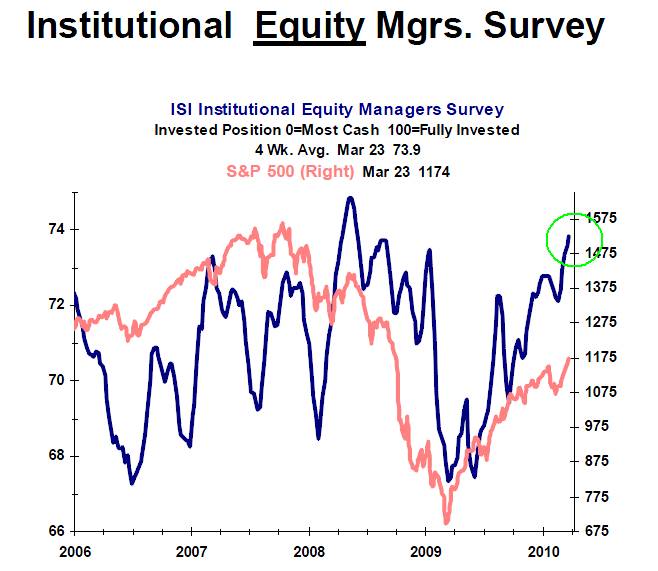
f course they missed it! They were either a) listening to Wall Street analysts and strategists; 2) were watching financial TV coverage of the crisis; III) were normal emotional Human Beings unable to detach themselves from their own neurobiology.
In all three examples above, the related thread was the behavior of organic matter. When it comes to investment, Carbon based goo tends to be a poor element in the decision making process.
Here is an excerpt:
“Americans are down on the economy and the markets even as stocks and growth indicators are up.
By an almost 2-to-1 margin Americans believe the economy has worsened rather than improved during the past year, according to a Bloomberg National Poll conducted March 19-22. Among those who own stocks, bonds or mutual funds, only three of 10 people say the value of their portfolio has risen since a year ago.
During that period, a bull market has driven up the benchmark Standard & Poor’s 500 Index more than 73 percent since its low on March 9, 2009. The economy grew at a 5.9 percent annual pace during last year’s fourth quarter.”
The most intriguing data point to me is the belief that the economy has worsened over the past 12 months. The public is technically correct; much of the data is modestly lower than it was 12 months ago. However, the rate of change is far, far less than it was. The parachute has opened, and the free fall is over.
However, unlike Phil Gramm, I cannot dismiss the public’s concern as a mere mental recession. The obvious missing element is job creation, and that is the most likely reason for the negative sentiment.
Public sentiment is a very important factor impacting spending decisions. I suspect that if we were to get three or four months of 100k plus job creation, that would go a long way towards moving the sentiment needle.
Until then, we meed to closely watch retail sales data for evidence people are coming out of their bunkers. I see it already in Manhattan, but we have lots of Wall Street bonus cash sloshing around. When the rest of the country feels better about the economy, it might create a virtuous cycle of hiring and spending . . . Or, hiring and spending will make the rest of the country feel better about the economy.
Either way, retail sales might be the early signal . . .
>
Source:
Americans Say They Missed 73% Rise in S&P 500 as Economy Surged
Mike Dorning
Bloomberg, March 24 2010
http://www.bloomberg.com/apps/news?pid=20603037&sid=aTp.Sf7cvYvU
See also:
New York Helicopter Commute for $200 a Day Signals Revival
Esmé E. Deprez
Bloomberg, March 26 2010
http://www.bloomberg.com/apps/news?pid=20601109&sid=aWz55bmEsxa8&


Tweet
Facebook
Reddit
Digg this!


March 29th, 2010 at 9:35 am
Once bitten, twice shy.
March 29th, 2010 at 9:45 am
“Carbon based goo tends to be a poor element in the decision making process.” Oh please! The Fed’s zero interest policy for the foreseeable future has only one ‘objective’ meaning: we are on the edge of the financial abyss for the foreseeable future.
March 29th, 2010 at 9:48 am
BR:
It’s myopic to equate Wall Street’s fortunes with those of common folk or the broader economy. Step beck and look at the Big Picture. If this a return to normalcy, normalcy has been redefined (along with GAAPs).
While the US markets are up, the toxic derivatives have not been unwound, the “assets” on banks’ books are falsely valued and cannot be liquidated, and every penny imagined into existence has less value than the one that came immediately before it.
Poison Ivy starts out as green shoots, too.
March 29th, 2010 at 10:06 am
We are years now into falling home prices. Some locales were a little behind the fun, as I’m just NOW noticing home prices falling in my area, central Alabama. Drove by a house friday nite that was interesting to me, so I grabbed one of the for sale flyers and noticed they are selling for 10% less than the purchase price in 2007. I feel strongly that they overpaid, based on what I know of the neighborhood they are in, but certainly this isn’t the only case locally.
Falling home prices aren’t going to do much for consumer sentiment either, even if jobs start to come back.
March 29th, 2010 at 10:07 am
Barry:
This report at Calculated Risk indicates that the spending is coming from savings, not new income:
February Personal Income Flat, Spending Increases
March 29th, 2010 at 10:12 am
BR,
You nailed it. Things are returning back to normal. Falling at a slower rate is great news. Falling more slowly is almost better than rising at any rate. Retail numbers will likely show people spending borrowed money using leveraged homes as an ATM. Being fully extended using your home as collateral for borrowed money is the natural state of humanity. Low interest rates should spur the sale of vacation homes and we should soon see a resurgence of home flippers.
Retail is going to be on a boom cycle starting about now. People love to spend money and buy things they think they need. Recreational purchases of useless crap is on the agenda.
Analysts claim job creation will be 300,000 monthly starting this month. They’re always understating the true case of the economy so 400,000 new jobs monthly will probably be the new normal.
The stock market is discounting all of this and appropriately rising in anticipation of a future trailing P/E of 30. When Wall Street bonuses get spent in NYC, the entire economy follows in lockstep. People love to imitate Wall Street folks. I plan to buy some boats.
PS: can anyone explain why analysts always have their estimates exceeded? Given the concept of the bell shaped curve, there should be a majority that get estimates right, and essentially equal numbers that understate and overstate. Yet, every quarter, estimates are universally exceeded for almost every bit of new. Why does this happen?
March 29th, 2010 at 10:18 am
Somewhere is a family that stopped paying their mortgage and re-allocated it to the stock market beginning at the low. They are slow playing retail in case their bank decides to begin foreclosure, but they can’t resist just a teeny bit of spending on goodies. If the market begins to decline in earnest, they plan to sell and catch up on their deliquent mortage payments. Fortunately, the family members are still employed, so they can support everyday spending on food & fuel. For now, they fly under the radar.
March 29th, 2010 at 10:19 am
“Among those who own stocks, bonds or mutual funds, only three of 10 people say the value of their portfolio has risen since a year ago.”
Wow~ That’s hard to believe..that’s from the Mar ’009 lows (?)
wtg MutFund Mgr.s~
March 29th, 2010 at 10:19 am
And don’t forget – the jobs the people ARE getting in many cases are paying less than the ones people had before, and very few people are getting raises of any kind in this environment, well, except for the folks on Wall Street, of course. Nice to have your entire industry subsidized, I guess. The New Welfare Queens sure do live well and in this case.
March 29th, 2010 at 10:22 am
I see a “Is the stock market topping out?” headline on Yahoo/Marketwatch today and a few similar headlines recently. Not a good sign for my short POSitions.
March 29th, 2010 at 10:31 am
“By an almost 2-to-1 margin Americans believe the economy has worsened”
I run a small ($25M) business and the economy is not improving for me. 2008 was 30% worse than 2007. 2009 was 33% worse than 2008. 2010 is showing eerie similar trappings. I belong to a golf club that is dominated by small business owners from all types of service/retail etc.and the reports are almost exactly the same. Business is down 30% to 50%. Nobody has plans to add staff. I just don’t get the improving idea. Job creation is the key. Retail sales might be a good first step but if the job situation doesn’t improve retail will slip right back where it is. Off!
March 29th, 2010 at 10:54 am
I think that this equity rally is still a fake one – it is bid up among banksters on state subsidies and hedge fund players. But hedgies are only players and they will turn around and short if they smell the tide turning. So this rally lacks in substance and volume, as the retail investor never joined.
Perversely the latter may be the reason for the continuation of the rally – hedgies and banksters need to unload their stocks that they bid up so far to the “dumb money”, before they can start shorting. So until the retail investor joins, the rally may continue as we have zero rates and fake accounting as an excuse to bid shares further up.
March 29th, 2010 at 10:56 am
Things are returning to normal.
EXCEPT 1/10 can’t find job. And 1/4 house under water. SP500 back to where it was in late 90′s instead of early nineties.
Other than that – things are great. What’s not to love?
March 29th, 2010 at 11:13 am
I think we are just one shock from a market crash, or at least a pull back. Most big cities have unsustainable spending obligations. Real estate, on both coasts, is way over-priced, at least the ones I saw this morning. Some smaller municipalities have already collapsed, when a big city goes, or a state, then the market will re-evaluate how it is pricing equities. Of course there is Europe to worry about too. Default in one of those countries has to, at some point, draw attention to our miserable situation.
March 29th, 2010 at 11:20 am
If this gentleman is right, it would explain why the market is rising:
http://www.aheadofthecurve-thebook.com/charts.html (got this from Barry’s “Blog Roll”
I don’t know enough about the US economy to pick apart Ellis’ reasoning, but going through all of his charts and comments was edifying.
March 29th, 2010 at 11:22 am
@wunsacon
I see a “Is the stock market topping out?” headline on Yahoo/Marketwatch today and a few similar headlines recently. Not a good sign for my short POSitions.
I thought the headlines were supposed to be incredibly bullish at “The Top” like GS talking up $200 oil and systematic lack of reinvestment when oil hit $140. has anyone spotted a “Bear” magazine cover lately?
BR, second request: Are there any Smart Bulls who can make an intelligent case for continued increase? Also wondering if it is possible to do a pole of market sentiment and market positioning for participants in this blog. Are the people talking bearish really short, or, just underinvested?
Please don’t give me a five year ban from the blog for asking about a bullish opinion. I am bearish, just bi-curious(?).
Wish everyone celebrating tonight a happy and healthy!
March 29th, 2010 at 11:26 am
I said it last week, and I’ll say it again: This market climb will continue until middle class America starts putting money back in again. This is an investor class and institutional rally. This is not an individual investor rally. Things are continuing to go up, but very slowly. How long have we traded in the 10,000′s on the Dow now? That’s a fairly narrow range, and is not indicative of a new bubble that has formed. NAh. I think now is actually a great time to get in for someone looking for profit. But don’t plan to hang around long. Get in, get some appreciatation to DOW 12,000, then get out.
LOW, LOW volumes for a long, long time during this rally……
March 29th, 2010 at 11:32 am
Barry, I know you’re a pro and all, but this layman doesn’t see anything good on the horizon. I honestly think you folks with money to invest and play with just aren’t looking at the big picture, despite the name of this blog. This probably has to do with your vested interest in the current system, but outside of the rarified atmosphere of high finance, things are sliding rapidly to hell.
The worst thing of all is that NO ONE HAS BEEN PUNISHED. Every evil sonofabitch responsible for wrecking America is living like an emperor. As a consequence, a sea change in society that’s completely under your radar is taking place. Housing is never “coming back.” The banks are insolvent. The government is insolvent. Hell, *I’m* insolvent. The spaceships from Venus are never going to land with bailout bullion for the U.S.A. The freaking BEES are dying. We are governed by blindered idiots.
I have another 30 years of useful life if I don’t just drop dead. I plan to spend them on a quiet farmstead somewhere. All best…
March 29th, 2010 at 11:38 am
While I didn’t go hog wild last year. I did buy LQD after doing some research on BR’s call for it in late 2008, btw thanks BR!. I also went in in March on DXO and was paid well, until the CFTC (may they eat gangrenous donkey wong in hell) screwed that up. Course I would have made much more had I gone all in. But do to another post of BR’s about trading as a monkey I just couldn’t cut loose of that last 30% for the last quarter. Instead I took a little bit of that cash (about $2500) and went to Thailand. Deflation ain’t all bad.
March 29th, 2010 at 11:39 am
the difference is expereince and knowledge, the street knows how the politicians and the fed bail them out, this time they did it twenty different ways, while the average person see’s it as a bad sign, if so many programs were needed and laws changed, etc. etc.
March 29th, 2010 at 11:41 am
In my Northern California hometown, the unemployment rate has risen from 15.5 percent last Februrary to 17.7 percent this February. In this kind of economy, flattening of the curve just doesn’t cut it.
March 29th, 2010 at 12:03 pm
Many states and cities are now cutting teachers, library services, police officers, and releasing “non-violent” criminals from overcrowded prisons. It’s spring and the housing market is still comatose. The news looks unrelievedly grim. People are understandably morose over the economy.
March 29th, 2010 at 12:10 pm
The TBTF’s and Hedgies are getting closer to pulling the plug. They just need some bagholders to whom they can sell their worthless paper. Joe and Jane Retail are slowly coming back to the party to be fleeced yet again. And this will all be Banana Ben’s (and Fed’s) fault for pushing otherwise conservative people into chasing yield in what is merely a speculative gambling foray at the c@sino table. Way to go Benny. You’d better hope you’re gone by the time this house of cards falls again, as I’m thinking the Sheeple won’t be as kind to you the second time around.
http://www.zerohedge.com/article/flows-domestic-equity-mutual-funds-hit-highest-pre-february-correction-year-date-flows-still
March 29th, 2010 at 12:22 pm
[...] Just what is the state of investor sentiment? (Big Picture) [...]
March 29th, 2010 at 12:42 pm
As you pointed out before…Best year for the market?1932….Best 2 year run?1932-1933….Best 5 year run?1932-1937.
The reality of getting worse more slowly is…bad and getting worse. Even bad and not getting better is not going to cheer up the general populace.
Over-leveraging and over-indebtedness are problems for many American households and many countries around the world. Both problems must be unwound, gently and gradually or quickly and more painfully. That pain could lead to a lot more than Tea Parties and Greek street demonstrations.
March 29th, 2010 at 1:00 pm
“The parachute has opened, and the free fall is over” doesn’t have quite the ring of “happy days are here again” now does it? Same effect though.
Nothing organic about the market . Nothing real. Nothing “free”…..Just artificial bids, self dealing, manipulation, insider trading and general BULLSHIT to provide the appearance of “recovery” (so important psychologically for the masses).
Parachutes above and TARPs below covering the cesspool toward which we are STILL slowly drifting….BFD.
Barry, i have to ask but, did you think the run up from 666 was organic and market driven or fomented by a desperate FED/.GOV? Did you look at Japanese charts from their QE days and think “aaahhh! we’ve got a year’s run up ahead of us!” ?
March 29th, 2010 at 1:16 pm
Here is what I am noticing in my hood of SE Pennsylvania/suburban Philly…
People are sick of the recession. They are going out to eat (PF Changs had a 90 minute wait Friday, Olive Garden had a 45 min wait at 830PM!). They are shopping- the outlet mall near me was Holiday season busy. Grocery stores are selling higher end items again (I went to Wegmans and it was busy). Traffic is busy everywhere. People may not have the adequate savings, but they are sick and tired of socking $$$ away and are out shopping again, perhaps in reduced quantities but they are not staying away. That to me is an indicator that numbers may come out better than expected.
March 29th, 2010 at 1:23 pm
@investor: I’m seeing similar things here in the Twin Cities. I wondering if these little spending spurts will happen in a choppy fashion as more and more people decide to “dip their toe” into the spending pool once again but not consistently so? Based on my conversations with people, I certainly don’t the sense that people are overtly optimistic about things, but I do get the sense of “recession-fatigue”. People are now shrugging their shoulders at bit and shrugging off the malaise to “enjoy life” a bit, I think.
March 29th, 2010 at 1:33 pm
Agree with ya 100% Mannwich…its probably some combination of getting back a tax refund, no more snow shoveling, better weather, and the recession fatigue all coming together at once..
March 29th, 2010 at 1:33 pm
Dead Hobo: As I don’t see an answer to your PS, I will offer an explanation that I am 100% sure is correct after doing this professionally for 23 years.
Sometime in the 1990′s, both companies and analysts realized that “beating earnings estimates” led to stock price outperformance. You have to understand that from an analyst’s point of view, you make a lot more money being right on a bullish call than being right on a bearish one. So it is in the interest of both company and analysts for the stock to do well. They both lowball the numbers. It wasn’t coincidence that GE and Cisco used to beat estimates by exactly 1 penny every quarter for about a decade.
Companies systematically and purposeful guide analysts to low numbers. Then they beat the numbers in hopes that the stocks go up. The system is designed to beat the “estimates”, which aren’t really estimates at all. That’s why your bell curve doesn’t apply. I have asked many analysts over the years, and they have all agreed with this.
This practice reached its peak in the tech bubble, which in turn led to the rise of the “whisper number” concept. Note that “whisper numbers” are ALWAYS higher than published estimates. So when companies beat estimates but not “whisper numbers”, the stocks often declined much to the confusion of many investors.
This isn’t a bullish or bearish forecast comment— just an answer to your question. The system does irk me, but it is what it is.
March 29th, 2010 at 1:34 pm
Of course, people almost always get in a much better mood here in the TC as spring hits, and we’ve had an amazing stretch of unusually sunny, warm, and dry March weather the last couple of weeks. Going to even be in the 70s the next few days.
March 29th, 2010 at 2:02 pm
So… the broader indictors are very good — classic recovery. Unemployment has already fallen from 10.1% to 9.7%… employment is always last (its a long-lag indictor)… but in 1-yr unemployment will be under 8%.
Consider that job growth as measure on NFP numbers was -700k per month 1-yr ago. In the last 3 months it is roughly flat, +/-50k jobs. Over the next 3 months… its expected to be +150k, +250k, +300k. There is no reason that wont continue to grow over the next 6-9 months.
Similarly earnings on S&P500 companies looks great and should continue to drive stock prices higher, push strong GDP growth, and that leads to hiring. EPS for Q1 will by $18/shr on S&p500 (versus $10 last year, >70% YoY growth). Last 4Q was even better. So far in 2010… over 70 companies in the S&P500 have increased dividends… the most div increases EVER.
Again, no reason this will not continue.
Besides basic “leading economic indicators” thinking… remember “why” recovery happens:
1) In recession, people put off larger purchases — new appliances, new cars, new tires, vacations, new underwear, etc. Many of these choices simply build-up… you cant really drive on those tires or wear that underwear THAT much longer. So the recession causes pent up demand. We are seeing that in computers, cars in Q1, retail sales, etc.
2) At the same time… costs come down because of “slack” in the economy. This includes financial costs (0% interest rates), rent costs, labor costs, commodity costs. Business benefit massively from lower costs when demand recovers per #1. There is LOTS of profit leverage to recovery.
3) People work harder and smarter. Recession focused risk takers, pushes employees to do their best, focused research scientists to invent new technology etc. It is NO SURPRISE the internet boom and bio-tech emerged from the last 80s-early 90s bond and real-estate bubble. This has always been true… winners and losers.
As we can see already in the public markets — the best investments are made EARLY in the 3-10 year recovery. Everyone should take measured risk… but at the same time, avoiding risk after a major downturn is RARELY the right strategy.
March 29th, 2010 at 2:07 pm
Exactly what money are we supposed to spend on retail goods, without decent-paying reliable work?
The public sees the whole economy. Wall Street is only a mirror–right now a funhouse mirror. The public sees not many jobs. They also see (not much domestic) manufacturing. Much of their savings has evaporated. No-one’s going to be spending freely in a situation like that.
And the public has a valid intuition that nothing’s been fixed yet, and they’d have to be asleep to miss Chinese neo-mercantilism.
March 29th, 2010 at 2:13 pm
Easy Raven, the unemployment rate is 9.7%. The BEST is ever is is 5%. So about 5% of people dont have jobs.
The problem (classic Keynes) is that the huge portion of people WITH JOBS… actually have been given a large “real raise” because the prices of everything (condos, cars, clothing, etc) have deflated. This is the classic “Great Depression” and “Japan” scenarios. But the Fed seems to be effectively fighting this battle… and it appears about to turn (large nominal GDP growth + >2% inflation).
But dont forget… the police, fire, teachers, restaurants, companies… 95% of workers STILL HAVE jobs and are doing GREAT.
March 29th, 2010 at 2:17 pm
@cognos:……………”and are doing great”?? C’mon, man. Sure, many are doing very well and even OK overall, but 95% “doing great”? What world are you living in? Are you really Brian Wesbury?
March 29th, 2010 at 2:25 pm
And please stop ignoring the fact that in reality nearly 20% of employable adults are either unemployed or severaly underemployed. So your assertion that 95% of the workers “have jobs and are doing GREAT” is utter rubbish.
March 29th, 2010 at 2:37 pm
Cognos says “But dont forget… the police, fire, teachers, restaurants, companies… 95% of workers STILL HAVE jobs and are doing GREAT.”
Wall Street is not the real world. Government jobs are not the real world. The real world is hurting bigtime. The workers that are doing so well are overhead expenses to those who don’t have jobs or are anticipating losing their job.
The vast majority of new jobs come from small business. What small business in their right mind would hire someone today? Look into the future… Higher healthcare costs, higher energy costs, higher taxes on everything and anything, more expensive federal regulations to comply with.
Small businesses are circling their wagons and trying to survive until the real world changes. Same with all the millions of unemployed or fearful-of-being-unemployed.
I think we will see torches and pitchforks before we see your “recovery”.
March 29th, 2010 at 2:37 pm
BR,
Re: your comment about retail sales and seeing it in Manhattan. It isn’t just Manhattan. I’m in Miami and we started seeing the traffic back in November/December but at the time I put it off to the fact that we have a lot foreigners, especially Latin Americans, who come here to shop for the holidays. But after the first of the year, it didn’t drop off. Shops/malls are crowded and restaurants are full. Nine months ago you could walk into any place on the upper east side, even on a weekend, and get a table pretty quickly, if not seated immediately. Now, forget it. Every place is packed and waits of over an hour, even (especially?) after 9 pm (even weekdays) are common. And this isn’t Miami Beach I’m talking about. Brickell area and the gentrifying areas north of downtown are jumping. Condos are filling up (yes, mostly with renters and at low rents, but filling up nonetheless) and new retail places are opening. Existing retailers are seeing big jumps in sales downtown. I’ve been more bullish on the economy than most over the last year and I see no reason – for now – to change.
I know there are still areas that are suffering but Miami is ground zero for the real estate bust and the improvement is obvious to the naked eye here. I don’t know how long it will last, but for now, things are improving.
http://www.miamiherald.com/2010/03/11/1525583/new-life-in-the-big-city-as-condos.html http://www.miamidowntownlife.com/profiles/blogs/downtown-miami-experiences http://southflorida.bizjournals.com/southflorida/stories/2010/03/15/story9.html
March 29th, 2010 at 2:38 pm
I’m sorry but I distinctly disagree.
Most people have reasonably FIXED salaries, in the short term.
If you still have your job (95% of people who were working)… and that salary is FIXED or interestingly in the case of union workers… heading upwards on a set schedule (+5% annual). Then why arent you doign great? Go buy a house for 50% of what it cost a few years ago. Cars, vacations, computers, etc… ALL COST WAY LESS.
Now you probably have a house, and thats costing you some money to recover from that loss. But overall your INCOME to EXPENSE ratio… is the best its ever been. Right?
Again… my point isnt “there no recession”. Its that some basic structural things ARE true, and DO HELP the recovery. One of them is that many people with jobs have HIGHER real incomes and more disposable income. We here about the unemployment rates and lower house prices plenty… but the are natural recovery mechanisms. (No large portion of people is doing very poorly. SOMEBODY is spending $1B on iPads this month. Who is it?)
March 29th, 2010 at 2:39 pm
Cognos, the unemployment statistic you’re using is only reliable in normal times; these aren’t normal times–there are many discouraged workers. There’s also the problem that a lot of well-paying steady jobs have been replaced with low-paying uncertain jobs, which that statistic does not show.
Go you to Brad Delong’s blog. Scroll to the bottom of the page and look at the charts. Pay attention, especially, to the employment/population ratio. It has not been this low since 1983 or 1984. The GDP vs. unemployment chart does indeed show some recent improvement, but only during the last quarter (I think). Things are hard, out here on Main Street.
March 29th, 2010 at 2:41 pm
Mannwich — If you want to take the broader look at unemployment given by “u6″ then compare that with the lows on U6. What are they?
I bet its currently 19% u6 unemployments… but the normal lows are only 10%… so again, by that measure 91% of people have the SAME JOB. And general HIGHER REAL INCOME.
Keynes really had the “depression process” nailed. The failing is that instead of companies cutting income by 10% across the board… they cut the work-force 10%. Encouraging lower demand broadly. He said this as, “prices and wages are inflexible in a downward direction”.
March 29th, 2010 at 2:42 pm
@cognos: So nobody’s taken salary or bene’s cuts? My wife’s company has cut out her dental plan and the 401k match. I”m sure millions of others have taken outright salary cuts so no, salaries are not “fixed” in this environment. Hardly. In your environment and the people you know, maybe.
March 29th, 2010 at 2:47 pm
Manny – bet you 10 bucks Cognos is someone’s alter ego – similar vein to F411 and HarryWanger. The user name may change but the “contrarian not matter what” is the same. I think that user (or the person who plays that user) is here for no other reason than to spur debate. As with F411 and HW, that user account will eventually disappear only to be replaced by a different user account saying basically the same thing :-)
March 29th, 2010 at 2:49 pm
It has been a geat recovery for investors. Everyone else… not so much.
Which brings me to my big question for Barry… WTf do “investors” actually contribute? We’ve been fed the line that the stock market allows businesses to grow, but where is that actually happening? If the Dow and S&P are doing so well, why hasn’t that resulted in more businesses, more jobs, and better living for the rest of the country?
To me, there is no connection at all to anything real. Can you demonstrate where any trade you made translated into a positive development in the real world?
It just looks like a giant ponzi scheme from the outside, where people make money off other people buying properties that have little real value in the world. Is the stock market any different from the sports card market anymore?
March 29th, 2010 at 2:52 pm
@Thor: I’ve had several thoughts that cognos is indeed the old HarryWanger. The tone and style of his/her writing is eerily the same.
March 29th, 2010 at 2:53 pm
Or shall I say “similar” to those folks……
March 29th, 2010 at 3:09 pm
On a positive note, my sister and a friend just got the good news today that each starts a new job Monday. Both over 50 and out of work for 5 mos. & 1 yr. Evidently cable tv and nuclear power are looking up. This is the kind of stuff I’m paying attention to.
March 29th, 2010 at 3:23 pm
@Cognos – promoting the recovery case by yourself. thought I would help with some observations
1. You are right on with the idea that 95% of the (employable) people are working (more if you count 10 mill illegals) My theory of economics is that higher and longer unemployment benifits lead to overstated unemployment. Some of these “Unemployed” will leave the work force when unemployment benefits run out. My sympathies to the real unemployed and underemployed.
2. People who still have jobs did get a break as many prices deflated. And many government / union workers did not take pay cuts. State workers in Michigan are getting a 3% raise,
3. Anectdotal evidence: I thought condo prices in Sarasota were artificially high and would plunge when people realized that homebuyer credits and low mortgage rates could not bail them out. Reality is that lots of condos in prime neighborhoods are still selling at prices well above my bids.
4. Less bad is good, especially when most people outlook was depression and the sky did not fall.
Cognos may be the lone bullish voice on this site, but I respect his right to voice his opinion and “Bring the Facts or anectdotal evidence to back it up”
March 29th, 2010 at 3:24 pm
Diego says —
“govt jobs are not the real world” (15% of economy?)
“wall street is not the real world” (15% of economy?)
healthcare is pretty recession proof (15% of economy)
technology is doing great (15% of economy)
Hmm… so that’s 60% of the economy, that is “not the real world”. Makes no sense.
I think you guys are specifically focused on the WORST 15%… yeah that looks REALLY bad. But it is not the only “real world”. Construction jobs… middle america union manufacturing jobs… real estate jobs. These areas probably are not coming back. BUT employment is always the LAST indicator to turn… and it peaked Q4 last year. Its turning now. Classic recovery. Those workers will find jobs in new areas — clean tech, energy tech, services (!), etc. In 1 yr unemployment will be 8%. In 3-yrs, <6%.
No torches necessary.
March 29th, 2010 at 3:26 pm
http://www.google.com/search?hl=en&q=vat%20tax&um=1&ie=UTF-8&tbo=u&tbs=nws:1&sa=N&tab=wn
The VAT cometh, as well..
March 29th, 2010 at 3:26 pm
@Cognos ( or F411 or HW) You go girl!
Bring those controversial , even heretical, bullish ideas
March 29th, 2010 at 3:35 pm
microcap Says:
March 29th, 2010 at 1:33 pm
Dead Hobo: As I don’t see an answer to your PS, I will offer an explanation that I am 100% sure is correct after doing this professionally for 23 years.
reply:
———–
Thank you.
March 29th, 2010 at 3:53 pm
Dead Hobo –
On your PS. I thought the previous answer was good. That companies always give conservative guidance and its better for analysts (even the really bullish ones) to be slightly above that. Why actually go WAY above the estimates? It tends to be less about getting the number “right” and more about being better than peers. So if you’re the most bullish… you might as well be just a bit above every else.
The 2nd reason… is a classic “averaging” phenomenon. So sometime earnings fall off a cliff. See Q4 2008 at the CLASSIC example. In this case the Lehman failure caused a seizure of all business activity and financing. EPS fell basically to $0 on S&P500 for Q4 2008.
But that really isnt a “miss” by analysts. The goal is not to “call the crisis”. I mean, if a meteor hit a major city and this caused a big downturn in earnings and markets… would we say Roubini and El Erian were right? Double dip? See thats moronic. They dont really watch for meteors, right?
At the same time, there is always some chance of recession. Some chance of a 9/11, a crisis, a catatrophe. And so that gets “averaged in”. So 90% of the time earnings estimate get beat by 10%. And then 1-5% of the time they fall precipitiously in a crisis and miss by -90%.
It kinda makes sense.
March 29th, 2010 at 3:56 pm
Cognos,
I finally took the time to try to understand what you are really saying, and the problem with your analysis is that it’s not completely wrong, it’s just out of phase with current economics. You assume the current system is creating honest valuations and markets are realistically reflecting these valuations. This is the crux of the problem.
Today, valuations are phony, pumped up and likely to continue in this way without some form of financial regulation that brings a higher level of honesty to stocks, commodities, and other things commonly traded. Everyone who can steal is still stealing as best they can. The Fed pumps are also a controlling factor in hyped valuations. Sales pundits and idiot newsies complete the circle.
Much of your analysis will have credibility if valuations are allowed to find natural levels as opposed to hyped levels. Once a real bottom is realized, THEN, assuming no overriding Fed pumps ensue, the final recovery will be an opportunity of the ages. Recovery won’t be 1000 Dow points a month, but it will be more realistic. At that point, Investment might reflect economic growth as opposed to screw your buddy.
March 29th, 2010 at 3:59 pm
Cognos,
In the government’s 15% of the economy, what exactly do they produce or sell? In my mind, that 15% is overhead expense. In Wall Street’s 15% of the economy, how do their profits match up against the taxpayer’s contributions to them? I’m thinking that’s more overhead expense for taxpayers. Healthcare just added yet more overhead expenses to the taxpayers. If you think adding more and more overhead costs makes things better, we are surely on our way to a spectacular recovery.
If you are so confident in your “95% better off” scenario, go long with no stop and lets talk again at the end of the year.
March 29th, 2010 at 4:32 pm
re: Michigan ‘public employees recieving 3% pay hike..
http://clusty.com/search?input-form=clusty-simple&v%3Asources=webplus&query=Michigan+government+employee+layoffs
things are not too rosy in The Wolverine State..
and, some Factoids..It has the longest freshwater shoreline of any political subdivision in the world, being bounded by four of the five Great Lakes, plus Lake Saint Clair.[5] In 2005, Michigan ranked third among US states for the number of registered recreational boats, behind California and Florida.[6] Michigan has 64,980 inland lakes and ponds.[7] A person in the state is never more than six miles (10 km) from a natural water source or more than 87.2 miles (140.3 km) from a Great Lakes shoreline.[8] It is the largest state by total area east of the Mississippi River.
Michigan is the only state to consist entirely of two peninsulas. The Lower Peninsula, to which the name Michigan was originally applied, is often dubbed “the mitten” by residents, owing to its shape. When asked where in Michigan one comes from, a resident of the Lower Peninsula may often point to the corresponding part of his or her hand. The Upper Peninsula (often referred to as “The U.P.”) is separated from the Lower Peninsula by the Straits of Mackinac, a five-mile (8 km)-wide channel that joins Lake Huron to Lake Michigan. The Upper Peninsula is economically important for tourism and natural resources.
Michigan has highly educated residents and ranks fourth in high-tech employment.
However, due to industrial restructuring and loss of blue-collar jobs, Michigan also has the highest rate of unemployment in the U.S., with a rate of 14.3% in January 2010.[9]
http://en.wikipedia.org/wiki/Michigan
as always, w/ wikipedia, 2x-check..
March 29th, 2010 at 4:34 pm
Diego –
The govt “produces” — roads, schools, waste, police, courts system, national defense, FDA, EPA, etc. What a waste!
The financial sector pays >$500B/yr in taxes. What are the “taxpayer contributions” of which you speak? Ha!
I have been long with no stop loss for >1 yr and quite consistently vocal about in for 6+ months on this blog. I have been levered long on some dips (like Jan 29). I recommend a “buy the dips” approach to the next few years for everyone. A so-so market for 2008 or the decade since 1999 is exactly what sets up the recovery and has good potential to setup the long bull market.
March 29th, 2010 at 4:34 pm
@Hoffer: I’m very familiar with the “U-P” and the “little finger” north of Traverse City, MI. The wife has several extended family up there and we go up every other summer for a visit. Great summer places. Both very beautiful areas and both are really in a depression.
March 29th, 2010 at 4:40 pm
On a personal note, I spent more in disposable income in the past two months then the previous 8 months combined. All my spending was due to two factors: 1) pent up demand and 2) my tax refund. While the latter was not huge, it was enough to spend on a few pending purchases, and delayed home and car repairs. It would not surprise me if many average working folks had similar reasons for increasing their spending. I assure you, the increase in my spending is very temporary.
Not a dime more in pay last year, with a 30% increase in medical premiums. There will be no raise this year or it will be delayed 6 months and then perhaps 2% if we are lucky. My home insurer in Florida is determined to pump up their reserves via increased premiums. If my neighbor’s bills are harbingers, I can expect a 40% increase which will amount to about 5% of my take-home pay. Really. I am not exaggerating. I used a calculator and computed it twice. However, I am very happy to have a job, so I am not complaining, so much as reciting one person’s reality. If this is mine, then I feel for those who are elderly or single parent households.
If you are paying attention, you will know that between no pay raise, increases in medical premiums (and co-pays) and the home insurance increase, things don’t look so good for my single paycheck household. And, yes, I have cut out all the expenses I can with the exception of an employee-discounted low-minutes cell phone bill I share with my elderly mother and my cable/internet/home phone bill. My car is a paid-off 1998 Hyundai. Yada, yada. I could go one, but it is boring. My point is that I am sure I am not alone. The increased consumer spending may be temporary.
March 29th, 2010 at 4:49 pm
Dead Hobo —
Keep waiting for the “opportunity of the ages”. How can you say, “stuff is all overvalued”… BUT… you expect the true downturn to set up the “opportunity of the ages”. That’s called — wishful thinking.
You already missed it (probably for the 5th time in your investing life!).
Stocks at ~12x 2011 earnings are not “pumped valuation”. I think a strong recovery will push earnings even higher in 2011. Stocks will be back at all time highs at YE 2011, which is kinda fitting… cuz they’d be flat on 4 years (2007) and 12 years (1999, although positive 2% divs). Then… do they break up from there?
When do you admit your wrong… 1250 on SPX in the next 1-2 months? 1300 on SPX in the summer? When..?
March 29th, 2010 at 5:12 pm
Here in Missouri, I’m seeing more people out shopping.
we putt the father in laws house up for sale, there have been a lot of lookers but the offers were slow coming in. It looks like everyone was taking their time. Now we have an offer and if it falls through 3 more have expressed interest to bid.
My sister in southern MO branson area is doing better for a while they were living on her walmart $11hr job but construction has picked up and her husband is working even with the bad winter we have had.
Heard today on GMA that Costco sales grew 25% last year while walmart was flat. That tell you a lot about who is hurting and who isn’t. The working class got slammed. Those of us in better jobs fared better.
March 29th, 2010 at 5:26 pm
Opportunity of the Ages @Cognos @Dead Hobo
first Cognos, lets bring back the civil tone to the conversation.
second, You are correct about the best buying opportunity of my 26 year career. I bought the day after the 1987 crash, two weeks after 9/11, before the start of Bush II war in ’03, Junk bonds in Nov ’08.
But I completely missed the ’09 bottom. This sucker was way too scary for me. I had 10% of client money in preferred stock – that’s just income stuff right?, 1% in structured notes backed by Lehman – ouch, 20% of my net worth wiped out by Merrill and UBS, and then going into March ’09 $2 million of Citi structured notes on the edge of bankruptcy. When you spend all week calling clients to sell Citi structured notes to avoid the next Lehman, it is damn tough to put the money right back in.
Anectdotal evidence that Mar ’09 was the scariest bottom anyone has seen since 1974 and therefore must have been the best buying opportunity by definition.
Ken Fisher always says “It is not the expected that will change the market, it is the unexpected” Can anyone tell me something we don’t know about unemployment or housing, or China that is going to take this market back to the March ’09 low or down to what Habo is looking for at PE 10 around 7 like in ’74? What is the name on the Black Swan that everyone is waiting for which nobody is talking about?
March 29th, 2010 at 7:25 pm
Cognos and like types Q&A .. should folks (in twisted words) of Congressman Grayson of FL .. “don’t get (financially) sick & if you do die quickly” .. Q: does your design need? A: go out gently turning the other cheek ..OR.. B: tear up what you can going out … inquiring minds of commerce would like to know so they can bank on it
March 29th, 2010 at 9:48 pm
Manhattan, Miami != USA.
All I know is what I see happening at work. I’m a trainer on industrial equipment that starts around $250,000 on up to about $3 million. Until the end of 2009 we were swamped with new-operator trainees. Newbies mean, mostly, new equipment sales.
January was OK, but starting in February our uptime (meaning number of weeks running classes) has tanked. This month I’ve had two classes with just one student, down from the usual 4-5-6, and I’m not teaching this week because nobody signed up for my class. Of the 16 or so instructors in-house, only about five are teaching this week, and one is a service class for operators who’ve had six months experience running the machinery; that class is full, but they were all here last fall and do not represent new business. Some trainers haven’t taught a class in a month, and they’re getting very nervous.
In other words, domestic capital equipment spending shit the bed in the first quarter, at least in this sector.
Yes, I am being deliberately vague and do not wish to identify the sector nor the company, thanks.
March 29th, 2010 at 10:17 pm
I doubt you remember me, but we’ve emailed once or twice in the past, and I’m an avid follower of your blog.
I read your post today where you said that the missing ingredient in improving consumer sentiment is job creation, and I agree. I also have a data point that you may find interesting.
I run the leading trade publisher that serves the corporate recruiting profession. We run a web site (www.ere.net) and several events for recruiters. As you might imagine, this business is heavily dependent on economic conditions, particularly job creation and hiring.
Last week, we ran our flagship conference (www.ereexpo.com). It was up 30% compared to the comparable show last year, and almost 90% in the apples to oranges comparison to our conference 6 months ago. The mood of the recruiters on site was upbeat for the first time in two years, and they were actually interested in new purchases, vendors, etc. in a way that means that they expect to be hiring again soon, if they are not already doing so.
Recruiters having budgets generally precedes hiring, so I take this as an excellent (if tentative) sign for the economy as a whole.
March 30th, 2010 at 12:47 am
cognos,
” … employment is always last (its a long-lag indictor)…”
You are wrong with this. Employment is not always an indicator with a long lag. You had made the same assertion before, and I already had complaint about it back then. This meme about employment having a long-lag has been widely spread by pundits and others during this recession, since many are just parotting it. But in reality, it was only the case for the previous two recessions that there was such a lag, quite a long one after the recession of 2001. For most of the recessions after WW II, there wasn’t any significant lag between the end of the recession and unemployment rate. Employment went up right with the end of the recessions. Look at the data. This makes sense, since employment isn’t just a passive variable in the economy. It feeds back into the economy, instead. Rising unemployment supports economic contraction through income and demand contraction, decreasing unemployment does the opposite.
So the question rather is why were the previous two recessions different to the other ones after WW II, why did the expansion start and was sustainable despite a further increase in the unemployment rate. My hypothesis is it has to do something with the credit bubble that has been forming since the 80ies. The continuing rise of the unemployment rate would have supported a longer lasting recession in both cases, but demand expansion by expanding credit counteracted it and shortened the recessions.
I also want to say something else. I am glad that you are here in the forum with views contrary to the many here, even if it was true that you were the same one who had written under a different pseudonym here before. I don’t care about latter. Your presence and comments here help me to better understand the bullish, highly optimistic mindset of those market participants who have driven the stock market so far up to these again overpriced levels, and why this could last as long as it has and why it may last even longer.
rc
March 30th, 2010 at 7:34 am
Consumer spending increases in February, 5th straight month of gains
Consumers kept their wallets open for the fifth month in a row in February even though their incomes remained unchanged, according to government data released Monday. Spending on nondurable goods, such as clothing, jumped 0.9 percent last month, while spending on services rose 0.3 percent. Those increases were partially offset by a 0.2 percent decline in purchases of durable goods such as autos. Total consumer spending increased 0.3 percent. The steady gains in consumer spending are boosting confidence that the engine of the nation’s economy is starting to hum again. February’s increase was particularly notable because it came despite a freeze on wages following six months of growth. That sent the personal savings rate down to 3.1 percent, the lowest level since October 2008, reports Ylan Mui:
March 30th, 2010 at 4:41 pm
RootlessC -
That comment is crazy. Unemployment is THE classic lagging indictor. Every “modern” economics textbook has it so, since Samuelson wrote the first one in … 1948? It is lagged by about 1-yr (i.e. it “turns” 1-yr after the turn in stocks, curve, credit spread delta, orders, ISM, second derivatives, etc (i.e. “leading” indicators).
The only funny part… is that the concept of “leading” indictors is SO simple. They ALL turned HARD in April of 2009. The good economics shops (ISI / Hyman, GS) all called the turn well. If you understand company reports, Ks, Qs, this was also very helpful as many companies (BAC for ex) also called the turn after Q1.
I am not affiliated with Franklin411 or anyone else on this blog. I believe I have read the BigPicture since its very early days… and for a number of years at the old address (bigpictue.blogspot.com?).
March 30th, 2010 at 8:24 pm
cognos,
I don’t care what you claim what Samuelson allegedly wrote or allegedly every modern economic textbook. The unemployment rate only lagged significantly the end of the recession for the previous two recessions. Here are the data:
http://research.stlouisfed.org/fred2/series/UNRATE?cid=12
The peak of the unemployment rate was coincident with the end of the recessions for most of the recessions after WW II. Only after the previous two recessions it continued to go up further after the end of the recessions. Most times it definitely wasn’t “massively” lagging, contrary to what you claim. If you insist you will have to provide your data that prove otherwise, but don’t just make assertions.
rc
March 30th, 2010 at 10:49 pm
RC -
You are simply insane. The chart you linked showed exactly my point. Unemployment is a DRASTICALLY lagged indicator.
In ~1984 it is more than 8% (fully 1-2 yrs after recession has ended)
In ~1973 it is practically at peak levels (again, 2 yrs after the recession has ended)
In almost EVERY case it supports exactly my point. That it never helps call the turn. Two HUGE further points –
1. Were not trying to call the “end of shaded recession per NBER” right? We’re trying to call the STOCK MARKET. So the stock market LEADS that gray shaded recession area. So the 1 or 2 out of 10 times(really!) you see a “coincident” indicator which is really more like a small 3-month lag… thats still 9 months BEHIND the stock market. (Oh, wait unemployment is now down 0.4% from 10.1% peak… ah, just like the history).
2. Its better to look at the monthly #s rather that a 50 year chart. Its very non-specific. And to get even more specific… we’re looking for a “confirmed” downturn. So given that the number bounces around it takes a bit longer to get a confident downturn. This furthers the lag.
Seriously… I look at almost every one of those recessions and the unemployment rate is distinctly lagged. (Further, see point #1!) What are you looking at?
March 31st, 2010 at 2:47 am
cognos,
“In ~1984 it is more than 8% (fully 1-2 yrs after recession has ended)”
So what? At the peak it was almost 11%. Whether an indicator is leading, coincident, or lagging depends on when it turns around. The turnaround of the unemployment rate wasn’t “massively” lagging the end of the recession.
“In ~1973 it is practically at peak levels (again, 2 yrs after the recession has ended)”
Wrong. The unemployment rate has a local minimum around 1973. Perhaps, you have a problem with your eyes. After the 1970 recession, the unemployment rate didn’t rise significantly, but stayed elevated until the end of 1971. Then it started to drop. For that reason, I wrote “most” recessions after WW II.
BTW: The unemployment rate usually ticked up shortly before or with the start of the recessions. No lag here either.
“1. Were not trying to call the “end of shaded recession per NBER” right? We’re trying to call the STOCK MARKET. ”
After you insult me first, now you lie. You were talking about the unemployment rate as allegedly “long-lag” indicator in the context of the economic recovery in your comment at March 29th, 2010 at 2:02 pm.
And for you stock market calls, you prefer cherry-picking data and fantasy numbers anyway.
rc
March 31st, 2010 at 11:43 am
You call it “cherry picking data and fantasy numbers”.
I call it – “being right”.
But hey… thats what makes a market.