NPR: The Ethics Of Mortgage Modification

Email this post Print this post
By Barry Ritholtz - March 27th, 2010, 11:30AM

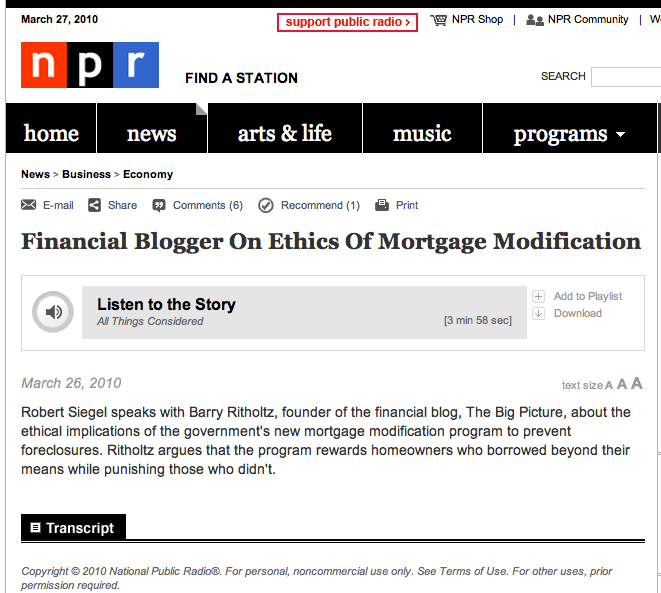
I did an interview with NPR yesterday on the foreclosure abatement proposals.

(Financial blogger? Really — after all this time, that’s how I am described?)

>

click for broadcast
Comments

Please use the comments to demonstrate your own ignorance, unfamiliarity with empirical data, ability to repeat discredited memes, and lack of respect for scientific knowledge. Also, be sure to create straw men and argue against things I have neither said nor even implied. Any irrelevancies you can mention will also be appreciated. Lastly, kindly forgo all civility in your discourse . . . you are, after all, anonymous.

48 Responses to “NPR: The Ethics Of Mortgage Modification”

  1. David Merkel Says:

    Maybe, just maybe, being a financial blogger worthy of being on television or radio connotes a degree of expertise in writing and knowledge about financial issues. It is a meritocracy, mostly.

    But I am dreaming…

  2. iratherbe Says:

    BR – Modifications, workouts, credits, Congressional hearings, perpetual low rates, etc. I have pretty much never heard the situation of renter’s nary mentioned in the media, by pundits or our legislatures during this financial crisis. As an example, here in the Philly metro area, my condo rent has increased almost 30% over the past 4 years inclusive of the Great Recession, credit & money crunch, heightened unemployment & the continued volatile market environment. Are we the black sheep of Greenspan’s great homeowner entitled society?

  3. Paul Anthony Kelly Says:

    That’s the issue Barry, you nailed it. This is not about saving homes for people and the recovery of the economy. It’s about saving banks money plain and simple. I am a recent convert to the big picture and great to put a voice behind the words. Great job.

  4. Mr.E. Says:

    I think you have it right. While it is far from perfect the HAFA program under the HAPM revisions announced yesterday, particularly the support for short sales , is a step in the right direction. It will help the move toward house price normalization, forcing the write-downs on the residual bad debt, and helping the “owers” move on with their lives to something that far better suits them.

    Maybe Mr. Geithner has been reading TBP ?

  5. writersblock Says:

    Heard it, loved it, and thought you really nailed it with regard to how it keeps the price up for the banks, and, therefore, forces first time home buyers out of the market.

  6. rktbrkr Says:

    The banks aren’t going to make many 30-40-50% writedowns, they’ll take their ball and go home if they can’t shift most of the pain to Uncle Sam.

    This program is a non-starter with fair, current valuations.

    Whatever happened to Tiny Tim’s toxic assets program?

  7. SINGER Says:

    Financial Blogger is a whole lot better than douche bag…

  8. wunsacon Says:

    SINGER nails it! LOL…

  9. flashcurious Says:

    The U.S. economy is like Wile E. Coyote when he has just been run off a cliff by the Roadrunner (who would best fit this role, any votes?) and is desperately running in air before falling into the abyss. He will start to fall when the govmint stops stimulating and decides/is forced to raise rates. Give that drunk another drink, he’s got the DTs!

    Our economy has been gutted by offshoring and outsourcing. The Great Leavening has begun, where everyone in the blue collar/middleclass world makes $24k/yr. The anger is palpable. Can anyone tell me exactly what McCain and Palin would have done differently?

    What BR suggests is exactly what should happen, but nothing that should happen right now is happening…yet.

  10. Charlatan Says:

    On the subject of banks and reforms, this is what Jim Cramer had to say a few days ago: “Because the President has been sidetracked by Volcker, we won’t get any real bank reform….There’s nothing wrong with saying that a great man has lost a step or two. You can say it about Willie Mays, you can say it about Paul Volcker… How cynical and calculating was President Obama with the ‘volcker rule.’ Very troubling.” Now, let us weigh BR’s bank commentary against Cramer’s……..

  11. DeDude Says:

    Actually the people helped the most are the ones that didn’t borrow beyiond their means. Anything that keeps house prices higher than they would otherwise have been, will help the people who are not under water.

  12. RC Says:

    Great interview, BR !!! I love the clarity with which you explained your position. I hope the administration is listening.

  13. tawm Says:

    DeDude: as someone who has been renting for 10 years, having not been willing to take on a $1M+ mortgage so as to pay inflated prices to get a house in suburban NYC, putting a floor under real estate prices hurts my chances to buy a home at a reasonable level. Keeps me locked out of the this market. Meanwhile my cash earns near zero. But at least I’m not worried about being screwed by huge increases in real estate taxes.

  14. DM RTA Says:

    BR, from your about page

    …”for investment professionals, as well as anyone else interested in investing, markets, and the economy. We key in on what you should — and more importantly, what you should not — do with your money”…

    If not financial blogger….what phrase would do it?

  15. mjocaj Says:

    DeDude: Please explain how this most helps people who did not borrow behind their means. People who borrowed within their means have no need to refinance so the market value of their house has no relevance. In my case, I paid off my mortgage 10 years ago and I would love the assessed value to decrease, the more the better. It would lower my property taxes. If I ever choose to sell my house any reduction in the price I receive will most likely be offset by a corresponding reduction in price of the house I buy. If I choose to rent, there is a direct correlation between housing prices and rental prices. If house prices go down rent tends to go down. Reduction in housing prices is a win all the way around except for the bank that loaned the money and the deadbeats not meeting their obligations. What really angers me about this latest bullshit is the fact that people who took out second mortgages to buy plasma TVs and take vacations will be able to walk away from their debts. Are they going to be forced to give back all the crap they bought with the money ?

  16. Bill in SF Says:

    Financial Flogger?

  17. The Window Washer Says:

    “If not financial blogger….what phrase would do it?”

    “Private money manager” would be my vote.
    I think press people talk up Bloggers to bring them into the press fold in the public eye, and thereby increase the credibility of their field.
    Barry is a financial adviser and money manager that generously publishes many of his thoughts to the public for free.

    I hope he never tires of posting. It will be a sad day when he drives into the sunset, may it be in the car of his dreams.

  18. constantnormal Says:

    So long as the banksters also are allowed to reap the just rewards of their follies, I am content to allow homeowners who cannot support the phony mortgages the banks sold to them to be busted back out onto the street.

    But so far as I can tell, that is not what is happening or is proposed in any legislation or policy to date. Instead, what we have here is an every-man/corporation-for himself scramble to avoid taking the hit they are due. And in particular, we have spent an EXTRAORDINARY amount of OPM protecting the banksters from the consequences of their folly.

    So why should there be a dual standard in the dispensation of moral hazard?

    When I see TBTF banksters failing and their CEOs heading toward prosecutions instead of multi-million-dollar bonuses, then I’ll be more inclined to make sure that homeowners who have been foolish receive their just desserts. Until then, we may as well let the every-man-for-himself game play out, rather than take sides against the little guy.

    No, it’s not the Right Thing to do, but it’s more right than smacking the homeowner for believing they could get away with it while allowing banksters to actually GET AWAY WITH IT. That message is a lot worse than the dilution of moral hazard that comes from bailing out the homeowners along with the banksters (but to a far lesser degree that the banksters).

    As for the description thing, it could be a lot worse — they could have identified BR as a “member of the Wall Street establishment”, or a “member of the NY financial elite”. Be thankful for small favors.

    I too, am plagued by a certain lack of respect and recognition when introduced by my friends — usually something like “this is that guy I was telling you about”, an intro that is guaranteed to invoke a certain degree of insecurity. I would much prefer “this is the wisest man I know” or some similar over-the-top apple-polishing appellation.

    But that’s Life — we rarely get the treatment that we believe we deserve. Take Lloyd Blankfein, for example — he would prefer to be known as “God’s servant” (certainly a servant to no lesser entity), and all he gets is grief.

    It’s a tough life.

  19. drewburn Says:

    Barry,

    NPR, God love ‘em, aren’t exactly “with it” on finance and Wall Street……….but they are sincere and honest. It’s the only radio I listen to and they may seem “out of it” on some subjects, but they are always insightful…….as in this case in drawing out your astute points.

    I thought you did a very nice job. My feeling is that Robert would have liked to spend more time on the interview……….but, so it goes. It’s really a complicated subject for most people, the idea of finding the clearing price, the real market price, and the reason that’s the best.

    I’ve said it many times……….Everyone likes a free market when it goes in their favor…………

  20. OkieLawyer Says:

    Barry:

    I needled you about this yesterday (you can hat tip me later, lol), but let me ask you a serious question in regards to the new proposed mortgage modifications:

    As I was listening to it, I had some questions regarding some of your comments. For instance, if the government is giving the mortgage company “up to 21% for every dollar they agree to forgive from the mortgage,” isn’t that still making the banks take a haircut of at least 79% of the forgiven debt? Or did I misunderstand the new program?

    ~~~

    BR: Any money the govt gives the banks is free money subsidizing their losses. W/O this program, the banks would have to take their loss – and receive nothing . . .

  21. rktbrkr Says:

    Okie, I think I read a few thou$ processing bonus for the banks, maybe somebody translated that to a % but I’d say the banks will hold out for a reversal with the US paying for 79% of the banks errors and the banks paying “up to” 21%.

    If the banks start taking substantial writedowns then you’ll know we’re really staring into the financial abyss. Nothing has been fixed except the SM with BBs freebucks

  22. Winston Munn Says:

    “Actually the people helped the most are the ones that didn’t borrow beyiond their means. Anything that keeps house prices higher than they would otherwise have been, will help the people who are not under water.”

    @DeDude

    You seem to be making the same mistake as our politicians in thinking that borrowing within means has something to do with price – it has nothing to do with price. Borrowing “within your means” simply means the monthly mortgage payment is affordable, regardless if the home value is above or below the total mortgage amount.

    The main thing the propping up of home prices accomplishes for owners is to temporarily inflate their personal balance sheet with make-believe value that does them no good other than making their net worth look artificially higher than it should be.

    This artificial value is of no consequence to the owner who is solvent and can pay his monthly mortgage, but it is of paramount importance to the owners who are insolvent and to the banks who own those mortgages. The longer we can pretend that home prices have adjusted to normal, the longer we can pretend there are not billions more in losses on the balance sheets of banks.

  23. Kent @ The Financial Philosopher Says:

    As long as the mainstream media perception of “blogger” i s “outside point of view” then you should continue doing exactly as you are doing…

    “We must not, therefore, wonder whether we really perceive a world, we must instead say: the world is what we perceive…. To seek the essence of perception is to declare that perception is, not presumed true, but defined as access to truth.” ~ Maurice Merleau-Ponty

  24. nebyarg Says:

    Barry, you are an excellent communicator. You spoke succinctly,honestly and to the point. Thank you for being out there. I will support you in which ever public office you would serve.

  25. JerryC Says:

    Nice! I might have added point #3, that being that when a house is allowed to fall to its fair value, someone who can afford it will purchase it and most likely invest in the community by hiring local contractors to upgrade/repair, buy drapes, carpets, etc. Please: no granite counters or stainless, though.

  26. dcsos Says:

    In NPR’s view, maybe, being gainfully employed managing money is a non-no in these times?
    Blogger then is a compliment from these folks!

  27. Boots or Hearts Says:

    Agree completely w/ what you have to say in the interview.

  28. Jim67545 Says:

    I disagree with much of the above. Where to start?
    1. NPR (linked through TBP a few weeks ago) had an interview with an attorney representing homeowners who had walked away from their homes. She described it as a “business decision.” I guess we are going to gut the concept of entering into contracts – which is what a loan is. I wondered how that attorney would feel when she took her Lexus into the dealer for a warrantee repair and the dealer told her that Lexus had decided to cancel all warrantee agreements – as a “business decision?”
    2. The above talks about taking real estate to its true value – or some such wording. Is true value attained when one dumps 1.3 MM housing units into an economy undergoing a depression? I live in an area where a sluggish economy and zero population growth led to no housing bubble. Our home prices are off 10-15%. Maybe that is “true value.” But is 50%?
    3. Nobody registers the damage being done by the 100k’s in households now with damaged credit – and more to come. Does it serve our nation to plunge these families into the lower end of housing and society? Consumer credit borrowing is down. Car sales are down. Sluggish consumer consumption? Constricting revolving credit? Longer duration unemployement (most employers pull the applicant’s credit.) Gee, I wonder if this could be a factor?
    4. It is fun to bash banks (as if all banks are the same.) Maybe they have the mortgage on their books. More likely that asset is on the books of YOUR pension fund. Or maybe they are held by interests overseas who we might want to invest in the US of A in the future. So, definitely, let’s screw them all.

    Could go further. Remove the screwjob from one and apply it to another. But in my humble opinion we should all relax and let this play out. BR’s desire to let the market, cruel though it may be, do its thing will happen. It’s happening today – 1000s a day. It’s called foreclosure. All the Kings horses, etc. can’t put this humpty back together again. It’s just too big and too many are too far under water or unemployed. On the margins they can modify some and maybe write down some to keep them in their homes. Fine. Let them. Maybe some good will come of it for some few homeowners. Great. But in this flood, it matters not that they divert a few buckets full of water. Stop fussing and let it happen.

  29. snapshot Says:

    You are right on with regards to ethics and the moral hazard issue, Barry. At this point, the years of advice to my children about responsibility and hard work eventually paying off are laughable. The crooks on either end of the transaction seem to be coming out ahead.

    I do wonder though, if part of the reason for the artificially high assessed value is also to soften the blow of property taxes falling. With a lower assessed value, less property taxes would come to the already hurting states. I struggle to understand why this approach is being taken and this is as good a reason as any.

    It seems more logical to sell the product (home – short sell, foreclosure) at the market price, have a steady tenant, make use of the many services needed to fix up the place and so on and so on. That’s what makes sense to us Barry. But after all, you are simply a financial blogger, and I – a reader of your financial blog – so what do we know.

  30. rktbrkr Says:

    Huge amounts of option arm resets (50% in CA) will be dominating the RE news soon. The Great California Depression? A;ready 12.5% unemployment in the Golden state

    http://wallstnation.com/FNM-FRE-ARMresets-02032010

  31. DeDude Says:

    Tawm, mjocaj;

    Lets first get this cleared out. Current housing prices are below fair value. The fair value is where new houses are sold for the cost of land+materials+labor+10%. If they sell for less than that we (as now) does not get many new houses build and eventually (although probably a decade away) market forces will increase prices. Second anybody can purchase a house. In Detroit you can get them for less than a month salary (even if you are on minimum wage). The problem is that as with Tvs, cars etc. that expectations and averages have grown insane. The normal house used to be 1600 sq.ft. now it is almost double that. Even within 90 min commute of Manhattan you can get a 250K home if you get those expectations down to something reasonable. Personally I live in a place where the average income is half of my income, I drove a 1997 Chevy Cavalier (broke down a month ago and was replaced with a stick shift Corolla for 15K cash). Most of my 6 figure income peers probably think I am a little nuts, I think they are.

    The reason that I, with my house payed off long time ago, actually benefit from house prices not falling further below fair value is that my house is part of my catastrophic event emergency fund as it is for everybody living in this country. Even with the recent reform anybody can be hit with medical emergencies that suck every penny out of them and then more (insurance companies may not be able to exclude sick people, but they can still call the only, or most effective, treatment “experimental” and refuse coverage). Every day in this country prudent high-savers are bankrupted by medical expenses and that will continue as long as I live. If prices come down even further below fair market, so that you guys can get into the market at the luxury level you think you deserve, then the medical bankruptcies will increase. Furthermore, a lot of pensions and life insurance products are tied to the housing market and yes the banks will lose, but dig a little deeper and you will see that it is actually not the bank CEO’s but a also a lot of regular peoples incomes and future incomes that are hurt.

    I have heard enough anecdotes about people who indulged themselves in the housing bubble wealth and also stories about unsophisticated individuals who were duped into taking on more housing than they ever had a chance of handling in the long run. I don’t indulge myself with materialistic possessions, so I don’t envy these people. For those who so obviously do envy them I would say, you had the opportunity so why are you blaming them for your own failure to take it. The laws were not secret, you knew that if you ended up under water you could just walk away. As pointed out here several times the deal handed to those few that actually can afford to stay in their houses are not that great. What are you so envious about.

  32. Barry Ritholtz Says:

    The fair value is where new houses are sold for the cost of land+materials+labor+10%.

    Note that new homes are only ~15% of the market –s o they are a small piece of the pie.

    I think what you describe is what a fair return is for a builder in terms of sale price — but it is not what I am describing in terms of median prices. It also ignores income, interest rates, and costs of renting — making it suspect.

    We are still dealing with an unwind of the “credit free for all” — That massively distorted prices to the upside.

    Thats now normalizing, except for the interference with the foreclosure process

  33. Dave Cohen Says:

    Oh, Barry. Financial Blogger.

    Over at NPR they know they are important and they know you are not.

    You reside in that vast Terra Incognita that lies Outside The Beltway.

    It is only on rare occasions that they report Events occurring in that Vast Wasteland.

    They do not venture out there themselves. They rely on “local” (means “foreign”) correspondents to see how the Natives are faring.

  34. kblasi Says:

    @ DeDude:
    “Current housing prices are below fair value. The fair value is where new houses are sold for the cost of land+materials+labor+10%.”

    Please explain what value represents the fair value for land. I’m no economics major, but I think the fair value would be the price at which a market catches bids. Now, in my neck of the woods, a single acre of land is being priced by sellers generally between $125K and $200K. Thing is, those “prime” parcels have been sitting, and sitting, and sitting… (cue the crickets).

  35. DonF Says:

    Barry, you have been making these common-sense points for a long time now and correctly predicted that loan remods would not work because they did not approach the core issue that people are still living in homes they cannot afford financed by loans they cannot pay. Any talk of new remod programs is maddening, absurd and a little depressing. It’s the American political way—kick the can down the road and blame the next guy.

  36. oldhillbilly Says:

    Before it became the (IMO) “political farce” that it has become today, the Tea Party movement got its “unofficial” beginning when CNBC Business News Rick Santelli made an on air rant from the floor of the Chicago Merchantile Exchange, about the “the first” government plan to refinance mortgages, and his complaint that it would reward past, and encourage more, bad behavior.

    That was on February 19,2009, and it touched a nerve among those of us who, for some stupid, out-dated reason, spent the better part of our lives living within in our means, saved for a rainy day, and understood the risks and accepted the rewards and defeats when we made financial decisions.

    How foolish of us.

  37. mjocaj Says:

    DeDude:

    Regarding your last somewhat incoherent post:

    1) “Every day in this country prudent high-savers are bankrupted by medical expenses and that will continue as long as I live. If prices come down even further below fair market, so that you guys can get into the market at the luxury level you think you deserve, then the medical bankruptcies will increase. ”

    No one who chooses to buy catastrophic medical insurance (actually quite cheap) is in any danger of medical bankruptcy. Those who don’t deserve whatever happens to them.

    2) “Furthermore, a lot of pensions and life insurance products are tied to the housing market and yes the banks will lose, but dig a little deeper and you will see that it is actually not the bank CEO’s but a also a lot of regular peoples incomes and future incomes that are hurt.”

    A house is not an investment. It is a place to live. Anyone who is hurt because they bought into a Ponzi scheme deserves whatever happens to them. That includes those with pensions, etc. involved in the MBS market. I have lost money many times on my investments. I have not received nor would I expect other taxpayers to write me a check to cover my losses. I suppose you believe those who lose money in Las Vegas should be reimbursed by the government. There is no tangible difference between this and artificially supporting housing prices.

    3) “What are you so envious about ?”

    I have no idea where this comes from. I live in a 120 year old house on a 100 acre property in the midwest and I could not be happier. In fact, you couldn’t pay me to live in one of the tacky, cookie-cutter houses in the suburbs surrounded by pretentious dip shits on all sides. Occasionally, for entertainment, I drive through “exclusive” suburban areas to view the foreclosure signs. Superficial people who bought houses they could not afford to impress their friends and family deserve whatever happens to them.

  38. alfred e Says:

    I wanted to lay off this thread, but what they are doing is too maddening.

    Used to be a single phrase that was the only one you needed to properly rear (raise) a child: “Never reward negative behavior” .

    And we keep voting for POTUS, Congressmen and Senators that keep repeating the same negative behavior.

    It is totally irresponsible. Not costing anything because it’s TARP money? Hey $50B is $50B. It’s coming out of our pockets and going to banks that exhibited negative behavior.

    What’s wrong with this picture? ????

    Oh, I get it. Elites $50B. Society – a kick in the groin.

    Sadly, it will still end very badly. Just another $50B more expensive. :<(

  39. DeDude Says:

    “No one who chooses to buy catastrophic medical insurance (actually quite cheap) is in any danger of medical bankruptcy”

    Sorry to bring reality into this discussion but more than half of all medical bankruptcies happen to people who had health insurance when their health problems began. You know sick people get fired, lose their income and can only chose between house-payments, food, medical co-payment, and COBRE for a certain amount of time – then they are kicked out by their medical insurance company. Catastrophic insurance does nothing for those people and cannot be purchased cheep to cover any preexisting conditions.

    “A house is not an investment”

    Not saying that. Just saying that those people who actually use their time to produce something, cannot be expected to know everything about anything they put their money into (you know they have a job and are to busy working). They have no choice but to rely on mutual funds and managers of the pension funds that their work force them into. Personally I think they are being hurt by something they cannot be held responsible for, unless we want everybody to give up working and become investors (see how long that will work). None of these people were gambling, nor were they even bold enough to “invest”. They simply trusted the professional to give them good advice (and if you say people should not trust professionals, then lets give up doctors and have people handle their own medical problems).

    “Occasionally, for entertainment, I drive through “exclusive” suburban areas to view the foreclosure signs”

    So you are not envious, yet you seem very upset that these people are not punished more and that they may get to keep their 3 year old plasma TV. Most of these people are not having any fun in the situation their ignorance brought them into, if they get to keep that plasma TV for its remaining 2 years of life that ain’t gonna make the whole thing worth it for them.

  40. DeDude Says:

    “Please explain what value represents the fair value for land”

    The fair value for land (under a new house) is what the people who build a house on it payed (market price). Obviously the specific 125-200K lots you are talking about are priced above fair value since they are not selling. It is a lot easier to judge the fair value of a house after it has been build, since at that time you know exactly what the expenses were and right now most new houses are sold at below fair market price. That is why the number of building permits have fallen so drastically and are not getting any higher. But that is probably a “net” good thing since the housing market has an excess of properties already, and anything that can help prevent prices from falling further below fair market is a good thing (only the vultures benefit from grossly undervalued prices in an economic downturn).

  41. gbgasser Says:

    mjocaj

    I agree with most of your post but this;”

    I have lost money many times on my investments. I have not received nor would I expect other taxpayers to write me a check to cover my losses. I suppose you believe those who lose money in Las Vegas should be reimbursed by the government. There is no tangible difference between this and artificially supporting housing prices.”

    This is not a very good analogy. People in Vegas know the odds of almost every game they play. These MBS “investments” were rated in many cases AAA . There is a tangible difference between supporting the housing market and reimbursing losers in Vegas. The housing collapse would hurt all of us even those who did not overstretch ourselves. How “wealthy” will you feel when you have a house and your job but 60% of the businesses are closed in your area. A lot of our feelings of wealth have to do with all we have surrounded ourselves with. When half of that disappears we have lost a lot.

  42. mjocaj Says:

    Dedude:

    1) “Sorry to bring reality into this discussion but more than half of all medical bankruptcies happen to people who had health insurance when their health problems began. You know sick people get fired, lose their income and can only chose between house-payments, food, medical co-payment, and COBRE for a certain amount of time – then they are kicked out by their medical insurance company. Catastrophic insurance does nothing for those people and cannot be purchased cheep to cover any preexisting conditions.”

    As I said, catastrophic medical insurance is quite inexpensive and can be purchased on an individual basis. It is not necessary for this to be provided by your employer. Most people, as you say, prefer to spend this money on Plasma TVs and other such crap. Anyone who loses their job and only has sufficient funds for a few months of unemployment deserves to suffer. Only the very young (under age 25) have a legitimate excuse. I do agree with you regarding the ability of insurance companies to cancel policies of people who become sick. This clause is the one (and only) good thing in the new Obama welfare program.

    2) “Personally I think they are being hurt by something they cannot be held responsible for, unless we want everybody to give up working and become investors (see how long that will work). ”

    There is some truth to this, however, the same applies to individuals who invest in mutual/investment funds with their own (non-pension) money. They are also relying on professionals. Should those who lost money in the 2000 NASDAQ crash be reimbursed by the taxpayers ? Should Bernie Madoff’s clients be reimbursed ?

    3) “Occasionally, for entertainment, I drive through “exclusive” suburban areas to view the foreclosure signs”. “So you are not envious, yet you seem very upset that these people are not punished more and that they may get to keep their 3 year old plasma TV.”

    As I said, I do this for entertainment. I have absolutely nothing to be envious of. I have everything I want and am set for life because I did not live my life like these people.

    gbgasser:

    1) “These MBS “investments” were rated in many cases AAA . There is a tangible difference between supporting the housing market and reimbursing losers in Vegas.”

    You have a good point in that the MBS investment ratings were impacted by fraud and negligence.
    If I were on a jury in a civil case against the ratings agencies I would look favorably on the plaintiffs. However, I still don’t see why the taxpayers should take the hit for this anymore than they should have been forced to bail out AIG, Goldman Sachs, GE, et al. Americans should stop being such cry babies.

    2) “How “wealthy” will you feel when you have a house and your job but 60% of the businesses are closed in your area. A lot of our feelings of wealth have to do with all we have surrounded ourselves with. When half of that disappears we have lost a lot.”

    People should be concerned less about how they “feel” and more about what they do. As I said before, superficial people concerned with material crap deserve whatever happens to them. Personally, I would love to see a large percentage of the strip malls and fast food restaurants in this country close. It is too bad the land is already scarred.

  43. gbgasser Says:

    If all those strip malls and ff restaurants close guess what? Prices skyrocket. You cant have that kind of supply contraction. What will all the employees of those businesses do? You really think all the remaining businesses could expand to meet the labor demand?

    My comment about how you would feel was less about superficial feelings but trying to get at the idea that having money but nothing to spend it on is NOT being wealthy.

    Yes America does have a lot of crybabies but their is no reason to force austerity on folks out of some sort of Calvinist view of the world.

    We have the resources to avoid a hard landing. Getting enjoyment out of seeing people lose jobs who simply were trying to provide for families is not my schtick. There is no way to simply let those who made bad decisions suffer, there will be much collateral damage which is neither good nor necessary. Especially after those at the top who made monumentally bad decisions have already been spared. Not providing the same to as many at the bottom of the ladder as possible would be criminal in my view.

  44. DeDude Says:

    “As I said, catastrophic medical insurance is quite inexpensive”.

    And as I said it is not available for you after you get sick and lose the employer based coverage. It also is a case of “you get what you pay for” so the low premium coverage does not cover that much when you look closer at it. But you don’t find that out until you get sick. That is why so many people think that our current health care system is great; they don’t get sick so they never experience all its holes and inadequate coverage. It’s not until after you get hit by a rare cancer that you really find out how lousy your catastrophic or regular insurance really is.

    “same applies to individuals who invest in mutual/investment funds”

    The difference between someone who choose to invest in a specific mutual fund and the teachers in the CA teachers pension fund, is that the teachers do not get to choose their own investments. If I chose to put money into Madoff or a specific mutual fund I have hundreds of other choices.

    “I have everything I want and am set for life because I did not live my life like these people”

    Well hopefully real life will not catch up to you and make you realize that there is only so much that you are in control of and the rest is dumb luck.

  45. socaljoe Says:

    Not to mention first time home buyers who have to buy their first home at artificially inflated prices.

  46. lowcountrytarheel Says:

    http://community.nytimes.com/comments/www.nytimes.com/2010/03/27/business/27modify.html

    even ny times readers are against this recent waste of taxpayer funds…isn’t the problem with socialism that you eventually run out of other people’s money to spend? this has got to stop.

  47. patient renter Says:

    Very well said Barry. Very nice.

  48. VennData Says:

    BR the friendly blogtender

122 queries. 0.466 seconds.

