Confidence bounces, labor market answers improve, but where the car buyers?

Email this post Print this post
By Peter Boockvar - March 30th, 2010, 10:32AM

Conference Board Consumer Confidence was 52.5, 1.5 pts higher than expected and up from 46.4 in Feb which plummeted 10 pts from Jan. The Present Situation rose to 26 from 21.7 but up only a touch from the Jan reading of 25.2. Expectations rose to 70.2 from 62.9 but are well below the Jan figure of 77.3. After falling to near its lowest level since ’92, those that said Business Conditions are good, rose back to its Jan level. Those that said Business was bad fell to the lowest since Nov ’09. The answers to the labor market questions did show some improvement. Those that said jobs were Plentiful rose .4 pts to 4.4 and matches the highest level since June ’09. Those that said jobs were Hard To Get fell 1.5 pts and to the lowest since Aug ’09. Those that plan to buy a home within 6 mo’s rose a hair, by .1 to 2.8, but that’s the highest since Aug ’09. Those who plan to buy a car however fell 1.5 pts to the lowest since at least 1967.

The Real Reason Buy and Hold Is Dead

Email this post Print this post
By Barry Ritholtz - March 30th, 2010, 10:30AM

~~~

Source:
More “Boom and Bust” Cycles Coming: The Real Reason Buy and Hold Is Dead
Aaron Task
Yahoo Tech Ticker, March 29, 2010

http://finance.yahoo.com/tech-ticker/more-%22boom-and-bust%22-cycles-coming-the-real-reason-buy-and-hold-is-dead-453648.html

The Coke Bottle Redesigned

Email this post Print this post
By Barry Ritholtz - March 30th, 2010, 10:00AM

A design student’s eco-friendly and edgy reworking of the Coke bottle.

This is only the first quarter of it — the full piece was 3 megs — too big to post here.

>
Click for full graphic

Hat tip GMSV

Home Price Index in line but real test lies ahead

Email this post Print this post
By Peter Boockvar - March 30th, 2010, 9:32AM

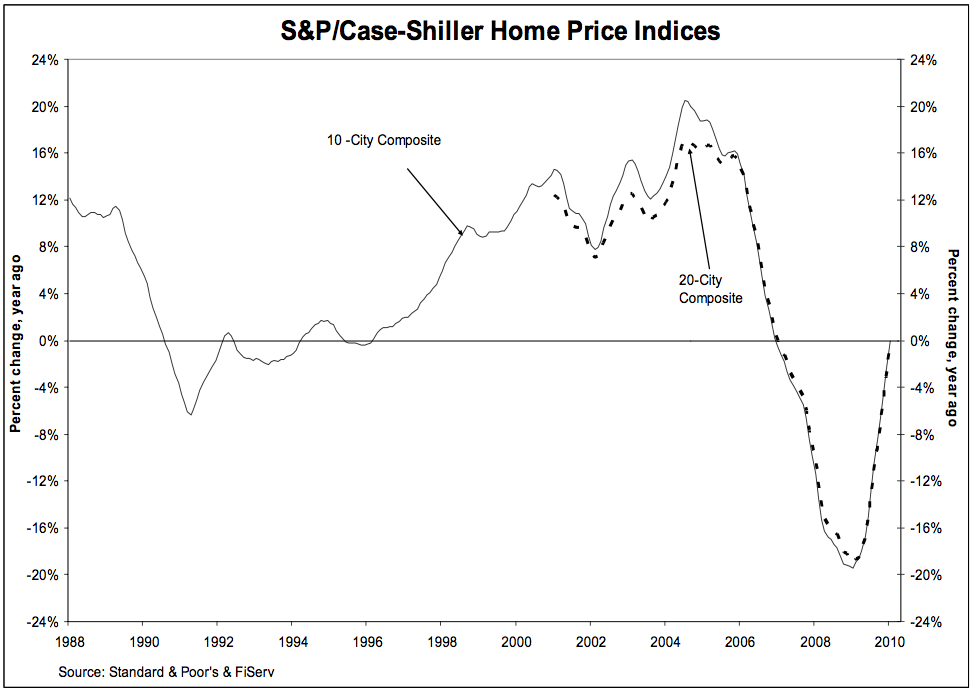
The Jan S&P/Case-Shiller 20 city home price index fell .7% y/o/y, right in line with expectations. 9 of the 20 cities saw y/o/y gains, led by San Francisco, San Diego and Dallas. The decline was again led by Las Vegas which had a 17.4% y/o/y fall. Miami fell by 6.7% and Phoenix was down by 4.6%, to name 2 other hard hit areas. On a non seasonally adjusted basis, prices fell .4% m/o/m but rose .3% seasonally adjusted. While still a very important indicator since homes are the biggest collateral backing trillions of $’s of debt, the real test for the housing industry and its pricing remains ahead in the next few months as the Fed completes its MBS purchases and the home buying tax credit expires. This headwind will be met by the seasonally strongest time of the year in terms of demand, the spring, where about half of all the year’s transactions take place.

Case Shiller Index Unchanged Year Over Year

Email this post Print this post
By Barry Ritholtz - March 30th, 2010, 9:11AM

Case Shiller data through January 2010 was down only 0.7% versus January 2009.

The report was mixed. There were improvements in the year-over-year data for all 20 cities, but the Fall 09 rebound in housing prices is fading. Fewer cities experienced month-to-month gains in January than in December 2009.

In four cities – Charlotte, NC, Las Vegas, Seattle and Tampa – prices reached new crisis lows. Tampa and Las Vegas experienced some of the largest gains and declines in this cycle, while Charlotte and Seattle had more modest price swings.

The peak-to-current declines for Charlotte, Las Vegas, Seattle and Tampa are -13.8%, -55.8%, -24.6% and -42.0%, respectively.

In a pique of understatement, Case Shiller/S&P noted that “Home sales suggest the market remains difficult.”


Source: S&P/Case Shiller

Read the rest of this entry »

10 Questions for Finance Reformers

Email this post Print this post
By Barry Ritholtz - March 30th, 2010, 8:26AM

The current series of proposals for reforming Wall Street and bankers are toothless facades of what real regulation should look like.

It seems that each new proposal for reforming Banking and Wall Street is more banker friendly – and ineffective – than the previous one. They are milquetoast, meaningless, appeasing nonsense. The reformers are in a race to see who can offer up legislation that is least offensive to bankers.

In order to legislate reform that will prevent the next meltdown from occurring, I suggest that anyone who introduces new reform legislation must answer the following questions about their proposals:

1. Ratings Agencies: The Nationally Recognized Statistical Rating Organization (“NRSRO”) such as Moody’s, S&P, and Fitch slapped triple AAA ratings on paper that was actually high yielding junk. The investment banks paid them for these ratings. The ratings agencies were the prime enablers of the credit collapse.

What does your proposal do about this business model? Does it maintain this unique privileged status? Does it introduce any competition to the ratings business?

2. Derivatives: The Commodity Futures Modernization Act of 2000 (CFMA) exempted derivatives such as CDOs and CDSs from all regulatory oversight, reserve requirements, capital minimums, exchange listings, transparent open interest reporting, and counter-party disclosures.

What does your proposal do to fix this?

3. Leverage: Prior to 2004, Investment Houses were limited to 12-to-1 leverage by the SEC’s net capitalization rule. In 2004, the Bear Stearns exemption was granted by the SEC, giving the five largest investment firms a waiver of this leverage limit. These five promptly  allowed their leverage to go up to 25, 30 even 40 to 1.

What does your proposal do about this excess leverage?

4. Insulating Main Street from Wall Street: Glass Steagall separated FDIC insured depository banks from the more risk embracing investment houses. Prior to the repeal of Glass Steagall in 1998, the market had regular crashes that did not spill over into the real economy: 1966, 1970, 1974, and most telling of all, 1987. These market crashes did not freeze credit for the real economy.

How does your proposal prevent the inevitable future market crashes from spilling over to the real economy – especially as applied to real credit availability?

5. NonBank Lenders: Most of the sub-prime mortgages were made by unregulated non-bank lenders. These firms abdicated all lending standards. They pushed the option arms, the interest only loans, and the negative amortization mortgages that defaulted in huge numbers.

How does your legislation deal with these (or similar firms) in the future?

6. Compensation: The banks and investment houses paid many of their senior employees huge bonuses. This encouraged employees to take tremendous risks to generate what we now know were phony profits.

What does your proposal do to address this? Does it allow for clawbacks of stock options, bonuses, and cash payouts for fake profits or future losses?

7. States Rights: Prior to the 2004, many States had Anti-Predatory Lending (APL) laws on their books. These states had lower default and foreclosure rates than the states that did not.

In 2004, the Office of the Comptroller of the Currency (OCC) preempted national banks from state laws regulating mortgage credit, including state anti-predatory lending laws. New subprime mortgages were sold in states that previously didn’t allow them. Subsequently, these states saw their foreclosure rates spike.

Does your legislation return to the States the right to oversee and regulate fraud and predatory lending?


8. Whistle blowers: The SEC had numerous whistleblowers identify funny accounting, malfeasance and even outright fraud. Yet they failed to thoroughly investigate most of these problems, including Bernie Madoff’s ponzi scheme.

What does your proposal do to put a strong police force back on Wall Street ? How does it encourage and reward whistle blowers?

9. Corporate Structure: None of the major Wall Street partnerships got into trouble, as they have full personal liability for their losses. Only the publicly traded Wall Street firms did. This strongly implies that personal liability of senior management prevents them from acting recklessly.

How does your proposal address the issue of personal liability for massive losses by senior management?

10. Fraud: Many families ended up obtaining mortgages they either did not understand or were materially misrepresented.

Does your proposal address consumer education or lender fraud?

If Congress can adequately answer these questions in reform legislation, they can prevent the next meltdown. Otherwise, we should expect the next collapse to be even more severe, and recovery more painful . . .

Greek debt not trading well the day after

Email this post Print this post
By Peter Boockvar - March 30th, 2010, 8:15AM

After pricing their 7 yr note yesterday at almost no premium to the market, Greek debt is not trading well the day after even in the new IMF/EU world they live in as yields are higher across the Greek curve on continued worries about their long term fiscal situation. 10 yr yields are rising to match the highest level in a month at 6.45% and 7 yr yields are up by 19 bps to 6.24%. The Greek hope with the IMF/EU was not just to provide a worst case backstop but to also help immediately lower borrowing costs. Greek stocks are down 1.5% even as the rest of European stocks are higher. Japanese stocks closed at the highest since Oct ’08 and the rest of Asia was up after a South Korean manufacturing index rose to at least the highest since ’03 when it was 1st introduced. On the China/US Congress battle on revaluing the Yuan, a Chinese official said “trade flow is determined by supply and demand instead of the exchange rate.”

Open Thread: Signs of a Top ?

Email this post Print this post
By Barry Ritholtz - March 29th, 2010, 9:37PM

I am starting to see some early signs of technical deterioration — not anything that would make me want to declare the high is in — yet — but early signs of weakness.

These include:

• MACD Crossover

• Average Percentage Change

• Breadth

• Valuation

What are you looking at technically that might assist in timing an exit before (or shortly after) any sort of topping formation?

~~~

Its a technical open thread:

What say ye?

Monday Reads

Email this post Print this post
By Barry Ritholtz - March 29th, 2010, 4:00PM

I’m outta here early for the holiday, but not before I left you with some worthwhile reading materials:

The Official Announcement: US to Sell 7.7 Billion shares of Citigroup Common Stock (Treasury)

Euro Trashed: The euro zone is broken. Germany should leave and form its own monetary union. (NYT)

• Intercontinental Exchange (ICE) hires its first lobbyist (Bloomberg)

• Eddie Lampert the Next Buffet? Hardly (Business Week)

• John Bogle: Old-fashioned investing advice still applies (LA Times)

• The Mother of All Jobless Recoveries (The Atlantic)

• Reform in Congress Lacking Cash Clause to Stop Lehman-Like Runs (Bloomberg)

Dan Gross asks this about politics: Is 2010 Going To Be 1994 or 1934? (Slate)

• China’s official instructions on reporting on Google (Washington Post)

• The Periodic Table of Periodic Tables (flickr)

•  Trashing Michael Lewis new book, The Big Short, for what it gets wrong (naked capitalism)

What’s on your browser?

No inflation? Look at what a comic book just sold for

Email this post Print this post
By Peter Boockvar - March 29th, 2010, 2:57PM

While the Fed has focused on the output gap and CPI/PCE in giving them comfort with the inflation outlook, I’ve been arguing that their easy money policy has again resulted in asset inflation that will at some point manifest itself in consumer prices. We’ve seen asset inflation with an incredible run in equity prices over the past year and dramatic tightening in corporate credit spreads. Like a sequel to a movie, the demand for yield in an artificially low interest rate world creates this action and distorted allocation of capital. We’ve also seen demand for hard assets too, as evidenced by the price of industrial metals, precious metals and energy. Today, add another to the hard asset grab, comic books. This morning was the sale of an 8.5 (out of 10) graded #1 Action Comics, the 1st Superman issue, at $1.5mm, breaking all sale price records. It passed the Feb record of $1.075mm for Batman #1 and an 8.0 graded #1 Superman also in Feb of $1mm

42 queries. 0.989 seconds.