S&P500 Consumer Discretionary Sector
For all of the people expecting a double dip — this chart seems to suggest otherwise. Consumer spending has been more impressive than expected. Perhaps the easy year over year comparables is part of the reason why.
>
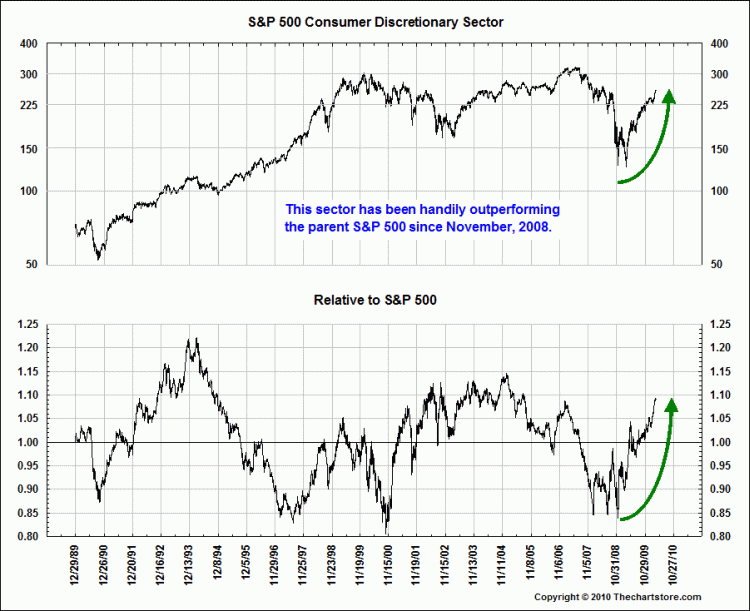
courtesy of the Chart Store


Tweet
Facebook
Reddit
Digg this!


March 25th, 2010 at 12:49 pm
Perhaps all of those 1 million BAC, 437k JPM, 379k WFC, and 249k Citi deliquent mortgage holders (among many others), are spending the extra money they aren’t paying on their mortgages…?
March 25th, 2010 at 12:51 pm
EUC a factor?
March 25th, 2010 at 1:07 pm
It only suggests otherwise if you think the market bears some relation to reality.
March 25th, 2010 at 1:15 pm
Barry,
Do you see this as sustainable? Do you attribute this to some return of the “wealth effect” after housing’s freefall has been propped up and some paper losses in the market have been recouped? Do you see it dropping again if they finally allow unemployment payments to run out?
March 25th, 2010 at 1:20 pm
Consumer spending is up because many people don’t have to or aren’t paying their mortgage (rent free living). With no large house payment and free living for a few years, those people can spend at will.
=^.^=
March 25th, 2010 at 1:34 pm
Hopium
March 25th, 2010 at 1:50 pm
Good to know everybody has reduced their debt to the point that they once again have discretionary income.
March 25th, 2010 at 1:52 pm
Well, we knew that the reflation trade would win in the end and here we are. Refis, squatters (those not making their mortgage payments) home buyer tax credits, extended unemployment benefits, medical insurances covered. Consumers, particularily those in financial trouble, have a lot more discretionary income because we got their back (bills) so another buying free for all ensues.
March 25th, 2010 at 2:00 pm
Or perhaps it is people just choosing not to pay their mortgages!
March 25th, 2010 at 2:39 pm
Reviewing the Econ section of CFA: savings are deferred consumpion, the expected future price is less than the current price plus the rate of return on investment.
If ten year ROR on stocks is 0% and current ROR on money market and CD’s is practically 0% and expectations of future prices are high (because deficit spending adds to fear of inflation) then economics tells us to consume today.
Let me put that in English for you: My money fund isn’t paying sh&T and I am afraid of stocks, F&*k it just spend the money.
Sounds perfectly logical that consumer cyclicals go up.
March 25th, 2010 at 3:28 pm
BR,
since many suggest that discretionary spending is due to non-payment of mortgages, has anybody run into a calculation of how much extra money is left in consumers’ hands as a result of mortgage delinquencies? That number would also suggest how much in losses is papered over on the other side.
March 25th, 2010 at 4:30 pm
I’m wondering the same thing as many of the people above. What’s the source of this increased spending?
If it’s either the decision not to pay mortgages (i.e. – living rent-free) or people dipping into the last of their credit limits before they hit the ceiling (i.e. – lack-of-spending fatigue), then we’re just pushing our problems down the road, no?
Of course, I guess that wouldn’t necessarily be new to us.
March 25th, 2010 at 4:51 pm
a report came out at 1.59 record delinquencies in prime mortgages, hmmmmmmm, makes u wonder why bac is so, i’ll be willin to renog
yeah, ben knows what he is doing, don’t let that oil get too 85
March 25th, 2010 at 5:32 pm
http://www.nakedcapitalism.com/2010/02/is-the-us-reaching-a-strategic-default-tipping-point.html
http://globaleconomicanalysis.blogspot.com/2010/02/disturbing-trends-in-fico-scoring.html
and many others including BR, and Rosie from his March 18,2010 newsletter,
“Meanwhile, a wave of new supply is coming from strategic defaults, which now account for 35% of all defaults according to research published by the University of Chicago.”
I didn’t see a link to the UofC research.
March 25th, 2010 at 5:56 pm
Barry–
In 2009 consumers spending as a percentage of earned income reached its highest level ever–almost 96%. That was managed given transfer payments and income tax reductions that summed to roughly $560 billion (those numbers are not included in earned income. Income tax refunds ytd are running ahead of last year–$178 billion vs $169 billion at this point a year ago. Their cessation might see a slowing down in consumer spending as well, and I’m not certain the political climate is as conducive as it was a year ago to the same level of transfer payments. It certainly also seems possible that the stocks themselves may be a running ahead of their businesses prospects. YOY earnings comparisons comprise a pretty low bar at the moment. The information in the BEA release at the link does not paint a rosy picture as to income growth. It’s well worth a look.
http://www.bea.gov/newsreleases/regional/spi/sqpi_newsrelease.htm
March 25th, 2010 at 7:10 pm
HMM… Looking at the lower chart (Cons. Desc. sector relative to the SP500) indicates that the top in the market is due some time late this summer. IMHO
March 25th, 2010 at 7:20 pm
There are big problems with the idea that the US consumer has been strong. First, the “retail sales” metric is highly flawed. It’s a sample survey that doesn’t take into account small retailers, plus sales for companies that don’t respond to the survey are estimated even though they may have gone out of business (and this doesn’t get corrected until months later via revisions). Second, there is too much focus on same store sales. Many companies are seeing higher same store sales because they’ve closed a lot of stores. Many companies also are seeing better same store sales because so many mom and pop shops have gone under. Many companies also take one time write-downs for closing their stores than see better EPS going forward as the write downs aren’t taken into account. Third, sales tax revenues continue to show significant weakness which directly contradicts the “retail sales numbers”. Many states continue to see sales tax revenues down 10-20% from the same period in the year before.
March 25th, 2010 at 7:59 pm
this wild thought, how many late payers are they not reporting
have folks who are upside down read enough on the internet, had enough with banker bonuses, and just have said, hey, might as well everyone is doing it, what is the worst that will happen
by all accounts nothing, nothing, nothing except eventually you move after pocketing 12-36k i guess tax free
it would be kind of funny if this is what ben created, he saves the banks over homes, and home owners just stop paying en mass, retail looks good good good, and bankers still hide hide hide
interesting times
March 25th, 2010 at 8:45 pm
CNBC’s “Fast Money” tonight was certainly “Hyping the Hype.”
I guess the “Charts don’t lie…the Tapes don’t lie” and folks can stay “Bullish” long after anyone would think there should be a crash.
I guess the Market Wisdom really is rallying around: “This Time it’s NOT DIFFERENT” so just “GET OVER IT!”
Makes me roll my eyes wondering how bad it could ever get before “THIS TIME…it REALLY IS DIFFERENT!
CRIMINALITY!
March 25th, 2010 at 9:24 pm
Young, and not so young, people are moving back with their parents (the only folks with any money these days). With no rent to pay they are free to buy the big TVs, iPods, etc.
March 26th, 2010 at 10:43 am
This chart shows sector stock performance not consumer spending data. The data should be the focus. Homebuilders couldn’t get any worse and their stocks are up 27% this year. Similar vein
March 26th, 2010 at 12:00 pm
The data from the Chicago Fed’s National Activity Index point to consistently weak personal consumption and housing. In February, it read -0.45, about twice as weak as levels in the first half of 2008. It’s bounced around a bit since then, but has basically remained stubbornly negative. (H/T David Rosenberg). IMHO if 10-year T-note backs up much more, the S&P consumer sector will be toast.
CFNAI data link:
http://www.chicagofed.org/webpages/research/data/cfnai/current_data.cfm
March 26th, 2010 at 5:02 pm
How much of this increased spending is actually simply the price increases of food, health care, and energy and how much is discretionary? Until we have that answer, I am not going to assume the latter and that this as a positive for the economy. With unemployment and under-employment barely changing, municipal sales tax revenues still declining (which belies in creased spending doesn’t it?), and personal income actually dropping in large states like California, I am leaning toward price increases in staples as opposed to “good-times are here again” discretionary spending.
April 7th, 2010 at 11:34 am
[...] we have previously exhorted, the consumer is “not quite dead, yet.” Indeed, the data suggests that [...]