
Anatomy of a Crash: 2009 vs 1907

Email this post Print this post
By Barry Ritholtz - April 5th, 2010, 11:30AM

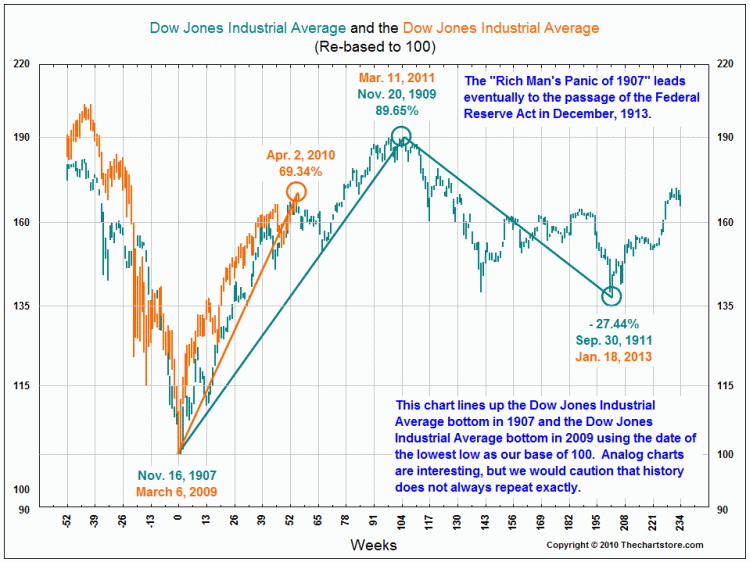
Fascinating chart from Ron Griess of the Chart Store comparing the Panic of 1907 with the more recent Credit Crisis that made a low in March 2009.

There is something about the parallel action of two panics a century apart that speaks to the immutable part of human psychology and behavior.

>
Comments

Please use the comments to demonstrate your own ignorance, unfamiliarity with empirical data, ability to repeat discredited memes, and lack of respect for scientific knowledge. Also, be sure to create straw men and argue against things I have neither said nor even implied. Any irrelevancies you can mention will also be appreciated. Lastly, kindly forgo all civility in your discourse . . . you are, after all, anonymous.

17 Responses to “Anatomy of a Crash: 2009 vs 1907”

  1. cognos Says:

    Voodoo.

    Its basically – “look Jesus’ face is on my grilled cheese”.

    And if you invest with it… it is like BUYING that grilled cheese on Ebay for 1000s of $.

    Now who’s jumping into the volcano?

  2. ashpelham2 Says:

    It is a strikingly similar chart. Means very little, and since it was 100 years ago, and this country was half as old as it is now, it’s just comparing apples to crabapples. The names are similar, but totally different fruit.

    I still say the political and business environment is too similar to ignore, to the time between 1930-1932.

  3. Fredex Says:

    The panic of 1907 followed the San Francisco earthquake of 1906. Insurance companies sold massively to to raise cash to pay claims. Nothing at all like today’s events.

  4. The Curmudgeon Says:

    “I still say the political and business environment is too similar to ignore, to the time between 1930-1932.”

    You’re being too optimistic. The difference between now and 1930 is the American Empire was ascending, having yet to extend its reach farther than it could grasp. In 2010, the Empire is undeniably on the top. But there’s only one way from here. The question is not if, but when, the Empire’s inevitable slide into world irrelevancy earnestly begins. 2009 was just a preview of what a tumble might look like. The best we can hope is that we enjoy some sort of stasis for awhile.

  5. Mike in Nola Says:

    Yeah, whether it’s a real parallel depends on whether the problem is something that could be patched up by J.P. Morgan (the real person, not his hedge fund namesake) or a structural problem.

    Cognos: An expression of gratitude from The One:
    http://www.fakesteve.net/2010/04/an-open-letter-to-the-people-of-the-world.html

  6. JSchmid Says:

    The most important thing to take from this comparison is that we are far from out of the woods yet. There are several financial issues that can spook the market at any point causing another massive sell off, primarily national debt and interest rates.

  7. DL Says:

    In 1907 they managed to survive without a TARP.

  8. Comparaison du Dow Jones actuel d’avec celui de la crise de 1907 | Weinstein Forcast Invest Says:

    [...] que nous connaissons aujourd’hui ? http://forcast.canalblog.com/archives/2008/11/14/11367184.html http://www.ritholtz.com/blog/2010/04/anatomy-of-a-crash-2009-vs-1907/#comments Partager [...]

  9. DL Says:

    ashpelham2,

    Political environment, quite possibly.

    But the monetary and fiscal environment, not so much.

  10. SINGER Says:

    I like this… People don’t change…

  11. nickgogerty Says:

    A signficant amount of the crisis of 1907 was a liquidity crunch caused by the failure of the knickerbocker trust located at 34th &5th ave in NYC. http://en.wikipedia.org/wiki/Knickerbocker_Trust_Company

    Trusts at the time were often involved in the then legal purchase of stock based on what would be considered illegal information and games of mis-information. The trust was a scam a la madoff with a beautiful architectual front located next to the then waldor astoria hotel. Everyone one wanted to be located conveniently next to the train station for prestige ( in this case Pennsylvania station).

    The propreiter of the trust wanted to be bailed out by JP morgan himself. Morgan declined, so the fellow shot himself. Ouch.

    The resulting liquidity crisis was resolved when Morgan locked the high and mighty in his library overnight and told them to settle it. Imagine Warren Buffet physically locking the top bankers in a room without their toadies or black berries and not letting them out until they resolved things.

    The liquidity crisis was solved and everyone was glad it was nothing like the panic of 1893 or even worse 1873, which were real issues. 1907 and the scope of the crisis were minor relative to the growing economy. There was a fear of a gold drain to resolve the earthquake in 1907 San Francisco.

    For the history buffs. Bank of America was effectively born in the San Fran Earthquake when its then (italian founder), pulled a wooden table out of the ruins of his bank and offered loans in the open air to the immigrant community with limited to no documentation. Please appreciate the irony of “no/low doc loans in a point of crisis” providing the foundation for a bank that is effectively now come full circle due to no doc loans.

    A fellow can get a civilized drink (morgan martini) at the JP morgan library. Free entrance on Friday after 7PM, with live classical music. It is one of the few remaining cultural events in NYC that remains cultured rather than cluttered or cultivated. 225 Madison Avenue. http://www.themorgan.org/home.asp

    I am a hedge fund analyst who beat the indeces by 5,000 bps in 07-09 with a deep tech/finance background looking for a new role. Interested in someone with deep perspective who was also head of Europe’s equivelant to the MIT media lab and testified before the US senate about Systemic counterparty risk? Lets talk.

    Nick Gogerty http://www.gogerty.com

  12. mitchn Says:

    To Cognos, et al –

    The aptness of the analogy is that then (1907) as now the financial system had morphed beyond the capacity of regulators or the average (or even sophisticated) investor to understand what was going on. Then as now, the foxes had secured control of the henhouse.

  13. royrogers Says:

    striking similarity, until it will diverge. History never repeates itself, graphically speaking,
    although in terms of human nature, it always repeats.

  14. cheese Says:

    Am I the only one having a “trader” moment?

  15. Clem Stone Says:

    I wonder if they were whining about the PPT back in 1907?

  16. ben22 Says:

    neat chart, however, I don’t find much use in it, would prefer to see a fractal example rather than trying to map the look at the same degree.

  17. Jack Says:

    Are you saying that markets are behavioral and not rational? Do you mean emotion and thinking compete to win the battle of being rich?

    Or maybe you’re just jerking my chain?

76 queries. 0.967 seconds.
