Are Earnings Expectations Too High?
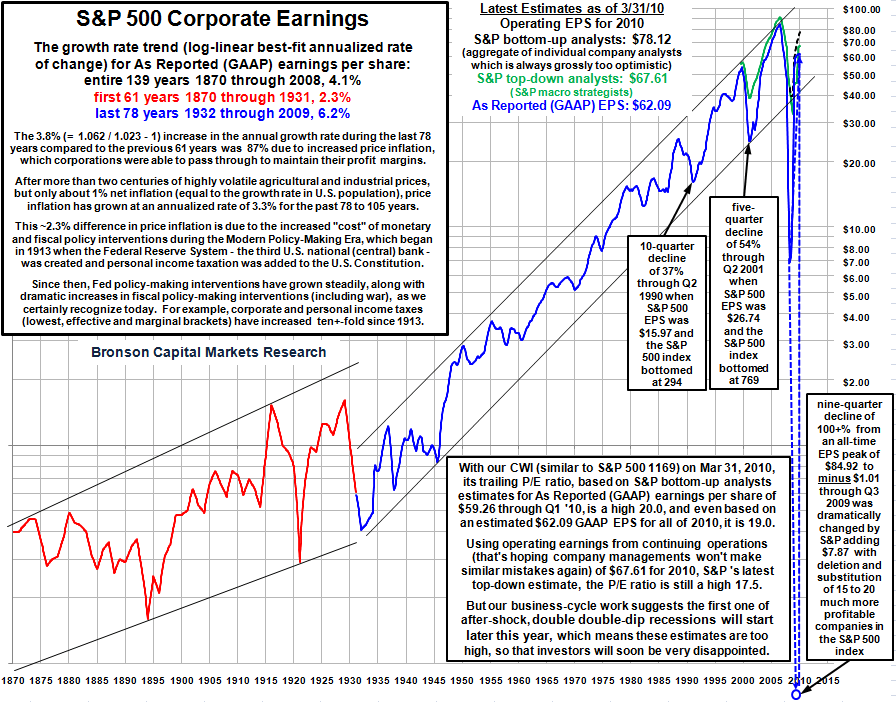
We’ve run many charts over the years from Bob Bronson. Back in late 2008, Bob was forecasting a S&P500 Q4 earnings collapse.
Let’s balance this morning’s guarded bullish comments with commentary a touch less optimistic.
As the chart below shows, he might have been too optimistic!
Here is what Doug of D-Short had to say about this particular graph:
“The bullishly-biased financial media continue to tout supposedly “strong corporate earnings” to justify investors buying stocks at ever more expensive prices. Investors are not reminded, however, that the key factor driving both the magnitude and timing of this rebound is that it is coming off last year’s extraordinarily low EPS base — in fact, the lowest base in over 140 years of U.S. corporate history!
The two recent quarters of the rebound in EPS came only after nine quarters of decline that amounted to the biggest drop in EPS since The Great Depression, as measured by the companies of the Standard & Poor’s 500 index and its previous and subsequent indexes that we use in our database, described here: Revealing BAAC Supercycles.
Moreover, the plunge in EPS would have been the worst ever recorded (see the steep, nearly vertical drop in blue dotted line in the chart below) if Standard & Poor’s had not removed 15 to 20 companies reporting huge losses (primarily financial-sector companies) from the index and replaced them with much more profitable companies. “
In other words, though earnings are improving, they are coming off such low levels as to require the rampaging bulls take it down a notch or three.



Tweet
Facebook
Reddit
Digg this!


April 26th, 2010 at 11:41 am
Since the accounting standards are essentially useless today, how can anyone assess what is an appropriate EPS multiple? It’s because of this problem that I elect to trade ETFs on a technical basis only.
April 26th, 2010 at 11:55 am
The rapid earnings growth might be attributed to international trade which has been expanding since the 50s and is accelerating today. On many earnings reports, both the rate and the share of corporate earnings from international operations are substantially higher than domestic operations. Companies such as Intel, Microsoft, Yum, Boeing, CAT, Citicorp, Walmart, Coke, GM, etc. etc. show much higher rates of sales and earnings growth overseas. This is true even for a number of mid-cap and small-cap companies.
Thus, for many companies, the higher rate of profit growth may continue until international trade growth slows to the level of domestic growth. If so, current equity valuations may be more fundamentally driven than many think, that is unless one thinks we are an unsustainable global bubble.
April 26th, 2010 at 12:30 pm
@bsneath
With the dollar declining those international earnings have to be adding quite a kick to the pie no? I know up here in Canada we have seen the loonie go from about 80 cents to the dollar all the way up to parity. That is a significant move over the last couple years
check out the monthly chart over the last decade. When foreign purchasing power is getting this strong you should be sustaining earnings
http://futures.tradingcharts.com/chart/US/M
April 26th, 2010 at 1:02 pm
maybe its just wall street trying to sell stocks..again?
April 26th, 2010 at 1:46 pm
I believe that the growth in earnings has to be further scrutinized. Exactly how are the increased earnings being attained?
Of particular concern is a continuing lack of revenue growth across a broad spectrum of companies.
This is troubling, as comps are easy and the purported economic recovery is now about 9 months old.
Here is a my latest post further discussing this issue, for those interested:
http://economicgreenfield.blogspot.com/2010/04/nfib-small-business-optimism-few.html
April 26th, 2010 at 1:47 pm
“…Profit estimates for Standard & Poor’s 500 Index companies from Apple Inc. to Intel Corp. and CSX Corp. climbed 9.1 percent on average in April through the end of last week…”
“…The benchmark gauge for American equities is trading at 14.2 times forecasts for its companies’ earnings, lower than any time since 1990, except for the months after Lehman Brothers Holdings Inc. collapsed…”
“…Income is beating analysts’ estimates by 22 percent in the first quarter…”
http://www.businessweek.com/news/2010-04-26/u-s-stocks-cheapest-since-1990-on-analyst-estimates-update1-.html
April 26th, 2010 at 2:20 pm
Did anyone notice the portion of the graph where the earnings went to 0 in year 2009 if it was not for S&P 500 swapping out 15-20 bad companies and swapping 15-20 good companies as a replacement?
Stock market indices are a big fraudulent racket. Whenever things are not going well, the makers of the index move the goalposts to make the index look better. They do NOT account for the changes.
April 26th, 2010 at 2:33 pm
Since the Foxes on Wall-Street and in Washington are a culpable should any of this seem strange?
April 26th, 2010 at 4:04 pm
Common Man, the good news is now you can pick up a Florida vacation condo for a song!
Florida condo market gets relief
…the buyers were mostly from the Northeast and from Canada, and they weren’t investors. “These are second homes,” she said. “Ninety-nine percent of these buyers were cash buyers
http://charlotte.floridaweekly.com/news/2010-04-08/Real_Estate_News/Florida_condo_market_gets_relief.html
April 26th, 2010 at 7:34 pm
Ted…
There a whole bunch of “troubling” things in this earnings growth. I have 6 main categories of things that trouble me. Thing is… one year ago I had 12… and all of them keep getting better.
See you at 1,300…. 1,400. This is what a recovery looks likes, classic case.
April 26th, 2010 at 10:32 pm
“Investors are not reminded, however, that the key factor driving both the magnitude and timing of this rebound is that it is coming off last year’s extraordinarily low EPS base — in fact, the lowest base in over 140 years of U.S. corporate history!”
Reminded? Aren’t they paying attention? It was just last year! People with that “length” of an attention span need to be duped.
April 27th, 2010 at 5:16 pm
This is some very, very sloppy analysis.
Back in 1956, the S&P “500″ was actually the S&P 93. That is, there were only 93 stocks in the index. That changed in 1957. So the composition of the S&P 500 has been changing all through its history. Bronson hasn’t shown us any comparisons between the most recent “substitution of 15 to 20 much more profitable companies” and other historical substitutions.
Note his imprecision with respect to exactly how many companies have actually been substituted: is it 15 or is it 20? Juxtapose that imprecision with his “precise” claims concerning EPS. How can precise claims concerning index EPS be based on an imprecise change to the index composition?
Futhermore, he says one of the things affecting the chart is a ten-fold increase in personal and corporate taxes since the introduction of income tax in 1913. However, he qualifies that statement, by saying it was the lowest, effective marginal rate that has increased. But most shares are owned by players who’ve seen their top marginal tax rate drop from a high of 90% before the “Reagan Revolution” to below 40% today. Additionally, their capital gains taxes also have been dropping (now down to 15% for long term capital gains and 28% for short term).
I’m not a permabull. I do agree that the market is way too optimistic and this rally is based on mob psychology, not on fundamentals. But this chart is a poor argument for that position.
Barry, I’ve always been impressed with your critical analysis. But I think you’ve dropped the ball on this chart.
April 27th, 2010 at 5:29 pm
I don’t always agree with Bob Bronson, but I find his analysis very intriguing — that is why I posted it here.
You may be missing the forest for the trees — his point here is not to show a precise history of SPX earnings, but rather, to show how the collapse of earnings and subsequent snapback have both been extremely aberrational.
April 28th, 2010 at 2:19 am
Thanks for responding, I appreciate it.
I agree that the snapback could be an artifact which is caused by changing the way the data is gathered. But Bronson’s characterization of that snapback is based on his claim that if the composition of the index had not been changed, then it would have resulted in -$1.01 earnings . He’s very precise about that number, but he’s extremely imprecise about how many companies were replaced to get that precise number. That inconsistency is a red flag for me, especially within the context of the rest of the problems I see in his analysis. So it makes me wonder if we can trust his “old S&P 500″ earning estimate.
April 30th, 2010 at 9:40 pm
[...] The stock market is cheap on forecast earnings. (Bloomberg contra The Money Game, Big Picture) [...]