Declining Bailout Costs or Bad Math ?
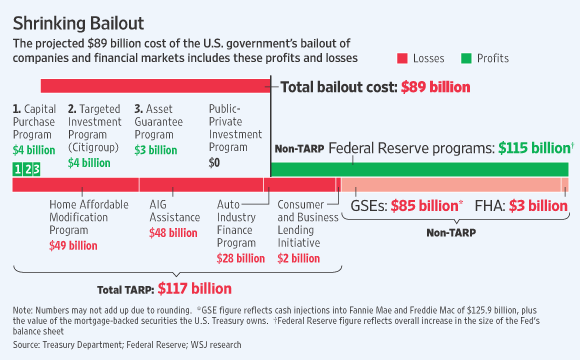
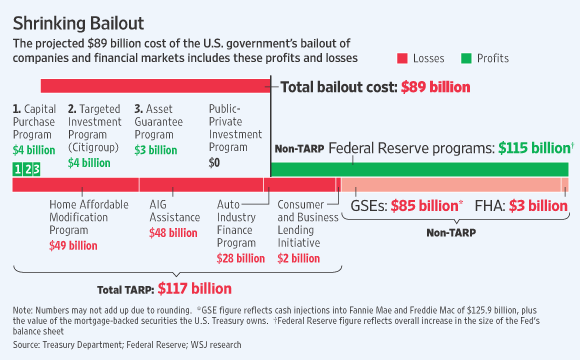
There is a bizarre article in this morning’s WSJ. It declares that the bailouts will cost less than initially feared. It is notable not for what it includes, but what it managed to completely ignore.
The 2008 Emergency Economic Stabilization Fund passed by Congress was over $700 billion dollars — not $250B.
There is no mention of the trillions of dollars on the Federal Reserve’s balance sheet. The ongoing costs of the Federal rescue of Fannie and Freddie — indeed, the complete takeover of $5 trillion in mortgages by Uncle Sam — is glossed over. The journal also seems to have forgotten about the cost of bailing out Chrysler and GM (they mention GM possibly going public, but just barely).
Foreclosure trends are increasing; second liens are defaulting in greater numbers. Banks now have over $30 billion in bad home equity loans. Somehow, these are not mentioned in determining the health of rescued banks.
Depleted FDIC reserves? Not mentioned. Bad loans on bank balance sheets? Ignored. FASB 157 authorizing fantasy bank accounting? Never mind.
The newly concentrated banking sector’s lack of competition is apparently too abstract for discussion. Nor does this final calculation so much as consider any future problems caused by moral hazard (its not so much as mentioned). Future inflation? US Dollar debasement? What TF are they?
Here’s the WSJ:
“The U.S. government’s rescue of wobbly companies and financial markets is starting to look far less expensive or long-lasting than once feared.
As momentum grows at companies that looked like zombies just a few months ago to repay taxpayers for lifelines they got during the financial crisis, the projected cost of the bailout is shrinking to just a fraction of previous estimates. Treasury Department officials say the tab is likely to reach $89 billion, which includes the Troubled Asset Relief Program, capital injections into Fannie Mae and Freddie Mac, loan guarantees by the Federal Housing Administration and Federal Reserve moves such as buying mortgage-backed securities and propping up the commercial-paper market.”
You can read the article, but you might notice it has a hole or two . . .
>
Total Bailout Costs = $89B! WTF?
>
Source:
Light At the End of the Bailout Tunnel
DEBORAH SOLOMON
WSJ, April 12, 2010
http://online.wsj.com/article/SB10001424052702304846504575177950029886696.html
Profit for Banks Dimmed by Home-Equity Loss Seen at $30 Billion
Dakin Campbell and David Henry
Bloomberg, April 12, 2010
http://www.bloomberg.com/apps/news?pid=20601087&sid=ayhRMX.B.hJE&



Tweet
Facebook
Reddit
Digg this!


April 12th, 2010 at 8:54 am
BR -
Your post here is skewed. It seems they mention many of the costs you say they neglect — “GSEs $85B”, “Auto industry $28B”.
It seem like you are making up costs — “depleted FDIC reserves” — so what? These are paid, and will be repaid, by increased PRIVATE industry fees. No taxpayer here. Dont pretend there is. People love a witch hunt.
Another cost you made up — “costs of $T Fed balance sheet” — first, the Fed continues to send an elevated $100-150B/yr to the Treasury. Bernanke has clearly stated that not only does that look likely to continue but that “no SINGLE Fed asset program” looks like it will lose $1. In a way, you are double counting because the largest Fed purchases are simply Fannie/Freddie mortgage pools. Since the risk to loss on these is guaranteed by Fannie/Freddie we might as well make the interest carry for the taxpayer. This is what the Fed is doing.
Finally… the holes I notice are a likely under-counting of TARP profits. Should’nt the bank-related TARP have about $50B in profits? By my estimates they made 5% interest on nearly ALL monies lent, then they made another 5-10% profit on warrants, AND now they are up over $10B on Citi equity alone.
Where is that $50B?
Why is AIG estimated to cost $50B… looks like this will also end up profitable?
Its likely that we see a greater than $100B move to the positive from here. But its good to keep estimates conservative (as they have been in the past… this number has consistent move into the green the last 18 months).
April 12th, 2010 at 8:55 am
remember “deficits don’t matter” .. kinda true – to the point someone is willing to go to war over them … at that point – short and long positions change spinning gold for some and movement in the pipes for all
cash is scratchy green TP at its face invented to keep commerce moving for the fun of it all … so when are the longs and shorts going to war for their funday in the sun .. inalienable rights and justice stuff
April 12th, 2010 at 9:08 am
I guess I’m getting psychic powers. When I read the post, I thought to myself that cognos was going to be very pissed at Barry for falling of the Pollyanna wagon. When I went to post same, I saw that it had already come true.
April 12th, 2010 at 9:19 am
there is no denying that this article (and many others) are nothing but propaganda tools to slant the reader to a particular viewpoint. checking your facts and ensuring completeness is something relegated to the pile of history given our quasi-corporatist government complex. at least an attempt at discussing the giant gaping hole of the crap moved to the Fed’s balance sheet and the backstop of Fannie/Freddie would at least show some attempt at intellectual honesty. but that isn’t the goal after all.
April 12th, 2010 at 9:31 am
The oft-criticized Ron Paul has a good take on what’s going on in DC.
http://www.creditwritedowns.com/2010/04/ron-paul-has-barack-obamas-number.html
April 12th, 2010 at 9:44 am
BR lets not forget that there is 1.25 Trillion in unhedged exposure in the Fed’s SOMA fund. For each 1% rise in rates that’s a loss of an extra 100 Billion more than already assumed by buying them @100%.
Courtesy of Zerohedge.
http://www.zerohedge.com/article/why-fed-actively-managing-25-billion-maiden-lane-mbs-portfolio-when-its-24-trillion-soma-hol
April 12th, 2010 at 9:56 am
Callistenes —
This is 100% incorrect. First the math is bad by about 2x (you lose about $60B from duration). Second you HAVE to consider CARRY.
1.25T at 5% carry is about $60B per year in Fed interest carry. Interest rates would have to increase about 2% in order to just break-even on carry + roll down.
Only read ZH if you want to lose large amounts of money.
April 12th, 2010 at 10:38 am
They also didn’t mention lost interest income for the general public by rates being kept artificially low.
April 12th, 2010 at 11:16 am
In a Galaxy Far Far Away: “These are not the droids you are looking for. Move along!”
In a Galaxy Oh So Near: “These are not the bailouts that are the bailouts that we’re counting as bailouts. Move along!”
In both Galaxies The Force (Propaganda) can have a strong effect on the weak minded.
April 12th, 2010 at 11:57 am
I think most of the bailout cost is hidden in accounting rule changes and tax breaks. The government is getting much less revenue as a result. That won’t be accounted for anywhere.
April 12th, 2010 at 12:35 pm
Shadowy figures pulling their favorite media strings to make everybody forget and feel all warm and fuzzy so that they will once again be ripe for the “next” CON. Simply put, what America has somehow come to call CAPITALISM.
April 12th, 2010 at 12:51 pm
[...] Bailout pressures begin to ease. (WSJ contra Big Picture) [...]
April 12th, 2010 at 3:29 pm
Did We Make a Profit on Citigroup?
The Washington Post (aka Fox on 15th Street) once again proclaimed TARP a success. The cause for the latest revelry is the fact that the government appears to be in a position to make an $8 billion gain on the stock it holds in Citigroup. Before we join the Post in breaking out the champagne, it’s worth taking a bit closer look at our investments in Citigroup.
Our ownership of Citigroup stock has it origins in the dark days of late November of 2008. At the time, Citi’s stock price was rapidly descending toward zero and private investors would not go near the collapsing behemoth. The Treasury and Fed boys spent the weekend before Thanksgiving working out a rescue package.
They came up with a package that had the Treasury buying $20 billion in preferred Citigroup stock and guaranteeing the value of $300 billion in troubled assets. In exchange for this guarantee, the government got another $7 billion in preferred Citigroup stock. The total value of this deal — $27 billion – exceeded the full market value of Citi’s stock on the last trading day prior to the rescue. In other words, the government could have owned Citigroup outright for the money that it handed the bank that weekend.
Four months later, the government traded its preferred shares for common stock that gave it a 27 percent stake in Citi. While we had put up enough money in November to buy Citi outright, when Treasury did the conversion to common stock, taxpayers only got a 27 percent stake.
Citi’s shares had risen in the interim. The highly paid executives at Citi no doubt attribute the rise in stock prices to their expertise and shrewd business dealings. The rest of us attribute Citi’s recovery to the immense amount of aid and coddling that these highly paid executives got from the Fed and Treasury. If we try to put some dollar figures on our other handouts to Citi, it is clear that taxpayers have not come close to making a profit on this deal.
First on the list of taxpayer handouts to Citi would be the “too big to fail” (TBTF) subsidy. This subsidy is the result of the fact that investors know that the government will not allow Citi to fail because it would create too much disruption in the economy. In effect, taxpayers are implicitly guaranteeing Citi’s loans. This allows Citi to borrow at much lower cost than if it had to compete in the market like other businesses. In a paper I co-authored with Travis McArthur last year, we calculated that Citi’s TBTF subsidy could be as much as $4.4 billion a year.
If the markets expect this subsidy to persist (a safe bet given the current status of financial reform legislation), then the value of this subsidy would account for most of the current market value of Citi’s stock. In effect, the government’s profit is entirely due to the value of the government’s guarantee. In Washington Post land, the government could make money by buying shares of a company’s stock, offering to guarantee the company’s debt, and then selling our shares at a gain when the market recognizes the value of the government’s guarantee. Of course this strategy provides much larger gains to the other shareholders and allows the top executives to score billions in bonuses for being such shrewd managers, but in Washington Post land they don’t pay attention to such things.
Of course this is just the beginning of the list of handouts to this sick financial giant. The rescue in November of 2008 was actually Round II. The first round took place the prior month when Treasury handed Citi $25 billion in TARP money. While we did collect interest payments on this money, in addition to stock warrants, taxpayers got far less than the market rate. The Congressional Oversight Panel for TARP commissioned an independent study to compare the value of the assets that Citi gave us with our $25 billion investment. In their assessment, we overpaid Citi by $9.5 billion.
April 12th, 2010 at 3:40 pm
Good post and subsequent comments…
April 12th, 2010 at 4:18 pm
[...] – Declaring bailout costs may look less expensive than initially feared may be a bit premature, FusionIQ CEO Barry Ritholtz says. [...]
April 12th, 2010 at 7:55 pm
I don’t know what is more disappointing:
a) the crumbling of accounting as a profession and the concepts of objectivity and fair statement, or
b) the crumbling of journalism as a profession and the concepts of objectivity and fair statement.
Votes anyone?
April 13th, 2010 at 9:16 am
[...] is still incomplete, but a significant improvement. Recall yesterday we criticized the WSJ’s wide approach (Light At the End of the Bailout Tunnel) as so much happy [...]