Double Triple Bubbles

Email this post Print this post
By Barry Ritholtz - April 30th, 2010, 12:00PM

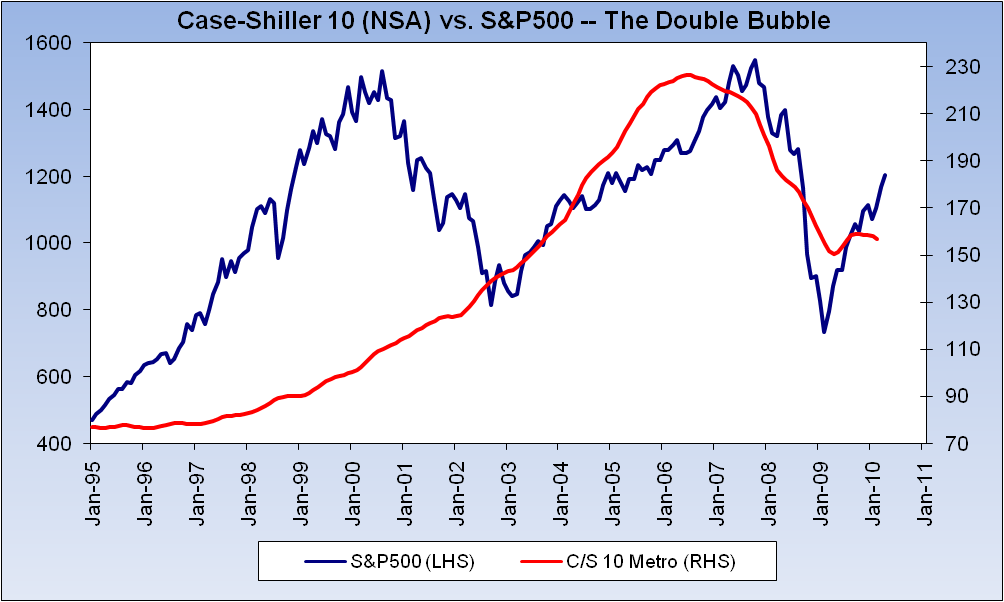
This is a terrific chart (via Invictus) showing the past two — really three — asset bubble tops.

1. Tech/Dot.com bubble 1990s

2. Credit Bubble/Housing boom 2002-07

3. Finance collapse 2008-09

The second two are obviously related: The easy money, credit driven financialization of the economy led to two asset class peaks: Stocks and Houses

>

Three Giant Bubbles in a Decade
Comments

Please use the comments to demonstrate your own ignorance, unfamiliarity with empirical data, ability to repeat discredited memes, and lack of respect for scientific knowledge. Also, be sure to create straw men and argue against things I have neither said nor even implied. Any irrelevancies you can mention will also be appreciated. Lastly, kindly forgo all civility in your discourse . . . you are, after all, anonymous.

29 Responses to “Double Triple Bubbles”

  1. Mike in Nola Says:

    Barry, are you implying through the chart that the current bubble just hasn’t grown large enough to pop yet?

  2. callistenes Says:

    Sure looks like the other shoulder is forming…..

  3. Invictus Says:

    I would be quick to note that as long as the blue line continues its ascent while the red line flat lines or rolls over, the sheeple will not be happy and populist rage will continue. That the investor class continues to gain while the American Dream continues to fizzle is not a recipe for success, in my opinion. So…since the housing market is going nowhere fast…

  4. broseidon Says:

    This also highlights the problem of just looking at one market if you’re looking for a bubble. As an equity investor, if you looked at the standard deviation of valuation over price, you could have seen the equity bubble in the 90′s pretty easily, although conviction and timing are obviously still difficult. If you were looking at the same measures in the 2000′s though, you never would have seen the housing bubble and subsequent stock market crash coming. Even some investors that saw problems in housing failed to anticipate the broader ripple effects.

  5. constantnormal Says:

    The decades’s not over yet.

  6. constantnormal Says:

    if they’re gonna do a GM IPO and are aiming at an eventual price target of $100/shr, there’s gotta be one hellacious stock market bubble to support that …

    http://news.businessweek.com/article.asp?documentKey=1376-L1NV2F0YHQ0X-5

  7. guidepostings Says:

    do you think lloyd’s trying to tell us something?

    http://3.bp.blogspot.com/_RHwzqq5yGy0/S9sRhQEEp5I/AAAAAAAAAvo/9jW136JSEtA/s1600/the+Lloyd+Blankfein+Top.jpg

  8. The Curmudgeon Says:

    What’s good for GM (puke) is good for America…

    And the federal reserve said in 2004 that housing price increases were “hard to explain” according to the just-released minutes of their deliberations back then.

    When money’s cheap, everything else is expensive.

  9. call me ahab Says:

    yeah- except that 3rd bubble forming won’t have the legs of the other two

  10. Mannwich Says:

    All hail the bubble markets and economy. We bow down to thee fake “free markets”.

  11. Mannwich Says:

    Personally, I’m most worried about cognos’ GS holding today.

  12. scepticus Says:

    all this easy money nonsense really irritates me.

    this is why we have easy money:

    1. capitalism always leads to overinvestment because capitalists rather than spending their gains on consumption reinvest it in their wealth cave, like buffet. This compounding of returns sucks money out of the lower layers of the economy and leads to a demand problem, which causes the bottom to borrow to make up for their lack of purchasing power, egged on by the top.

    2. then we get a recession which governments fix by ramping up their debt until the private sector can be persauded to increase their leverage.

    3. repeat 1,2, above enough times and you get rates at 0%, liquidity trap and depression. The huge injustice here is that the deflation results in very high real rates which sucks even more marrow from the poor fvckers at the bottom.

    the root of the problem is (1), not 2, or 3.

  13. call me ahab Says:

    manny-

    check out BR’s language-

    “past two — really three — asset bubble tops”

    is he calling a top?

    hmmmm . . .

  14. Mannwich Says:

    I don’t think so, ahab, but he appears to be edging closer to that point.

  15. b_thunder Says:

    what about oil bubble? gold bubble (still in progress?) and the biggest of them all, the US Treasuries bubble?

  16. Super-Anon Says:

    Yep. It’s a new baby bubble!

    The only thing that will stop it is if the politicians understand that another bubble could mean the complete collapse of the global financial system and a very angry mob beating a path to their door.

  17. bergsten Says:

    What I find “interesting” is that they are coming closer and closer together.

  18. Mannwich Says:

    Great observation, bergsten. Rapid fire bubbles.

  19. constantnormal Says:

    “closer together” … if I may put this forward without looking too “out there” … as we move forward along the increasingly steep curve of techno-societal change, we will see bubbles in increasing frequency and severity, as we get an increasing pace of innovations (financial as well as technological), and not all of the them will turn out to be for the betterment of existing society. But it will become increasingly easy for disruptive technologies to reshape our civilization faster than civilization can adapt.

    If we look at recent financial history, we have the commoditization of debt (sans controls, as the process developed faster than we perceived a need for controls), the introduction of insanely complex derivatives — also completely unregulated, without a shred of a clue as to what would be a proper way to regulate them (other than banning them).

    All of this reinforces the point that buy-and-hold, as a modus operandi, is now and forever more dead. Buy-and-hold presumes a stability that we are unlikely to ever see again.

    I’ll bet a nickel that in another decade, we will see AI investors, that are completely outside of human oversight or control, things that are as far removed from today’s program trading algorithms as those are from their ancestral roots of 30 years ago (“portfolio insurance” — wiped out most of Wall Street firms back in the day). Programs that will be capable of deciding to make a buck by wiping out nation X, and proceeding to implement that strategy in the twinkling of an eye.

    Securities laws will continue to be way late to the party — in fact, they will be increasingly later as time goes on.

  20. constantnormal Says:

    Oh, and one more thing … “nation X” might just as well be us and any other nation.

  21. constantnormal Says:

    Oh, and one more thing … “nation X” might just as well be us as any other nation.

  22. constantnormal Says:

    Isn’t it about time for another round of commodity bubbles? Oil, copper, agricultural stuff, who knows, maybe even a gold bubble.

    I mean, it’s been almost 24 months since I had to pay over $3.50 per gallon of gasoline. That seems like practically forever.

  23. TakBak04 Says:

    @constantnormal Says:

    I’ll bet a nickel that in another decade, we will see AI investors, that are completely outside of human oversight or control, things that are as far removed from today’s program trading algorithms as those are from their ancestral roots of 30 years ago (“portfolio insurance” — wiped out most of Wall Street firms back in the day). Programs that will be capable of deciding to make a buck by wiping out nation X, and proceeding to implement that strategy in the twinkling of an eye.

    Securities laws will continue to be way late to the party — in fact, they will be increasingly later as time goes on.

    ———-

    Might be prudent for us retail investors to start planning on finding some other way to invest or other forms of investing if your dark scenario plays out. And, it’s possible what you say could happen given the rapidfire changes we are seeing. Perhaps Community Banks where there’s local control over borrowing and lending. Let the Big Guys on Wall St. have their fun with their computer toys and the rest of us find find security in building back our communities. Perhaps new ways of doing business will emerge that aren’t dreamed of for the small investor, too.

  24. constantnormal Says:

    @TakBak04

    – not to worry, I’m sure that there will be a MacAfee Hedge or Norton Portfolio Insurance add-on to your favorite trading software …

    hmmmm … maybe we’d better brush up on our bartering skillz …

  25. ashpelham2 Says:

    takba04: I’m understand what constant is saying about the artificial algorithms that exist even now, to create some AI investment players. Can’t beat pure mathematics. If we’re looking for other ways to invest, we will have the choice to invest in the next can’t miss “automatic gain producer” which Wall Street will sell as a “can’t miss” because it takes out “human error and emotion”. Until the rules change and the algorithms go nuts and everyone’s scottrade account goes blank.

    I can see it now: ETF Algorithm Investments. Coming to a 401k plan near you!

  26. constantnormal Says:

    There actually, very probably already exists a market for actual individual “portfolio insurance”, that an individual can purchase for a certain monthly fee, which is a variable quantity. Something like personal FDIC insurance payments. It would pay off at algorithm-specified amounts for specific portfolios, triggered if those portfolios fall by more than a set percentage amount, which would be specified in the insurance contract.

    Yes, it might seem expensive, but in this case “expensive” is relative to an experiential background that does not include rapid-fire bubbles. For instance, an insurance company might offer not only fire or other casualty insurance on your home, you might also be able to purchase a rider against your home falling in value due to “market events” to less than a specified amount. I’ll bet that you can get a conventional home insurance company to issue a rider to that effect today, it’s just that people are not willing to spend money for that.

    But keep the housing markets sufficiently volatile, and they’ll come around … a $20 – $50 per month payment against your home losing half its market value might come to be an acceptable thing.

  27. TakBak04 Says:

    constantnormal Says:

    There actually, very probably already exists a market for actual individual “portfolio insurance”, that an individual can purchase for a certain monthly fee, which is a variable quantity. Something like personal FDIC insurance payments. It would pay off at algorithm-specified amounts for specific portfolios, triggered if those portfolios fall by more than a set percentage amount, which would be specified in the insurance contract.

    ——

    AYYYYY.. you are making my head hurt…..with your proposal! ;-( So Complicated…and it could BLOW UP like all the rest!

    Anyway, for Math Geeks it could sound good and if a “Portfolio Manager” could explain it to Liberal Arts Graduates it might be something for the future. As a Liberal Arts Graduate….I am very worried these days….jobs…investments…movies…print…publishing…all of it.

    The Fabulous Fab has made us Lib Arts folks cower…and feel very impotent…like we are doomed for Destruction because our Math Neurons (is that the correct term?) were lacking…and we just read poetry and literature from the past….and it’s all dead! :D

  28. How the Common Man Sees It Says:

    You need to mix in the China bubble at the end there. That is where the next one is forming

  29. Craig H. Says:

    constantnormal >

    I’ll bet a nickel that in another decade, we will see AI investors, that are completely outside of human oversight or control, things that are as far removed from today’s program trading algorithms as those are from their ancestral roots of 30 years ago (“portfolio insurance” — wiped out most of Wall Street firms back in the day). Programs that will be capable of deciding to make a buck by wiping out nation X, and proceeding to implement that strategy in the twinkling of an eye.
    ___________________________________________

    I would be very interested in reading more about this if anybody could suggest good references.

80 queries. 0.345 seconds.
