
Economic Data: Beware One Time Adjustments
>
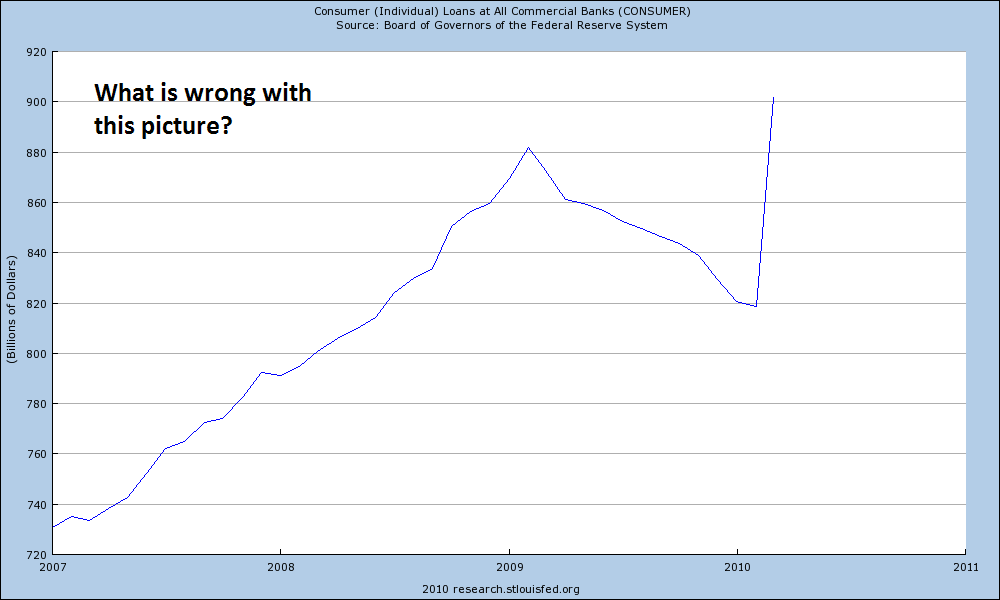
One look at the chart above — which I first saw over at Mark Perry’s Carpe Diem blog last week — might have one jumping for joy over the what appears to be a consumer lending explosion — credit, it appears, seems to have shot through the roof. Per his post’s title, at a Record High in March.
Have Americans suddenly found their credit cards en masse? Have banks suddenly loosened their record tight credit standards? Is all the money that’s been sitting on their balance sheets about to flood into the economy?
Hardly.
Whenever I come across highly aberrational economic news data series, I always try to discover if anything is haunting the underlying data series.
In the case above, the ghost in the credit machine was a FASB related change in the way accounting now gets reported, thanks to FASB 166/167. The Fed announced, in Notes released on April 9, certain accounting changes to this data set.
With regard to the specific series in question, the Fed wrote:
As of the week ending March 31, 2010, domestically chartered banks and foreign-related institutions had consolidated onto their balance sheets the following assets and liabilities of off-balance-sheet vehicles owing to the adoption of FASB’s Financial Accounting Statements No. 166 (FAS 166), Accounting for Transfers of Financial Assets, and No. 167 (FAS 167), Amendments to FASB Interpretation No. 46(R). Domestically chartered commercial banks consolidated $377.8 billion in assets and liabilities.[...]
…consumer loans, credit cards and other revolving plans, $323.9; consumer loans, other consumer loans, $41.3; [Ed note: These two series comprise total consumer loans.]
Adjusting the data for the accounting changes the Fed delineates, we get somewhat of a different picture:
>
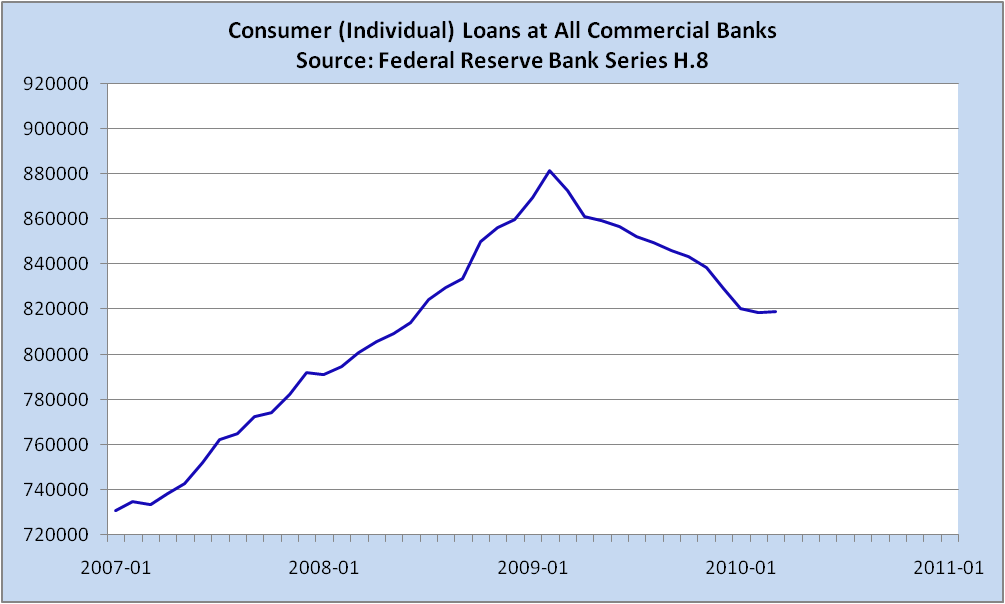
>
The moral of the story is we must always look twice at aberrational data series. This includes economic news that is either too bad or too good or simply too strange.
One must always look twice at anything that is unusual.
This incident highlights a problem that arises in both journalism and blogging. That a professor of economics might, upon looking at the graph, miss the implication that there is more to the story than meets the eye shows you just how challenging it can be to make sense of these economic data series.
Even worse, the erroneous post has been mirrored and reproduced at other websites, thereby compounding the original error.
Yes, Virginia, you cannot always trust everything you see on the internet . . .



Tweet
Facebook
Reddit
Digg this!


April 26th, 2010 at 3:18 pm
“One must always look twice at anything that is unusual.”
Indeed, like a 50% annual increase in housing prices during the boom. Or a 71% increase in the DOW here lately, preceded by a 60% decline. Anomalies can be the result of noise in the statistics, or they can be the noise. In either event, grown-ups will look at The Big Picture, figuratively and also literally, to give the numbers context.
April 26th, 2010 at 3:24 pm
Barry, that was just a bookkeeping change from “Securitized consumer loans” on line 45 under Memoranda up to “consumer loans” on line 15. Note that Securitized consumer loans went from $382 about three weeks ago (SA in billions of dollars) down to $24.4 while “consumer loans” went from $821 up to $1198.9 in the same period.
http://www.federalreserve.gov/releases/h8/current/default.htm
April 26th, 2010 at 3:46 pm
@Lamont
My post, not Barry’s.
And I dug into the releases in order to figure out what was going on. It was Professor Perry who did not.
April 26th, 2010 at 3:46 pm
“One must always look twice at anything that is unusual.”
yes, of course..and, a Good Point. though, it would apply beyond ‘Data Series’, no?
maybe, to something like: Senator Dodd’s Regulation Plan (?)
along the lines of: “…The objective is a good one. Unfortunately, the 1,408-page bill includes numerous provisions that would hurt—not help—consumers and the economy. It would even make another financial crisis or bailout more likely to occur.
Fourteen Flaws
Among other things, the bill:
1. Creates a protected class of “too big to fail” firms. Section 113 of the bill establishes a “Financial Stability Oversight Council,” charged with identifying firms that would “pose a threat to the financial security of the United States if they encounter “material financial distress.” These firms would be subject to enhanced regulation. However, such a designation would also signal to the marketplace that these firms are too important to be allowed to fail and, perversely, allow them to take on undue risk. As American Enterprise Institute scholar Peter Wallison wrote, “Designating large non-bank financial companies as too big to fail will be like creating Fannies and Freddies in every area of the economy.”[1]
…”
by James Gattuso
http://www.heritage.org/research/reports/2010/04/senator%20dodds%20regulation%20plan%2014%20fatal%20flaws
ya know, while We’re diddling with minor mis-directions, and misdemeanor obfuscations, We’re fixin’ to get locked-up, tighter than before, by that which We’re paying, far, too little heed..
April 26th, 2010 at 4:07 pm
Good stuff. Now go do the same with historic data of the CPI and the unemployment numbers. How about the federal defecit and debt? The books are being cooked all the time. (Don’t bother doing it, just visit shadowgovernmentstats and scrutinize their research)
There was the greatest generation, the baby-boom generation, generation X, I like to call this the flim-flam generation.
April 26th, 2010 at 5:34 pm
Since over three hundred million dollars in formerly “off balance sheet” loans have been now added, due to FASB pronouncement, why do I not see the scale at the left of your graph change. It looks as though you simply removed these loans from the subsequent, supposedly “corrected” graph.
The correct way to do this is to find out what those loan balances would be going back through the period you show, and increase the balances and thus the number hit on the Y axis at each earlier data point. This would show the data in a comparable historical series through the entire period shown. We now do not know what those added loans would have done to the older figures, and really do not learn very much at all from this entire exercise.
I agree with you that odd anomalies like this need to be investigated and handled. I especially agree that anomalies not be thought of as newly originated items, or as economic activity. I just think a bit more needs to be done to really show the total picture. How about a thorough explanation of where these loans would have been shown prior to the FASB pronoucement, how much they were likely to be during the earlier periods and their effect over the entire time period?
April 26th, 2010 at 5:34 pm
@Stephen
I have not yet found the “books are cooked” arguments persuasive. Not to say that I can’t be persuaded, just haven’t gotten there yet. There are, from time to time, legitimate reasons that data have severe one-time breaks due to changes in regulations, accounting, whatever. This is one of them. I simply cannot agree that my finding this aberration (which was, after all, explained) supports the notion that other stats are cooked. I’m not (yet) a fan of shadowstats.
April 26th, 2010 at 5:35 pm
So in other words, prior to March 31, 2010, FSAB allowed banks to report consumer loan data to the Federal Reserve that was materially misstated (less then actual).
What is unclear from the Fed wording (to me at least), are banks now “consolidating” as in adding to the balance sheet SIV assets and liabilities that previously were excluded?, or are they “consolidating” as in netting out SIV assets and liabilities and reporting the difference on their balance sheet? (in which case one still may not have a complete picture of the bank’s outstanding consumer loans – assets and liabilities normally are reported separately and are not netted out.)
Why were “opaque accounting practices” allowed if the first place? Who convinced FASB to agree to off balance sheet accounting? What else needs to be corrected before a bank financial statements can be trusted?
On the last question, perhaps FASB should reconsider the various “retained earnings” adjustments that allow banks to book certain losses as direct reductions to book value thus overstating profits (and bonuses).
April 26th, 2010 at 5:38 pm
OH, and Stephen has a great site for us to check out. Unfortunately, the real stats over at “ShadowGovernmentStats” dot com are for an annual fee. But the site does a great job of showing how government figures have been “altered” as to their basis of preparation. There are rationales for this, but the problem is that our current figures are no longer comparable to much older figures. Shadow Stats attempts to provide as an added figure, what those older bases of preparation would show.
Seems worth the subscription. If I do go back and study for a Masters and PhD in Econ, then the subscription is a given.
April 26th, 2010 at 5:58 pm
+ 1,000
April 26th, 2010 at 6:16 pm
The other less substantive ‘what is wrong with this picture’ issue: I hate it when y-axis values are initiated close to the initial x-axis data point (that is, starting the y-axis at 720–and 2007 data point is ~735). This approach visually exaggerates change over time–when the data are accurate. In this case with bad data, even the direction for overall trend is wrong.
April 26th, 2010 at 8:14 pm
BR -
mad excel skilz impersonating FRED
Also, about Shadow stats and inflation and cooking the books,
BR has already performed the yeomans service of pointing out that treasury yields never incorporated anything like the inflation claimed at Shadow Stats. I was pointing this out to people too before that, but in less public forums. Now, you can make the case that for the prices that matter to bond vigilantes, their inflation rate was appropriately discounted in treasury prices, while consumers experienced higher inflation. But you cannot make the claim that Shadow stats has the very last word on inflation – inflation is simply too complex a subject.
April 26th, 2010 at 8:45 pm
Does it surprise you that a Professor of economics (Perry) wouldn’t have thought to question this plot let alone investigate further?
April 26th, 2010 at 9:10 pm
@Murphy
I’ve been looking at charts and graphs for 20+ years, and am friends with more than one economist. Almost every chart I see — including what you’d find at the St. Louis FRED (see above for proof of that) — starts the Y-axis close to the minimum value. I wouldn’t say doing so “exaggerates” the change over time, I’d prefer to say it “accentuates” it.
April 26th, 2010 at 9:12 pm
@crtune
My point was not to retroactively redraw the series based on the FASB-related change. It was simply to highlight the necessity of always questioning what one sees. If you’d like to redraw the history of the series based on the changes I discussed, by all means have at it.
April 27th, 2010 at 9:23 am
An excellent topic containing a universal moral: “One must always look twice at anything that is unusual.” … Absolutely.
And on the triggering subject matter at hand, in light of its enhanced level of accounting and reporting transparency, it’s gratifying to see the recent adoption of FASB 166/167 has been met with general acceptance here at TBP. Perhaps FASB ain’t so bad after all.