Existing Home Sales Gain Aheadof Tax Credit Expiration
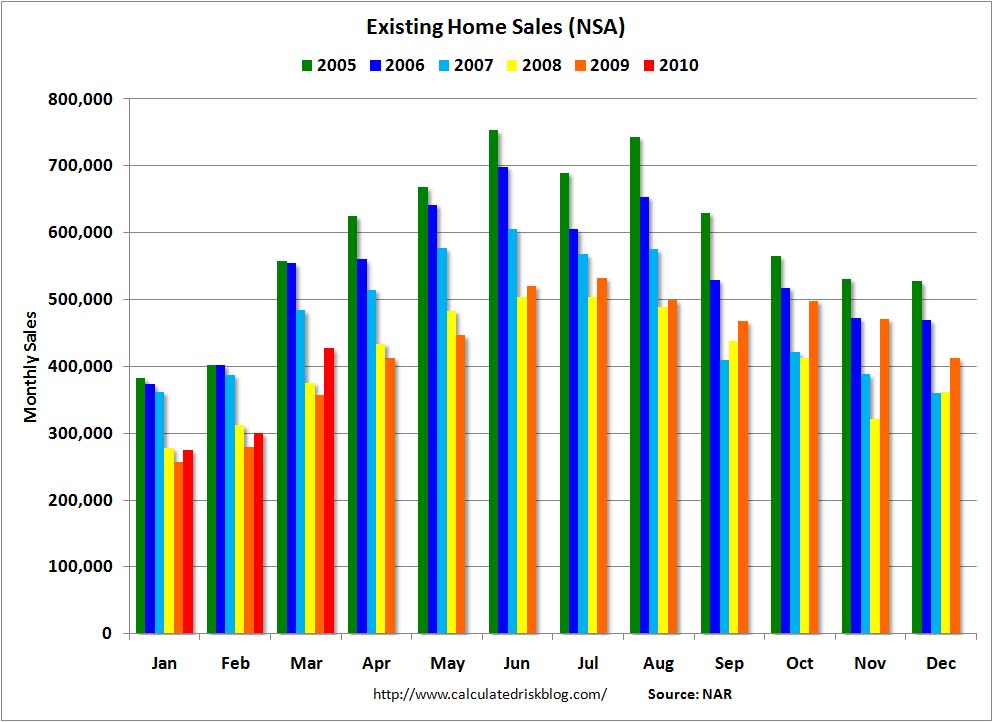
We haven’t looked at this chart in a while, but let’s pull up the ole NSA Existing Home Sales, courtesy of Calculated Risk:
>
Existing Home Sales, Non Seasonally Adjusted
Put this in context, and a few things stand out:
1) From June 2009 to present, monthly sales have improved from year ago levels; Sept-Dec 2009 improved upon 2 year ago levels.
2) Current Existing Home Sales remain far below 2005-06-07 levels.
3) The combination of MBS purchases by the Fed (holding mortgage rates artificially low) and purchase tax credits from Congress appears to have (at least temoprarily) goosed sales.
MBS is now finshed, and the Tax credit expires at the end of this month.Can Home Sales stand on their own feet without any further subsidies?
I doubt it . . .



Tweet
Facebook
Reddit
Digg this!


April 22nd, 2010 at 11:48 am
“Can Home Sales stand on their own feet without any further subsidies? I doubt it . . .”
BR- residential permits for April should speak volumes- as there is not enough time to construct a home by the 6/30 delivery requirment for the tax credit-
demand was pulled forward by those sitting on the fence- and the USG should know this- because folks don’t buy a house to get a tax credit- but if tentatively in the market for a new home- they will time it so they are eligible for the credit-
my guess is many folks will be waiting around for “new incentives” before buying a new home- the very gimmick that slaps car manufacturers around to this day
April 22nd, 2010 at 11:54 am
“Current Existing Home Sales remain far below 2005-06-07 levels.”
Should we be using sales numbers from the very top of the housing bubble as the benchmark?
April 22nd, 2010 at 12:01 pm
Thor Says:
“Should we be using sales numbers from the very top of the housing bubble as the benchmark?”
I have the same question and my answer is no we should not. Have the dotcom equipment vendors returned to their peak levels?
April 22nd, 2010 at 12:03 pm
No.
Even more significant inthis mean reverting exercise — proces remain elevated by historoic metrics — but mortgage rates remain attractive.
April 22nd, 2010 at 12:09 pm
If you believe that prices will eventually revert to a mean then you must believe that the government programs intended to slow price declines have extended and delayed the mean reversion.
Good or bad?
April 22nd, 2010 at 12:09 pm
Someone hand that coyote an anvil.
April 22nd, 2010 at 12:14 pm
@Shnaps: LOL!
April 22nd, 2010 at 12:52 pm
Why doesn’t the public know about Senators like this:
http://www.youtube.com/watch?v=c4jr6KGMoqw&feature=player_embedded
April 22nd, 2010 at 1:22 pm
Because they are Democrats, you know, socialists, anti-free market, do not support tea-baggers, and the worst sin of all, they believe that regulation works.
April 22nd, 2010 at 1:40 pm
“Should we be using sales numbers from the very top of the housing bubble as the benchmark?”
Why not? So long as we use prior-year quarter over quarter comparisons for the performance of the economy? It shows things aren’t as bad as they were before. But this economy, and this housing market and the stock indices, all have a long way to go to revisit the levels of 2006/07. 11,000 on the Dow looks really good relative to last year. Relative to 14,400, not so much.
But my question would be why the level of sales activity of existing homes is all that important a metric for the health of the housing market. Except for real estate agents sloughing off their percent, and title companies, etc, doing the same, nothing of real value to economy-wide performance happens. It’s just trading one 3/2 dump for another one.
April 22nd, 2010 at 1:49 pm
Existing home sales mean little to nothing. If Barry sold his house to Jimmy and Jimmy sold his house to Barry, there are two existing home sales. Does having an increasing number of people swap houses show that the economy is growing? No. But it sometimes helps labor mobility, which helps the economy indirectly.
April 22nd, 2010 at 2:33 pm
It is true that existing home sales contribute little to the real economy. Recovery in sales is still an indication of things coming back to normal, sort of.
Except … it’s hard to get too excited about sales increasing when there are 6 million seriously delinquent mortgages and “the volume of distressed properties in the housing market climbed to more than 50%” (the latest Campbell Survey).
I actually do expect existing home sales to keep increasing, but not in a very good way. The GSEs have changed their emphasis from “keeping people in their homes” to pushing short sales as “foreclosure prevention” (yes, but). And the temporary effect of foreclosure freezes from HAMP has peaked (http://www.clearonmoney.com/dw/doku.php?id=investment:commentary:2010:04:16-no_one_has_noticed_the_big_news_from_hamp).
April 22nd, 2010 at 2:44 pm
crunched:
Because he, like Bernie Sanders, is a threat to the status quo. And Ohio has been hit pretty rough by the recession(and even before). Do you ever wonder why the same people(John McCain for one) keep ending up on the Sunday Morning gasbag shows(or similar)?
April 22nd, 2010 at 3:25 pm
Can Home Sales stand on their own feet without any further subsidies? I doubt it . . .
Barry, I agree. I believe the demand side for housing will be depressed for many years. The market for starter homes should be saturated after this second round of incentives. Those 5 or 6 million homeowners who are defaulting on their mortgages will be out of the market until their credit is repaired. New homeowners will be required to pony up larger down payments which will require time to save up, particularly since it appears consumers cannot resist the immediate gratification of spending on an ipad or a new pair of shoes. Houses no longer carry the investment status of before. Unemployment is likely to remain high (and job creation low) for a while and many who have moved in with family may not be quick to leave.
Barry, since I know how much you enjoy anecdotes :} , here is mine. Over the past year all three of my 20 something children moved back home. Each has recently found a well paying job or received a good promotion. But none are in a hurry to move out. They prefer to pay down their credit cards (finally learned), save up for new cars and buy the typical 20-something discretionaries- electronics, entertainment and clothes. Given the uncertainties ahead, I much prefer them stay at home and build up their savings rather than risk getting extended. I suspect other parents have similar experiences.
But on the other side of the coin, those who have been on the sidelines will likely be back in the housing market now that they feel more secure in their jobs, housing prices are reasonable and interest rates are low. The stock market will give more prospective homeowners the cash needed for a down payment. More of the “move up crowd” might re-enter the market if they are now able to sell their current home. Deep pocket investors have been waiting for this moment to buy large numbers of distressed units (turn into rentals?) Autos rebounded nicely following a short drop off after the “cash for clunkers” program. Who knows maybe housing will do the same although my gut tells me it will be a long slog, particularly in new home construction.
April 22nd, 2010 at 4:00 pm
@crunched: great video. Thanks.
Good question. The law has been there for decades but unenforced. GO figure.
Today’s politicians need talking points.
I am reminded of a TV article years ago about India. They have so many laws nobody remembers most of them. And no one enforces any of them.
April 22nd, 2010 at 4:48 pm
My sources tell me that the housing marketing has “gone silent” here in the Twin Cities over the past couple of weeks. I think we’re going to find out just how much demand they pulled forward with that housing credit and just how few buyers remain without the perceived “free cheese” from Uncle Stupid.
April 22nd, 2010 at 6:50 pm
Mannwich: Same here in Seattle. Had dinner with two friends (one is top realtor in city) and they both said they did not see a big pick up like they did in Fall with the expiration coming up. She told me she sold a nice condo a great price downtown to which I replied, “the buyers should have waited a month, they could have gotten it a lot cheaper”.