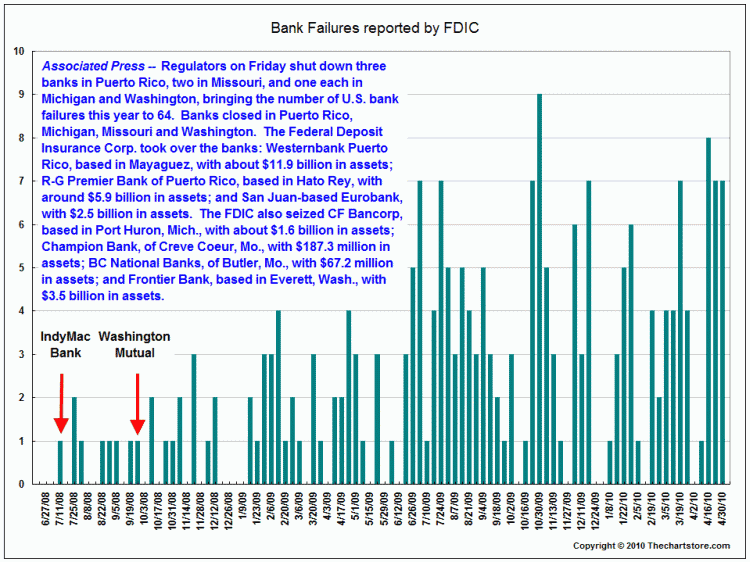
Bank Failures

Email this post Print this post
By Barry Ritholtz - May 3rd, 2010, 7:00PM

These two graphics, via the Chart Store, are quite compelling:

>

Click for larger graphics

Comments

Please use the comments to demonstrate your own ignorance, unfamiliarity with empirical data, ability to repeat discredited memes, and lack of respect for scientific knowledge. Also, be sure to create straw men and argue against things I have neither said nor even implied. Any irrelevancies you can mention will also be appreciated. Lastly, kindly forgo all civility in your discourse . . . you are, after all, anonymous.

16 Responses to “Bank Failures”

  1. JustinTheSkeptic Says:

    Barry, who’s going to call Buffett out? C’mon man!!!!

  2. alfred e Says:

    @Justin: Correct.

    Well, too many people have bought into the MSM American mythology that Warren is just this simple Omaha country bumpkin that invests in (not controls) the markets based on fundamentals. That’s a mythology critical to the survival of the existing PTB. His operandus modi (sp?) has been simple. Buy companies with monopoly control over markets. Or at least a part of the elite oligarchy.

    So exactly why is it the major ratings company he owns has not been questioned?????

  3. cognos Says:

    If you put up the graph of “costs”… 2010 will be FAR less costly to the FDIC than 2009. Most of the banks closed in 2010 have been tiny. (That said, these Puerto Rican banks were the largest and mostly costly banks closed in 6 months. But its not “continental US” so I am not sure it counts.)

    In fact, the FDIC is drastically overstating costs and will be very profitable on their “loss sharing” deals with the people who have taken these over. And Sheila Bair is an awful regulator, but that a whole nother discussion.

    This story is over. Look at financial stocks. Look at credit bonds. Look at mortgage credit bonds. Up, up, and UP.

  4. Metzen Says:

    It really cheeses me off that the Puerto Rican people and American people are being duped into sewing a 51st star on the flag: Puerto Rico.

    The house passes a “non-binding” resolution giving the Puerto Rican people permission to “choose” their own destiny on Friday, and the very next day the FDIC shutters 3 banks in Puerto Rico for the first time. Of course, the resolution is a big fraud since the Puerto Rican people already have the right to choose, and have repeatedly chosen not to be a state.

    So why is it being rammed down their throats (and ours) now? To further the progressive agenda. The progressives in power immediately get a huge block of voters predisposed to vote their way, and the irresponsible dirt bags in D.C. get a whole new group of people to tax into oblivion.

    Anyone who looks into this for more than 5 minutes will see right through the rhetoric to what this really is: disgusting politics at its worst to further the progressive agenda here and in Puerto Rico (they added this exact play to their party platform in 2008, even being so brazen as to call it by it’s actual name: The Tennessee Plan). I could puke right now, and I’d prefer to do it all over a progressives dinner plate and expensive suit.

  5. Brendan Says:

    @Metzen: you could take two minutes to look up the history of the bill, or you could be a reactionary partisan hack that thinks everything is a damn conspiracy theory. I see you chose the latter. Don’t you people ever get sick of listening to yourself spout disinformation?

    For everyone else who wants facts, not Rush Limbaugh talking points, a bill was introduced in 2007 but never made it out of committee. It was reintroduced last year in the new congress and made its way to the floor this year. Similar bills have been passed over the last 50 years or so, as changing attitudes in PR mean that the option to vote on becoming the 51st state is something that is periodically tested (it’s been 12 years since the last time, which is a long time in politics). It was only narrowly defeated then, meaning that even a small change in attitudes could mean that a majority want statehood. Or perhaps things could be swinging against statehood. I honestly don’t know. Either way, the bill and shuttering of banks is obviously a vast progressive conspiracy to get votes in 2010 (after all, I’m sure they didn’t want them in 2008 and that’s why they waited until now)! Whatever…

    In general, I agree that a chart showing the dollar amount of the failures might also be enlightening.

  6. Mark E Hoffer Says:

    http://www.census.gov/compendia/statab/2007/tables/07s1300.xls
    http://www.census.gov/compendia/statab/2007/puerto_rico_the_island_areas.html

    cognos,

    w/this: “But its not “continental US” so I am not sure it counts..”, would you do us a favor, and explain that POV?

    U$D ~7 Bn of, annual, Transfer Payments (as of 2005, 1st Link) would give one the impression that ‘it counts’..
    ~~
    “…Statehood is for the Poor, after all, is the title of Romero’s book, and the main reason given is that, as a state, Puerto Rico would, on balance, get a lot more in federal transfer payments. As soon as he settled into his current Washington office he joined in with fellow Democrats in the Congress in railing against the U.S. manufacturing companies that form the backbone of the Puerto Rican economy, calling the federal tax breaks that lured them to the island in the first place mere “corporate welfare.” And the New Progressives have always had close ties with organized labor. They have consistently favored the application of all federal minimum wage laws to Puerto Rico, and, most recently, Governor Rossello introduced legislation that would permit the unionization of all Commonwealth government employees.

    As for the better known welfare, even though out of power, the pro-statehood lobbyists were the biggest single force behind the Congressional action that has largely given Puerto Rico its transfer-payment dependency. I speak of the food stamp program. Using the dignity-of- American-citizens argument they persuaded the Congress to treat Puerto Rico as though it were a state in 1974, a move that the incumbent governor, Hernandez Colon, initially opposed. Soon the cupones rained down upon the island like manna from heaven, though the demonstrated need hardly compared to that of the Israelites in the desert. By 1982, with the annual food stamp tab for Puerto Rico about to crest one billion dollars, the Congress realized that things were a bit out of hand. They took Puerto Rico off food stamps and replaced it with a block grant, initially capped at $825 million and misleadingly entitled the Nutrition Assistance Program. Actually it was not misleading until Romero, who by that time was in his second term as governor, got through with it. To “save administrative costs,” he did not institute his own program of food stamps with the money. He simply had his Department of Social Services send those families deemed eligible a monthly check in the mail. Now, with the annual expenditure for the program over a billion dollars and with the appropriation still part of the mammoth agriculture bill, as though its purpose were to help U.S. farmers by giving poor people the wherewithal to buy their output, this is still how the program is administered….”
    http://www.independencia.net/ingles/danger_statehood.html
    http://clusty.com/search?input-form=clusty-simple&v%3Asources=webplus&query=Cost+of+Federal+Transfer+Payments+to+Puerto+Rico

  7. Andy T Says:

    Well Barry…you’re the “quant.” Isn’t the slope of the 2010 failures somewhat similar to what we saw in the 2/H of 2009? It’s just more of the same. Wouldn’t a statistician wishing to put a “bullish” spin on things put all of the failures on a log continuation chart, which might demonstrate that the slope is starting to become less severe? Heh, heh….

    One can make the numbers “look” however one would like them to look.

    “There are three kinds of lies: lies, damned lies and statistics.”

    That stated….this doesn’t look so “hot.”

  8. KidDynamite Says:

    i am dying to see a chart of the actual costs to the FDIC’s DIF in each year… I thought the Chicago bank failures 2 weeks ago were big (bigger than normal) – until Puerto Rico blew them out of the water on Friday.

  9. Metzen Says:

    @Brendan If you look into it you’ll see the progressive party in Puerto Rico has already designed the ballot and it doesn’t ask “Do you want statehood”, rather it forces this issue with a series of manipulative questions. Then our congress won’t vote on it, rather the Puerto Rican congressmen will just show up on our doorstep demanding to be seated. If they want to have the vote I think that’s great, but that isn’t what is happening at all. BTW, I’m not interested in talking points and really don’t like Limbaugh.

    As for the graphs, while I agree that the number of banks failing makes it look worse than it is, the fact that so many are still failing is a pretty good indicator that things aren’t quite as rosy as some (like cognos) may want to believe. There is still a massive shadow inventory of houses that should be foreclosed on but haven’t been (yet!), and even more where people would sell if they could, but haven’t listed because they know its not even worth trying. Until that shadow inventory is dealt with, this recovery is just a fresh paint job on a busted up clunker.

    When the real recovery does come it will be because we’ve paid the price in foreclosures and price adjustments and returned to common sense fundamentals, not because of bailouts using debt, bailouts using printed money, the wholesale raping of America in the name of “reform” and regulation, and the invention of more and more convoluted “financial instruments”.

  10. mark Says:

    I’m not feelin’ the love for St. Warren the Avunculus. Watch out. He’ll sic his lap dog Ben Nelson on you.

  11. surferdude Says:

    cognos said “If you put up the graph of “costs”… 2010 will be FAR less costly to the FDIC than 2009. Most of the banks closed in 2010 have been tiny.”

    well here are the failed bank numbers through april 30th:

    2009 – total 29; assets $14.7 billion; estimated cost of $4.09 billion
    2010 – total 64; assets $61.8 billion; estimated cost of $15.9 billion

    based on these results, the math i was taught says that failure costs are up 389% or nearly four-fold on a year-over-year basis.

    so it is not exactly clear where cognos reaches the conclusion that costs are much lower in 2010.

  12. Robespierre Says:

    cognos Says:
    May 3rd, 2010 at 7:41 pm

    “(That said, these Puerto Rican banks were the largest and mostly costly banks closed in 6 months. But its not “continental US” so I am not sure it counts.)”

    Last time I checked FDIC used continental US dollars for these…

  13. ToNYC Says:

    I cannot imagine the founding fathers designing any nation could maintain itself with extra-continental states. Hawaii , Puerto Rico, Cuba were taken to various degrees because they were in for the bid, and another nation would have grabbed ‘em. Alaska is a stretch , but without the foreign oil substitution, it might as well be Canada.
    The way we were trying to go, we’d have a second state of Georgia. We have a credit collapse to thank for throwing a spanner in the ‘stan works.
    Let’s talk about % losses at these banks versus stated balance sheets the day before fateful Fridays and the wicked Bair and ask why the practice is totally bankruptING in not marking bank assets on the books at bid market.

  14. rktbrkr Says:

    The TBTF have been insulated from the consequences of their follies but the community banks will be dropping like flies from the cumulative effects of bad mortgages and commercial loans, very early on in this process the decision was made that the community banks were expendable and the TBTF will just gobble up their desirable assets at FDIC tag sales

  15. phb Says:

    Damn Cognos, I continue to marvel at your posts. You clearly have control of the facts and are quite skilled at presenting them in a fashion that consistently contradicts reality, complete with the obligatory “this story is over” theme! Well done! I suspect the meatheads on Yahoo no longer provided a challenge for you, now you prefer to spare here. Keep it coming, I love it!

  16. phb Says:

    Opps, excuse my Dan Quayle spelling – spar not spare!

74 queries. 0.208 seconds.