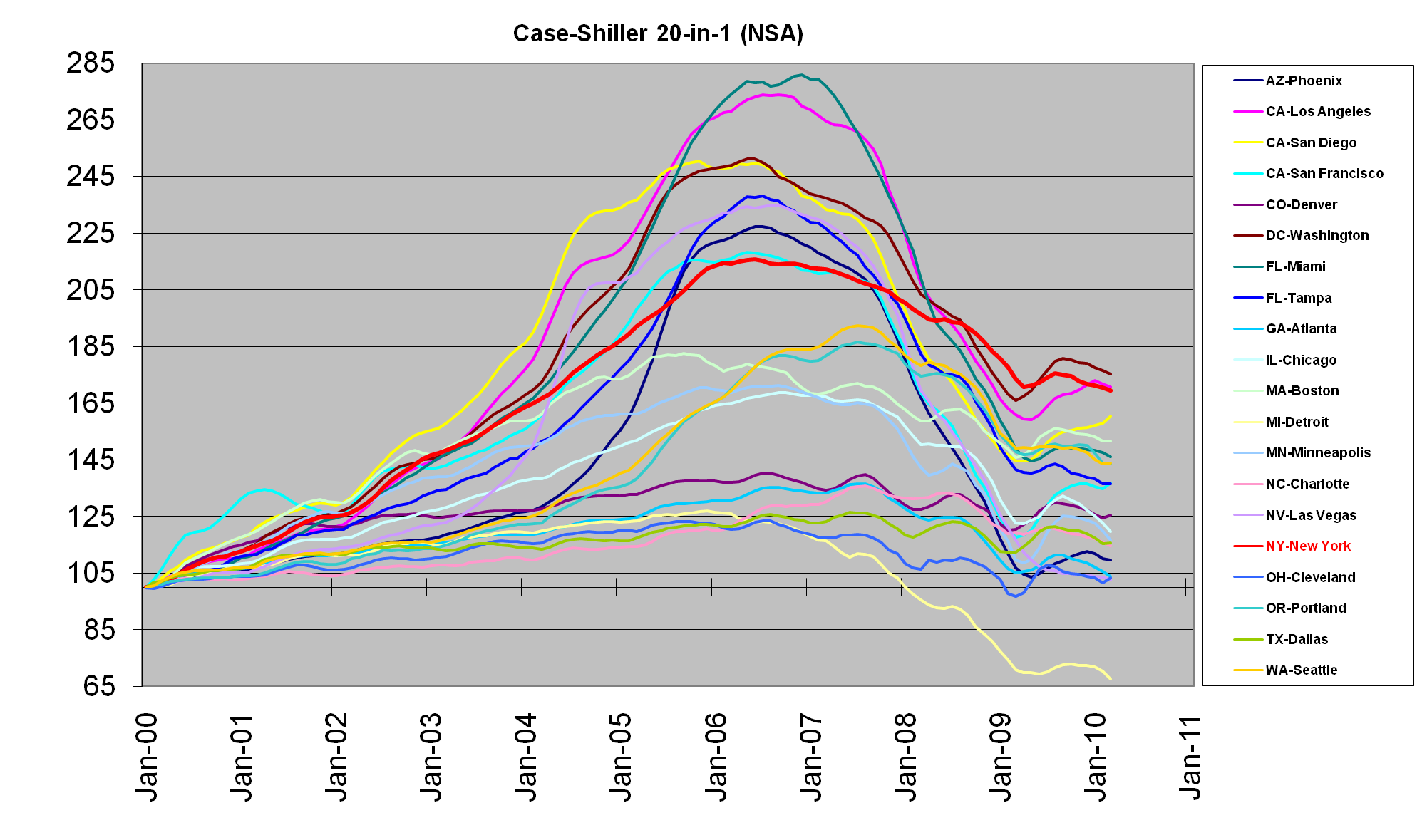
Case Shiller: Weakening Home Prices in Q1
I’ve been putting together a longer post called “Residential Real Estate: The Second Leg Down.”
Today’s Case-Shiller Home Price Index confirms that a softening of residential sales and prices is already under way. It is likely to accelerate over the next few quarters.
Here is Case-Shiller:
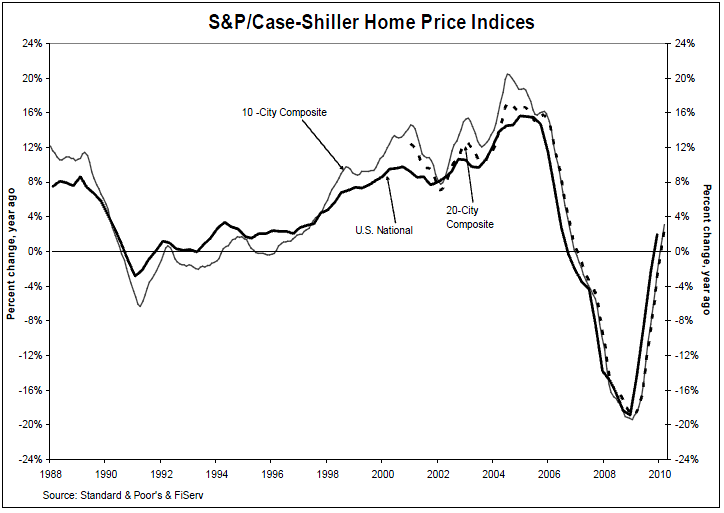
Data through March 2010, released today by Standard & Poor’s for its S&P/Case-Shiller Home Price Indices, show that the U.S. National Home Price Index fell 3.2% in the first quarter of 2010, but remains above its year-earlier level.
In March, 13 of the 20 MSAs covered by S&P/Case-Shiller Home Price Indices and both monthly composites were down although the two composites and 10 MSAs showed year-over-year gains. Housing prices rebounded from crisis lows, but recently have seen renewed weakness as tax incentives are ending and foreclosures are climbing.
>
Source:
The First Quarter of 2010 Indicates Some Weakening in Home Prices
New York, May 25, 2010
http://www.standardandpoors.com/indices/sp-case-shiller-home-price-indices/en/us/?indexId=spusa-cashpidff–p-us—-



Tweet
Facebook
Reddit
Digg this!


May 25th, 2010 at 9:55 am
If anybody knows of a Case-Shiller type of thing for Australia, I’d love to hear about it. Oz has a US/UK style housing bubble of their own going on right now. There are a few sources I’ve been getting house price readings on, but nothing I’ve seen is as comprehensive as Case-Shiller.
May 25th, 2010 at 9:55 am
“Housing prices rebounded from crisis lows, but recently have seen renewed weakness as tax incentives are ending and foreclosures are climbing.”
what kills me about that is that the tax incentives were still in full force- all the way until April 30th- why would something weaken because it will end April 30?
and that permits were at 13 year lows for April- and sure rates are low- but in a negative inflationary environment- what are real rates- how low are they?
does not bode well for the housing market-
May 25th, 2010 at 9:56 am
The government has been artificially propping up the prices through tax credits,low mortgage rates and FHA.Still the housing prices are falling . This should send a message to the govt to allow the prices to reach a natural level of demand and supply
May 25th, 2010 at 9:57 am
OT: Here’s another one form the Onion…
STOCKWATCH
BP
$40.78 (down 2.58%)
The company has come under increasing
fire for its slow and clumsy response to the
massive slick of red ink that continues to
spread across its balance sheet.
Eco
May 25th, 2010 at 9:58 am
@beatstreet Says:
May 25th, 2010 at 9:55 am
“If anybody knows of a Case-Shiller type of thing for Australia, I’d love to hear about it.”
This is all you need to know that housing will not end well in Australia:
(from Mish)
“ING Direct, Australia’s fifth largest lender, is preparing to sell loans that have no fixed term and no requirement to repay any capital along the way.
At current rates, the interest-only loans would cut repayments on a $300,000 mortgage by $5000 a year.
“People are needlessly being denied the chance to buy a property while prices spiral rapidly out of their reach” ING Direct CEO Don Koch said. “There is an urgent need to provide more affordable options and borrowers should be able to choose whether they want to repay the capital, or not.”"
May 25th, 2010 at 10:00 am
BTW why are US banks lowering their bad RE loan provisions when it is obvious (even to them) that RE is actually getting worst?
May 25th, 2010 at 10:01 am
Thanks Rob. I read that. Great stuff. Here’s the link to the full article for everyone’s enjoyment. You can’t make this stuff up …
http://www.adelaidenow.com.au/money/revealed-the-home-loan-that-could-save-you-a-fortune/story-e6fredkc-1225870019522
May 25th, 2010 at 10:25 am
“ING Direct, Australia’s fifth largest lender, is preparing to sell loans that have no fixed term and no requirement to repay any capital along the way.
At current rates, the interest-only loans would cut repayments on a $300,000 mortgage by $5000 a year.
It seems the dealer is getting more desperate than the junkie.
I laugh but it is one of those uncontrollable laughs you get when you happen upon a very awkward situation.
And by the way, where are the regulators in this situation? Why are they turning a blind eye? Can they not find recent examples of how this already turned out bad?! How about on the front of the newspaper
May 25th, 2010 at 10:26 am
more from WSJ …
“Prices fell month-to-month for the sixth-straight month.
“Eight metro areas posted new price lows in March: Atlanta, Charlotte, Chicago, Detroit, Las Vegas, New York, Portland and Tampa.”
http://online.wsj.com/article/SB10001424052748704026204575266200277903596.html
WSJ MarketWatch …
“Here’s a list of the 20 cities in the Case-Shiller index, with percentage changes over the past year:
“San Francisco, up 16.2%; San Diego, up 10.8%; ; Cleveland, up 6.7%; Minneapolis, up 6.5%; Los Angeles, up 6%; Washington, up 5.6%; Denver, up 4.1%; Boston, up 3.8%; Dallas, up 3%; Phoenix, up 2.4%; Atlanta, down 1.3%; Miami, down 1.7%; Chicago, down 2.3%; New York, down 2.4%; Portland, down 2.8%; Tampa, down 3.5%; Seattle, down 3.6%; Charlotte, down 3.9%; Detroit, down 4.6%; and Las Vegas, down 12%.”
http://www.marketwatch.com/story/us-home-prices-fall-05-in-march-sp-2010-05-25-93900
May 25th, 2010 at 10:26 am
It’s almost like the land down under is following what happened here and in the UK to a point. Why repay a loan? You should be given the option if you want to repay!
there is an option and it’s called RENTING. Wish I was renting a high rise condo right now, in the city, with no lawn to cut.
May 25th, 2010 at 12:17 pm
I went ahead and created a new chart today titled “Case-Shiller, FHFA and CPI Rental Indices Compared”. It gives an interesting look at how the inclusion of the non-conforming mortgages in the Case-Shiller index creates much wider price swings than the FHFA.
Clearly the CPI rental index (used instead of Owner’s Equivalent Rent since the rental index is a more robust historical series) missed the bubble on the way up but seems to be reflecting the crash in a much more pronounced way in recent months.
http://www.thumbcharts.com/1384/case-shiller-fhfa-and-cpi-rental-index-compared
Here is the link to the newly created “U.S. Housing Market” chart series:
http://www.thumbcharts.com/series/us-housing-market-1975-2010?&sort=updated
May 25th, 2010 at 12:58 pm
Robespierre,
“People are needlessly being denied the chance to buy a property while prices spiral rapidly out of their reach”
Wow, stunning. Not learning from the past is one thing. Ignoring the present is just flat out f*cking irresponsible.
The Dutch so want to be Switzerland, the poor dears.
May 25th, 2010 at 2:02 pm
My real-estate friends tell me that since the tax-credit has been over they’ve seen weakened demand, and some vultures coming out trying to low-ball people. They mention retreating sellers that would rather hold-on than sell for the new, lower prices, and expect a slightly smaller than usual uptick in the summer because of the pull-forward effect of the tax credit.
I see this as an opportunity. When everyone else is talking about buying gold and silver.. I see an opportunity in property. My outlook is for ~5-10 years of strong deflationary pressures keeping growth very very sluggish followed by maybe some normalcy and an eventual period of high inflation, but no Wiemar Republic kinda thing. Following my line of thinking, I could jump on the Gold bandwagon to play musical chairs with the rest of the hedgies.. or I could sit around in TSYs, earning a real rate above the nominal until I find a piece of real estate that I think is a good value in a place with reasonable or no property taxes. Mortgage the place fixed for 30 years and then rent it out, even if means slightly negative carry. If there is indeed very high inflation one day, it will act as a good hedge, and I’ll have picked it up on the down, instead of on the up, like Gold is right now. Hard assets are hard assets and leverage is much more attractive in property. Low long-term rates courtesy of the government, tax deductions, no punitive “collectibles” tax, and a mtgage can be hand for around the same price as a retail margin loan (~call+300, but remember margin rates are variable)
but that’s just me
May 25th, 2010 at 2:17 pm
US national average house prices, while possibly useful, have the potential to be misleading
chart: US Average house prices
http://mysite.verizon.net/vzeqrguz/housingbubble/
May 25th, 2010 at 4:38 pm
RE: “Today’s Case-Shiller Home Price Index confirms that a softening of residential sales and prices is already under way. It is likely to accelerate over the next few quarters.”
An interesting and (relatively) rare perspective. I too think that housing prices have yet to come near any meaningful bottom.
However, the consensus expectations on home prices is for slight and steady gains over the next few years. Here is my blog post that discusses these expectations:
http://economicgreenfield.blogspot.com/2010/05/macromarkets-home-price-expectations.html
May 25th, 2010 at 7:46 pm
thumbcharts: Nice charts, but I hope you realize that you are now on Steve Jobs’ sh#t list for ruining the user experience with Flash charts with all that extra info. Barry’s not even going to be able to use his new ipad to see them.
May 25th, 2010 at 9:57 pm
there is also the totally under-reported commercial real estate sector:
“Defaults on apartment-building mortgages held by U.S. banks climbed to a record 4.6 percent in the first quarter, almost twice the year-earlier level …
“Commercial-mortgage defaults also rose in the first quarter for loans against office, retail, hotel and industrial properties, Real Capital said.”
http://www.businessweek.com/news/2010-05-24/defaults-on-apartment-building-loans-set-record-for-u-s-banks.html
June 21st, 2010 at 11:32 am
[...] we are now in the early stages of a second leg down in Housing, plus the excess new and shadow inventory that is out there, its hard to consider anything other [...]