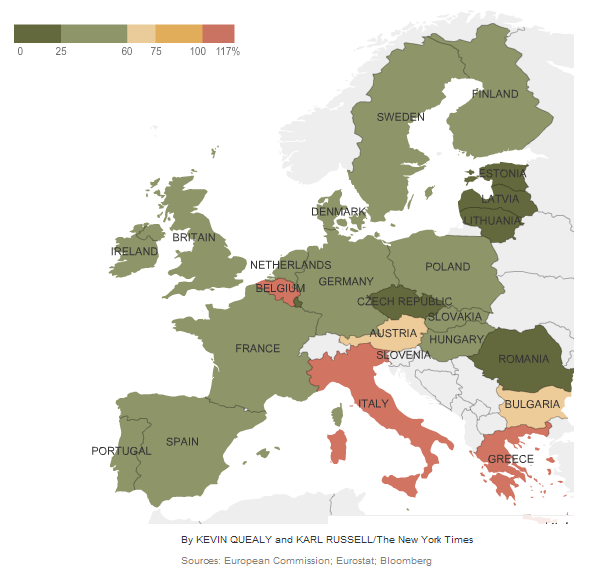
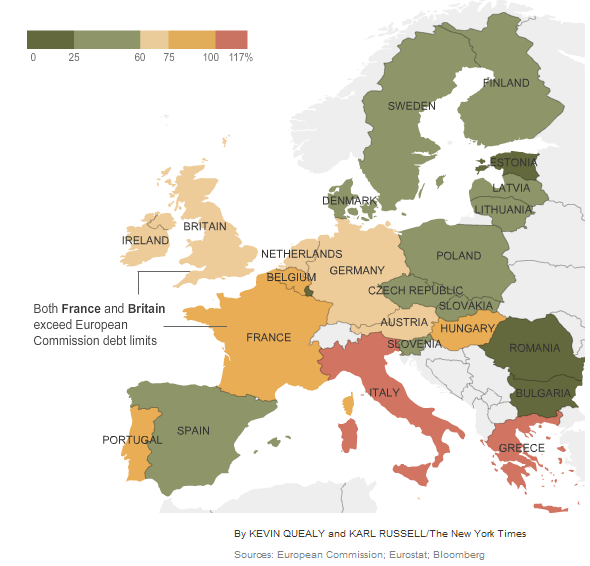
Changes in European Debt, 2000-09
Great interactive sets of charts from the NYT regarding the growing debt over the past decade.
What is so striking is not that PIIGs states have gotten so much worse — but rather, the relative increase of the rest of European debt to GDP:
>


Tweet
Facebook
Reddit
Digg this!


May 11th, 2010 at 10:37 am
I know that people always have trouble with debt, but you must have huge debts when you have huge savings. The saving rate in europe is 15% and that money has to go somewhere, it can’t just end up in the banking system. (that’s at least the view of Richard Koo and imho it makes very much sense)
May 11th, 2010 at 10:57 am
@handelsblatt
If you don’t alreaddy work there, Lord Blankfein has an opening at the Goldman sucks office in Paris and would like to hire you.
May 11th, 2010 at 11:25 am
Classic.
But interest rates were cut enormously over that period. Probably by 2/3rds.
So debt service costs / GDP = LOWER than 2009.
But thanks for fear mongering. Recovery (and stopping deflation) is the solution to this.
May 11th, 2010 at 11:34 am
@handelsblatt — thanks. thats a great point. for each $1 someone “saves” … there needs to be a “debtor”.
so pick your poison… do you want it in the banking sector? or in the govt sector? or somewhere else?
May 11th, 2010 at 11:43 am
Since 2000,the whole world has been driven by a debt driven boom.Every Tom,Dick and Harry borrowed to his eyeballs and now we face the results of that binge.Its not going to be pretty and no amount of currency printing will be able to save it . A Period of Austerity for the countries with too much debt is inevitable
May 11th, 2010 at 11:51 am
Inflation is always relative; is everybody inflates together then things are relatively unchanged. It used to be differential between countries that mattered, but now that the whole world is borrowing the future, it is not country vs. country, it is savers vs. spenders. When all currency loses value, all savers are the losers.
This is another issue driving equity markets to absurd levels.
May 11th, 2010 at 11:56 am
good work by NYT
but media still obsesses over one number: debt/GDP
at least NYT included deficit as % of GDP
notice here that Spain, Ireland, UK have levels similar to Greece
i’d like to see comparison of debt servicing costs as % of total govt revenue
(this would factor in Greece’s lousy tax compliance)
also, this % could ultimately be the USA’s undoing
May 11th, 2010 at 12:38 pm
@ R. Cain
The cost of debt service and the structural deficit are the things one should watch in sufficiently indebted economies. If a nation is really struggling and it has a balanced budget outside of their debt service then default becomes the rational choice as losing access to capital markets means dick. Of course, it isn’t that simple, but that’s the start of the rationale.
If a country owes the debt to foreigners, it can start feeling indentured, and that’s not going to end well. Nobody likes predatory lenders.
If people want to keep this debt as a drug analogy, defaulting when you balance your budget is like getting clean and telling your old dealer to f**k off.
Let’s also not get so freaking obsessed with debt levels because this time range is bullshit. 2000 was a prosperous year, we were riding the .com bubble and all that, 2010 is following a worldwide recession that saw both GDPs decrease (or increase at a diminished rate) and debt that ballooned as the result of fiscal stimulus. Why don’t you try that graph with 2002-2010 or 1998-2006? I call recession porn on this one.
May 11th, 2010 at 12:49 pm
@cognos 11:34 am
thats a great point. for each $1 someone “saves” … there needs to be a “debtor”.
So what does that say about our Bananamerican indebtedness, what with our pitifully low rate of saving? I suppose you would say that we are happily kept afloat due to all the foreign funds fleeing into the USD, our bond market, and our stocks?
And if that’s the case, then the true salvation of the EU lies in getting the euro back up there again, and not with balancing their spending with their production?
But but but … OUR production has been nothing to write home about, with capacity utilization being deep in the cellar, unemployment growing (I’m ignoring the distraction of a paltry few jobs being created when those jobs lag far behind the numbers of new potential workers attempting to enter the work force), and the percentage of mortgages in default growing larger and larger (remember mortgages? They used to be the bedrock of Bananamerican savings).
May 11th, 2010 at 1:00 pm
I remember, when the European Union was created, there was very strict financial rules to let countries join the Union. It was clear then that the EU had to be built on solid financial foundations.
With time other considerations took over, it seems European leaders decided it was urgent to make the EU very big, maybe they thought the Euro would definitely become the number one currency with more and more countries in the EU.
The era of easy growth/easy credit gave a favorable edge to this expansion. Now its over, at least for a while, for advanced nations, and Tim Jackson suggests we will have to find prosperity without growth, as continuous growth, logically, is ultimately unsustainable because of ecological limits in our finite world.
http://www.earthscan.co.uk/Portals/0/pdfs/Chapter_1.pdf
On the charts, only Belgium seems apparently to fare better in 2009.
Is the EU unsustainable as it is now ? Its been described as anti-democratic forced union, put together by eurocrats dreamers, as John Whitehouse says:
http://english.pravda.ru/opinion/columnists/113319-0/
He also suggest to change the acronym PIIGS to SPRIGs …
The Spanish Foreign Minister vowed to open new European Union accession chapters for Turkey before Spain’s presidency of the bloc ends in July. Again a rush to include a new country in the EU…
http://www.hurriyetdailynews.com/n.php?n=eu-promises-turkey-accession-progress-by-july-2010-05-11
May 11th, 2010 at 1:49 pm
Constantnormal —
We are SUPER wealthy. Do you really think every American is so indebt? Half of all homes have no mortgages. Call a bunch of nice restaurants in your area and ask for a Friday 830pm table. You cannot get one. Ipads are selling $1B/month.
This idea that Americans are poor, indebted people is comic.
You seem to miss the basic point that “debt structures” are the same thing as “savings structures”. All savings is lent to someone else as debt. Accounts balance, right?
May 11th, 2010 at 5:47 pm
This is a wonderful chart. However savings do not have to be converted into debt. Savers could invest
it directly into companies to create capital, whether that be conserving energy (McKinisey estimates that investing half a trillion dollars will generate 1.3 billion dollars in savings in the United States, http://www.mckinsey.com/clientservice/electricpowernaturalgas/downloads/US_energy_efficiency_exc_summary.pdf), building alternative energy sources, finding cures for diseases, providing electricity to those in the developing
world who lack it or make it more reliable. This investment needs to be of a share economy, a share
of the revenue or savings (http://uthreee.blogspot.com/2009/05/share-economy-reduction-ad-absurdum-or.html). Thus it doesn’t create debt. Or an asset bubble.
Also, if one allows deflation, one can simply allow savers who wish not to invest to hold their
money as currency. The currency supplies go down, the prices drop. This will be OK as long as
debt and long term obligations are priced in terms of a share of one’s earnings and not a fixed price.
May 11th, 2010 at 5:50 pm
I just wanted to add that Paul Krugman showed that at current interest rates, current deficit
rates are sustainable. The problem is when people stop wanting to roll over the debt.And the
companies have been dramatically increasing their debt.
http://uthreee.blogspot.com/2010/03/debt-and-deficit-thoughtful-thursday.html
And it seems no entity really intends to pay pack the debt.
May 11th, 2010 at 6:07 pm
“Half of all homes have no mortgages.”
Did you know that 85% of all statistics are made up on the spot?
Meanwhile, back in reality, the Census Bureau finds that one third of all US homes have no mortgage (25 million out of 76 million).
http://www.bloomberg.com/apps/news?pid=20601087&sid=a37uyBrX6dvY&refer=worldwide
http://www.marketwatch.com/story/nearly-25-million-us-households-feel-no-mortgage-pinch
How does going out to nice restaurants and buying new iPads (or buying McMansions and suburban assault vehicles) prove that an individual or a nation is not in debt?
“All savings is lent to someone else as debt. Accounts balance, right?”
Yes, but the savers and the borrowers may live in different countries (China and the US, for example).