Comments
Please use the comments to demonstrate your own ignorance, unfamiliarity with empirical data, ability to repeat discredited memes, and lack of respect for scientific knowledge. Also, be sure to create straw men and argue against things I have neither said nor even implied. Any irrelevancies you can mention will also be appreciated. Lastly, kindly forgo all civility in your discourse . . . you are, after all, anonymous.


Tweet
Facebook
Reddit
Digg this!


May 27th, 2010 at 12:56 pm
BR…nice drawing…what is your conclusion. I am a fusioniq sub. Are you still in just 18%? So is this just a correction and the bottom is in (1040)…..or on our way to Bear MKT? Make a call!
May 27th, 2010 at 1:29 pm
I have a couple guesses as to what the next few months will look like:
http://efficientish.blogspot.com/2010/05/next-few-months.html
Regardless I think we put in a bottom on Tuesday it’s time to get long.
May 27th, 2010 at 1:37 pm
Be careful when looking for H&S on major indexes. When they’re obvious and everyone sees them, they generally don’t work.
May 27th, 2010 at 1:53 pm
When a clear H&S pattern develops, is it always (or even usually) followed by X (X = up or down)? Is an H&S pattern followed by X in a statistically meaningful way?
May 27th, 2010 at 1:55 pm
Is there any data anywhere, that shows when a “head and shoulders” formation is developing, that it is likely to complete ?
Or any other “formation”, for that matter ?
If not, why are we wasting our time with this baloney ?
May 27th, 2010 at 2:11 pm
I went to see my village shaman last night, and after slaughtering a goat and gazing into the entrails, he told me to double down on my longs. Since his approach is proven to be twice as accurate as the kindergartners with crayons technique, I’ll listen to him.
May 27th, 2010 at 2:16 pm
Did Halliburton forget to put an o-ring on that well, too?
May 27th, 2010 at 2:17 pm
LMFAO
May 27th, 2010 at 2:26 pm
@ Bernie X or Anyone Else…
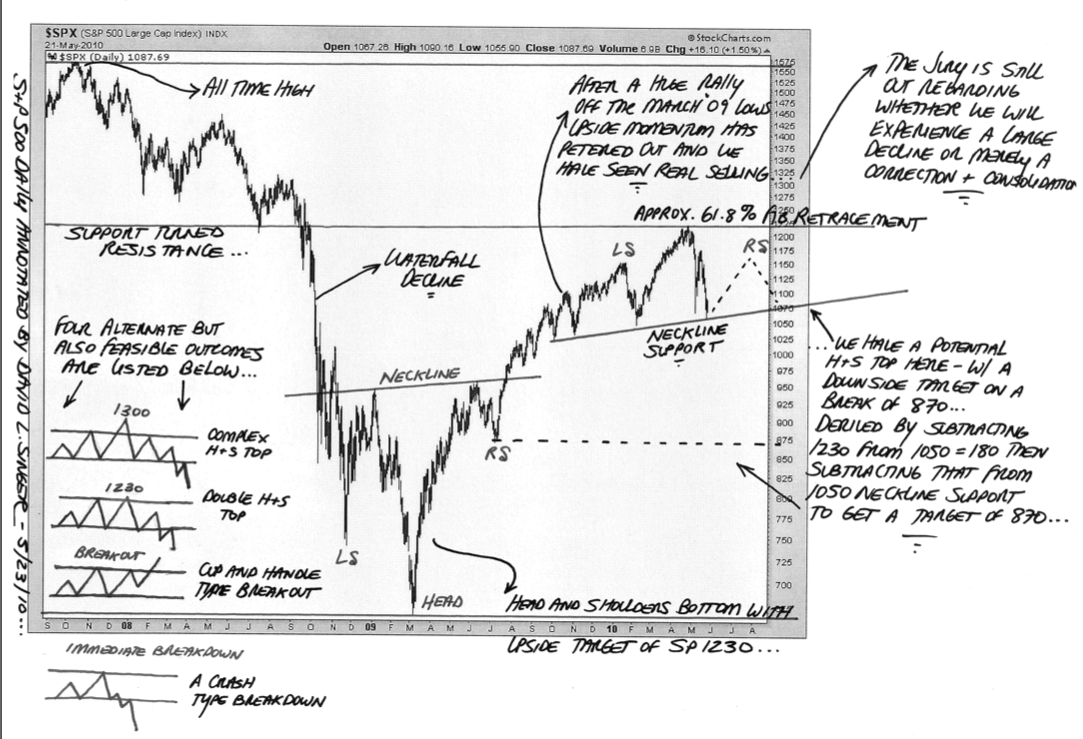
Please see this link to the post below. I posted this chart on August 3, 2009. The chart showed a completed inverse head and shoulders pattern measuring to 1230 on the S&P 500. It is the same pattern shown on the above chart spanning October 2008 to August 2009… The pattern and targets derived from them do not become valid until the pattern completes – until then it is just potential…
http://singerprofitcharts.blogspot.com/2009/08/spx-s-500.html
May 27th, 2010 at 2:38 pm
@f411…you are entitled to your opinion, however uneducated and unprofessional it may be. But if you are going to challenge Singer then leave out the goddamn kindergarten remarks yourself.
May 27th, 2010 at 2:42 pm
Normally, I would think of this as a magic chart. But this time it’s probably right because there are no fundamentals that are available to maintain the prop in the market. The Fed is no longer goosing much of anything openly and much of what is going on in Europe is not flowing into credit markets in a gross way. The fiscal pumps are running out and won’t offer any stimulus unless Congress votes to kick he can down the road a little further. Unemployment is still permeating the labor market and no reversal is in sight, unless BD jobs count as real jobs to anyone other than wall street stock touts.
Maybe the HFT computers will rise the market on empty calories again. There are enough compulsive buyers who regard themselves as professionals to chase the momentum a little. But there’s no growth in the economy, no growth forecast in the economy, and no more free oceans of liquidity flowing out of Fed programs. On the other hand, the market used to rise a lot inexplicably on bad news during the Fed pump. Today reminds me a little of those days.
If the market rises for several days on high volume then the world might look a little bright. That isn’t happening today and is probably another weird fake out.
Anecdotally, the Sunday advertisements have been getting thinner in recent weeks. No empty storefronts are being occupied yet. Oil is mysteriously not exploding in price (= peak oil is junk science when it comes to explaining oil prices).
May 27th, 2010 at 2:43 pm
“The pattern and targets derived from them do not become valid until the pattern completes – until then it is just potential…”
Not trying to argue with your here – but if it’s just a “potential”, and not statistically meaningful, then what is the point? If you cannot accurately predict an outcome after a completed H&S pattern, I’m not sure what the value would be. . .
May 27th, 2010 at 3:06 pm
Weighted evidence means that if you can show a probalistic outcome greater than random chance, that potentially means your approach is creating alpha. I do not believe that any one strategy is the final answer, and hence our Fusion of discipline approach.
Nothing is magic, and many theorists have been fooled by randomness. But technicals have been around for centuries, and there is a more than random basis for using tested technical patterns these as part of your approach.
For those of you who are interested in learning more, I suggest Evidence-Based Technical Analysis: Applying the Scientific Method and Statistical Inference to Trading Signals
May 27th, 2010 at 3:08 pm
@Thor,
The point of dealing with the as yet “potential” patterns is:
1) Every completed pattern at one time was just a potential pattern…
2) Potential patterns allow you to hypothesize about the several different potential outcomes that may eventually materialize as reality… Since the gap between the myriad potential futures and the one that materializes is large, you don’t trade on it until it is complete, i.e. has materialized….
May 27th, 2010 at 3:37 pm
“The pattern and targets derived from them do not become valid until the pattern completes ”
Heh. I like that. Sort of like: nobody knows the future until it gets here.
May 27th, 2010 at 3:42 pm
@ Wally:
Are you aware of someone who knows the future before it gets here? I’m not…
May 27th, 2010 at 3:47 pm
Thanks for the book link.
The more god-damned math I try to put into it, the less sense (signal to noise) it makes. Predicting near-term movements has a lot in common with picking the quickest lane in a traffic jam or trying to steal second base.
Accordingly, this is just one of the pitcher’s moves.
Sentiment, how the money is acting, a 20 on the Johnny-come-latelies are some other moves.
May 27th, 2010 at 3:53 pm
@ SINGER: So you’re saying a pattern MAY complete. Based on what data ? And how often does a pattern NOT complete ?
Until that alaysis is performed, you have no idea whether or not your pattern predictions are better than random.
@ Barry Ritholtz: Without buying the book, could you give an example of “evidence” for technical analysis ? Has someone performed a statistical analysis on trendlines, or “patterns”, or “retreat levels”, etc. ?
May 27th, 2010 at 4:05 pm
Singer,
Do you ever try to figure out WHY a chart may foretell future events, or do you see a formation and only consider the possibility or probability of a repeating pattern WITHOUT regard to why it may occur?
also
“Are you aware of someone who knows the future before it gets here? I’m not…”
Yes, Criswell, but he has left for the great beyond so he probably doesn’t count anymore.
May 27th, 2010 at 4:13 pm
You curse the technicians and weep for the fundamentalists…
Yet, no matter what market you look at: stocks, bonds, commodity, currency, or anything…
You find precisely the same technical patterns forming and reforming, over and over again.
Price is a function of how it’s perceived. And when it comes to perception, human nature never changes.
Fear, ignorance, hope and greed — all on display in one easy-to-read chart.
.
May 27th, 2010 at 4:54 pm
Singer,
Excellent chart, keep up the good work breddah.
Franklin,
Nice to see you’re still the same little bitch you’ve always been. Why dont you go shove a crayon up your ass, instead of being such a douche bag?
Now how’s that for “ad hominem”?
May 27th, 2010 at 6:19 pm
@Wally and @F11 and @Bernie et al
Your skeptical questions are of the general form
Technical analysis does not give you a signal until after a target completes, so what good is it?
That is the definition of technical analysis, learn to watch the market and recognize what it is telling you. The head and shoulders pattern is telling you that a change in direction is confirmed. It is not the start of the change, it is confirmation and you would do well to stop fighting the tape like you did in July of 2009.
Other simple concepts like taking out a former low: The market moved sideways from 4/1 to 5/3. May 5th was the first close (most technicians look at closing data) below the 4/1 close and the 4/27 close. I think the May 5th close was a signal for many technicians to sell or put in stops. where were the stops?
We found out on May 6th that a ginormous number os stops were entered just below the exponential moving average of the SP 500 at 1145. When the market went through this level and took out the stops the 700 point vacuum to the downside occurred. If you don’t want to trade based on technical analysis, that is your choose. If you want to totally ignore what the billions of dollars trading based on technical analysis are doing, you are giving away valuable information.
You can learn more at stockcharts.com/chart school
Maybe you should take a little time to learn before you denigrate technical analysis
May 27th, 2010 at 6:29 pm
DS,
Great work on the chart, thanks.
What do you think about the giant H&S that has been forming over the last decade or so? It’s textbook but the price implications…..
Lot of eyes on the smaller inverse H&S today, though I didnt’ think it looked as good on the Q’s as the others.
that IYR call you made last year was the one I thought would never be right and you basically nailed it.
Thanks again.
May 27th, 2010 at 7:06 pm
Thanks, Ben…. You mean this one?
http://www.ritholtz.com/blog/2009/11/annotated-real-estate-shares-iyr/
May 27th, 2010 at 7:07 pm
Singer,
Thanks for sharing your ideas. A more civil blog would welcome your input and learn from it, even if learning took the form of pointing out weaknesses in a theory instead of the innumerate “Voodoo Science” rebuttal.
The possibility of a cup and handle becomes more clear after you point it out. It is consistent with the sideways consolidating market we had in 2004. And, (even though Wally, F411, and Bernie will miss the buy signal). Do you have any guidelines for depth and duration for a cup and handle pattern?
May 27th, 2010 at 7:10 pm
man, this chart would have been quite useful back in sept 2008.
Most importantly, what is BR’s interpretation and conclusion from this chart ??
May 27th, 2010 at 7:24 pm
Bulkowski’s site has this to say re: cup and handle patterns….
http://thepatternsite.com/cup.html
BTW, if you are interesed in the quantification of how often these pattern complete, are effective, whatever you want to call it, Bulkowski’s site addresses that……
@ Cynic…
I have no particular guidelines… Its more of a “visual analysis” thing for me… You need to know the figures for the “brim”, i.e. resistance and the bottom of the cup portion of the pattern because upon breakout, that is your measured move target… i.e. Brim-Bottom= x… x+Brim= Target…. The handle is just a small version of the cup….
May 27th, 2010 at 8:28 pm
Singer – Thanks for your (very patient :-) explanations and most certainly for the time you take to put these together for TBP. It was not my intention to denigrate you in any way.
What I was looking for was more along the lines of the studies listed below. To answer my own question: TA has indeed been studied and has been shown to be statistically invalid.
http://papers.ssrn.com/sol3/papers.cfm?abstract_id=1181367
http://papers.ssrn.com/sol3/papers.cfm?abstract_id=603481&rec=1&srcabs=1181367
http://papers.ssrn.com/sol3/papers.cfm?abstract_id=566882&rec=1&srcabs=1181367
http://papers.ssrn.com/sol3/papers.cfm?abstract_id=980583&rec=1&srcabs=603481
Cynic – I would suggest you read through these studies before you lecture folks on the usefulness of TA .
May 27th, 2010 at 9:21 pm
@ Cynic_FA
Who’s denigrating it ? All I’d like to see is some sort of statistical analysis showing that “pattern” recognition, trend lines, etc. have better than random results.
And there is a big difference between using a moving average, support level, trend line etc. as a stop loss to get you OUT of the market,
than there is using the same technicals while you’re in the market to predict direction to try to profit.
May 27th, 2010 at 9:37 pm
In the end, TA practitioners can argue vs TA non believers for years right. Only way to prove who’s right and who’s wrong is judging by the results. Which means.. no one ever knows how each other would perform.
May 27th, 2010 at 9:54 pm
Wolfe – Yes, that’s very true, and in the end, a good trader is a good trader, no matter what techniques they use. How much money a person makes in the end is all that matters.
May 27th, 2010 at 10:32 pm
@Thor “Read These Studies”
You may want to read the summary of study #2 on your list. It says “Among a total of 92 modern studies, 58 studies found positive results regarding technical trading strategies, while 24 studies obtained negative results. Ten studies indicated mixed results.” That is your own evidence in your face. 58 out of 92 studies of TA found positive results. These have to be statistically significant, and most efficient market defenders say, “Well, it does not make you enough money for the trading and tax costs”
My point to anyone with a different investment strategy is not to convert to TA; Take into account what TA or quant models are going to do which will move the market. Understanding TA can be like playing a poker game while the guy next to you plays his cards face up. How do you think the simpletons with a gazillion stop loss orders at the 100 day exponential moving average got shtupped so bad on May 6th. Some of the big Ibanks or hedgies knew the “TA Rule” and they punished the stops. Even if you would never trade TA, you need to understand the principles because they move the market.
You might also learn that at the heart of TA is the belief that some material information is non-public. Many studies of strong form efficient market theory have shown that insiders and market makers have material non-public information. For example, the market makers knew where those stops where on May 6th. Insiders knew about problems at Enron and Countrywide and Merrill. The pattern of trading reflects this information. TA states that stocks move before the fundamental analyst can figure out a reason. Twenty six years in the business and I can tell you the million dollar sell side analysts are more likely to be wrong than right.
May 27th, 2010 at 10:49 pm
Cynic -
Fair enough – but with all of this, the general idea of your statement – that the market makers are the one’s in control (which I strongly agree with), why would anyone even think of trying to make money against these odds? It’s as if you’re playing in a very large ca$ino only the odds are stacked strongly in the houses favor. Why would anyone participate in such a thing?
More broadly though, if the market makers are really the one’s pulling the strings, would it be fair to hypothesize that they are also in possession of proprietary TA that the public has no knowledge of? My guess would be yes – to use an IT analogy, it would be like the trading public using version 3.0 of TA while the large trading houses are using version 7.0.
May 27th, 2010 at 11:00 pm
I have to agree with Cynic. Knowledge of what others traders are looking for is invaluable. Gunning and running stops is a time honored practice as old as stops themselves. Looking for the footprints in the dust is also a time honored practice and human nature never changes. TA is simply a reflection of human nature, fear and greed, amateurs and pros showing their cards, or trying to hide what they are doing.
Day after day you see people scratching their heads saying “where did that move come from?”, but the signs are there if you know what to look for and know how to interpret what you are seeing.
Those that deny the methodology behind TA are like blind men looking for a pot of gold. They don’t get it and never will.
May 27th, 2010 at 11:44 pm
This nice pic meens that you are going to outsmart the sp500 :)
May 28th, 2010 at 8:05 am
DS,
7:06, yes, that’s the one I was thinking of with your IYR call. Was a good one.
May 28th, 2010 at 12:32 pm
Thanks Barry for showing these ‘heads and shoulders’, necklines etc which make it great to know that there are people out there who are following this hocus pocus bullshit.
May 28th, 2010 at 3:43 pm
I see there are more smart asses on this site than are usually found on similar sites. Whatever, I’ll put this thought out there.
As someone who has traded markets for 40 years, I’ll add my comment based on my experience(s). The purpose of technical analysis, in my opinion, is to give me a frame of reference to guage probabilities of going long, short or to stand aside. Mr. Singer presents the potential for a H&S formation in the making. Of course there’s no guarantee it will complete! But, if I consider it in light of other technical indicators, e.g. low volume if/when the right shoulder forms with upside resistance forming as well below the height of the left shoulder, it adds more validity to the potential H&S pattern. I canthen take a short position with low risk exposure with a stop loss above the height of the left shoulder.
And that, smart asses, is the value of technical analysis. It gives me logical places to cut losses short and a signal to let profits run when the pattern develops. That’s the name of the game, because I can have twice as many losses if I cut them short and still make overall profits on the winners. If you haven’t figured that out, forget about technical analysis and see how fast you go broke flying by the seat of your pants!
May 30th, 2010 at 8:38 am
I think it’s a great chart, and printed it out. The chart is consistent with my thoughts and it is nice to have a lot of possibilities succinctly on one chart.
I did add 2 possibilities:
1. A H&S breakdown that fails, similar to what happened on a shorter time frame in July 2009.
2. A multi-month, broad trading range.
Dave, if you happen to look back at this thread, thanks for the chart, it’s very practical as an easily referenced big picture reminder. Barry, thanks for posting.
May 31st, 2010 at 12:31 am
I prefer the megaphone top weekly chart scenario at this stage :
http://stockmarket618.files.wordpress.com/2010/05/f_10-05-30_dow-wk.png
The uptrend since March 2009 was a bear market rally contained within a much larger downtrend that started in 2000 …
https://stockmarket618.wordpress.com/about