
Many Still See Economic Gloom

Email this post Print this post
By Barry Ritholtz - May 1st, 2010, 12:00PM

Now, for the flipside of The ‘Worrisomely Unworried’ Crowd.

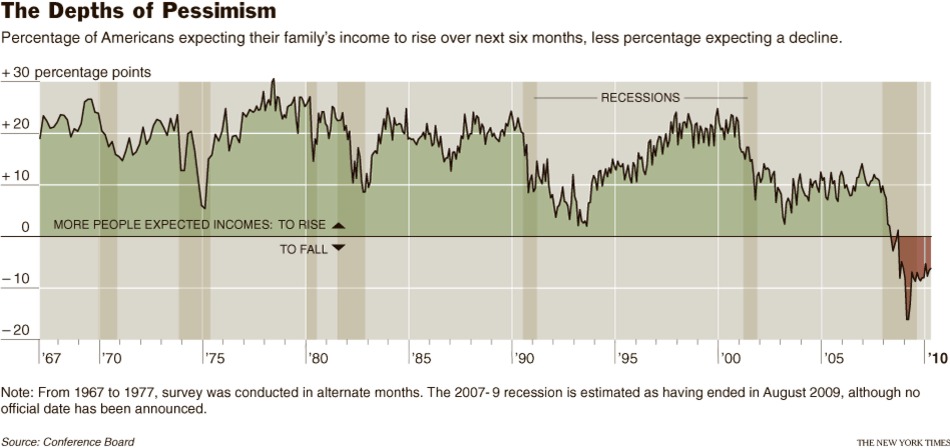
Floyd Norris points out that the Conference Board’s economic survey, which dates back 4 decades, shows a curious change in future expectations. Since 1967, Americans have for the most part, remained more optimistic than pessimistic about their own futures. This was true even when their expectations for the overall economy were negative.

But that optimism disappeared during the 2007-9 downturn. A majority of folks began to expect their own financial situation would get worse — versus those expecting better personal times ahead:

“In April, the Conference Board reported this week, about one person in 10 expected his or her family’s income to improve, while about one in six expected family income to go down.

As can be seen from the chart (below), good times in recent years have produced less net optimism than in previous cycles, while bad times have brought more pessimism.

On its face, such a result would seem to indicate Americans are losing their optimism, but it may not be as simple as that. In this cycle, unlike earlier ones, many workers were forced to take pay cuts, at least on a temporary basis. So it became reasonable to expect lower income, even for some who did not expect to lose their jobs.

Still, the decline in expectations regarding their own incomes is another indication of how much this recession scared people — and that some of the fright remains.”

I suspect that the length of the recession, unusually long compared to recent contraction, might be partly to blame for this. So too does the permanent loss of certain types of employment, and the underemployment lower wages of large percentages of US workers (think U6 data as a basis for this).

Regardless, whether the shift is temporary, or more long-lasting, it is noteworthy.

>

Question: In six months, does the respondent expect his or her own family’s income to be higher, lower or about the same?

click for larger chart
Courtesy of NYT

>

There is a trader’s caveat to this: General surveys have less resonance for market watchers than a bullish/bearish survey does. YMMV.

>

Source:
As Recession Ebbs, Many Still See Gloom
FLOYD NORRIS
NYT, April 30, 2010
http://www.nytimes.com/2010/05/01/business/economy/01charts.html

Comments

Please use the comments to demonstrate your own ignorance, unfamiliarity with empirical data, ability to repeat discredited memes, and lack of respect for scientific knowledge. Also, be sure to create straw men and argue against things I have neither said nor even implied. Any irrelevancies you can mention will also be appreciated. Lastly, kindly forgo all civility in your discourse . . . you are, after all, anonymous.

48 Responses to “Many Still See Economic Gloom”

  1. Bob_in_MA Says:

    I’ll bet dollars to donuts this would track well with personal income ex-transfer payments. These expectations were probably pretty much on the mark.

    It reminds me of the fact that when Wall St economists were saying there was little chance of a recession in the fall of 2007, polls showed average people saw it as around the corner.

    Right now, Wall Street is once again telling us things couldn’t look better and we are headed for a V-shaped recovery. But people see it a lot differently. Wall Street is convinced the average schmoe will once again follow their advice and help them achieve a new bubble in equities. But maybe not…

  2. b_thunder Says:

    It’s not just the length of the recession – for too many folks the last decade turned out to be a “lost decade.” They earn less, they owe more, the lost the faith that their house/apartment/condo will appreciate in price.
    Too many people are disillusioned in terms of their wealth / wealth accumulation and believe that with middle-class jobs disappearing they’ve “lost control” over their future. And unlike the previous cycles, there is a perception that the next decade will be like the last one at best. Nobody expects a decade like the smooth growth of the 1990s or the 1950s with GDP growing @10% for a few years.
    Are their feelings justified or simply influenced by the media? I don’t know. Does everyone feel the same way? Obviously not, but enough people do to “flip” the 40-year trend.

  3. VennData Says:

    Well sure people are pessimistic. They might end up taking one of those jobs only immigrants used to do in Arizona.

  4. constantnormal Says:

    Not really surprising, that people might be pessimistic about their own prospects, after a decade of having obscene greed and completely over-the-top financial rewards ladled out year after year to the financial industry and the CEO class in general, while their own real incomes have been held flat at best.

    Why, looking forward, should they expect anything other than to be ground into grist by “the system”?

  5. constantnormal Says:

    Nice counterpoint piece, BR.

  6. Barry Ritholtz Says:

    I guess I cannot help but be fair and balanced !

  7. Gloomy Says:

    Gloomy Says:

    May 1st, 2010 at 12:19 pm
    Great post from Doug Noland:

    “I’ll date the beginning of the end for the Wall Street/mortgage finance Bubble on June 7, 2007. While subprime problems had been festering for months, that was the day Bear Stearns announced that two of its mortgage derivatives funds would no longer allow redemptions. From that moment on, speculative finance was on it way out of the mortgage sector. I would not be surprised if Tuesday April 27, 2010 marked an important inflection point for the Global Government Finance Bubble. The stock market was able to muddle through more than a year of mortgage market tumult before succumbing to an all-out crisis. So, marketplace complacency in the face of expanding crises in European debt markets and Wall Street risk intermediation is not all that surprising.

    Greek debt contagion took a dramatic turn for the worst. Two-year Portuguese government yields jumped 104 bps Monday to 3.97% and then spiked above 5% in Tuesday’s rapidly escalating market dislocation. After beginning the month at 1.58%, Portugal’s two-year government yields Wednesday traded as high as 5.93%. At the worst of the week’s dislocation, Portuguese Credit default protection jumped to 450 bps, after starting April at 144 bps. Ireland’s two-year government yields surged as high as 4.28%, up from last Friday’s 2.34%. Yields in Spain jumped above 2.3%, after ending last week at 1.70%. Italian two-year yields also jumped as much at 50 bps from Friday’s level to approach 2.0%. It is certainly worth mentioning that Greek two-year yields rose above 18% Wednesday, before ending the week at 12.67% (after beginning the year at 4%).

    And most will argue, perhaps even persuasively, that European debt market tumult will have little impact on our market and economic recoveries. Readers surely remember how the U.S. economic expansion was supposed to be immune to subprime woes. But fragility is inherent to Bubbles, and contagion is fundamental to Bubble risk. It is the nature of things that the weakest link tends to be the first to succumb. And as confidence falters, previous risk misperceptions are comprehended and complacency is abandoned – greed morphs to fear and the dominoes begin to tumble. I don’t know how much or for how long it might take for contagion to find its way to U.S. debt markets. I am, however, confident that we face enormous structural debt issues that the markets won’t disregard forever.

    The Goldman fiasco does not inspire confidence. Tuesday April, 27 was not a good day for Goldman, proprietary trading, the OTC derivatives marketplace or private-sector risk intermediation. It definitely marked an inflection point for efforts to impose greater regulatory restraint upon the financial sector. The old ways may have persevered through the LTCM, Enron, GSE and mortgage fiascos, but today’s intense scrutiny of Goldman Sachs will alter the manner in which Wall Street goes about its business. The near-term ramifications for our government-dominated Credit system and economy are anything but clear. There days financial conditions are loose, confidence is high, market liquidity remains overabundant, and there is little difficulty intermediating risky Credit. But there is, at the same time, Bubble fragility unrecognized in an overconfident marketplace.

    Reigning in Wall Street proprietary trading desks and derivatives operations pose major additional challenges for an already challenged private-sector Credit mechanism. The Street’s new realities will make it more difficult for private-sector Credit to anytime soon supplant Washington’s Credit juggernaut. From my perspective, this equates to massive deficits – for bigger and longer. This means, at some point, greater market risk to a change in market perceptions and a surprising jump in yields. And I would argue that Goldman and Wall Street’s problems ensure that the markets for risk intermediation – interest-rate, Credit, equities, currency, etc. – become less liquid and more vulnerable to dislocation.

    Perhaps it doesn’t matter all that much for now, but the dislocation that unfolded in European Credit default swap markets on Tuesday April, 27, 2010 portend serious issues for sovereign debt markets both abroad and at home. There’s hope that European policymakers and the IMF can come up this weekend with a credible plan for Greek aid. I would tend to believe that the “genie is out the bottle” and that global markets are in the early stage of adjusting to new uncertainties and risk realities. Many that have planned on using derivatives markets to hedge future market risks may begin to reevaluate their approach to risk taking and management.”

    http://www.safehaven.com/article/16619/tuesday-april-27-2010

  8. mark Says:

    Which of those recessions in the chart was part of a global financial crisis, an imploding global real estate bubble, global interest rates at the zero bound and inflation near zero and still falling?

    Without context the chart is worthless.

    As for consumption, I recommend Dean Baker’s take (Dean is one of the few economists to recognize and publicly warn about the housing bubble ahead of time):

    http://www.cepr.net/index.php/beat-the-press/actually-economists-who-know-arithmetic-are-not-qhopeful-that-families-will-continue-to-pick-up-the-pace-of-purchasingq/

  9. jeg3 Says:

    For the majority of Americans seeing gloom is a reality that may take a generation to change:

    http://www.economicpopulist.org/content/war-middle-class

    But things may change:
    “If the GOP in the Kansas Senate is voting for tax increases instead of strictly looking at more budget cuts, I’d say that hearing from the folks back home is having an impact.”
    http://firedoglake.com/2010/05/01/teacher-layoff-season-returns/

  10. dss Says:

    WalMart isn’t lowering their prices because they think that the economy is going to improve in the next 6 months to year. What is WalMart seeing that Wall Street is not? I don’t understand why the retailing segment is doing so well given that WalMart seems to think lowering prices is the best strategy.

    While business might be doing well for some pf those companies who survived the recession, the millions thrown out of work are still unemployed, underemployed and have few prospects, hence the lack of optimism.

    Plus this is the first deep recession where the largest cohort, the boomers, have been affected and many are not finding jobs or the jobs they do find are paying less with fewer benefits. Many boomers are too young for Social Security, and too poor to retire on their own depleted retirement accounts. How many will never find work again at their former level of pay?

  11. Sunny129 Says:

    1. The bulk of Baby Boom (1946-1963— 45-55 yrs house holds) is changing from consumption phase to retirement with poor savings and battered housing value and pensions.401ks and IRAs!
    Frugal living is not just option but compulsory!

    2. 70% credit created for the last 5-10 years was from SECURITIZATION which is virtually dead now!

    3. Progressive Global labor arbitrage since 1999 is a new and significant phenomenon, altering the pay scale in Western world!

    4.There cannot be healthy Equity market without healthy Credit market which is in ICU and may be subjected to repeated cardiac arrests! Credut for Private is contracting and facing competition from Govts all over!

    5. The attitude towards DEBT is different in the current generation compared to earlier. They have seen what Debt has done to their parents, relatives and friends!

    There is a head wind against the ship with multiple leaks covered with band aids.

    (I bet I missed something ‘doom and gloom’!

  12. Barry Ritholtz Says:

    Sunny129, I don’t disagree with any of your 5 points.

    But here is the key question: How much of that is well known, reflected in prices, expectations and markets?

    My issue is always what is widely understood, consensus that is reflected in market prices.

    Its not that what you say is false — its that its too true, and already part of what is known and understood.

  13. hue Says:

    Confessions Of A Wall St. Nihilist: Forget About Goldman Sachs, Our Entire Economy Is Built On Fraud

    “There was a strange moment last week during President Obama’s speech at Cooper Union. There he was, groveling before a cast of Wall Street villains including Goldman Sachs chief Lloyd Blankfein, begging them to “Look into your heart!” like John Turturro’s character in Miller’s Crossing…when out of the blue, the POTUS dropped this bombshell: ‘The only people who ought to fear the kind of oversight and transparency that we’re proposing are those whose conduct will fail this scrutiny.’

    The Big Secret, of course, is that every living creature within a 100-mile radius of Cooper Union would fail “this scrutiny”—or that scrutiny, or any scrutiny, period …” http://bit.ly/9sevw8 (via Infectious Greed)

    hyperbole? Mark Ames, the author, and Matt Taibbi, the man who brought us “the vampire squid”, were once co-editors.

  14. willid3 Says:

    i am thinking it was the lack of job growth in the last decade along with income growth which was negligible at best, or was in negative mode. all the while we were sold that the economy was doing great! for some 1% of people maybe it was. and that if we just gave them a bigger tax cut they would provide jobs, what a sales job that was! and some still sell it today. and some still sell their snake oil that do every thing for business will improve the employees lot. not

  15. Mike in Nola Says:

    The only problem is that the chart doesn’t go back far enough. You probably would have seen something similar back in the 1930′s. All the financial baloney going on since the crash has not done much for the middle and lower classes, other than inflating 401k’s a bit for those lucky enough to still have them. Joe Sixpack is screwed and scared, as are those getting out of college with huge loans and no decent jobs. It will take another generation to get over it, mush as happened with the Depression generation.

    My parents came up through the Great Depression and they have been worried about money throughout their whole life, even though they had a pretty smooth life after the war, worked for one company for 30 years with no layoffs, no serious health problems, no housing problems and even health insurance from Lever Bros. during the first 20 years of retirement.

  16. dss Says:

    This number might account for the pessimism:

    And as for fairness, Real Weekly Earnings peaked over 35 years ago in September 1972! Using the CPI to adjust wages to today’s dollars, the average worker made $738.48 per week in September 1972. In January 2008, that figure was $598.18.

    Read more: http://www.creditwritedowns.com/2008/03/populist-interpretation-of-latest-boom.html#ixzz0mhx51v2g

  17. JustinTheSkeptic Says:

    Who cares! Have a cigar and enjoy the Derby. I hear the odds on Bernanke are??????

  18. Joey Says:

    Not too surprising, especially when set against the backdrop of a business community & government that is increasingly seen as morally bankrupt & predatory.

  19. zell Says:

    U-6 holds the key, not only to the gloom but also to the “nascent recovery” which is the pent up demand of the fortunate who have survived to spend another day. Still, going forward, with the widely accepted assumption for the labor market, the economy is going to missing alot of participants, and will not justify optomism. The market bulls can do what they want but numbers like those cited by “dss” above are the real story. We have all seen the market go up and down. So what.
    We have “eaten” our young and are still going to watch the undertow of debt play itself out internationally. Cheers!

  20. DoctoRx Says:

    Forget “Great Recession” euphemisms. This was a depression–just not a Great depression. That’s why.

    Of course BR is correct re markets “knowing” this. The prob is that cyclically adjusted P/E and “q” as interpreted by Andrew Smithers show the stock mkt is at near-record overvaluation levels. It is only against ZIRP that current prices and dividend yields are justifiable.

    Plus, even in 1932, the large banks were safe. Now they are prob insolvent and/or there is absolutely no way to tell.

  21. Patrick Neid Says:

    Aside from moderate swings inside a trading range, pessimism will rule until housing prices fully recover. For the vast majority of homeowners it was their life savings or what they thought would be savings through appreciation. With that now gone there is a sense that there is not enough time to make up the losses amongst the retiring baby boomers. That spells funk.

  22. Transor Z Says:

    Boston and 30 surrounding communities are under a state of emergency. The main water line running into the metro area has had a catastrophic leak. About a million people are now under a boil-water order.

    http://www.thebostonchannel.com/news/23337764/detail.html?hpt=T2

    http://www.boston.com/news/local/breaking_news/2010/05/catastrophic_le.html

  23. alfred e Says:

    @Transor: How tragic. And a newer line. Isn’t Boston noted for it’s public works cost overruns and under-performance? Didn’t a similar thing happen on the Big Dig? Bet the contractor got his performance bonus, and the politicians got their “funding” as well.

    So, I suppose people aren’t totally out of touch. Who wrote the recent book something along the lines “When Societies Collapse/Fail”

    Kind of like watching the collapse of social order and corruption in Russia and Europe and saying that could never happen in America. Our social bonds, trust and honesty are too strong.

    Guess we’ve finally grown into the old world social order. And that’s really why people are down.

    First, Greece, then Portugal, then Spain, then Italy, then France, then USA.

    But the elites have theirs banked off-shore.

  24. snapshot Says:

    http://news.yahoo.com/s/ap/20100430/ap_on_bi_go_ec_fi/us_economy

    “As Recession Ebbs, Many Still See Gloom”

    Maybe that’s because:

    “Growth would have to be 5% for a full year to drive the unemployment rate down by 1 percentage point.”

  25. Mannwich Says:

    @Transor: That is terrible news. I’ll have to check in with my MA peeps for an update.

  26. Mark E Hoffer Says:

    somewhat OT:

    BR,

    excuse me if I mis-recall, though, didn’y you, just the other day, have + things to say about this dude, Khuzami:
    “…“You don’t get it, Ames. Even Khuzami, the SEC guy in charge of the Goldman case, is a fraud; the fucker was Deutsche’s general counsel when they pulled the same CDO scam as Goldman. You have no idea how deep this goes.”

    And it’s clear that a lot more people here are aware of how fundamentally rotten things are but they’re not willing to face the big fraudonomics bummer yet, preferring instead to stick with specific accusations….”
    http://exiledonline.com/confessions-of-a-wall-st-nihilist-forget-about-goldman-sachs-our-entire-economy-is-built-on-fraud/

    how would Khuzami, even, begin to clear those types of, seemingly, imbedded conflicts?
    ~~
    another, worthwhile, one: http://exiledonline.com/did-goldman-sachs-manipulate-journalists-and-stock-price-on-same-day-as-senate-testimony/

  27. CitizenWhy Says:

    Part of the growing pessimism about America’s prospects is due to the relentless right wing propaganda aimed at destroying confidence in government. Another right wing tactic, as articulated by Reagan’s budget director, is to increase federal debt to the point where social benefit programs are curtailed or eliminated.

    This right wing attack on the legitimacy of government (except for war and policing) occurs at the same time that corporate control of the government and the economy becomes clearer and clearer. The far right is determined to continue transferring wealth from the middle class to the wealthiest.

    The right gets a mandate to rule in times of fear and pessimism. Even without the mandate, it has a strategy to have its propaganda talking points repeated by all media, including liberal media. And it knows that lobbyist control of Washington will only increase, to the benefit of the right.

    By reducing populism to and public discourse to “no taxes” and the “perpetual war on terrorism” the right easily proceeds to govern even as a minority.

  28. Transor Z Says:

    @alfred e:

    Guess we’ve finally grown into the old world social order. And that’s really why people are down.

    Wish I didn’t agree with you.

  29. alfred e Says:

    @MEH: First article killer. In a reverse kind of way. Truth.

    Second article good, but left hanging.

    Might be really interesting to know who juiced GS stock on testimony day. Start with volume and then move to … GS prop desks and HFT???? No way. Aren’t you glad the efficient market theory is finally dead?

    Me thinks something else is rotten in the state of Denmark. To quote a bard.

  30. Mark E Hoffer Says:

    Transor,

    Warnings, like these: “When a road bridge over the Mississippi river collapsed in 2007, the images of the disaster reminded a shocked nation of Hurricane Katrina and 9/11. Segments of the interstate were lying in the waters, dozens of cars had been hurdled into the river, a freight train lay crushed under tons of concrete and steel.

    But rescue workers soon realized that neither a natural disaster nor a terrorist attack had caused the catastrophe. The 40-year-old bridge had simply collapsed, becoming another example of America’s crumbling public infrastructure.

    The warning went unheeded. In 2009, the American Society of Civil Engineers still rated critical infrastructure in the United States as a lowly “D”. About 2.2 trillion dollars would be necessary over the next five years to upgrade key infrastructure, the engineers estimated.

    The U.S. is not alone. Worldwide, some 35 trillion dollars will have to be spent over the next 20 years to meet infrastructure needs, estimates the World Bank…”
    http://knowledge.allianz.com/en/globalissues/climate_change/top_climate_stories/infrastructure_investments_lack_accidents_global_risks_2010.html

    have been sounded, from Responsible Authorities, for more Moons than I care to count…
    further.. http://clusty.com/search?input-form=clusty-simple&v%3Asources=webplus&query=Infrastructure+Water+World+ASCE

    yet, no matter the ‘Party’, in Power, nothing of any consequence has been done to close the ‘Infrastructure Gap’..

    and, Memo to the: “Designed in Cupertino, Made in Shenzen”-acolytes: your apped-out Globalized Hyperspace runs on ‘Bricks and Mortar’..

  31. Mark E Hoffer Says:

    alfred e,

    from the Comments, of the 2nd Link: “Great stuff, Ames.

    Half our media intake is PR lead – and if you’ve got as much money and power as Goldman Sachs, the possibilities are endless.

    Calling out the journalists by name is the only answer.”

    like this: “Everywhere you look, there’s this insane reverse-populist spin on the Goldman story, as if they’re the underdogs, as if they never fucked the entire country and the next three generations to come by tanking the markets, ruining the middle class, and then sucking out tens of billions in taxpayer bailout funds. Even my old friend Megan McArdle at the Atlantic Monthly tweet-attacked the Senate’s bullying and posturing:…”

    of a certifiable Hack, like McArdle, the takeaway, I derived, from the article..

    ~”You gotta understand who you can’t understand..”
    ~~
    “”News is what someone does not want you to print – the rest is advertising,”
    Randolph Hearst

    The relationship between the news media and the PR industry is a complex and increasingly symbiotic one. The media is the central vehicle for much of the PR industry’s messages. PR practitioners want to place their stories in the news or other publications and programmes. Without being able to do this, PR would lose one of its main avenues for communication with the public.

    The media in turn has become more dependent on PR to supply content to fill air time or column inches. Whilst newspapers have been steadily shedding staff over the last couple of decades they have simultaneously managed to produce ever thicker publications, and the ever growing ranks of PR are happy to help fill the pages.

    The power of the big agencies and spin doctor goes beyond this however. As the primary point of contact between businesses and the media, PR people can control access to information which journalists want. This gives them tremendous leverage in negotiating with journalists, as they are in a position to refuse information. Magazine editor, Mark Dowie, comments “even the most energetic reporters know that they have to be somewhat deferential in the presence of a powerful publicist. No one on a national beat can afford to get on the wrong side of a Frank Mackiewicz or a Harold Burson, knowing that their firms [Hill & Knowlton and Burson-Marsteller] together represent a third of the most quotable sources in the country.”[70]

    5.1 Planting Stories…”
    http://www.corporatewatch.org.uk/?lid=1572

  32. Paul Jones Says:

    They have the gloomy feeling of a man who’s crushing cardiac arrest pain was dulled by morphine only to find that the cath lab doesn’t take his insurance…

  33. alfred e Says:

    @MEH: Great points. Agree.

    What is one to do?

    My sense is lots of J6Ps aren’t buying all the MSM BS anyway.

    But what’s their choice? Watch 8 million gallons a day of water run of their taxpayer pipeline?

    And have to boil water to drink it?

  34. Cdale_dog Says:

    Barry can say all day long that all the terrible news is priced into the market, but I still believe that if we had a republican in the White House, this market would be at 6500 still. Cheerleading for BHO is the ONLY reason this market is up. We only get good news on 95% of the MSM and all you hear about these days is how much better things are getting. I can tell you with certainty things ARE NOT getting better out here in the midwest. State governments are going bankrupt and have started to stop enrolling new workers into defined benefit plans (401k’s for the gubment workers is a BIG change).

    I will wait until the European contagion hits us and I will be buying SDS all the way down….

  35. dsawy Says:

    Wait a minute: Haven’t we agreed on TBP that EMH is pretty much BS by now?

    If so, why would this be priced into the market?

  36. How the Common Man Sees It Says:

    The boomers are beginning to embrace Joe Black and thinking of doing some serious suck face with him

    @BR

    But here is the key question: How much of that is well known, reflected in prices, expectations and markets?

    My issue is always what is widely understood, consensus that is reflected in market prices.

    I think the printing press allowed folks to be in denial for a year (or maybe they weren’t in denial but they were just in avoidance mode) but that year has run out and reality is beginning to sink in. UE benefits are running out and the next stage is welfare for the grasshopper generation

    Morpheus: Welcome to the Desert of the Real

  37. purple Says:

    This just reflects reality. The wealthy are doing well, everyone else is not. Ensconced economics professors tinkering with imaginary models are probably surprised, true.

  38. farmera1 Says:

    DEBT-DEBT-DEBT keeps rolling around in my mind as my root cause of the current ma-laze. J6P doesn’t understand this specifically but he knows something is wrong and his wallet has been assaulted for the last two decades as the debt grew exponentially.

    http://www.bullandbearwise.com/DebtOverGDPChart.asp

    The total debt (governmental, personal and corporate debt as a % of GDP) in the US is at record highs now at some 360 percent. This excessive debt falls into my definition as debt that will nor can it be repaid. As a percent of GDP total debt peaked out in the early 1930s at about 190% of GDP. This percentage dropped and stayed low until the 1970s where it started going up and has been growing exponentially. By the way exponential growth curves are inherently unstable.

    By the way this graph doesn’t show unfunded liabilities such as Medicare that is completely out of control. All of our great financial engineering ala Goldman et al just allowed this graph to grow much higher than it could in the 30s. My only hope is that the subsequent fall isn’t correspondingly hard.

    Historically there is only two ways out of an excessive debt situation: 1) A depression where excessive debt is destroyed. 2) Inflation where cheap money pays off the unpayable.

    Bernanke and the boys are trying to finesse this debt by managing a combination of inflation/deflation. Will they be successful, I personally doubt it in the sense that there will be tremendous pain no matter what is done now. There will be tremendous pain no matter what IMHO.

  39. HEHEHE Says:

    BR,

    I agree with you that the only real issue from an investment standpoint is what is currently priced into the markets. Personal opinion is that little of that is currently priced into equities. They are still riding the $3-4T paper job the government instituted. You can’t tell me that wave of liquidity isn’t currently priced into the market.

  40. snapshot Says:

    So do I have this right so far?

    We can’t throw the crooks in jail – they are all crooks and the markets would tank ala Lehman days – game is rigged – game over.

    We can’t allow the house prices to fall to their natural level because the banks couldn’t take the hit – banks done – markets tank – pensions, cities, countries lose it all – game over.

    We can’t allow the house prices of houses to fall and be reassessed at new lower values because the cities and states are already not taking in enough tax revenue…need to avoid mass layoffs – that would devastate/ bankrupt cities/states – game over.

    Folks are either out of work or earning less so they are holding on to what little money they do have – because they know they could be next – reduced spending – GDP of less than the 5% needed to reduce the unemployment rate by even one percentage point – for years to come.

    A few folks will go to jail to keep it real. And the gov will continue to do whatever they can to prop up the mortgage market. The gov must also come up with a way to show we are serious about our debt so we need a VAT – some new tax funds to address our deficit. (Besides the health care bill that is truly just a taxing mechanism.)

    What else?

  41. Transor Z Says:

    Katrina exposed the weak underbelly of domestic infrastructure/preparedness (or lack thereof) a few years ago. I’m dreading the impact of this oil slick and watching ineffectual clean-up efforts. The tally is now 2 million here in eastern Massachusetts on a boiled water alert. We bought 50 gallons of bottled water mid-afternoon yesterday and people were getting physical with each other in the water aisle. The state wasn’t giving a time estimate for repair, so we knew it would be a while. Probably embargoed that detail to prevent panic. Released it this morning: “days if not weeks.”

    Murphy’s Law.

  42. jeg3 Says:

    Me thinketh that Wall Street thinks it has Main Street discounted (which still likely has further to fall), but has not
    discounted its own self inflicted woe.

    Besides Fed-Treasury Bailouts, How Much everyone paying for gasoline?
    http://maxkeiser.com/2010/05/02/ote52-on-the-edge-with-max-keiser-david-degraw/

    At least spring is here.

  43. flipspiceland Says:

    @CitizenWhy

    Can’t believe after all that has happened that clearly points to the guilt and ineptitude of politicians in both partys that you would make this a partisan rant.

    Transgress.

  44. willid3 Says:

    maybe this shows why?
    http://calculatedriskimages.blogspot.com/2010/05/investment-contributions-q1-2010.html

    notice that after 2001 we never really get back to any normality.
    and then after the GR starts

    it gets worse!

    http://calculatedriskimages.blogspot.com/2010/05/investment-contributions-q1-2010.html

  45. How the Common Man Sees It Says:

    If 2009 equals 1929 then I suppose 2012 will equal 1932 (the year of the bottom). The ’10s will equal the ’30′s and the war will start to kick in through the second half of the decade. Something tells me it won’t be Germany that triggers it this time.

    Something also tells me that before this is all over I’ll be very thankful that I am completely out of debt

    Anyway, strap yourselves in folks. This could get bumpy

  46. Mark E Hoffer Says:

    alfred e,

    to your query: “What is one to do?”

    one might be well-served to review: “When in the Course of human events, it becomes necessary for one people to dissolve the political bands which have connected them with another, and to assume among the powers of the earth, the separate and equal station to which the Laws of Nature and of Nature’s God entitle them, a decent respect to the opinions of mankind requires that they should declare the causes which impel them to the separation…”
    http://www.archives.gov/exhibits/charters/declaration_transcript.html

    see snapshot’s post, above, and, in part: “..A few folks will go to jail to keep it real. And the gov will continue to do whatever they can to prop up the mortgage market. The gov must also come up with a way to show we are serious about our debt so we need a VAT – some new tax funds to address our deficit. (Besides the health care bill that is truly just a taxing mechanism.)..”

    to think that the current schema is of any benefit, compared to its costs, for the vast majority that derive few of its fruits, begins to stretch credulity..
    ~~
    “If treasury bills are emitted on a tax appropriated for their redemption in fifteen years, and (to insure preference in the first moments of competition) bearing an interest of six per cent, there is no one who would not take them in preference to the bank paper now afloat, on a principle of patriotism as well as interest; and they would be withdrawn from circulation into private hoards to a considerable amount. Their credit once established, others might be emitted, bottomed also on a tax, but not bearing interest; and if ever their credit faltered, open public loans, on which these bills alone should be received as specie. These, operating as a sinking fund, would reduce the quantity in circulation, so as to maintain that in an equilibrium with specie. It is not easy to estimate the obstacles which, in the beginning, we should encounter in ousting the banks from their possession of the circulation; but a steady and judicious alternation of emissions and loans would reduce them in time.” –Thomas Jefferson to John W. Eppes, 1813. ME 13:275

    “Certainly no nation ever before abandoned to the avarice and jugglings of private individuals to regulate according to their own interests, the quantum of circulating medium for the nation — to inflate, by deluges of paper, the nominal prices of property, and then to buy up that property at 1s. in the pound, having first withdrawn the floating medium which might endanger a competition in purchase. Yet this is what has been done, and will be done, unless stayed by the protecting hand of the legislature. The evil has been produced by the error of their sanction of this ruinous machinery of banks; and justice, wisdom, duty, all require that they should interpose and arrest it before the schemes of plunder and spoilation desolate the country.” –Thomas Jefferson to William C. Rives, 1819. ME 15:232
    http://etext.virginia.edu/jefferson/quotations/jeff1325.htm

    “To preserve [the] independence [of the people,] we must not let our rulers load us with perpetual debt. We must make our election between economy and liberty, or profusion and servitude. If we run into such debts as that we must be taxed in our meat and in our drink, in our necessaries and our comforts, in our labors and our amusements, for our callings and our creeds, as the people of England are, our people, like them, must come to labor sixteen hours in the twenty-four, give the earnings of fifteen of these to the government for their debts and daily expenses, and the sixteenth being insufficient to afford us bread, we must live, as they now do, on oatmeal and potatoes, have no time to think, no means of calling the mismanagers to account, but be glad to obtain subsistence by hiring ourselves to rivet their chains on the necks of our fellow-sufferers.” –Thomas Jefferson to Samuel Kercheval, 1816. ME 15:39
    http://etext.virginia.edu/jefferson/quotations/jeff1340.htm

    Sometimes, too much is enough..

  47. dss Says:

    Let’s go back to taxing the rich at 90%, and raise the capital gains taxes. Tax hedge fund managers at regular income rates, and all bonuses at 90%. Stop giving favorable tax treatment to stock options. Social Security taxes need to be increased like Medicare taxes, on all income. Social Security would be self funding.

    Ban all securitization of mortgage loans, auto loans and credit card loans, the world survived quite well before they were invented. Ban all credit default swaps.

    Why are we afraid to increase taxes, especially on many of those who caused this mess?

  48. Ted Kavadas Says:

    I found the blog post and comments interesting.

    I think that these optimism readings, or lack thereof, is based upon a number of factors. Certainly the job situation is weighing heavily upon current readings.

    For those who found the chart shown interesting, I have recently posted four other confidence charts that show confidence readings from a long-term perspective. They are very interesting and show confidence to be at subdued levels from a historical perspective – and are glaringly divergent to the price action of the S&P500:

    http://www.economicgreenfield.com/2010/04/29/four-confidence-survey-charts/

111 queries. 0.594 seconds.