Euro Zone’s Problem Children
Der Spiegel has this terrific set of graphics looking at the Euro Zone’s problem children:
>
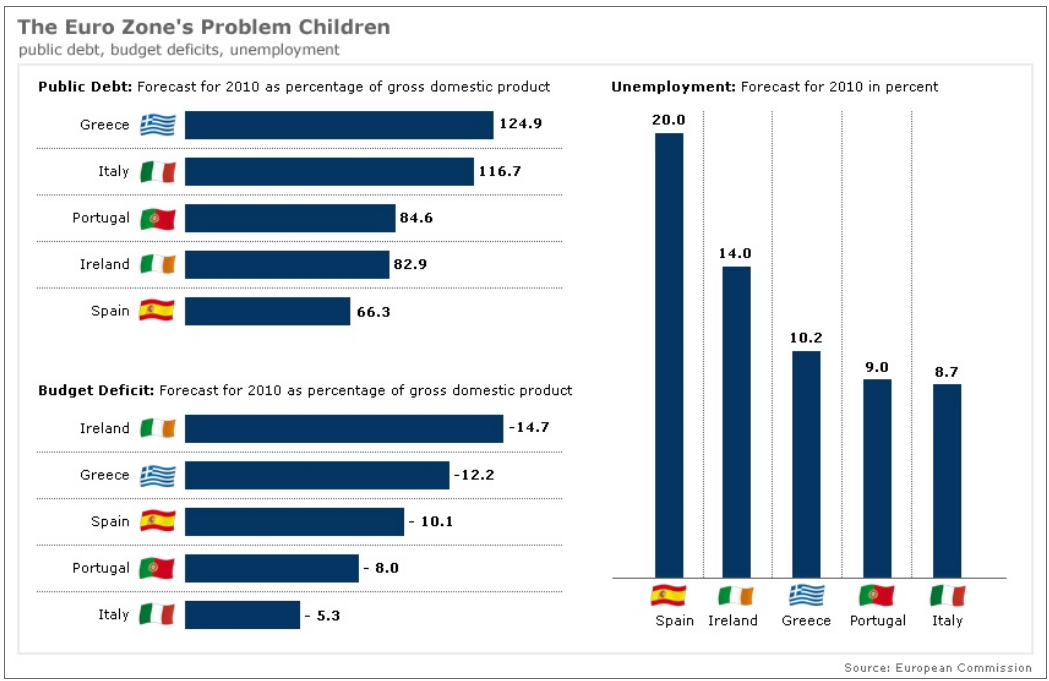
Der Spiegel has this terrific set of graphics looking at the Euro Zone’s problem children:
>
Please use the comments to demonstrate your own ignorance, unfamiliarity with empirical data, ability to repeat discredited memes, and lack of respect for scientific knowledge. Also, be sure to create straw men and argue against things I have neither said nor even implied. Any irrelevancies you can mention will also be appreciated. Lastly, kindly forgo all civility in your discourse . . . you are, after all, anonymous.
May 13th, 2010 at 12:14 pm
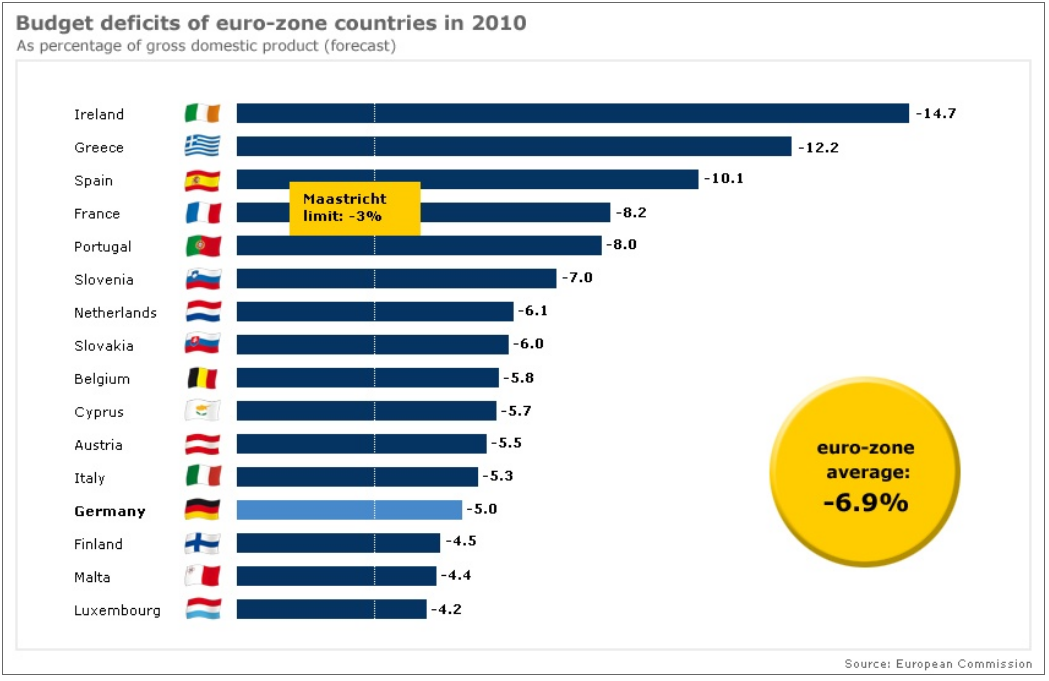
The fucking Eurozone average budget deficit exceeds its own rules for fiscal discipline. Need some retroactive rule re-writing, I suppose.
And this is all fixed? Europe’s median age is roughly forty, across the board, and we are to believe that they’ll grow their way out of this? Nonsense. They’re not growing, they’re dying.
May 13th, 2010 at 12:19 pm
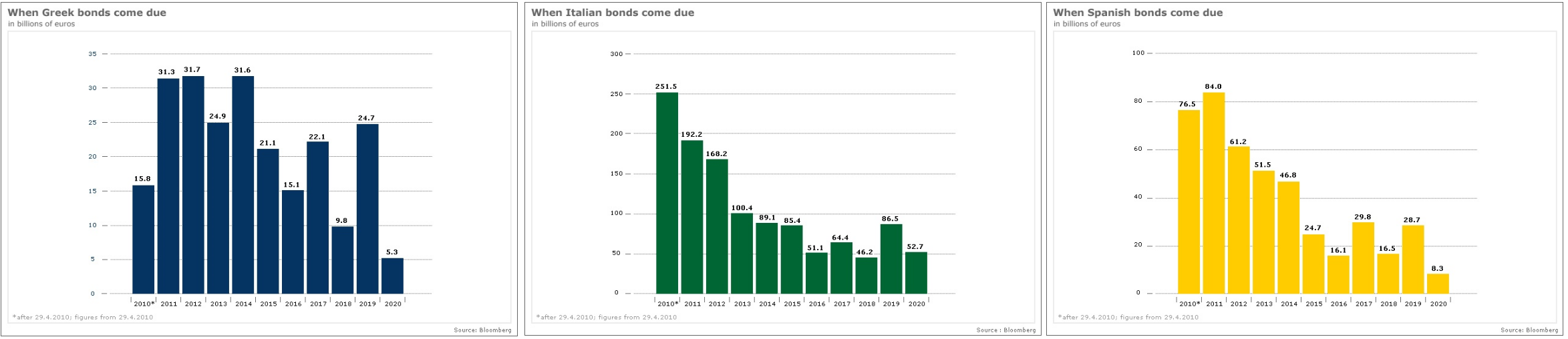
Ouch, take a look at the number Italy is going to have refinance this year alone, let alone 2011 and 2012. Better get that bailout money soon before its all used up. The Euro is still in for some serious problems.
May 13th, 2010 at 1:03 pm
Not one country out of the lot can keep within its budget deficit targets. That is outrageous
May 13th, 2010 at 1:12 pm
En europe,nous vivons actuellement trois krachs: un krach monétaire avec la chute de l’euro et accessoirement de la livre sterling, un krach obligataire avec la chute des obligations d’Etat des pays du sud de l’euroland, un krach boursier avec la chute des actions partout dans le monde
desolé mais mon anglais n’est pas tres bon
In Europe, we are now three crashes: a currency crash with the fall of the euro and the pound sterling incidentally, a bond market crash with the fall of government bonds of countries in the south of the euro zone, with a stock market crash falling shares around the world
sorry but my English is not very good
May 13th, 2010 at 1:15 pm
your english is much better than my french. Thanks.
May 13th, 2010 at 1:28 pm
Malta is doing pretty well. I’d say that’s reason for optimism for the whole lot.
May 13th, 2010 at 1:29 pm
@forcast
What are the common people saying about gold over there? Is it gaining interest?
May 13th, 2010 at 1:39 pm
actually, Italy is in the best position to get out of this currency crisis.
May 13th, 2010 at 1:57 pm
It became more than an interest in the Gold, in some cities there are almost as many coins (Napoleon)
Here the rise in euro gold has become parabolic
May 13th, 2010 at 2:28 pm
unfortunately, the USA fits right in:
2010
Public Debt/GDP ($B)
9,881.9/14,727.1 = 67.1%
Deficit/GDP ($B)
1,565.6/14,727.1 = 10.6%
Unemployment rate = 9.9%
http://www.gpoaccess.gov/usbudget/fy10/pdf/hist.pdf
http://www.bea.gov/newsreleases/national/gdp/gdpnewsrelease.htm
http://www.reuters.com/article/idUSTRE60U00220100201
http://www.usgovernmentspending.com/index.php
May 13th, 2010 at 4:13 pm
Funny.. Not ONE surplus? It could be surmised that even if we were taxed at 100% government would find a way to spend even more than that… Pathetic.
May 13th, 2010 at 6:13 pm
Merci Forcast, I was dusting off my old school French lessons trying to discern what you wrote en Francais.
Maybe Papandreou could say “apres moi, le deluge”
The Euros don’t have firm commitments for funding the announced bailout and this is no “slam dunk”
May 14th, 2010 at 4:16 am
Why don’t you put the US data for comparison?
US Public debt; 98% of GDP
Budget Deficit: 10.64% of GDP
Unemployment: 10%
Portugal has better numbers than the US.
The US started this crisis with years of promoting unregulated market fundamentalism and now the US wants to lecture Europe on the need of tough social cuts. Here in Europe we do not need more US and IMF recipes.
May 14th, 2010 at 5:54 am
Surplus is mostly absorbed by the private sector in a capitalist system, the public sector raises cash by borrowing or taxing (with much resistance) from the private sector. Public debt is part and parcel with a capitalist economy almost by definition. Looking at the history of the US this seems to be true.
More immediately, how does one eliminate public deficits without crashing the economy when unemployment is at 8% in the OECD countries as a whole. Don’t count on China – with its over capacity – being the consumer of last resort.
Good luck with the austerity project in a system built on selling stuff.
May 14th, 2010 at 6:45 am
I understand the unemployment is 10% in Greece, but I heard 1/3 of the employed people work for the government? If I’m trying to figure out how strong their tax base is, in order to pay off debt, isn’t it important to see how many people work for the government or are full time military?