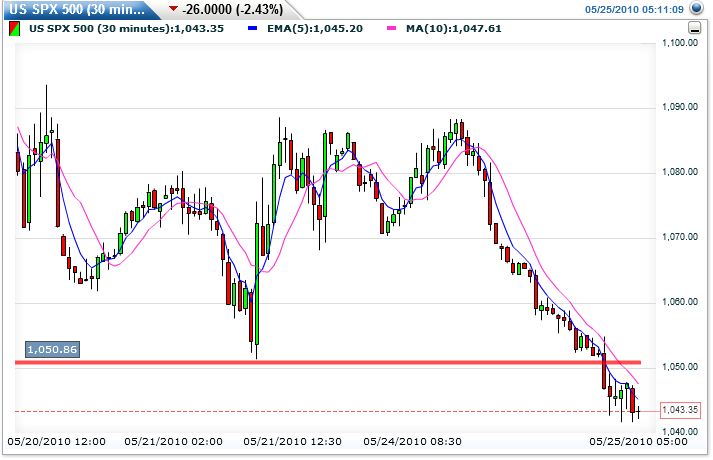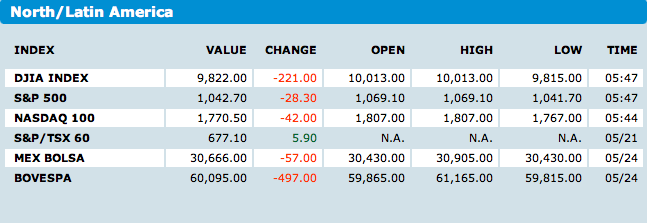
Look Out Way Below
>
Global markets are showing all red, with most markets off by 3%. Nikkei 225 is down -3.06%; Hang Senf Index is off -3.47%.
European Bourses are also off 3%, with Spain down 5%.
Futures indicating a big gap down here, with the Dow set to open down 250 points.
>


Tweet
Facebook
Reddit
Digg this!


May 25th, 2010 at 6:10 am
If there is going to be a head and shoulders bounce, it should be here at the February low IMO.
This is end of month window dressing? Makes one wonder what June will be like.
May 25th, 2010 at 6:25 am
Ode de Caja Sur: http://www.youtube.com/watch?v=rY0WxgSXdEE#t=0m7s
May 25th, 2010 at 7:20 am
QE and accounting trickery might land a few punches, but reality is tenacious, goes for the knock-out, and is undefeated.
May 25th, 2010 at 7:27 am
Worldwide, money is leaving stocks and going to cash (just like BR). Cash, in almost all cases, is USDs — the reserve currency. The dollar is getting stronger, and quickly. I don’t think everybody is just going to sit and hold a commodity that is designed to devalue, and that is backed only by the full faith and credit of known thieves and sociopaths. Where, oh where, will all of that cash go?
May 25th, 2010 at 7:46 am
I love a good carry unwind and margin calls in the morning:)
May 25th, 2010 at 7:49 am
PS. I expect a big rally on Friday. Some will be short covering, but a lot will be the Feds invisible hand getting the sheeple happy before the holiday weekend.
May 25th, 2010 at 8:00 am
Another multi-underwear day? Week? BR, are you back on the road again???
May 25th, 2010 at 8:04 am
Marcus Aurelius,
And they same amount that is “leaving” stocks is being invested in stocks at the same time. Where there is a seller, there is also a buyer. Otherwise there wouldn’t be a trade. The amount of cash in the system isn’t different compared to before.
May 25th, 2010 at 8:06 am
Does anyone remember how we were told that high unemployment was good for stock prices because it meant that businesses were eliminating “dead weight” and saving money? How’s that working out for ya?
Brian Williams on David Letterman a few weeks ago: “the world is out of money and the Emperor has no clothes.”
And on a (not so?) lighter note, you just know Steve Barry will be coming out of the woodwork soon.
May 25th, 2010 at 8:10 am
My “Dow 10,000″ hat is almost worn out…
May 25th, 2010 at 8:12 am
Phat finger alert. The PPT will have to roll up their sleeves and put some of Uncle Ben’s hot money to work.
Still just speculation about what happened on that epic Thursday and the individual stock circuit breakers rules aren’t in effect yet so we’re dependent upon the Invisible Hand of the PPT
May 25th, 2010 at 8:15 am
Well Euro-style shock & awe might have saved the big German & French banks from the bad Greek investments they made but not the Spanish & Irish banks with all those sand-states type exposure in RE.
The Stoxx Europe 600 Index tumbled 2.5 percent to the lowest level since September. Banco Santander SA, Spain’s biggest lender, slid 5.5 percent and Bank of Ireland Plc plunged 11 percent as banks led declines.
May 25th, 2010 at 8:18 am
Curiously, the Russell 2000 is still (as of Monday’s close) 10 percent above the February lows and above its 200-day moving average. The same applies to the Dow Transports. The Transports, in particular, should be very sensitive to the much feared global economic slowdown or double dip scenario. There’s a message there to anyone who cares to read it.
May 25th, 2010 at 8:20 am
so . . .all this liquidity nonsense and “don’t fight the Fed” finally being put to rest?
anyone waiting out their long positions may want to reconsider
May 25th, 2010 at 8:53 am
This must mean we’ll see a gap up opening? Why should anything make sense? Nothing has for a little over a year now.
May 25th, 2010 at 8:55 am
Europeans having all the fun with our S&P futures again………….
Apparently its the only thing left that they are allowed to short!
May 25th, 2010 at 9:02 am
Back to the dividend income and short position woodshed. O joy.
May 25th, 2010 at 9:14 am
I’m using the new accounting rules so my futures are still at the 11, 500 level.
May 25th, 2010 at 9:18 am
And to think that only moments ago everything was perfect!?
The Fed etc. are in a trap, the final phase of currency destruction is here.
May 25th, 2010 at 9:26 am
Remember; there is always a tomorrow.
So far.
May 25th, 2010 at 9:34 am
CBO: The Budgetary Impact and Subsidy Costs of the Federal Reserve’s Actions During the Financial Crisis
The Budgetary Impact and Subsidy Costs of the Federal Reserve’s Actions During the Financial Crisis, May 2010
“This Congressional Budget Office (CBO) study — prepared at the request of the Ranking Member of the Senate Budget Committee — describes the various actions by the Federal Reserve to stabilize the financial markets and how those actions are likely to affect the federal budget in coming years. The report also presents estimates of the risk-adjusted (or fair-value) subsidies that the Federal Reserve provided to financial institutions through its emergency
programs. Unlike the cash treatment of the Federal Reserve in the budget, fair-value subsidies include the cost of the risk that the central bank has assumed. Thus, those subsidies are a more comprehensive measure of the cost of the central bank’s actions.”
Related postings on financial system
Permanent Link Topic(s): Congress, E-Government, Government Documents
http://www.bespacific.com/
May 25th, 2010 at 9:38 am
Jim Sinclair’s Commentary
It is not what is reported here, but the use of EU credit default derivatives that brought about the dive in the euro.
With CDS pounding and the Libor rising the bear play on the euro is successful. This mechanism will turn on all Western world currencies within 12 months, one by one. …
http://www.jsmineset.com/
much to Paul Jones’ point..
May 25th, 2010 at 9:38 am
“Where, oh where, will all of that cash go?”
In storage. Under mattresses. Until it crashes too. Then it can be used to generate heat. But thankfully that won’t much be necessary, what with all this global warming, which must be true because May’s average temperatures where I am are a good ten degrees warmer than they were just last month.
May 25th, 2010 at 9:55 am
I’m buying…the only real concern I have is that the Europeans seem to be worshiping at Herbert Hoover’s altar by cutting budgets during a recession. They’ve demonstrated an incredible degree of stupidity–nobody ever cut their way to prosperity, and there’s no inflation problem on the horizon at all–but I think the people of Europe will deal the right-wingers across the pond a backslap that will put an end to all of it.
May 25th, 2010 at 10:27 am
Nobody ever borrowed their way to prosperity, either, F411. The Europeans, not having the ability to print their way around their troubles, have no choice but to reduce their fiscal imbalances. If the UK, which can print its way to bigger problems, doesn’t get its fiscal house in order, international currency markets will do it for them. Financial insolvencies are rapidly becoming sovereign insolvencies. Greece is just the tip of the iceberg. This is Act II of the Financial Calamity play that started in 2007/8.
But really, it is not a right-wing/left-wing thing. A broke country is a broke country, and at some point the reality of its insolvency can’t be refinanced, again. Greece is broke. It will default on its obligations soon enough. The only reason there is no inflation is because the EU members can’t print money. Look at the UK, which can. There’s plenty of inflation there.
May 25th, 2010 at 10:34 am
rc:
I don’t get your point. If the same amount of money stayed in stocks (or anything else, for that matter), always and forever, there’d be no fluctuation. For every seller, there might be a buyer, but the seller doesn’t necessarily take his capital and put it right back into the market. Right now, money is leaving the markets (markets are down) and going into cash (and maybe Treasuries), making the dollar stronger. It’s the allocation that matters. It can’t stay under the mattress. My question is, where will it go?
May 25th, 2010 at 10:37 am
franklink411,
This may not be totally wrong, if one has a 20 to 40 years horizon, assuming there won’t be a full systemic breakdown. Although, there may be a much better entry point in in a later stage of this secular bear market, i.e., when P/E ratios are well below the long-term average of about 14 to 16 (based on reported earnings averaged over 10 years), instead of the current value of about 19. Since the US-economy will probably be back in a recession later this year, and all the “recovery”-propaganda will fall apart, chances are good that a much better entry point in the markets for long-term investing will materialize as well.
Why is that? Are you assuming a permanent depression a la Japanese style, with continuing deflationary pressure as far as you can see ahead?
May 25th, 2010 at 10:38 am
Preposterous, TC. We spent trillions of borrowed money during WWII and it produced the greatest era of shared prosperity mankind has ever known.
Furthermore, consider your argument–it reflects the utter failure of conservative thought.
1. We can’t spend our way into prosperity.
2. We can’t cut our way into prosperity.
That’s the conservative ideology in a nutshell. Conservatives hold that prosperity is an illusion. All the wealth that ever was is all the wealth that ever will be. Since we can’t create wealth, we must conserve it. Not everyone can eat, so some must feast and most must starve.
Conservatism has never driven prosperity, anywhere in the world.
May 25th, 2010 at 10:39 am
Nice opening today. Looks likethe market wasn’t oversold enough!
May 25th, 2010 at 10:44 am
franklin411 Says:
“Conservatism has never driven prosperity, anywhere in the world.”
____________
True.
May 25th, 2010 at 10:57 am
@f411, allow me to clarify. You are correct that some borrowing can be good. Long term borrowing to invest in things that generate money greater than the debt service is a good and valuable thing. But Greece and its fellows in the EU need to borrow to pay money it has promised to its citizens. The more Greece borrows, the bigger hole she digs. She is not, and neither are any of her fellows, borrowing to invest in infrastructure that will generate returns greater than debt service. They are running fiscal deficits because they can’t pay for the social welfare promises they’ve made to their people. Simple as that. They aren’t borrowing to win WWII.
As for your diatribe against conservatism, you win. I’ll hardly waste time defending a political ideology. Ideologies are for people that choose not to think.
May 25th, 2010 at 11:04 am
My move to cash began when XLE etf slipped under $60.00. It’s been free-falling toward $50.00 since then. I just work too goddam hard to watch it fritter away when someone else is pulling the strings.
Most of my customers had not fully moved from their cash positions since the last downturn, so they are not in terrible shape for this one. These markets make me want to start doing taxes again, and quit with the investment game.
May 25th, 2010 at 11:14 am
@f411
You can’t really compare our current situation with WWII, the destruction and reconstruction that followed favored industry, there was no way but up.
Nowadays we seem to be in a derivative black hole, with a beast twenty times the size of the world’s real economy, I can’t see spending or not spending our way out of it.
You’re right about the austerity plans though, Hoover style, but I don’t think this will fly for very long.
May 25th, 2010 at 11:16 am
WOT:
BR,
re: “Bailout Nation”, are We going to see any BN T-Shirts for the Summer ’010 Season?
something tells me that that ‘Bullpig’ deserves a wider airing..
May 25th, 2010 at 11:25 am
Marcus Aurelius,
Perhaps, it’s just the way how you are putting it that confuses me. The money is not “in stocks”. Neither before, nor after. There isn’t any flow in or out of assets. Markets/assets (stocks, bonds, commodities, whatever) aren’t containers, into which money is poured or from which money is drained. The flow occurs between the holders of the assets (including cash). Let’s take seller A and buyer B of stocks. Before the trade, stocks are on the balance sheet of seller A, and the cash is on the balance sheet of buyer B. After the trade B has become the holder of the stocks and A the holder of the cash. The amount of cash in the system is exactly the same after the trade as before, whatever the seller decides to do with the cash later. Assets and cash only exchange their owners. Price fluctuations occur due to imbalances between supply and demand for an asset, i.e., due to different eagerness to sell or buy an asset, and the trade is settled at a price where the seller side can realize the same amount of cash in the transaction, which the buyer side is willing to invest, so that the assets can exchange their owners.
Why is the question, what the previous owners of the assets do with their new cash of greater urgency than the question what the new holders of the assets and previous owners of the cash did with all their cash before the transaction? What do holders of cash do with their cash at any time? They put into bank deposits, or into money markets funds (i.e., the according assets in those funds are being bought by the fund managers and someone else sells those assets at the other side of the trade and gets the cash). Somehow I don’t see the big problem.
May 25th, 2010 at 12:07 pm
franklin411,
Particularly from the point of view of the United States who were the foremost economic winner of WW II. Perhaps, you should reflect a little bit what you are talking about here, though. The pre-condition for the revival of capitalism after WW II after its biggest crisis and the deflation of the largest debt bubble known until then during the 30ies was immense destruction (and even greater human suffering) in large parts of the world. Your reference is totally ahistorical and ignores the different circumstances and different states of the world and economy back then and today. After WWII, there was a large demand for goods and investments, for instance in destroyed Europe, where debt stimulation could drive a long-term cyclic expansion of global capitalism. Now, there is a global debt bubble and massive industrial over-capacities worldwide, and a new technological age with automatized production, in contrast to the 40ies and 40ies of the 20th century, when Fordist organization of mass production was at its heights. To believe one can solve this debt crisis by piling on even more debt is just delusional, since it doesn’t fix the inability to pay off the already existing debt load under these conditions. Keynesian approaches have had their times, but they are failing under the given circumstances of this crisis of capitalism.
May 25th, 2010 at 12:35 pm
The markets seem to be recovering … well, there now, that wasn’t so bad, was it?
(ducks a fusillade of shoes)
But between a shootin’ war on the Korean peninsula (and yet another opportunity for Obama to extend our military might in an increasingly expensive and unwinnable conflict), a potential environmental cataclysm in the Gulf of Mexico (yes, it can get a lot worse from here, and uncertainties abound in assessing a likely outcome), and the collapse of the EU, and the continuing slide into the economic quicksand of the Bananamerican nation, it would seem that the black swan here would be for us to somehow muddle through — that is the thing that no one really believes is possible (except for cognos, and maybe Franklin411).
But the fact that a thing may fit the description of a “black swan” does not mean that it will in fact present itself — indeed, it is the rarity of presentation that creates the belief that the “black swan” is impossible.
May 25th, 2010 at 1:17 pm
The thing that drives prosperity is neither conservatism nor goobermint spending.
It is people working hard and producing things that other people want to own. Throw in sufficient credit as lubrication and you have the engine of capitalism. Too much credit and the lubricant catches on fire.
However (and F411, please pay attention here — this is the important part), what we have at the present is too much stuff, too few people with jobs and fear of poverty slowly rising to exceed the public’s dreams of “more stuff”.
Counter that with a crumbling class structure and government designed to extract wealth from the bottom 99% and funnel it to the uppermost 1%, and it is very difficult to see where any future “prosperity” comes from.
May 25th, 2010 at 1:19 pm
That should be “Combine that with” instead of “Counter that with” — these forces are pulling in the same direction, not in opposing directions.
May 25th, 2010 at 4:28 pm
Well, with real reforms totally thwarted and positions unloaded it is time to stop the music.
Change YOU can Believe in!
Sucker…Ha ha ha
Signed,
Your [post partisan] Leadership
May 25th, 2010 at 8:42 pm
Good to see every bear remaining bearish on the open today, ha! (Buying that dip was +5% or more in many names).
Good to see F411 trying to talk some sense into the broken clocks.
I am busy these days, back at a hedge fund. May has been tough, I’ve given up over half my ytd gains… but still up close to 10% on the year.
In the words of Tepper at Appolloosa, “plants grow and livestock fatten… so time is on the side of recovery”.