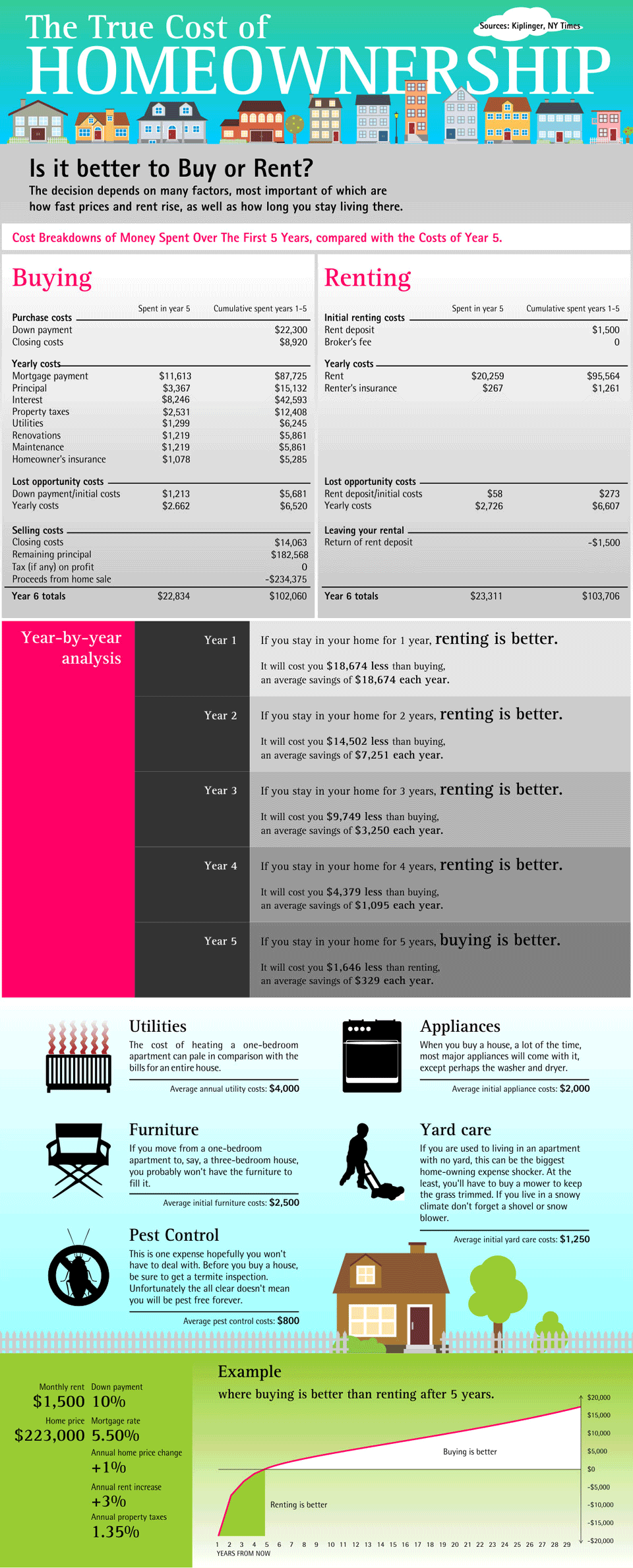
Cost of Ownership: Buy vs Rent

Email this post Print this post
By Barry Ritholtz - June 22nd, 2010, 2:48PM

via Moolanomy

Comments

Please use the comments to demonstrate your own ignorance, unfamiliarity with empirical data, ability to repeat discredited memes, and lack of respect for scientific knowledge. Also, be sure to create straw men and argue against things I have neither said nor even implied. Any irrelevancies you can mention will also be appreciated. Lastly, kindly forgo all civility in your discourse . . . you are, after all, anonymous.

18 Responses to “Cost of Ownership: Buy vs Rent”

  1. ashpelham2 Says:

    I’m first: Only quibble I have is that with a 10% down payment, the buyer has to pay PMI, which isn’t insignificant on a home with that price. Figure that to be 100 bucks per month, 6000 dollars over the first 5 years, and renting still wins.

  2. Effective Demand Says:

    The rent vs buy scenarios are highly dependent on rent increases, housing price increase, tax bracket and opportunity cost. The above scenario is a favorable one for buying but if you look at todays reality of falling rents and prices and factor those in at all the situation changes rapidly.

    The above was clearly just based on the output from the NY Times rent vs buy calculator:

    http://www.nytimes.com/interactive/business/buy-rent-calculator.html

    Change rent increase even a little, home price appreciation even a little.. The situation changes dramatically.

  3. patient renter Says:

    This isn’t very useful. The overriding variable is always appreciation/depreciation. Things swing wildly in favor of renting or buying depending on this one factor alone.

  4. Arequipa01 Says:

    What about RISK? Implicit in this numerical construct is a set of circumstances that are historically determined. How about this: don’t buy a G-D- thing when the banksters are falling over themselves to hand out money. If you can do that, then any decision relating to housing will likely turn out well.

    You must deny the rentiers access to your ‘excedente’.

  5. aypay Says:

    My first post seems to have been eaten.

    Try the place we rent in Silicon Valley. $2k rent on a $810k home. Even with 20% down payment and 1% property tax you are never better buying. If you bump the annual appreciation all the way up to 4% then after 30 years your average annual “savings” are $1800. In other words “noise” on a $1.8million calculation. Even if you zero out interest risk and interest by making a 100% down payment you need more than 30% appreciation to come out ahead at 30 years.

    If you want even more fun, go in and make the same assumption that the pension funds are making: 8% yearly return on investment. Then you REALLY never make money buying.

  6. aypay Says:

    Should be “3% appreciation” not 30% appreciation.

  7. ck1000 Says:

    Another huge factor in this equation is the ratio of how much you pay for the property relative to how much you could rent it for. In this example, the house costs about 12.4x the annual rent… which is dramatically lower than what you currently observe in most major metro areas:

    http://www.nytimes.com/interactive/2010/04/20/business/20100420-rent-ratios-table.html

    Frankly, using 12.4x is a pretty bogus starting point given that current and historical ratios in the US are quite a bit higher.

  8. Dow Says:

    No mention of homeowner association fees.

  9. hgordon Says:

    What happened to tax deductions for mortgage interest and property taxes ? These calculations are meaningless without factoring in the tax impact.

    ~~~

    BR: Excellent point! I will notify the author

  10. maxrockbin Says:

    People feel compelled to post these half-assed rent/buy comparisons over and over again.
    ANYONE who has owned a house for 10 years could add plenty to this list.
    Paint (exterior): 6 – 10K every 8-12 years. Roof: $8k every 15-20 years.
    AND most houses aren’t brand spanking new. They have a buttload more maintenance/upkeep than listed.
    How about New Furnace – $4 – 10k every 15 -20 years. Appliances? New fridge every 10 years
    Start adding this up. It comes to thousands more every year. The only way this will ever make sense is if you look at actual house expenses instead of some graphic designer pulling diluted numbers off other websites at random.

  11. Porsche87 Says:

    Kind of an apples and oranges comparison, 3 br house vs 1 br apartment. Try comparing renting vs owning a 3 br house. One implicit factor is limitations on job mobility. If you own, you think thrice before moving out of town or even significantly increasing your commute. With renting, you can follow your job (aka, the money). Having both rented and owned, I put it down to a lifestyle decision more than an investment decision.

  12. wunsacon Says:

    Agree with Effective-Demand, in that the appreciation/depreciation factor easily overwhelms.

    Also, to elaborate on Arequipa01′s comment about “risk”, why not add 3% in “risk” to the cost of capital?

    I’m not interested in buying until the *nominal* cost of owning is *cheaper* by 15% than renting equivalent. Why? Well, suppose crime increases in the neighborhood. Suppose taxes increase. Suppose your insurance company has a history of nickel-and-diming you if you have any real losses. (And how ’bout those homeowers in California that can’t even get earthquake coverage for the full value of their house? Are they incorporating that long-tail risk into their “cost of ownership”? Bulls***.) “Owning” a home entails significant long-tail risk. As an investor, you should demand to be paid for assuming that risk.

  13. Alex Says:

    These comparisons are always hard, but it is surprising to me that they always lack analytical rigor, even in the obvious areas of comparison.

    For instance, while utility expenses are probably going to be lower for an apartment than a home, they are not zero. Yet this comparison has utility expense for a home but not for a house. Also, comparing utilities for a one bedroom to (presumably) a three bedroom home is not all that useful. We should at least be comparing the cost of a two or even three bedroom apartment.

    I agree with big picture comments above, especially the fact that tax benefit is not taken into account. I see someone mentioned appreciation, but for the life of me I cannot find that either.

    I would also add another big-picture factor. Apartments are rarely abundant in the best neighborhoods, which I would define as having the best public schools and the lowest crime.

    One of these days, someone is going to do a decent spreadsheet comparison of renting versus buying, but unfortunately this is not it.

    I am beginning to think of these as rorshach tests, where we get a view of popular perception toward renting versus buying. Near the peak of the bubble, these silly things all but screamed that buying was walk-away superior. Now we are at a point of indifference. Maybe in a few years these will “tell” us that buying a house is a bad deal…and then it will be time to buy.

  14. baychev Says:

    This is utter nonsense. The implied rent yield is 8% on this fictional home and only supposed to grow with the time on an ageing asset.

  15. baychev Says:

    You can rent one bedroom apartment in Manhattan for $1,500 a month and you cannot buy a 3 bedroom house for $223,000 any closer than 200 miles from Manhattan. What is the cost of a 400 mile daily commute?

  16. Mike in Nola Says:

    Looking at the alleged homeowners insurance cost, this house cannot be near the gulf coast. Or maybe any coast.

    Agree that the outcome of the calcs is completely dependent on the assumptions, which can vary widely. Typical economics.

  17. Buying A Low Priced Franchise Will Take Away The New Business Start Up Problems | MLM Niche Marketing Says:

    [...] Cost of Ownership: Buy vs Rent | The Big Picture [...]

  18. ashpelham2 Says:

    I’m surprised I missed the tax benefits, which could be significant. Still, that PMI number that is left off probably takes out that benefit, since the PMI is paid and is nondeductible from income. At some point, when the equity in the home reaches 20% of loan value, PMI drops off, but this rarely happens in the first 10 years of ownership. And with property values declining, all bets are off if the mortgage lender will actually let you out of the PMI. The tax benefit for the note is a signficant number though.

    Not sure if that mortgage interest deduction is disallowed when computing AMT, but I’m carrying this way too far, and starting to look like a nerd.

73 queries. 0.194 seconds.