Another interesting chart, via David Rosenberg
The ECRI not only leads but is also more timely than the ISM since the data are released weekly and the index covers the whole economy, not just manufacturing.
We divided the ECRI into four different phases:
1. From the trough to zero (coming out of recession).
2. From zero to the peak (“sweet spot” of the cycle — from the end of the recession to the cycle peak in growth).
3. From the peak back to zero (past the peak in growth; economy slows but not back in recession).
4. Zero back to the negative trough (heading back into recession).
>
ECRI Weekly Leading Indicator: Growth Rate
click for ginormous graphic
courtesy of Gluskin Sheff
>
More David Rosenberg after the jump…
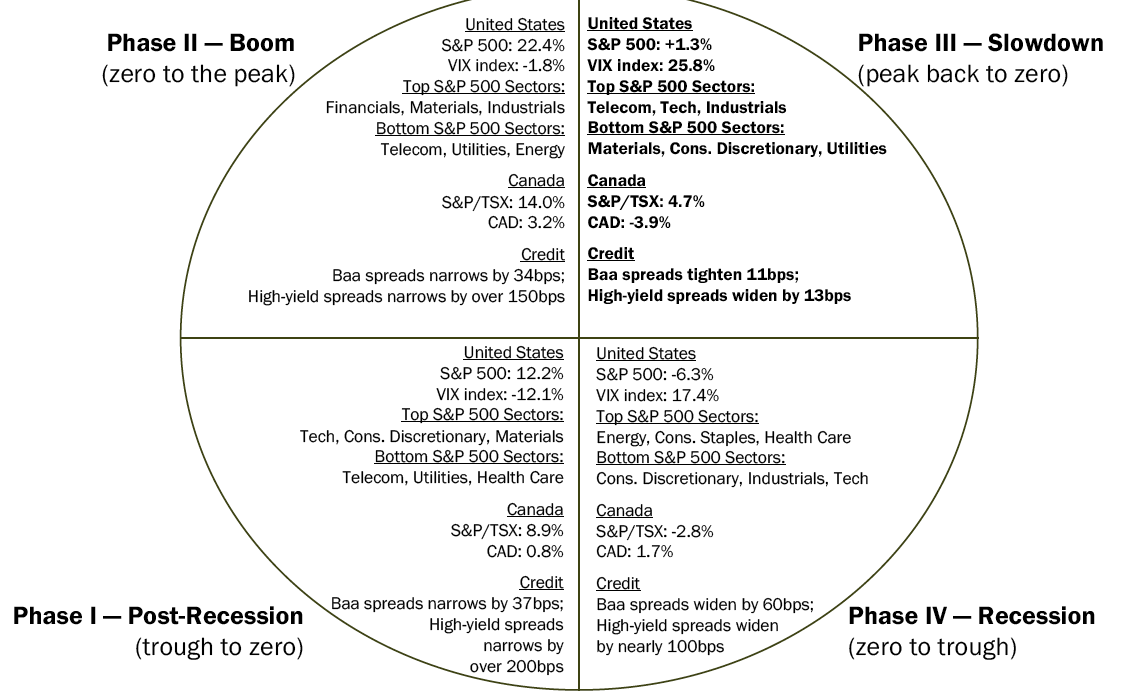
From late 2008 to the fall of 2009, we were in Phase 2. Since last October, we have been in Phase 3 and it looks like we could be here for a while.
In Phase 3, historically, the S&P 500 has provided tiny positive returns (average price appreciation of +1.3%). Tech, industrials and energy are the top performing cyclicals, along with health care and staples in the more defensive area. This cyclical-defensive barbell works well — basic materials, consumer discretionary, financials and utilities tend to lag the most. In the credit market, this is a period to be focussing on reducing duration and scaling into quality: Baa spreads tighten, on average, by 11bps but widen in the high-yield space by an average of 13bps.
Nothing is to say that we will automatically revert to Phase 4 just because we are in Phase 3 right now, although we are only 5.1% away from zero, even with policy rates still close to 0%. Then again, this was a credit cycle, not a rates cycle. It was credit that created the 2003-07 boom, and it was credit that created the 2007-2008 bust. A 5.5% peak in the funds rate was hardly the culprit, and we know that it was not a 0% rate in late 2008 that triggered the 2009 renewal in economic activity and investor risk appetite but rather the Fed’s massive expansion of its balance sheet and the government’s willingness to push the fiscal deficit to record peace-time levels. In this sense, any analysis that relies on the classic post-WWII recession-recovery experience — even this one — has to be viewed in the context of a secular credit contraction, which began two years ago.
In Phase 4, the S&P 500 on average declines 6.3% with eight of the 10 sectors declining — a barbell of being long energy on the cyclical side and consumer staples on the defensive side has worked well.
Consumer cyclicals, technology, industrials and financials are crushed in this segment of the ECRI cycle; telecom, utilities and health care do not perform as well as staples but are areas where at least you don’t typically get beaten up (for relative-return folks). The CRB is down an average of 3% but gold and oil tend to be supported by a weaker U.S. dollar. The yield on the 10-year note rallies an average of almost 40bps; as with equities, corporate bonds are hurt in this quadrant — Baa spreads widen about 60bps and high-yield by close to 100bps. We have to be mindful that this can very well be the next phase of the cycle even without the Fed raising rates.
The ECRI bottomed this cycle a good four months before the equity market did and for those folks that paid attention, like Jim Grant, kudos to them.
Because from the trough to zero — Phase 1 — the equity market rallies on average by 12% with all 10 sectors in the green column, led by tech, consumer discretionary and basic materials. Energy, telecom and utilities tend to lag behind. Financials are basically market performers. The government bond market is still rallying in this segment and the curve is steepening — that along with a slight softening in the U.S. dollar provides a positive liquidity backdrop, which in turn is conducive to spread narrowing in the credit market (average tightening of around 40bps in investment-grade and 200bps in junk).

What's been said:
Discussions found on the web: