
First-Time Homebuyer Traffic Nose-Dive
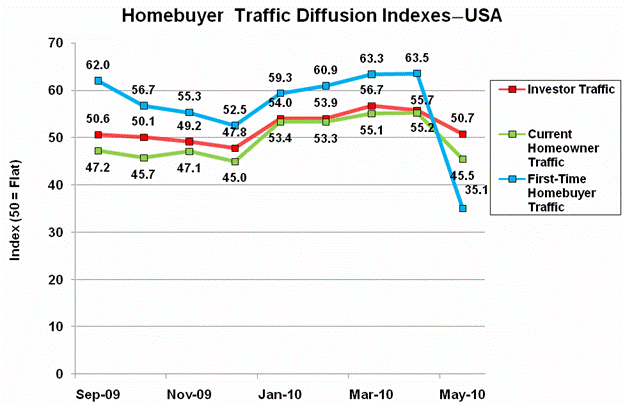
First-time buyers purchased 46% of existing home sales in May, down from 49% in April.
We all knew that first-time home buyers activity was going to fade after the tax credit expired. But there was not much of a way to quantify exactly what the impact would be beforehand. We could wait for subsequent monthly sales data to reflect that weakness — but that is hardly much of a solution.
Enter the Campbell/Inside Mortgage Finance Monthly Survey of Real Estate Market Conditions, a proprietary survey of 1,500 real estate agents nationwide.
The results of the first survey are out, and not surprisingly, it indicates that first-time “homebuyer traffic dropped sharply in May. This drop implies fewer signed contracts in June and fewer closed transactions in July and August.”
>
>
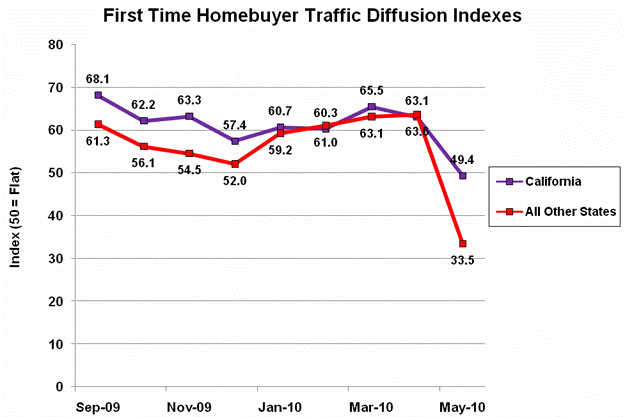
Given its fiscal condition, one wouldn’t imagine California could afford its own own first-time home buyers tax break, but somehow, they came up with one. California enacted its own $10,000 credit on May 1 — the day after the federal tax credit expired.
Not surprisingly, Cali fared better than the rest country in terms of first-time home buyer activity. As the chart below shows, California’s first-time homebuyer traffic did much better than the rest of the nation:
>
>
Sources:
First-Time Homebuyer Traffic Took Nose-Dive in May
Campbell/Inside Mortgage Finance Survey, June 21, 2010
http://campbellsurveys.com/housingreport/press_062110.htm
Home buyer Traffic Tumbled in May as First-Time Shopping Stalled (PDF)



Tweet
Facebook
Reddit
Digg this!


June 29th, 2010 at 7:27 am
California, oh! California why must you decieve yourself? Perhaps because you think your another one who thinks your too big to fail???
June 29th, 2010 at 8:06 am
Apparently, CA ain’t an austerity kind of place (I hear tell the streets are paved with gold).
Somehow, they came up with the money for a kickback, despite being bankrupt. We know they don’t have cash, so they must have used credit. Who is extending them credit?
Since our initial default by Nixon in 1973 — the act which committed us to inflation and reliance on credit/debt instead of income/assets — the only two balancing options available have been default or inflation. Austerity — at least for any prolonged period of time — is not an option.
Ask yourself: Do you think CA will be allowed to default on its debt?
Currently, we’re hearing lots of hot air being blown about ‘austerity’ measures being taken by western countries as a means of balancing debt with money supply. That idea won’t last for too long, as the middle class is already feeling the pain, and in the context of have and have not, will not settle for less while a very few are elevated in wealth beyond any measure of propriety.
Deflation is rearing it’s ugly head. There is already not enough money to settle existing debt. In deflationary scenario, existing debt can never be settled. Austerity measures can only make this worse. As we have a purely fiat monetary regime, there is really no justification, other than political chicanery, for deflation to persist, as balance can be immediately achieved through wage inflation and taxation of those higher wages.
There will be blowback as soon as we arrive at this Ah Ha! moment:
http://www.kevincharnas.com/uploaded_images/cows-eating-grass!-718884.bmp
June 29th, 2010 at 8:08 am
Try this:
http://www.austintown.k12.oh.us/~aust_tr/homework/quickfiles/Cartoons/15%20cows%20eating%20grass!.bmp
June 29th, 2010 at 8:12 am
Looks like y’all will have to cut and paste the link.
BR: what’s up with that?
June 29th, 2010 at 8:13 am
Just an ancedote, but my house was listed for 2 days, had 9 showings and 3 offers, one of which was for full listing price (which I insisted be set 10% higher than what the agent suggested). Hell, I wouldn’t have paid what my house just sold for. This is in Western PA.
And when we were looking for a house, they were selling within 2 weeks of listing.
The market doesn’t blow everywhere.
June 29th, 2010 at 8:33 am
You stop giving them free down payments and they stop buying houses. It’s that simple. First time homebuyers don’t usually have big down payments. Duh.
June 29th, 2010 at 8:40 am
Rescission:
From what we’re going through, it would seem they don’t (or soon won’t) have the income to service their mortgages, either. If you can’t make a down payment, you aren’t qualified to buy.
June 29th, 2010 at 8:58 am
Marcus Aurelius:
Bingo!! When young people, or those that would be in the first-time home buyer segment, can’t find jobs they won’t be able to afford a home of any price.
June 29th, 2010 at 9:27 am
When I bought each of my homes (in 2001 and again in late 2003), the economy was in a very different place. I bought my first home in 2001, without the aid of any “credit” and with the 10% I could scrap together living in Charlotte, NC working as a junior accountant. In retrospect, should have waited. But sold that first home 2 years later for a small appreciation, and moved on.
I doubt I’ll ever get that kind of appreciation in the house I’m in now, which I’ve resided in for nearly 7 years now. Funny….talking to my mom the other night on the phone….My mom and dad’s first home doubled in value in just around 9 years. This was in the early 1990′s when they sold it, after buying the mid-80′s.
It sucks to be in my generation.
June 29th, 2010 at 9:31 am
Is it back to pre tax-incentive days for first-time home buyers?
Why not include the last 10 years for example.
June 29th, 2010 at 9:33 am
@Mr. Obvious,
clearly not, as has been mentioned before for their are at least two types of US housing markets. Hence why Schillers housing index for 20 cities is the best indicator.
June 29th, 2010 at 9:34 am
BTE, Cognos?
June 29th, 2010 at 11:41 am
“1 in 5 choosing to default on mortgages though they can pay”
http://www.palmbeachpost.com/money/real-estate/1-in-5-choosing-to-default-on-mortgages-774736.html quotes a study by Experian.
Is this the study that will finally sort-of, kind-of maybe partially convince BR that strategic defaults are:
1) happening at a fairly high (19%) rate, and that includes the states where banks can go after borrowers to recoup the losses, and
2) “strategic defaulters” still pay off their car and credit card loans, which means they’re spending MORE than they otherwise would have? iPad, Kindle, 52″ 3D LED LCD TV anyone?
June 29th, 2010 at 12:56 pm
The fact that California has a ~$20 billion deficit (again) and still managed to come up with an industry giveaway shows the extent to which our pols can be completely and utterly bought and paid for by special interests.
June 29th, 2010 at 12:58 pm
I don’t like the definition of a strategic defaulter. You are a strategic defaulter if you don’t pay your mortgage but pay your other bills like car payment, phone bill, electricity, water, sewer etc. Without a car, phone and utilities, how can you really survive? Especially these bills are usually much smaller than a typical mortgage payment.
June 29th, 2010 at 1:16 pm
[...] First-time home buyers have disappeared. (Big Picture) [...]
June 29th, 2010 at 1:56 pm
I live in SoCal and can say that at least in San Diego there has been a fear in the market to buy for first time buyers. The fear being that home prices and or interest rates will rise again to a point that is not in line with median household income. But I digress because quite frankly, San Diego is a pretty dynamic market overall. Its geographically diverse and incomes are all over the place.
I am a first time buyer on the fence and have seen multiple offers on “affordable” homes here (<$350k) in desirable areas. I would say that a good majority of these offers have flopped last minute due to lending standards being what they should have been in the first place and first timers just not cutting the mustard.
I am waiting until the CA tax thingy is over and the buzz fades away on govt giveaways. This should at least illustrate some transparency in the real market and the buyers out there. The word on the street here is that there is just so much shadow inventory, that releasing it without some restraint actually might cause another bubble-like rise.
July 1st, 2010 at 1:52 am
[...] elemento in questa discussione, ci sembra interessante segnalare un grafico dal blog di Barry Ritholtz , che mostra la dinamica delle vendite di case (“usate”) negli [...]