
Economic Forecasting? Why Not Better Data Analysis?
One of the things I find perplexing is the seeming obsession with economic forecasting. Especially, when one considers, who poor economists are as a profession at forecasting the economy.
Real Time Economics looked at this yesterday evening. As a whole, economists are “striving to be better forecasters.
Perhaps that is the wrong goal. I believe the profession would be much better served if they were better interpreters of the current data. As we have noted previously, Forecasting is folly, and the sooner the dismal set figures this out, the better we all will be.
ISI and ECRI are two of the few firms that seem to get things a lot more right than wrong. They each try to put economic data into the context of the cycle — rather than take a snapshot, they look at the whole movie.
Meantime, with the Fed and other banking sectors suck in the old paradigm of forecasting (miss) forecasting (miss), we should not expect much int he way of improvement anytime soon.
>
UPDATE:
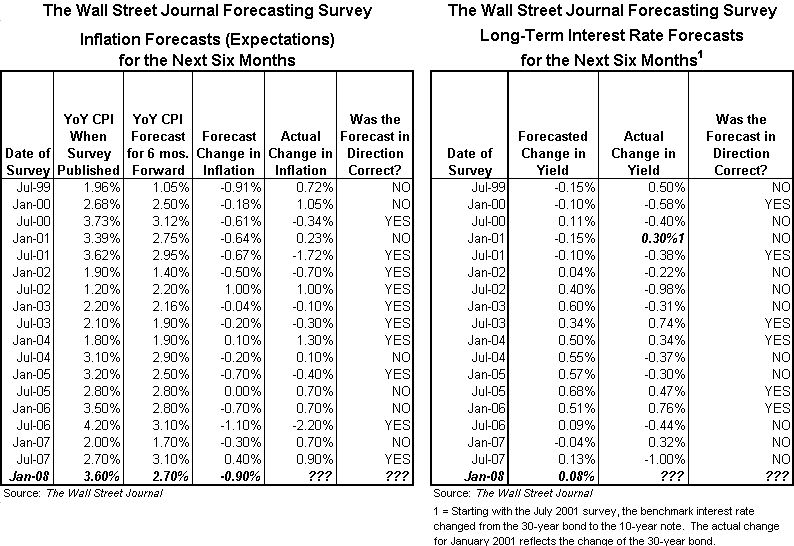
Jim Bianco points to this track record of Economist forecasting: Inflation good, Interest rate bad:
click for larger table:
>
Previously:
The Mystery of the Awful Economists (March 2nd, 2005)
Why Economists Missed the Crises (January 5th, 2009)
Source:
Economists Strive For Better Forecasting Regime
Real Time Economics
June 8, 2010, 5:06 PM
http://blogs.wsj.com/economics/2010/06/08/economists-strive-for-better-forecasting-regime/
More related posts after the jump
Apprenticed Investor: The Folly of Forecasting
Barry Ritholtz
TheStreet.com 06/07/05
http://www.thestreet.com/story/10226887/apprenticed-investor-the-folly-of-forecasting.html
The Mystery of the Awful Economists (March 2nd, 2005)
Part II
Part III
Mathematicians – Not Economists – Should Run the Fed (May 4th, 2010, )
How Economists Got It Wrong (September 6th, 2009)
RIP Chicago School of Economics: 1976-2008 (December 23rd, 2008)
The Illusory World of Economic Forecasting (September 19th, 2006)
Read It Here First: “What Good Are Economists?” (April 25th, 2009)



Tweet
Facebook
Reddit
Digg this!


June 9th, 2010 at 11:24 am
“Predictions are for gypsies.”
Toe Blake, coach of the five-time Stanley Cup Champion Montreal Canadiens in the 1950s.
June 9th, 2010 at 11:30 am
Aren’t nearly all economic forecasts nearly void(or assured, which clearly isnt the case) once uttered since there will be reactions to the predicitons which will affect real events? Also, aren’t these forecasts burdoned by the complexity, or “number of nobs”, of the input data such that ex-anti analysis is impossible?
Scientist have ceased predicting earthquakes, but have switched to describing event likelihoods. Economists seem uninterested in probablities. The scientists are also able to examine past events, if the earthquake record is complete, which economists are unable to do either because of poor data or the apparent inability of a modern economic model to apply to anything other than the moment of it’s creation/application.
Q: can we create any robust economic forecast based on events?
June 9th, 2010 at 12:13 pm
The great Despair.com Demotivational poster [ http://despair.com/economics.html ] defines the profession thusly
“Economics: The science of explaining tomorrow why the predictions you made yesterday didn’t come true today.”
June 9th, 2010 at 1:11 pm
[...] Do we need better economic forecasters or better economic analysts? (Real Time Economics, Big Picture) [...]
June 9th, 2010 at 1:58 pm
I agree that the right data analysis can avoid the oracular posturing of ivory tower arrogants.
But data analysis is hard, and requires constant attention to how to aggregate or dis-aggregate or cluster.
And then again fundamental data structure assumptions can become invalidated, forcing a re-evaluation.
And then again, data sources can be un-reliable and intentionally inaccurate – today’s CPI is a fabrication influenced by those oracles selected to insert fudge factors.
Still worth the effort perhaps, but now that we have evolved to post-modern Bananamerica, it’s all mostly “behavioral” economics, posturing, and trying to herd the sheeple. Cramer comes to mind.
June 9th, 2010 at 2:20 pm
How about better data collection? The data we have doesn’t accurately represent the economy as we now have it, so interpreting it is about 50% comprised of teasing reality out of the data first, then analyzing trends.
Example: the whole BLS model for employment – what a load of nonsense it is. The “birth-death” model has to be removed from the reported data before we get near anything resembling truth, and even then, we have two competing methodologies we need to analyze. How about economists work on ONE methodology that actually does something like, oh, I dunno — counting the employed or unemployed consistently?
June 9th, 2010 at 3:10 pm
A central problem with a lot of economics is that its unit of measure, currency, is a fiction and is frequently manipulated for policy reasons.
Behavioral economics is in its infancy and, to the extent it aspires to be more scientific, will progress slowly.
My favorite example of REAL economic study mixes topography and biology: research into why certain paths became established trails around and between human settlements. The researchers in this study hypothesized that the answer was in optimal expenditure of calories.
I like this example because it shows a couple of things: first, the resulting scientific claim is pretty modest when you think about it. Is it really shocking or enlightening that humans travel along routes that best conserve food energy? Not really, but it is interesting.
Second, it suggests that economics can be rooted in biological data (hello!) — not in bullshit self-serving EMH-type ideology about how made-up people who never existed interact in hypothetical transactions that never happen. IMO this approach is bootstrapping: justifying the existence of certain financial constructs and conventions after the fact. Economics as handmaiden to ideology that isn’t questioned in the process of its pseudo-scientific inquiry. Economics justifies and provides the gloss of academic legitimacy to some fairly troubling constructs, to put it mildly.
Until the human brain is decoded, economics will always describe the world indirectly, at best, and will continue to suck as a predictive tool — as long as it goes beyond the level of its real scientific competence, which is studying things like primitive people and their trails.
June 9th, 2010 at 5:03 pm
There are 2 very strong justifications for the efficient market hypothesis for stock markets. The first, of course, is that it gives economists a ready answer to the ever-present, but oft-unstated question “If you’re so smart, how come you’re not rich?” The second is to make forecasters look reasonable by comparison to the wiggles of the presumed ideal.
June 9th, 2010 at 5:30 pm
i am thinking the biggest problem is the lack of data, real data. for example, you can’t even come up with a real employment rate because: we count based on what business (seemingly voluntarily provide) counts of their employees. and if they don’t submit a report for a month, its not treated as a problem. we also use currency (for example the dollar) to judge production. which would be like judging how fast a car is going using miles per hour, but changing how far a mile is, or how long an hour is. and economists seem to think theirs is a science, just because they use math. but they never validate their assumptions, as long as it fits the accepted ideology (EMH for example)
June 17th, 2010 at 7:38 pm
” and economists seem to think theirs is a science, just because they use math.”
Nobody has ever thought this.