
Props to BR; Bond Bubble; Deleveraging

Email this post Print this post
By Invictus - June 21st, 2010, 10:14AM

Kudos to BR for a nice tout in this week’s Up and Down Wall Street column in Barron’s, penned this week by Randall Forsyth:

A graphic from the U.K. Guardian passed along by Barry Ritholtz on his terrific blog, The Big Picture (www.ritholtz. com/blog), shows that the U.S. consumes 25% of global oil output while having less than 5% of the world’s population. This helps explain the Brits’ feeling that we Yanks are being less than honest with ourselves in our pique at BP. “They raise a valid point,” he adds.

Beyond that, Mr. Forsyth jumps right into a recent discussion had right here at TBP, to wit:  The future of the bond market:

THERE’S MORE TO LIKE ABOUT Treasuries other than the lack of alternatives. Even though their yields are down substantially from early April—when the benchmark 10-year note was 4% and the conventional wisdom said it had nowhere to go but up—don’t be surprised if it drops back below 3%.

Hmmm…sounds like a familiar theme.

Of most interest in the column, however, was this (emphasis added):

The real problem is that the economy remains mired in a debt-deflationary cycle from which the only way out is through paying down the debt. Nomura chief U.S. economist David Resler says that, even after households paid down debt for the seventh straight quarter in the first quarter, the process still has a long way to go. That, even with a $374 billion reduction in household borrowing from its peak of $13.9 trillion in the second quarter of 2008, with most of the drop coming in mortgage debt.

In fact, financial deleveraging has just begun, according to BCA Daily Insights, a publication of the Bank Credit Analyst. That points to renewed underperformance by financial stocks, which has started during the market’s current corrective phase, it adds. [...]

“The end of the implosion in credit quality has also helped support profits, but there has been a massive amount of wealth destruction. This implies that credit creation will remain weak and it will be difficult for the financial sector to re-expand.

“As long as credit growth remains flaccid, hiring stays weak and inflation non-existent, there’s no logical reason for the Fed to start tightening. And with short-term rates (and inflation) hovering near zero, a sub-3% 10-year Treasury and a long bond under 4% hardly seem unreasonable.

Now, if there’s meaningful data point out there to be mined, you can pretty much rest assured that David Rosenberg has mined it.  And, in fact, his current presentation includes a slide, which I’ve replicated below, that shows the extent of the problem described by Mr. Forsyth via David Resler and BCA Daily Insights:
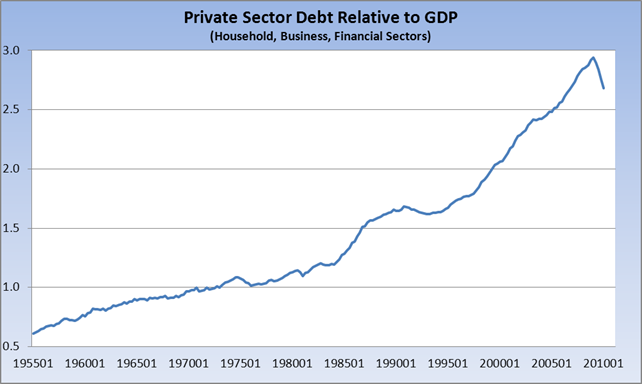
(Source: Federal Reserve Flow of Funds, BEA.gov)

Dave titles this slide “The U.S. Will Spend Years Deleveraging This Chart,” and it’s certainly hard to quibble with that.  If anyone has a reasonable argument to make that the downtrend in the chart above is going to reverse itself any time soon, I’m all ears.

Comments

Please use the comments to demonstrate your own ignorance, unfamiliarity with empirical data, ability to repeat discredited memes, and lack of respect for scientific knowledge. Also, be sure to create straw men and argue against things I have neither said nor even implied. Any irrelevancies you can mention will also be appreciated. Lastly, kindly forgo all civility in your discourse . . . you are, after all, anonymous.

18 Responses to “Props to BR; Bond Bubble; Deleveraging”

  1. Chief Tomahawk Says:

    “If anyone has a reasonable argument to make that the downtrend in the chart above is going to reverse itself any time soon, I’m all ears.”

    Even a dead cat bounces, right?

  2. zebov Says:

    “If anyone has a reasonable argument to make that the downtrend in the chart above is going to reverse itself any time soon, I’m all ears.”

    We’re no longer in a recession.

  3. Mike in Nola Says:

    Invictus, when you’re right, right.

  4. insaneclownposse Says:

    that chart could easily reverse itself in a deflationary environment, which is why debt+deflation = murder. If GDP shrinks faster than the debt is paid off, then you could have a serious problem. I don’t know if things will get that bad, but the scenario doesn’t seem unreasonable to me.

    My own feeling is that you will see a currency devaluation by the policy makers if things get that ugly. It’s the only cure at this point. All this wishful thinking about the U.S. economy coming roaring back is just a fucking fantasy. Things are about to get a lot worse.

  5. constantnormal Says:

    “If anyone has a reasonable argument to make that the downtrend in the chart above is going to reverse itself any time soon, I’m all ears.”

    How about … consumer spending is increasing and unemployment is beginning to diminish, which will alleviate fears of losing one’s job that is depressing the consumers’ willingness to take on more debt?

    Oh wait, you said reasonable. Hmmmm, that’s a harder nut to crack.

    How about this: only about 10% of the consumers have lost their jobs, and the remaining 90% (OK, if you want to use the latest U6 numbers, 16.6% without jobs and 85.4% with jobs — the idea remains the same, that the 10%-to-15% without jobs don’t matter) have been paying down debt (while the jobless have been reducing debt by another means entirely) for quite a while now, and are telling themselves that they deserve a vacation, a reward, a little treat from the tree of debt. You can even make the case that if the debt were distributed about the same on a per capita basis, the defaults by the unemployed have resulted in most of the debt reduction that we see in the above chart, and therefore, so long as unemployment does not increase to 20%-25%, the decline in debt is over.

    Hmmmm … better, but that “if” regarding the distribution of debt seems specious. And then there is the small matter of state and municipal goobermints having their backs against the wall, with a decidedly different ability to run prolonged deficits as compared to the feds. As the states and municipalities adjust budgets to meet the new reality of decreased revenue, there are only two approaches they can take: 1) increase taxes 2) downsize their labor pool. Both will be utilized going forward over the next several years, and utilized HARD. Neither of these choices increases the willingness of those who can take on more debt to do so.

    So I guess I cannot come up with a “reasonable argument” that the downtrend is going to stabilize, let alone reverse itself.

    Sorry.

  6. ashpelham2 Says:

    I wonder if someone can draw a mean regression line on that chart, to roughly imply where the number SHOULD be, and when it might get there?

    Just eyeballing it, seems like somewhere around 2.0, with an expected date of arrivale sometime before 2020, at the present rate of decline. That’s a long, long time for debt to contract relative to GDP. Or, we are gonna have to move a lot of overseas jobs back here. To me, that’s a more logical answer to get it under control.

    If I were a politician right now, everything I’d be doing would be to benefit manufacturing and job creation here in the United States. Increasing demand for products that can be made here, not in Hang Seng, or whereever they make all that fancy Apple stuff at.

  7. constantnormal Says:

    When will the public sector deleveraging begin? I doubt that the private sector alone will be able to deleverage us down to a reasonable level of debt-to-gdp, and I believe that a level of about 150% of GDP is as far as a nation can reasonably go without acquiring levels of risk that are unacceptable to a stable society. At least stat’s what the historical record appears to show. It might be a bit higher, but there is no data that I am acquainted with that shows a debt-to-gdp level in excess of 200% being a healthy place to be.

    The only way that I can see public debt deleveraging is for the Bananamerican Republic to either default or hyperinflate its way to success.

    The point here is that the private sector debt load is the smaller part of the problem.

    Luckily, we don’t have to stabilize our debt load next week, but the longer we keep increasing it (and on a total basis, we are still increasing our debt load), the longer and harsher will be the inevitable correction.

    Don’t get me wrong, I’m not a would-be deficit-destroyer, I can stomach a quite substantial federal deficit for good purposes. Unfortunately, bailing out banks, insurance companies, mortgage lenders, and auto companies that have self-destructed does not strike me as being a good use of our debt. There are plenty of other people eager to try and take the positions in the economic ladder of the corpulent incompetents that are teetering at the top of the ladder.

    I just hope the ladder doesn’t break under the strain of a cluster of 800-pound clumsy oafs clustered at the top …

  8. adeptic Says:

    @ ashpelham2

    I think you are right – 2.0 ratio looks about right.

    However, the 2020 “ETA” for this assumes that the GDP will not shrink much! If the GDP tanks by 6% for a few years (like it did in 2008) or if we get a nice little war going that shrinks it by some 30% — then all bets are off.

    my depressing $0.02.

  9. Dow Says:

    How can that chart herald anything but deflation?

    BLS for May 2010:

    In May, the civilian labor force participation rate edged down by 0.2 percentage point to 65.0 percent. The employment-population ratio was about unchanged over the month at 58.7 percent.

  10. Transor Z Says:

    Speaking only to one section of the private sector: household debt

    1966 – BankAmericard (now Visa), first general purpose plastic credit card introduced; first AmEx Gold Cards

    1980 – The annual fee is born

    1987 – AmEx offers first credit card

    1980 – 1990 – Number of credit cards doubles; household revolving credit debt quintuples

    1996 – US Supreme Court decides Smiley v. Citibank (South Dakota), upholding Citibank’s god-given right to charge a California card holder late fees that accord with South Dakota’s (nonexistent) usury laws, as opposed to California’s usury laws. Hilarity ensues.

    1990 – 2008 – Average U.S. household credit card debt triples

    Sources: http://www.pbs.org/wgbh/pages/frontline/shows/credit/
    http://www.supremecourt.gov/opinions/boundvolumes/517bv.pdf

    —————–

    Seems to me that a lot of people are hanging their hats on a single data point indicating “the American consumer is back” because of a recent uptick in consumer spending. To paraphrase Mark Twain, IMO reports of the American consumer’s resurrection from the dead are premature.

  11. Helsinki Heist Says:

    China holds US debt – anti-inflationary view.
    China (and the rest of the world, for that matter) holds considerable US equity exsposure – net growth view.
    Gold is off 22 as I write at 1236 (and recall in 2006 the gold bugs calling for $2000).
    Copper is still a 20% off its recent highs.

    I would proffer the evidence is suggesting we are certainly not in a period of a building-up of inflation, nor even expectations of inflation. Globally, the European crisis negates to a degree the yuan’s gradual appreciation, and the US deficits, well, she seem to be able to roll over debt issues with negligible international investor concern on her financial health. Forget the ethics of this, the markets have done. What is of question is the sustainability of a recovery without the spectre of inflation. I’m sure the economists amongst you have some historical data to produce.

    All I see is more random speculation. Prices go up, prices come down. And in the bigger picture of the above chart, even without my specs it is clear that the trend has not been broken.

  12. Marc P Says:

    Who was it that said “whatever can’t go on forever, won’t”?

    I am amazed at the number of otherwise-intelligent commentators who think that everything will be OK as soon as the American consumer resumes the ramp-up of borrowing. I suggest charting household income to household debt over the past 40 years, and then asking “can this go on forever”?

  13. Sunny129 Says:

    The above chart is simply SCREAMING that we just CANNOT go back or shouldn’t even try to revive the same old ‘Consumption on DEBT’ based Economy. That was the model which is the root cause of our present predicament – INSOLVENCY!

  14. Mark E Hoffer Says:

    re: Chart, and Post

    for further, peep may do well by wading through http://clusty.com/search?input-form=clusty-simple&v%3Asources=webplus&query=debt+saturation+fractal+economics

    as some of the Liturgy goes: “Saturation Economics The temporal evolution of the money-debt-asset system conforms to a very exact science that is denominated and characterized in the nonlinear rotational quantum..” link #5

    “Debt load becomes a primary factor in the fractal decay process … state, the saturation areas, and importantly the expected fractal nonlinearities of the complex macro economic …” link #7

  15. cognos Says:

    This chart WILL continue to trend higher (just like the last 50 years).

    The small dips in the chart were all fantastic times to TAKE leverage and use it to take risk.

    NOTE that 1995 was the end of the last couple years of “deleveraging”. The mid 80s were also a time for “deleveraging”. Just as the game is always played… this opens up a huge opportunity for those willing to take leverage/risk.

    I’d bet all the chips that a pattern similar to the last 50 years… continues.

  16. amateur-traveler Says:

    I shake my head every time someone says the US uses 25% of global oil production but only has 5% of the world’s population. Yes, but the US generates close to 25% of the World’s GDP. That’s how you get more productive, you use energy!

    ~~~

    BR: If most of the energy consumption went towards producing that 25% global GDP, you would have a valid point.

    But the data does not support that. Indeed, the vast majority of the US energy consumption is inefficient, non productive uses — like individuals commuting vast distances each day, alone in 2 ton SUVs. Low CAFE standards. Mediocre public transportation and rail networks. Or the worst insulation standards in home construction in the world. There are myriad other inefficient, profligate uses of energy.

    Your comment is an empty, vapid talking point. Please keep this weak ass shit outta here

  17. Jim67545 Says:

    Read this post and then read the Monday Reading item in the WSJ about lack of small business lending. In general the WSJ article adequately covers the topic – both from the demand and supply perspective.

    The same elements are playing out on the consumer side. People with damaged credit records either cannot get credit at all or have to pay through the nose to get it. Sub-prime auto? Hard to get and expensive (which squeezes out those with poor credit AND marginal income.) Sub-prime or Alt-A real estate loans, revolving credit? Forget it. Beginning to see “Angels” buying used cars and lease-to-buy them to the less creditworthy desperate to get to work. Grim.

    Consider on the consumer side that if the more frugal (and creditworthy) are deleveraging and the more profligate (and uncreditworthy) can no longer get credit, the impact is greater than the unemployed 10% or 16% out of the game. Who is in the game? The fixed income crowd – retired and the wealthy who could care less.

  18. ashpelham2 Says:

    @amateur-traveler: pwned!

    I don’t think we can overlook the fact that the US is the most productive society in the world. Who else? Greece? Spain? We contribute most of the world’s demand, therefore, I say it’s perfectly fine that we use more energy, even disproportionately so. But one also cannot argue that we are so wasteful and inefficient, as to be a national security threat. We must come up with better alternatives that are attainable by our masses, that do not involve fossil fuels.

    That whole part about “attainable to the masses” is where capitalism comes in.

78 queries. 0.449 seconds.