
When Should Fiscal Tightening Begin?
In Why plans for early fiscal tightening carry global risks, Martin Wolf of the Financial Times demonstrates yet again why he is the most savvy columnist writing on that side of the pond.
He looks at the foolishness of the Austerians, the name Mark Thoma has given to the newly converted deficit chickenhawks.
Wolf:
“Yet again, we hear the cry of the old economic religion: repent before it is too late; the wages of fiscal sin is death. But is it already time to retrench? I doubt it. At least, we must recognise the risks: delayed retrenchment poses the danger of inflation and even default; premature retrenchment threatens recession and even deflation, as I argued last week. Having barely survived the biggest financial meltdown in history, we need to appreciate that these downside risks are serious . . .
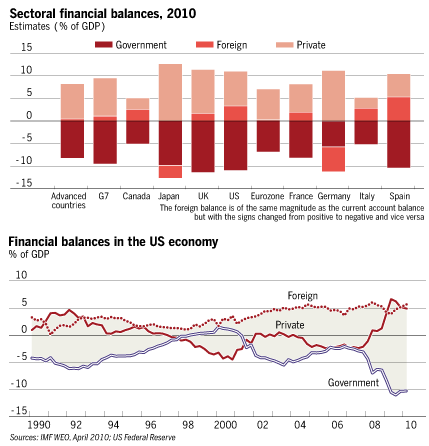
Let us look at where we now are, courtesy of the financial balance approach of the late Wynne Godley. This forces us to examine how the private sector is behaving. In 2010, according to the International Monetary Fund’s latest forecasts, the private sectors of every large high-income country will run a huge excess of income over spending. This is forecast at 7.8 per cent of gross domestic product for these countries as a group, at 12.6 per cent for Japan, at 9.7 per cent for the UK, at 7.7 per cent for the US and at 6.8 per cent for the eurozone. What we are seeing, in short, is an epidemic of private sector frugality – just as many economic doctors recommended.
Yet such thrift entails either current account surpluses or fiscal deficits. Of these countries, only Germany and Japan have current account surpluses. The rest are capital importers. These countries will duly run fiscal deficits that are bigger than their private surpluses. We have, as the hysterics note, a tide of fiscal red ink. Which came first – private retrenchment or fiscal deficits? The answer is: the former. In the case of the US, the huge shift in the private balance between the fourth quarter of 2007 and the second quarter of 2009, from a deficit of 2.2 per cent of GDP to a surplus of 6.6 per cent, coincided with the financial crisis. The fact that aggregate demand and long-term interest rates tumbled at the same time shows that the collapse in private spending “crowded in” the fiscal deficits. Wild private behaviour drove the wild public behaviour.
Yet it would now be particularly damaging for fiscal austerity to overcome the European economy and so force beggar-my-neighbour outcomes on the hapless US. As Fred Bergsten of the Peterson Institute for International Economics in Washington noted in the FT last week, such policies could be very dangerous. Thus, far from being stabilising, premature fiscal retrenchment threatens destabilisation of the world economy. In this case, a decision to turn the eurozone into a huge Germany would – and should – be seen as an act of mercantilist warfare upon the US. How long would the latter put up with the hypocrisy of surplus countries that blame borrowers for the deficits their own surpluses make inevitable? Not much longer, would be my guess, at least now that the US government has become the world’s borrower of last resort.
I have to ping Thoma to ask if its a mere coincidence that Austerians sounds awfully similar to Austrians . . .
>
>
Source:
Why plans for early fiscal tightening carry global risks
Martin Wolf
FT, June 15 2010 22:41
http://www.ft.com/cms/s/0/fc8d1dd4-78b6-11df-a312-00144feabdc0,s01=1.html



Tweet
Facebook
Reddit
Digg this!


June 20th, 2010 at 2:44 pm
Wolf make a tired old argument. Anyone with their eyes open can see why.
As for Thoma, sheesh, where to start – that guy (and Wolf) want to borrow us into the stoneage.
Austerians? Haha, sums up the quality of the argument when he has to resort to name calling.
Luckily, stick and stones etc; and anyway, nothing he has to say will stop something which isn’t stoppable.
Happy Mondays.
June 20th, 2010 at 2:52 pm
After bailing out bondholders and crooks, it’s time for austerity.
June 20th, 2010 at 2:57 pm
FYI, I’m all in favor of balancing the budget even now, even though I expect it to produce acute short-term economic pain, by cross-the-board cuts in salaries and pension benefits for government workers (and contractors). But, it better be combined with food stamps and continued unemployment benefits, plus highly progressive taxation. I want that purchasing power *back* from the rentiers.
In other words, I like what the “left-right” coalition in the UK is doing without their “centrist” party.
June 20th, 2010 at 3:23 pm
We need to stop talking about deflation as if it is a bad thing. Deflation is bad to reckless borrowers because it provides less dollars for them to pay off their presumption of what they thought the future would look like.
Deflation is also bad for the 60 year old guy that is trying to sell the house that has been growing in value for the last 40 years. When you bought your house for $5,000 though why should you quibble about the 20% loss you are getting on 350K?
The reason I say this is because after that deflation there is a young family that can now afford to buy your house. These folks are the future and are the ones that are going to take the reigns of society and support the old guy with their tax dollars flowing into his ponzi scheme…er, I mean, social security.
So it is time we stop taking the big money lapdog press talking points at face value and realize that they are just spouting the party line as they try to entice those 20 somethings to get in line for debt slavery and selling their souls to the company store! How’s that for a run on sentence! Poetry doesn’t have periods ;)
June 20th, 2010 at 3:27 pm
BTW, I went to the store a couple weeks ago to buy a pair of jeans. The store had ‘deflated’ the price by 40%. Not only did I buy 5 pairs instead of one but with the money I’ll have in the future from the savings of those long term purchases, I’ll be able to buy more goods. And which store do you think I’ll check first when I want to buy more of those goods?
Deflation greases sales skids. No only now but also in the future
June 20th, 2010 at 4:00 pm
@commonman
What part of the ponzi scheme of old folks that you refer to is attributable to the SSI and other hangers on who didn’t put one red fucking cent into the kitty?
As an owner of a rental unit 90% of those who call about renting the unit have 1-5 kids, each one getting $350.00 a month, ALL from “social security”. 75% of them from black ‘single’ mothers another half from hispanics.
Why do you insist on blaming this financial mess on people who have paid into the system 30-40-50 years and not one sentence of criticism for those who have been taking money out for three generations with no intention of stopping this personal gravy train?
June 20th, 2010 at 4:00 pm
@Common Man – The problem with your line of reasoning (deflation is good, it means I can buy more stuff for the same price) is that it presumes you will continue to have a job, and if so, one that pays the same wage. The history of deflationary episodes shows this presumption to generally be false. Likewise, the common idea that deflation is bad for the borrower but good for the lender is equally wrongheaded, because it presumes debts will always be repaid, when defaults generally skyrocket during deflationary periods. Reputable economists fear deflation for good reason.
June 20th, 2010 at 4:15 pm
@wunsacon: “After bailing out bondholders and crooks, it’s time for austerity” -Bulls-Eye!
@How the Common Man Sees It: “Deflation is bad to reckless borrowers ” – not even that, most of them could get by… The deflation is especially bad for the highly LEVERAGED SPECULATORS, whether it’s oil, real estate, gold, or stocks. In a true deflation episode they would ALL be wiped out. But don’t forget the simple fact of life that for the last 100 or so years the bankers have been setting economic policy. Before, the deflation used to be a good thing for the bankers, since they could reposes property for a fraction of its (even deflated) value. Now, the banks are the most leveraged speculators out there, deflation would be a death sentence for the most of them.
In a capitalism/free market system there should be no guaranteed winners and losers. Since the 1970 the savers, the prudent middle class, seniors on social security ans many other forms of fixed income have been losers, while leveraged speculators have been winners. It’s time for the country to make hard choice, i.e let the excesses work themselves out, even though that will slow the wealth accumulation by the top 0.01%. But then it will set the base for the next multi-decade period of growth and prosperity.
June 20th, 2010 at 4:19 pm
The issue isn’t simply the size of the deficit; it’s also a question of the extent to which it is pro-growth (long term) versus the extent to which it exists merely to fund bailouts, transfer payments, vote buying, welfare checks, etc.
June 20th, 2010 at 4:23 pm
Yes, lets keep negative real interest rates so that speculators can continue to play. Great idea.
June 20th, 2010 at 4:28 pm
@flip,
That is the system people voted for. The whole SS system as it stands is a racket that people kept voting for because they knew they were taking it from someone else. Well, they’ve kicked that can down the road about as far as they could and now there is very little ‘down the road’ left
@rue
The last big deflation I have looked at was the depression. And even though the government heavily interfered with the corrective processes in it the last time I checked a minimum of 75% of the people were still employed through that time. Sure it was tough but it would have been a lot quicker if prices were left alone to find their clearance level.
I’m not saying periods of deflation after times of excess are fun. And we surely went through a time of greater than natural excess. I’m saying they are quicker and tend to take out the dead wood more efficiently
The last I checked 1/3 of Americans owed no debt on their houses. I’m sure if prices were to find their levels these wise homeowners would be buying a lot more properties and managing them much more responsibly that the reckless borrowers that got us into this mess in the first place. That is just one example. I’m sure there are thousands more business, banking and government examples if we took the time to sort through it all
June 20th, 2010 at 4:42 pm
I agree with BR entirely. It’s absolute insanity to even be discussing tightening when unemployment is at 10%. I’m glad that BR remembers his history–1937 can happen again if policymakers make the same mistake Roosevelt did. We can’t sacrifice a nascent recovery to the balanced budget bogeyman.
@common
Your scenario is called a “sale,” not “deflation.” Under a deflationary scenario, you would see the sign that the goods are 40% off and think “prices will go lower” and not buy. The only reason you’d buy new things would be to replace things that you absolutely need this very minute.
Inflation is normal, not deflation. Under inflation, people buy goods now because they think prices will likely be higher in the future. Deflation is a death spiral because people think prices will be lower in the future. Their failure to consume then causes more production to be shut down and people lose their jobs. Now they really can’t consume because they have no money, which causes prices to go down, which causes people not to buy, which causes production to shut down, which causes more unemployment, which causes people not to consume….
June 20th, 2010 at 4:58 pm
I find it interesting that there are those that are calling for “across the board cuts” as a way of dealing with something that is a problem because of a ratio. Debt to GDP ratios will not improve with across the board cuts. Across the board cuts is like lowering the level of a swimming pool without affecting the percentage that is in the deep end vs shallow end. Lowering spending will lower the GDP by a concomitant amount. When you lower GDP you make the debt to GDP ratio WORSE! If someone can come up with a way to raise GDP by lowering spending, we could have a winner. I dont think such a solution exists. Somehow people think we’ll all feel better if we just stop spending.
Lets all stop spending for a month and see what happens to our incomes that month.
June 20th, 2010 at 5:13 pm
One more point…People always talk about how “It’s going to be painful, but cuts must be made.”
Why do we always define “necessary pain” as spending cuts…especially cuts that don’t affect us personally?
Why is “necessary pain” never defined as higher taxes?
June 20th, 2010 at 5:22 pm
“when should the tightening begin”
never- or when BR and F411 say so because they’re economic geniuses-
“Under inflation, people buy goods now because they think prices will likely be higher in the future.”
the very reason we need tons of inflation- let’s get this party rolling
and deflation? gee I wonder what reasons there could be for deflation? It can’t be because-
debt= awesomeness? All the temporary satisfaction a person could want with each purchase. There simply could never be too much- it’s always a good thing-
and so what if the USG can’t even get its shit together in good times- always upside down- but it doubles and triples down on debt in bad times-
sounds like sound policy to me
-
June 20th, 2010 at 5:46 pm
I agree with Common on deflation. It is a good thing for the large majority of the people, but not for corporate America, which controls the politicians.
Deflation is good for savers, i.e. people that are financially responsible, and eventually once prices fall enough to increase demand sufficiently, prices will rise again.
Anyone on here who doesn’t understand this concept doesn’t understand economics, period. You can’t solve a problem of too much debt by issuing more debt.
And to Ruetheday, who do you consider to be a “reputable economist”? Anyone who tries to predict economics but does not manage money and therefore does not have financial consequences for their predictions is not reputable in my view. If you’re not managing money, but still have the nerve to make economic predictions, you are not a very credible source.
June 20th, 2010 at 5:49 pm
Why is “necessary pain” never defined as higher taxes
F411- you are an economic tour de force
higher taxes IS THE ANSWER- the more the better. We need to spread that shit around. Cuts? please- that’s ridiculous. Put simply- the takers should take more and the givers should give more-
more sound policy that should be implemented immeditately
June 20th, 2010 at 5:51 pm
gbgasser, you’re right to point out that deflationary paths make the debt more unrepayable. To address that, Congress should issue more base money, not “backed” by debt, directly to American citizens. They’ll go spend it. Taxes collected will pay down the debt. Keep these monthly checks going until we’re paid off.
(Or maybe keep paying these checks forever as a replacement for the ad hoc, crazy-quilt social safety net constructed over the years. See Friedman’s “Negative Income Tax”.)
Foreign creditors will be angry with us for depreciating their bonds. Serves them right for not letting their currency float as much as necessary to reach purchase power parity.
Without balancing the budget though, we’ll continue fooling ourselves about what we are and aren’t paying for. I want honest accounting. “Truth, though the heavens may fall.”
…
Maybe you don’t like the idea of this “technical default”. But, from the moment our oligarchs forced taxpayers (of all income levels) to assume the debts of Fannie/Freddie, “default” became inevitable. From this point on, we can only choose the “how”.
…
Actually, one other path, which I’ve mentioned before, is: if the central bankers aggregate all private bad debt onto their books, they can then horse-trade with each other and cancel each others’ debts. Unfortunately, this completely rewards the worst investors and also encourages the continued production of bad debt (up until the Fed stops accepting poop for currency). Because I don’t want to reward jerk investors, I prefer the overt default described above, the one that gives handouts evenly to every American. (No need to “means-test” either. Not worth the trouble. The rich pay higher taxes on the handout anyway.)
June 20th, 2010 at 6:24 pm
b_thunder, thanks…though you must recognize I’m “riffing off” about ten thousand blog readers who’re all saying the same thing! ;-)
…
As for deflation…
I think we should all recognize that — even if there were no offshoring — there comes a time in a species’ history when “something new” becomes more productive. Humans replaced apes. Well, we are at a time in our history when we’re building machines (and systems of machines and systems of systems) to replace us. I no longer want to pay the nearby pharmacist for his/her work, because I can order online. I no longer want to pay the nearby electronics reseller for his/her work, because I can order online. And fewer of them want to pay me for my work, because they can get that online, too. What this means is: it’s going to be a lot tougher — nay, impossible — for many people to pay back the debts they incurred prior to the advent of the internet and automation. Deflation is inevitable, from here on out until the artificial intelligence “singularity” — when the “value” of nearly all human output (as measured by other humans) drops to zero. At that point, no human-labor-backed financial debt will be repayable (with limited exception: politicians, priests, and maybe prostitutes…maybe).
This isn’t “news”. During the internet boom, Warren Buffett predicted the internet was going to be — in one sense — a great destroyer of wealth, because the value of many distribution businesses would diminish. Surely, the housing bubble “hid” this for a while. Now, it’s visible.
And, after the internet comes AI. To “compete” against outsourcing and the machines, we’ve been spending more and more years in school. But, we’ll eventually lose this race. The ultimate question is: when the “system” of machines is producing all the economic output, are we going to share that output equally? Or are we going to perpetuate old or devise new myths to apportion the output unequally?
We can either rework our ideologies to the changing landscape or “fight the last (ideological) war(s)” and pretend this isn’t happening.
…
Sorry, BR, for the tangents. ;-)
June 20th, 2010 at 7:18 pm
some seem to think that if we just cut spending that it will eliminate the ‘bad’ in the economy. and it won’t affect any thing else (other than those who make their living there of course). what they seem to be over looking when they look at the great depression is one thing. had FDR not done what he did, there was a very strong possibility that the US would have thrown away capitalism as a failed economic system. they might also have thrown away the democracy we have also for the same reason. when almost 30% of the population see no reason to continue an economic because it failed so spectacularly thing tend to change rapidly. in very unpredictable ways.
June 20th, 2010 at 7:18 pm
@wunsacon – excellent post about AI, machines, future!
There are only a finite number of jobs in any economy. Eventually, with ever more automation and productivity gains, we will have too many people and not enough work for them to do. We are just at the beginnings now. Unless we make most everything free, there are going to be a significant increase in footloose and fancy free (also unhappy & unemployed) people in the future.
The only solutions I see are reduce population growth (but who will then pay for the support of all the older people collecting SS & pensions and using Medicare?). Or discover some way to get into space quickly so we can export the excess population to other planets and star systems while opening up jobs mining moons and asteroids. Neither of these solution seems anywhere likely at all. And so we will continue to be sucked down into the whirlpool.
June 20th, 2010 at 7:43 pm
Obama’s loud-mouthed Chicago-style, tough-guy shakedowns on the Chinese yuan must stop now.
The Chinese will not respond to pressure. They are real macho people who will not be told what to do, even when it’s in their own interest… by the weak-kneed, wimpy, Obama. Oh… until today…
http://online.wsj.com/article/BT-CO-20100620-703848.html?mod=WSJ_latestheadlines
…well, I will now ignore the facts and turn on Fox “News” to find out how to talk about this failure of Obama foreign policy. Just say Schumer! Schumer! Schumer! Say Schumer over and over…
Remember this is really bad for America as Wal-Mart merchandise you buy everyday will be more expensive for you. This is basically a tax hike. Another tax hike by Obama! A daily tax hike by Obama. When will it end? …Schumer!
June 20th, 2010 at 10:18 pm
Wwillid3:
Thanks for reminding everyone that in every society…there are human beings! :-)
You are of course, absolutely correct: FDR was very aware that inaction entailed enormous risks of uncontrollable social unrest. Trying to repress such unrest that is passed the tipping point would’ve meant the end of the US as we know it. I dunno, but this doesn’t look like a pleasant outcome.
And there are still a lot of people who can’t seem to be able to grasp this simple concept: push enough people to absolute despair and they will conclude they’ve got nothing to lose by rebelling against the established order.
June 20th, 2010 at 11:40 pm
@F411
The only reason you’d buy new things would be to replace things that you absolutely need this very minute.
That’s pretty much how I try to live now and I believe that is how people should live
Inflation is normal, not deflation. Under inflation, people buy goods now because they think prices will likely be higher in the future.
Actually, not true. Inflation is a sign that more money is chasing the same goods around. It is a sign that the government is diluting the money supply (check out computers, cell phones, MP3 players etc.). The natural direction of prices is down due to productivity enhancements. This was proven for decades through a time when the US had a stable currency based on fixed measures
June 21st, 2010 at 1:02 am
While we’re on the topic of inflation/deflation, I am reminded again of Bernanke’s targeting of a “2%” inflation rate:
http://www.marketwatch.com/story/bernanke-says-2-inflation-rate-most-appropriate-2010-05-25
Someone should remind the chairman of the world’s most powerful central bank on how simple compound interest works… (hint: the growth ain’t linear)
June 21st, 2010 at 1:15 am
He looks at the foolishness of the Austerians, the name Mark Thoma has given to the newly converted deficit chickenhawks.
—
Chickenhawks? Much of Wolf’s commentary is focused on European fiscal policy.
In any event, as of June 11 nearly $400 billion ramained to be spent of the American Recovery and Reinvestment Act of 2009. The administration has spent the last few days talking up a storm about the big jolt we’ll see this summer as that money gets spent.
Perhaps you can explain to Americans, Barry, what impact that huge wad will have on our economy BEFORE you go back to the well and say we need still more, eh? At the the very least aren’t taxpayers owned that conversation?
June 21st, 2010 at 1:25 am
Those screams you have been hearing and will continue to hear, ever louder, are the Dracula like shrieks of Keynesians as their world view collapses. Running out of ink is always a painful experience. What’s most enjoyable is finding out the folks who are closet Keynesians all the while trying to maintain that they have a more nuanced view of things. Phonies all of them, big government pimps.
June 21st, 2010 at 1:49 am
Didn’t the experience of Japan’s Lost Decade finally shut all those Keynesian clowns Up? Oh that’s right… according to them, Japan’s gov’t just didn’t throw enough money at the problem. Such convenient excuses allow their failed ideology to persist indefinitely.
The problem with the Austrian theory is that politicians/central banks will never have the intestinal fortitude to remain “hands off” and stand aside to let natural market forces clear out the cyclical excesses of the boom times.
June 21st, 2010 at 2:06 am
Jeez, deciding between the Dracula shrieks of the Keynesian big government pimps, the doggy howls of the pseudo laissez-faire corporate whores and the cake is actually good for you punks of Austria is just so difficult.
June 21st, 2010 at 4:05 am
M3 is gong down rapidly in the US. Seems to me to be a sure sign of deflation.
http://www.shadowstats.com/alternate_data/money-supply-charts
I’m not seeing the deflation is a good thing, that is what happened in the Great Depression. I’m guessing that not too many people that lived through that episode would say it was a good thing.
June 21st, 2010 at 6:09 am
The irony of this inflation/deflation debate is that America became the great industrial power that it is through the 1800′s under deflation.
It’s amazing how entrenched the view that we can inflate our way to prosperity is. The normal state of affairs should be deflationary. If you think about any business, it generally tries to find more efficient ways of providing goods and services with less resources and higher labour productivity. Under this scenario why should the price level still increase?
June 21st, 2010 at 6:43 am
Those of you arguing that deflation is more natural than inflation are nuts. Neither are “natural” because they are results of monetary phenomena which in and of itself is un natural. Money is a man made, politcally driven entity. There is nothing “natural” about it. Mother nature has no cash register.
However, deflation is way worse for people who have debt, which is the overwhelming majority of people. Falling prices in general are a REACTION to falling demand, not an indication that productivity has improved. There are examples of prices falling from some technological improvements but in general falling prices are a result of falling demand which then lead to falling incomes, increased indebtedness (relative to income).
Deflation sucks.
June 21st, 2010 at 8:28 am
@gbgasser
I would agree that a high, sudden rate of deflation is bad for the indebted, however if the rate of deflation is predictable and gentle (0-2%) then surely this would ensure borrowers are using the debt for productive ends?
How can 2% inflation be ‘good’ while 2% deflation is an evil to be avoided like the plague? Why do we accept the asymmetry here, while complaining about the asymmetry with monetary policy. (ie. rates raised slower than they are lowered)
June 21st, 2010 at 8:50 am
I would only argue that delation makes us poorer. It means a loss of income. If prices fall too and we are able to purchase the same amount of stuff we may not “really” be any poorer but that is quite an assumption to make.
Most people are in debt. They are in debt to a small portion of the people. That small portion either has little debt or has their debts virtually guaranteed against large loss (TBTF). This is a reality of our modern monetary system which is largely credit money based and entrepeneurial. Without a lot of borrowing we dont have what we have now. Now I’m not arguing that where we are is “optimal” only that this IS how we got where we are. This credit based system relies on an accurate forecasting of future productivity to avoid booms and busts in our money supply.
For the average guy, we just go to work for someone else and try and keep a reasonable amount of debt to our income. If we lose our job (from none of our own doing) or take an income cut we are a lot worse off.
Many studies have shown that we react way more negatively to a loss than we do positively to a gain of the exact same nominal amount. Its how we are wired.
A small amount of inflation makes us “feel” richer.
June 21st, 2010 at 9:11 am
Keynes ideas were spot on. What people forget is that there were two parts to it. Priming the pump in a deflationary enviornment AND running a surplus when the inevitable recovery took hold with the resultant period of prosperity. The “Running a surplus” part didn’t work so well mostly because of the tax cut nuts.
Austrian theory doesn’t work so well because of that pesky need for all to have food and shelter.
What we have is a blend of concepts and it works well enough for all of us to have a reasonably decent life.
June 21st, 2010 at 2:02 pm
F411
“Why is “necessary pain” never defined as higher taxes?”
… Because my money is not my neighbor’s money.
If I were to go to my neighbor with gun and demand 30% of his income because I think he has too much I would be hauled off to jail in a heartbeat. The fact we can steal from our neighbors through a “representative” in a suit is laughable. It’s a lot easier to execute someone when nobody knows you flipped the switch.
June 21st, 2010 at 4:12 pm
In a free market system with a fixed quantity of money, deflation is the norm. As productivity increases and more goods are produced, prices have to fall. That isn’t to say it is good or bad, that’s just the way it is mathmatically. More goods, same amount of money equals lower prices for each unit of goods. Period.
As for fiscal tightening, it doesn’t have to mean what Wolf and Thoma think it means. Ask yourself this question: If the budget deficit were not as high as it is, would Bernanke feel more comfortable running an easier monetary policy? Don’t think he can’t – he just proved that he can ease even with rates at zero. He bought over $1 trillion worth of securities which I would say has a lot to do with where we are right now economically. The “stimulus” would have been an even bigger “failure” if Bernanke hadn’t started buying mortgages last year. My guess is that if there is a fiscal tightening that the Fed can and will offset any ill growth effects with monetary policy. Considering his avoid deflation at all costs mentality, I think it is obvious that he would start buying either Treasuries or MBS again to ease policy if necessary.
I do think it matters how we tighten fiscal policy though. Raising taxes will be self defeating; spending cuts will not hurt growth as much and may in fact be stimulating. There is a vast pool of cash tied up in treasuries and gold right now that would move into more productive investments with just a little confidence boost. And cutting the deficit might be just the thing to restore confidence.
As for the future of monetary and fiscal policy, I favor a narrowing of the Fed’s mandate to one of currency stability and a balanced budget amendment that requires balance across a business cycle.
June 21st, 2010 at 7:37 pm
jyc3…
“In a free market system with a fixed quantity of money, deflation is the norm. As productivity increases and more goods are produced, prices have to fall.”
This assumes that productivity increases are free. Somehow I don’t think that’s the case. Productivity can be increased via the application of technology or by increasing the labor input. If my productivity increases because I work more hours, I expect to get paid, and probably at a higher rate.
If my productivity increases because I utilize a new machine, I had to get that machine somewhere. I have to maintain that machine, probably replace it after some period of time. All that costs money, provides jobs to other people. It’s not free.
If my productivity increases because I innovated, I expect to be paid for that as well through patent or copyright. I’ll extract royalties or license fees from others who take advantage of my innovation. It’s not free.
In fact, my increased productivity might increase the demand for raw materials. If I’m making more widgets out of copper or steel or unobtanium, I’d expect demand for those materials to increase. Increased demand will likely increase prices.
Increased productivity isn’t free.
June 22nd, 2010 at 10:21 am
Grunschev,
You are the reason I don’t comment often on blogs. Please review the definition of productivity and get back to me.