
Yale’s “Buy-on-Dips Stock Market Confidence Index”
Since 1989, Yale Professor Robert Shiller has been compiling a “Buy-on-Dips Stock Market Confidence Index,” (now run by the Yale School of Management).
What is especially interesting is the divergence between individuals and institutions: From 2003-05, the Institutions were far less likely to buy on dips than the public. Since 2009, that has reversed, with the individual now far less interested in buying on the dip:
>
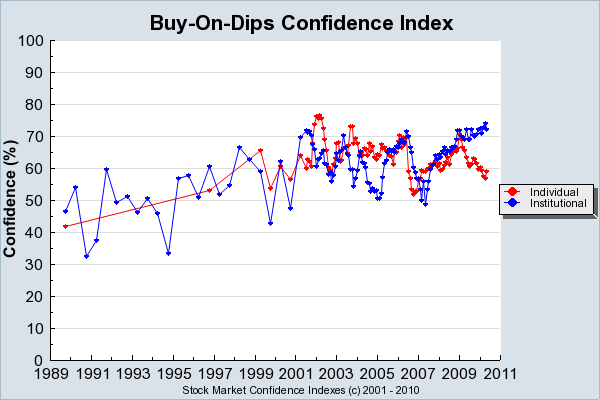
chart courtesy of e Yale School of Management
>
Yale:
“Confidence that the stock market will rise the day after a sharp fall showed an overall uptrend over the years from 1989 until shortly after it became clear that the 2000 peak in the market was a major turning point. Buy-On-Dips Confidence peaked at 71.93% as of July 2001 for institutional investors and at 76.65% as of March 2002 for individual investors. Between 2002 and 2006 Buy-On-Dips Confidence was often falling, but did not establish a clear trend.”


Tweet
Facebook
Reddit
Digg this!


June 9th, 2010 at 11:46 am
gee I wonder why?
let me ponder this- may take me a second or two
June 9th, 2010 at 11:51 am
So I guess this means that all we have to rely on are the QUANTS to keep the party going?
Can I hear an electronic “hip-hip-hooray!?”…
June 9th, 2010 at 12:05 pm
I just want to know what Bernanke has been smoking? Give me some!
June 9th, 2010 at 12:08 pm
Looks like the once-burned retail dips have largely stayed away from buying the dips, despite what has arguably been the largest governmedia-sponsored market and fake-recovery pump job in the history of Barnumesque suckering-in.
I’m curious about the institutional-investor-dips angle, though – is this largely the result of a herd of money-fund managers who missed the early part of the Great Liquidity Bounce and are now trying to make up lost ground? Perhaps a bit of I-need-to-sucker-in-some-retail-greater-fool-to-sell-my-shares-to added to that?
Keep buyin’ those dips, institutional-money dips … me and the rest of the real-economy-is-still-screwed-and-the-PTB-haven’t-fixed-a-damn-thing folks need another several-day-long dip-buying orgy to short the snot out of. So can you please get your collective act together and muster up more than a series of tepid, wussy, utterly convictionless one-day-wonder rallies? C’mon now, show us the courage of those green-shoots convictions y’all are constantly flouting on Tout TV.
June 9th, 2010 at 12:27 pm
Could it be that with the increased volatility, the institutions believe (rightly or wrongly) that they can adapt via hedging and various strategies (dark pool trading, after-hours trading, and a wealth of derivatives) that the individual investor does not utilize results in this confidence (or lack thereof)?
June 9th, 2010 at 12:30 pm
Or is this merely a symptom of stock markets being rigged in favor of the institutions?
And when we say “institutions”, are we talking banksters and hedge funds, or does that include pension funds, insurance companies, and the like?
June 9th, 2010 at 12:34 pm
Not a shocker, BR, when you think about it.
June 9th, 2010 at 1:15 pm
Because while “mom & pop” investors, already “burned” more than once, think “what if this dip is going to become the next ‘Big One’?', some selected institutions know FOR CERTAIN (thanks to the connections to the Fed and the Treasury) what kind of market we’re going to have. You don’t believe me? Then answer how many losing days did GS, JPM, BAC, C and MS had in last quarter? And the quarter before that? And how many losing days did you have? Regular folks simply lost the remaining trust in the integrity of the capital markets.
Unlike JPM that basically works for the Fed, GS that basically runs the Treasury and together with BlackRock and PIMCO shaped 2008 bailout regime (fannie/freddie nationalization, mbs buying/QE, tarp) I have no idea if this dip is going to be allowed to continue or will be aborted by:
* new FASB “mark to myth” rules?
* QE 2.0?
* Fed increasing/reducing balance sheet?
* stimulus 2.0?
* dollar devaluation through interventions?
Since I do not know anything about these possible ‘backstops” my exposure to the market is 15% at s&p 1040, and gradually goes to 0% as s&p rallies to 1100
June 9th, 2010 at 1:47 pm
Does anyone else find it strange that there appears to be a general upward trend in institutional confidence over the past two decades? Is there really any more reason to be confident about equities today than 20 years ago? Greater faith in the Greenspan (now Bernanke) put?
June 9th, 2010 at 2:56 pm
In retrospect, buying the dips in 2003-2005 (ala retail investors) was the correct strategy. Doesn’t mean they are right now. I think now is just an effect of the housing market bust, 16 year sideway market move, and generally lackluster economy.
June 9th, 2010 at 3:00 pm
Note to FRBOY (otherwise known as 33 Liberty)…
Thanks for “scaring away” all the shorts yesterday…
Now there is effectively NO BID under this market…
June 9th, 2010 at 3:22 pm
Institutions have the 0% loans — the *money* — necessary to buy and hold. Individuals have fewer resources and need the investment money for living expenses.
Heckuva job, Brownie.
June 9th, 2010 at 4:04 pm
in Parallel,
No Secrets: Julian Assange’s Mission for Total Transparency
June 7th, 2010
This is a very interesting piece about Julian Assange and WikiLeaks. (ed.)
Via: The New Yorker:
He had come to understand the defining human struggle not as left versus right, or faith versus reason, but as individual versus institution. As a student of Kafka, Koestler, and Solzhenitsyn, he believed that truth, creativity, love, and compassion are corrupted by institutional hierarchies, and by “patronage networks”—one of his favorite expressions—that contort the human spirit. He sketched out a manifesto of sorts, titled “Conspiracy as Governance,” which sought to apply graph theory to politics. Assange wrote that illegitimate governance was by definition conspiratorial—the product of functionaries in “collaborative secrecy, working to the detriment of a population.” He argued that, when a regime’s lines of internal communication are disrupted, the information flow among conspirators must dwindle, and that, as the flow approaches zero, the conspiracy dissolves. Leaks were an instrument of information warfare…”
http://cryptogon.com/?p=15835
June 9th, 2010 at 4:23 pm
Do I remember right that the institutions already have deployed their cash?
In that case we could end up a little short on buyers for the dips.
June 9th, 2010 at 5:20 pm
I just noticed a poster up above going on about the big banks having a perfect quarter of trading. Note, this is completely different to having a perfect quarter of prop trading. People seem to make this misconception all the time. Fixed income guys making the bid ask spread etc, all counts in those numbers you see. Nobody is having a perfect quarter of prop. trading. The fact that banks can make money every day isn’t that shocking to me at all.
June 9th, 2010 at 5:33 pm
And the trading robots today can find a few thousand dips a second. Most of us are simply outgunned.
June 9th, 2010 at 8:33 pm
You don’t think that this might be because the average small invetor has figured out that Wall Street is run by a bunch of crooks who stack the game in favour of large bonuses and against what quaintly used to be called “Investors”?
June 9th, 2010 at 11:08 pm
Why wouldn’t a buy and hold strategy of well-managed, blue chip, multinational, dividend-paying equities work here? I’m thinking JNJ, PFE, IBM, PG, HON, EMR, ECO, XOM/CVX, D and others. Unless the economy completely crashes, in what other financial assets should one put long-term savings? (If we need guns and toilet paper for Armagaeddon, then no financial assets will count at all.)
Government is seeing to it that inflation will keep somewhat of a floor under housing prices and the stock market.
And buying on dips — perhaps even BP — might make sense if one has high tolerance for gambles (IBM, MO, WM and ADM all came back from hard times) and can stomach some losses. Yes, there are the risks of catching falling knives, but buying low may work out well.
Again, why not buy and hold for the non-professional investors?
June 10th, 2010 at 3:04 am
[...] – Yale’s ‘buy-on-dips’ stock market confidence index. [...]
June 10th, 2010 at 7:38 am
Computers are programed to trade in reference to mythological technical levels. Since magic charts are strongly believed in by many traders, using a program to generate the appearance of very special technical levels is a most excellent method to fleece the sheep.
June 10th, 2010 at 1:08 pm
[...] Individuals are becoming less interested in “buying on the dip.” (Big Picture) [...]
June 11th, 2010 at 2:39 am
I think everyone is completely missing the meaning and implications of the Shiller index. The “Buy on Dips” survey is an indicator of Volatility. The questions posed to institutions and retail investors is:
If maket declines 3% on day 1, will be market go up or down on day 2?
June 11th, 2010 at 4:48 pm
[...] Individuals are becoming less interested in “buying on the dip.” (Big Picture) [...]