
Analyzing 2008 Tax Returns
Floyd Norris digs up the dirt on US income, via the SOI Tax Stats of the IRS:
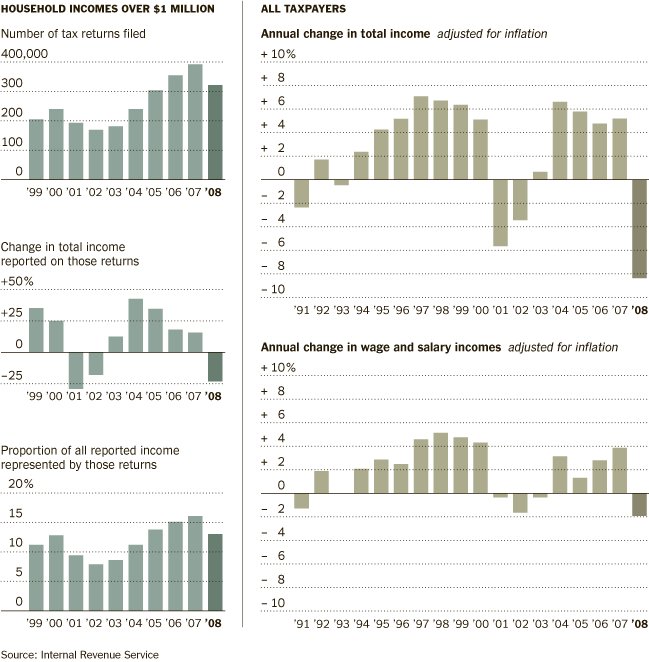
- In 2008, Americans reported $8.4 trillion in total income, down 4.6% 2007.
- Inflation adjusted, that is down 8.4% — the sharpest decline in total income since 1990.
- Biggest source of decline: Falls in Investment Income and sharp drops in Capital Gains.
- total wage and salary income was +1.9%; adjusted for inflation, it was -1.9%.
- Tax returns of $1 million plus fell by 22% to 321,294.
- 13,480 tax returns that reported income of more than $10 million — 36% smaller than the prior year.
- In the above $10m+ group, of the $400 billion in income was reported, only 19% came from wages and salaries, much less than cap gains (despite bad stock market).
- Tax returns with negative income (realized losses > than total income) leaped 31% to 2.5 million.
- 462 returns that reported some income from gambling, totaling 2.6 billion, or $5.6 million per return (average).
Fascinating stuff . . .
>
Source:
In ’08 Downturn, Some Managed to Eke Out Millions
FLOYD NORRIS
NYT, July 23, 2010
http://www.nytimes.com/2010/07/24/business/economy/24charts.html



Tweet
Facebook
Reddit
Digg this!


July 25th, 2010 at 1:59 pm
Looks like the rich has left the country.
July 25th, 2010 at 2:33 pm
One question that arises is, if we extend the “Bush tax cuts” for another year, will that result in more or less revenue to the IRS than if we let them expire?
If you’re in the Pelosi/Obama camp, how can you be sure that the large tax increase in 2011 will not curtail economic growth and increase tax avoidance? And if you’re in the Steve Forbes/Larry Kudlow camp, how can you be sure that keeping tax rates where they are (rather than raising them) will not result in a missed opportunity for politicians who want to spend more money?
July 25th, 2010 at 3:05 pm
I confused. Isn’t the average household income in the U.S. something like $60,000? With 115M households that is less than $7 trillion. What accounts for the difference between the $8.4 trillion number above from the IRS and the $7 trillion number from the census bureau and the CBO?
Does the typical measure of household income not count capital gains or other non-wage income?
July 25th, 2010 at 3:10 pm
dl, not so sure that the counter intuitive tax increases are the best thing for us. history has shown that to be true. Reagan raised taxes, economy did well, Clinton raised taxes, economy did well again. comparing today’s economy to the 50-60-70-80-90s with much higher tax rates and we notice, those were much better than ought s have been.
we have had the lowest tax rates in decades if not longer. and it doesn’t seem to have done much other than to create a fake economy that was really all based on easy credit and nothing else. and incomes in the lower levels are much lower now than they were before the big tax cuts!
and job creation during this era of low taxes has been miserable. it never ever got to be more than enough for population growth, if that. usually not even that, because it requires 1.8 millions new jobs per year. and we never got that far. and incomes reflected that
i worry more that the wimpy cry baby business leaders will continue to undermine it all. as they have in the past.
i suppose the rich could leave, and go where? China????Europe????
just where would they go that wouldn’t worse?
July 25th, 2010 at 3:54 pm
willid3 @ 3:10
“the lowest tax rates in decades …[hasn’t] done much other than to create a fake economy that was really all based on easy credit”.
I don’t think there’s any merit to the proposition that lower marginal tax rates on capital and labor result in a destabilizing increase in debt/GDP ratios.
As for looking at tax rates in prior decades, I think that, first of all, the global economy was radically different in the 1950’s than it is now, and one cannot make a comparison between then and now. As for the 1970’s, tax loopholes were rampant, and moreover, the economy was obviously not good during that decade. As for the 1980’s, the overall tax burden was lower when Reagan left office than when he started (although the decline in short-term and long-term interest rates was obviously a big factor as well). Also, in looking at prior decades, one must also take into account how corporate tax rates have changed over time in other countries, since capital is free to move globally.
As for the 1990’s economy, we’d all like to see a repeat of that (particularly Clinton’s second term). I highly doubt, however, that a higher tax burden on individuals and corporations will get us there.
July 25th, 2010 at 4:08 pm
DL, Sorry but I don’t think that it didn’t. I think that it made business take the easy way out every time. business stopped investing in the US, in spite of the lower taxes that were demanded. when they had to work hard, they seemed to do better. if we can’t compare today’s economy to others because the world has changed, then how do we know that the lower taxes helped? since the result was a fake economy based on credit and nothing else. when that credit bubble burst the appearance of any thing good, went with it
July 25th, 2010 at 4:11 pm
Did the IRS say if the gambling winnings were from Vegas, Atlantic City, or Wall Street?
July 25th, 2010 at 4:22 pm
DL and willid3:
As CR points out, there is oversupply in most of the economy, so the argument that increasing taxes (or allowing them return to pre-windfall levels) will discourage investment is a red herring.
July 25th, 2010 at 4:34 pm
Mike in Nola @ 4:22
No one invests his capital with the expectation of taking a loss. A loss may indeed occur, but that is never the intent. That said, it may well be the case that there are some investors (e.g., in real estate or stocks) who are “sitting on the sidelines”, waiting for a better buying opportunity (in accordance with their perceptions). So to the extent that there is indeed such “money on the sidelines”, a higher or lower capital gains tax rate may not influence their decision to take risk. But for those willing to take risk, the capital gains tax will make a difference.
In any case, the controversy is much less over what the capital gains/dividend tax rate should be, and much more over tax rates on so-called “earned income”.
July 25th, 2010 at 8:00 pm
I suspect the real reason that capital is sitting on the side line is simple. there is no demand in the economy. we are not at a point where that is self sustaining. and the current American business leaders are much more interested in investing in other countries where labor is much cheaper (less productive though. and there is a much larger cost of transportation to account for too). but having cut their American work forces, they now look and see little demand in the US. and that is getting worse as fewer potential customers exist for them. and those investments overseas aren’t turning out so well. since they don’t buy much in the way of goods. and now they have nobody to buy their offerings
July 25th, 2010 at 8:07 pm
@DL: “In any case, the controversy is much less over what the capital gains/dividend tax rate should be, and much more over tax rates on so-called “earned income”.
Really? Where did you come up with that one? The House Democrats?
A regressive tax gives a tax reprieve to those that earn income by virtue of their wealth and position (capital gains, options and on and on for all the tax loopholes that the wealthy can enjoy).
Why should the plutocracy be taxed at 15% when the little guys quickly wind up taxed at 35%?
July 25th, 2010 at 8:22 pm
Alfred e:
Obama has said that he will not try to push the cap gains or dividend rate above 20% in the foreseeable future.
Regarding your tax liability, has there ever been a year in which you sent 35% of your income to the IRS…?
(Note the disinction between a marginal tax rate, and total taxes actually paid).
July 26th, 2010 at 1:11 am
@DL: Yes there was a time where I paid substantially more than 35%. Try 50%. Probably more like 70%. I keep trying to forget how badly my timing sucked. And I was not in the top 1%. So ….
And you did not answer my question.
Obama does not want to push above 20%?
Does not match 35%.
Guess he needs some Rep votes for re-election. AH.
July 26th, 2010 at 1:12 am
And I was not in a position to play the tax code game.
July 26th, 2010 at 3:02 am
To willid3,
please, let us not confuse personal income tax rates with Corporate tax rates; US corporate tax rates are 35%, only Japan’s rates are higher, France’s are lower! for example!!. Actually, Corporations should pay zero taxes as taxes are in the final analysis just another cost of doing business; profitable business embed the taxes they pay in tn the price they ask for their goods and services…
July 26th, 2010 at 6:08 pm
adamsvictor, the stated rate maybe higher, but the real rate? its much much lower. corporate income taxes account for 12% of income taxes, falling far behind individual income taxes. and little wonder as so many corporations actually pay 0, or get tax refunds (some times…and even often in the millions, or hundreds of millions). but the point was. corporations see taxes as a cost of doing business. the reason they are doing nothing is simple
no demand.
and none coming any time soon.
they have exported their customers. willingly.
and i suspect that the stated rate was higher in the past (after all they have lobbyists on the job for decades to lower it. and to make sure they keep others out of being in the line of business