Bank Cash Assets, Failures, Trends

Email this post Print this post
By Barry Ritholtz - July 25th, 2010, 6:00PM

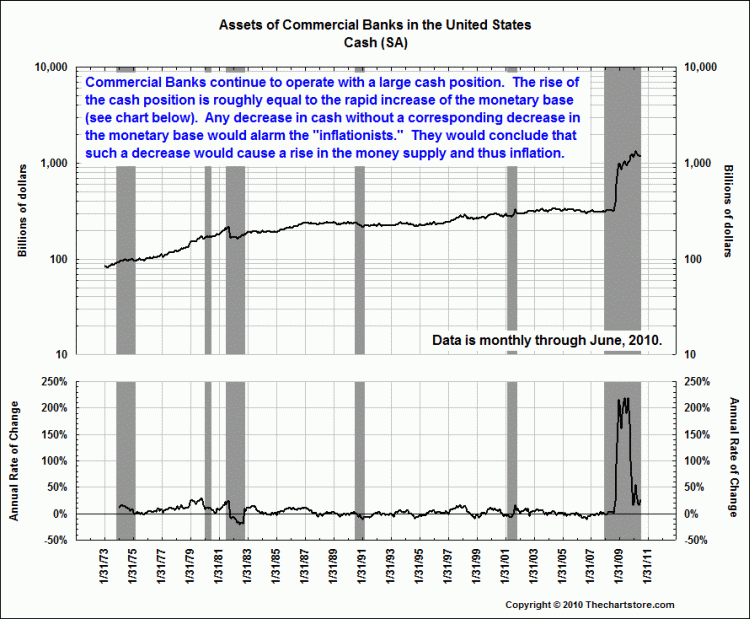
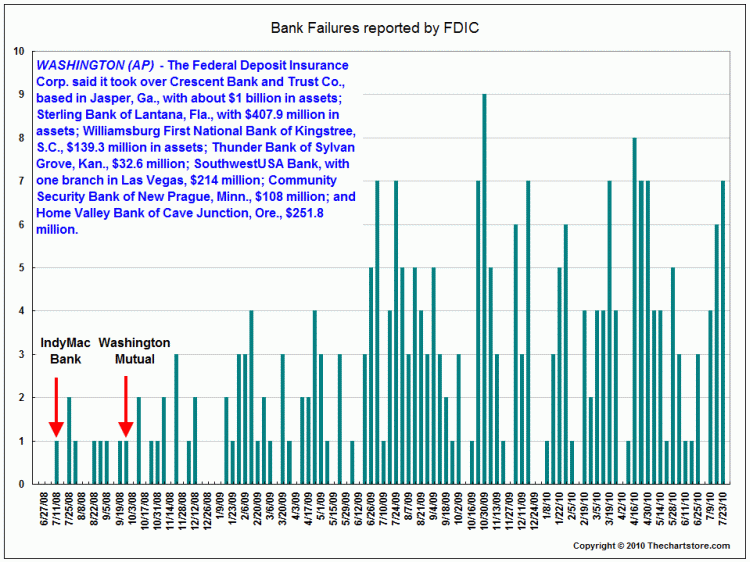
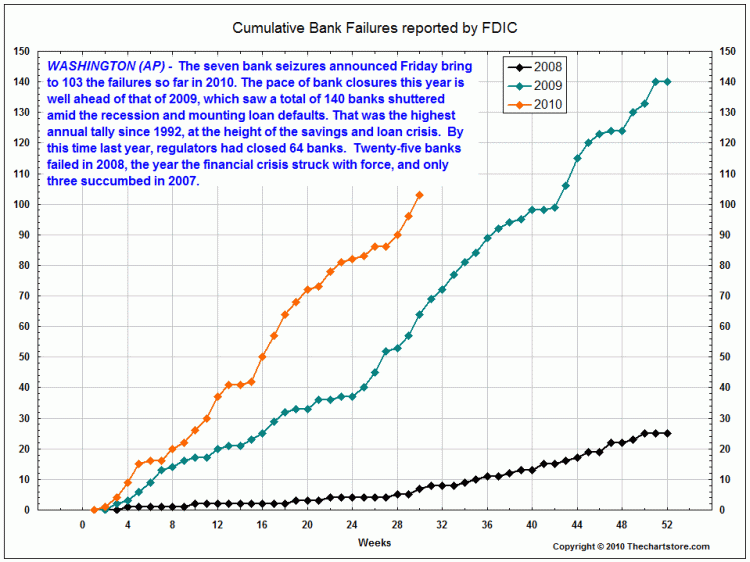
Three terrific charts, from Ron Griess of The Chart Store tells the tale of the current banking sectors:

>

Cash/Capital of Commercial Banks
FDIC Bank Failures
Cumulative Bank Failures
Comments

Please use the comments to demonstrate your own ignorance, unfamiliarity with empirical data, ability to repeat discredited memes, and lack of respect for scientific knowledge. Also, be sure to create straw men and argue against things I have neither said nor even implied. Any irrelevancies you can mention will also be appreciated. Lastly, kindly forgo all civility in your discourse . . . you are, after all, anonymous.

11 Responses to “Bank Cash Assets, Failures, Trends”

  1. alfred e Says:

    WOW. Where’s Cognos to pooh-pooh this?

    Eyeballing it, looks like we’re up 40 over last year, or 60-70% more failures. (100+ : 60+)

    Recovery.

  2. franklin411 Says:

    The only surprising thing about these charts is how kind the Recession has been to the banking sector. Two years into the worst economic collapse since the Great Depression, and we’re only *nearing* the number of bank failures we saw during the S+L Crisis? Now, the S+L Crisis was bad, but I think we all can agree that our present situation is orders of magnitude worse.

    So why aren’t we seeing orders of magnitude more failures?

  3. ACS Says:

    How’s that policy of flooding the big banks with cash to jump start the economy working out?

  4. alfred e Says:

    @frankie: Um, how about all the fed subsidies, grants and guarantees? That we the taxpayer get to foot the bill for.

    How about “mark to BS” which still has not unwound?

    How about the stupid end-of-quarter reserve transfers (105B????) to cook the books?

    How about TBTF and how many fewer banks there are now? Many consolidated into TBTFs?

    Answer your question?

  5. philipat Says:

    It worked in Japan didn’t it?!!!

    Swedish meatballs anyone?

  6. louis Says:

    Watch this and sleep well

    http://www.charlierose.com/view/interview/11132

  7. Jim67545 Says:

    @ Franklin411
    Dropping Fed Funds which then allowed the banks to dramatically drop deposit interest rates spread the net interest margin (= the difference between interest earned on loans and investments vs. that paid on deposits.) Presto: strong cash flow to offset charge offs. Good P&Ls.

    Warning: the longer rates stay low the sooner this phenomenon wanes as loan and investment yields catch up (fall) toward where deposit rates are.

    So, who paid to reinflate the banks? The depositors, not the government. Neat hey?

    I believe the banks that are failing are mostly those which got too involved in the mortgage market through commercial real estate or, especially, residential development loans. Too large a percentage of their loan portfolios went non-accrual and even with the fat spread too little of the loan side was paying, so they fell.

    Banks sitting with too much in the way of lendable assets? Why? 1. no loan demand, 2. concern about the future and their (and their regulators) desire that they maintain more liquidity 3. more conservative underwriting therefore “many are called but few are chosen”, 4. maybe desire to hold cash for acquisition of sound or FDICized competitors.

    Enjoy.

  8. d4winds Says:

    In Aug08 the Fed simultaneously very rapidly expanded the monetary base and started paying interest on reserves. Bernanke believes the latter to be a strong enough deterrent to money creation by the commercial banks (by lending excess reserves) to dispense with reserve requirements altogether. In any case, it has worked thus far, primarily because the deep, on-going recession has throttled loan demand as well increased credit standards by banks. A strong economic recovery, a la that clearly anticipated by the stock market run-up in the last year, would stimulate the money creation out of excess reserves (now circa $1tn) via the lending process. It is unknown to what extent the Fed could sterilize this since so much of its balance sheet increase came from various flavors of “cash-for-trash.” I.e., the sterilization potential, the market value of its balance sheet increases during the GFC, may be considerably less than the associated monetary base increase. Cheers.

  9. dead hobo Says:

    Hey, chart guy:

    If cash expands by a multiple of 10 and inflation remains invisible, then we have a DEFLATIONARY threat at hand. NOT INFLATIONARY. If the money supply diminished and velocity remained constant, then we have DEFLATION. If velocity also decreased with the money supply, we would have QE2 to look forward to, with perhaps a $5T target for new electron money aimed at the stock market, which we all know, most people confuse for the economy.

  10. dead hobo Says:

    alfred e Says:
    July 25th, 2010 at 6:36 pm

    WOW. Where’s Cognos to pooh-pooh this?

    reply;
    ————
    He’s hiding for fear of someone using current facts to expose his broker cheerleading. Or maybe (most likely) he’s posting under another name. I read someone a week or so ago that read remarkably like him. You can run Cognnos, but you can’t hide.

  11. HowardLothrop Says:

    @ Jim67545 gets it pretty much spot on. The missing subtlety is the main difference between larger banks (which are not failing, nor becoming less “too big to fail”) and smaller banks, which are dropping like flies. Big banks BUY fed funds as a low cost funding vehicle since they really don’t have the deposit relationships. Small banks SELL fed funds as they have excess deposits in periods of low loan demand.

    So the strategy of chopping fed funds rates to near zero was designed to bulk up big banks at the unfortunate expense of smaller banks. Problem is that big banks don’t lend to “Main Street”, despite their over-produced commercial advertisements that suggest otherwise. Small banks lend to mom and pop, and they’re the kind of businesses that create more jobs as you enter an expansion. Big banks = big loans = big companies which have lots of employees, but little job growth. Small banks = small loans = small companies which have few employees but produce most GROWTH in employment.

65 queries. 0.337 seconds.

