
NASA Images: BP Oil Invades Louisiana Coast

Email this post Print this post
By Barry Ritholtz - July 3rd, 2010, 2:22PM

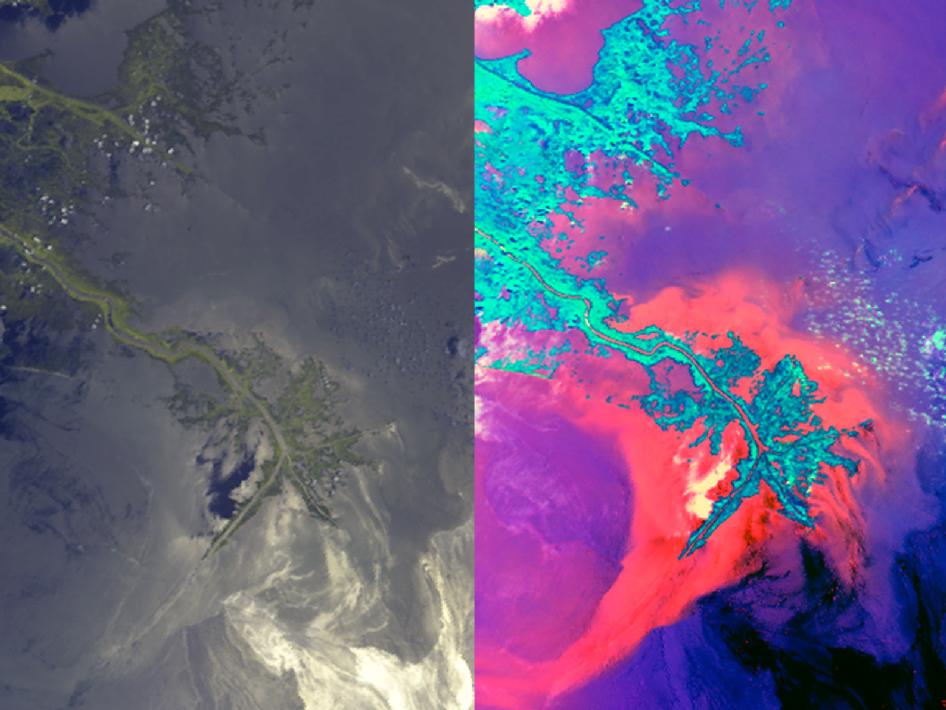
Multiple cameras on JPL’s MISR instrument on NASA’s Terra spacecraft were used to create two unique views of oil moving into Louisiana’s coastal wetlands:

click for larger images
>

Here is NASA:

These images, acquired on May 24, 2010 by the Multi-angle Imaging SpectroRadiometer (MISR) instrument aboard NASA’s Terra spacecraft, show the encroachment of oil from the former Deepwater Horizon rig into Louisiana’s wildlife habitats. The source of the spill is located off the southeastern (bottom right) edge of the images.

Dark filaments of oil are seen approaching the shores of Blind Bay and Redfish Bay at the eastern edge of the Mississippi River delta, and also nearing Garden Island Bay and East Bay farther to the south. These areas are home to many varieties of fish. To the north, the arc-shaped pattern of land and runoff is associated with the Chandeleur Islands, which are part of the Breton National Wildlife Refuge. This refuge is the second oldest in the United States and is a habitat for dozens of seabird, shorebird and waterfowl species. Oil is reported to have reached the islands on May 6. Eighteen days later, this image shows filaments of oil crossing the island barrier — which had been heavily eroded by Hurricane Katrina in 2005 — and entering the Breton and Chandeleur Sounds.

The left-hand image contains data from MISR’s vertical-viewing camera. It is shown in near-true color, except that data from the instrument’s near-infrared band, where vegetation appears bright, have been blended with the instrument’s green band to enhance the appearance of vegetation.

The Mississippi River delta is located below the image center. The slick is seen approaching the delta from the lower right, and filaments of oil are also apparent farther to the north (towards the top). The oil is made visible by sun reflecting off the sea surface at the same angle from which the instrument is viewing it, a phenomenon known as sunglint. Oil makes the surface look brighter under these viewing conditions than it would if no oil were present. However, other factors can also cause enhanced glint, such as reduced surface wind speed. To separate glint patterns due to oil from these other factors, additional information from MISR’s cameras is used in the right-hand image.

Comments

Please use the comments to demonstrate your own ignorance, unfamiliarity with empirical data, ability to repeat discredited memes, and lack of respect for scientific knowledge. Also, be sure to create straw men and argue against things I have neither said nor even implied. Any irrelevancies you can mention will also be appreciated. Lastly, kindly forgo all civility in your discourse . . . you are, after all, anonymous.

11 Responses to “NASA Images: BP Oil Invades Louisiana Coast”

  1. louis Says:

    It’s like lining up a bunch of Van Gogh’s and spray painting a red X on them. You can fix it but they will never be the same.

  2. Mark E Hoffer Says:

    if it were, only, “Oil” .. http://clusty.com/search?input-form=clusty-simple&v%3Asources=webplus&query=Corexit+9500+Nalco+Chemical+Goldman+Sachs+Gulf+of+Mexico

    one aspect of the ‘Fallout’ .. http://clusty.com/search?input-form=clusty-simple&v%3Asources=webplus&query=Gulf+of+Mexico+Seafood+Industry

    ~~
    http://www.seafoodbusiness.com/magazine.aspx
    ~~
    might, as well, get ‘comfortable’ w/ http://www.meatpoultry.com/default.aspx

  3. AGG Says:

    More contrived incompetence by our government for BP (OF COURSE!). If the data you collect can be subject to “legal liability interpretation”, you’ve got it made (as long as you don’t own ocean side gulf property).

    http://www.mcclatchydc.com/2010/07/02/96969/another-gulf-mystery-whos-in-charge.html

    “It has always seemed strange to me¦
    the things we admire in men, kindness and generosity, openness, honesty,
    understanding and feeling, are the concomitants of failure in our system.

    And those traits we detest, sharpness, greed,
    acquisitiveness, meanness, egotism and self-interest,
    are the traits of success.

    And while men admire the quality of the first
    they love the produce of the second.”
    John Steinbeck

  4. alfred e Says:

    Great photos. Thanks BR.

    Kind of spells it out. Makes it pretty obvious the govt bought into grotesquely underestimated spill rates.

    A 5,000 bbl daily rate was something of a BP joke.

  5. the terminal of geoff goodfellow Says:

    if you want an even closer up front and personal 13 min 51 sec look at The Mess, here’s a helping of The Truth about the BP Oil Spill from the other side of the world via the Australian version of 60 Minutes Report on The BP Oil Spill (via/hap-tip to):

    http://altimatrix.com/archives/886

  6. ToNYC Says:

    We are all Ogonis now.

  7. mathman Says:

    @ louis: this cannot be “fixed” (they still haven’t cleaned up from the Exxon Valdez!). There simply isn’t enough energy to do so. It and many others like it are having the effect of killing the ocean a little at a time, but the cumulative result will be deadly for humanity as well as marine life.

  8. zzzzmd Says:

    go to the nasa website, see all the pictures, then realize these are from may 24th.
    41 days ago!
    Whats it look like now?

  9. Barry Ritholtz Says:

    06.02.10 is the latest update

  10. adamsvictor Says:

    However bad BP has been at handling the spill, the US Government also shares in the blame , after all they issued the permit(s) to BP and are the lawful owner of the leased area. Obama has shown lack of: 1) leadership overall and 2) understanding of the economic underpinnings of this event. For all who continue to wring their hands and cry about the spill, here’s a soothing thought: THIS TOO SHALL PASS; meanwhile, the old adage stands: GOVERNMENT IS A POOR SERVANT AND A TYRANICAL MASTER

  11. Patrick Neid Says:

    After 70 days the EPA, Coast Guard and the admin finally let European tech and skimmers start doing the job. Pathetic.

65 queries. 0.356 seconds.