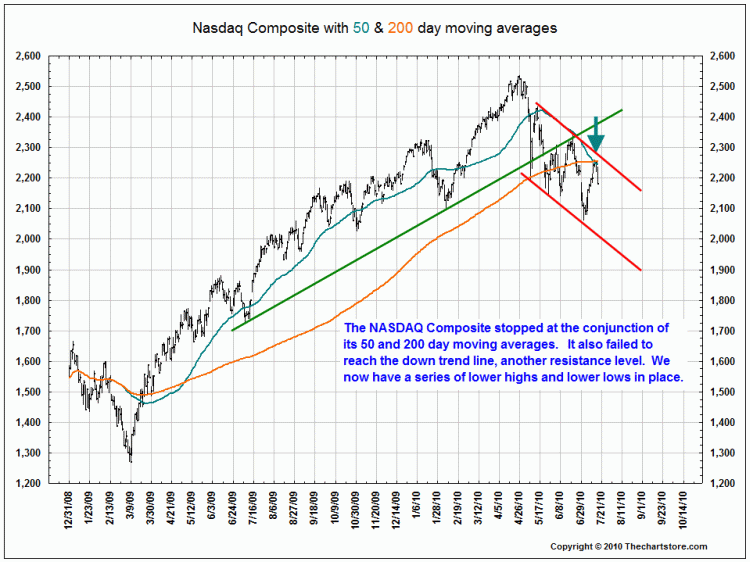
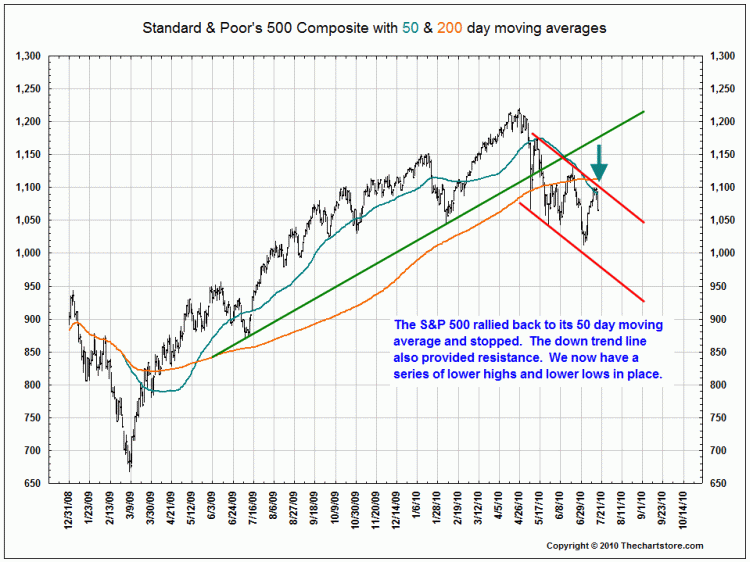
Broken Uptrends Now Plagues Most Indices
I did not show these slides (from The Chart Store) at the conference, as I did not want to get too deeply into a discussion on broken trends, technicals, momentum, etc.
As you can see, most of the major indexes look similar:
>
Dow Industrials: New Trend Channel
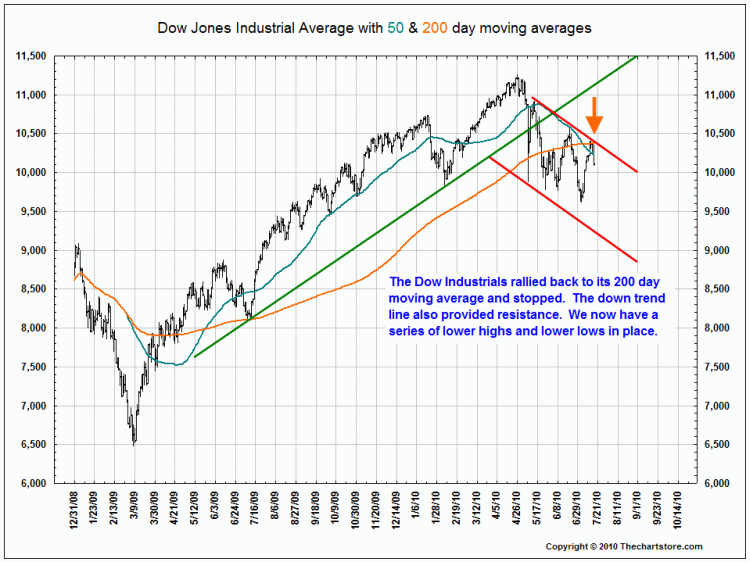
Nasdaq: New Trend Channel
S&P500 New Trend Channel
>
All charts via The Chart Store



Tweet
Facebook
Reddit
Digg this!


July 21st, 2010 at 12:42 pm
Once again, here’s the thing; they drew the straight lines after the jaggy ones were already there. Do it the other way ’round and you’d have something.
July 21st, 2010 at 12:46 pm
Where’s the China chart? A very long post by Mish today on China implies a collapse scenario is near…
July 21st, 2010 at 1:02 pm
What about the equally salient technical fact that they’ve all completed head and shoulders tops and project roughly 20% downside?
July 21st, 2010 at 1:04 pm
860 is target for the S&P.
July 21st, 2010 at 1:38 pm
Inverse H&S setting up. The dow bounced nicely off of its 15 DMA earlier in the week, today will bounce off the 50 DMA, and look to break through the 200 DMA. It is just as plausible as the H&S top called several weeks ago.
July 21st, 2010 at 1:48 pm
[...] equity market charts have broken down … US equities indices are inversely correlated to the US Dollar… hence a weakness in [...]
July 21st, 2010 at 1:55 pm
For serious chart porn I think this is today’s best read:
http://www.newyorkfed.org/research/staff_reports/sr382.html
July 21st, 2010 at 1:59 pm
except the top is complete (and major) while the bottom you anticipate is not. sure hope you’re right.
July 21st, 2010 at 2:26 pm
Sure feels like summer 2008 to moi. But don’t worry, Doug Kass said the bottom is in for the year. Too bad we should see a brand new spanking low by month’s end.
July 21st, 2010 at 2:29 pm
@Chief Tomahawk: I don’t see how public sector employees can be blamed for the collapse of China, so I’m suspicious Mish wrote anything at all on the topic…
July 21st, 2010 at 2:50 pm
@lalaland: LOL! So true. My new nickname for Mish – “Lou Mish”. Mish is to public union employees as Lou Dobbs was to illegal immigrants.
July 21st, 2010 at 2:54 pm
Mish sits on his doughy fat butt telling public sector employees they don’t deserve their jobs. Don’t you just love these folks in cushy positions telling other people they get paid too much? Talk about elitism.
July 21st, 2010 at 2:56 pm
The prop trading desks at the big banks (most likely Goldman) doing what they do best… start a rumor yesterday that some type of QE will be introduced by Bernanke today. Cause a huge short squeeze. Then sell the hell out of the market this afternoon. Works every time.
July 21st, 2010 at 2:57 pm
lalaland – hahahaha +20 points!
July 21st, 2010 at 2:58 pm
Crunched – hrmmmmm, interesting theory – and likely much truth to it.
July 21st, 2010 at 3:04 pm
3:05 PM — Breakdown as Bernanke speaks is looking ominous IMO.
July 21st, 2010 at 3:05 pm
A downward sloping channel is a bull flag… unless it’s not!
July 21st, 2010 at 3:11 pm
The quickest and easiest money for the TBTF’s now would be for another big market pullback, or even a crash, to scare out the weak hands so they can then ride in on the heels of another QE-fest and buy at bargain basement prices again. Tough for them to make all that money trading in a sideways market, which means eventually it’s going down again. As we’ve seen, they’ll make money anyway they can, and if that means scaring grandma out of her remaning equity longs at the lows again, then so be it.
July 21st, 2010 at 3:12 pm
Exactly Ruff. If we really wanted to quibble, we could questions the true value of HIS work, as many people think that as part of a crooked, broken system, that it adds dubious real social value as well. But he won’t talk about that now, will he? Look in the mirror doughy, pasty white Lou Mish!
July 21st, 2010 at 3:34 pm
RuffRednSore, Mannwich:
I think Mish’s point is simple. The salary differential between employees in the Public Sector and private sector is too wide for the work/services that they perform esp. if you consider health care, defined benefits, etc. Even more interesting…this gap is widening.
What is elitism here?
July 21st, 2010 at 3:43 pm
I’ll blame Thune’s post on ~Ego..
w/ this http://www.ritholtz.com/blog/2010/04/greece-gs-dow-off-200/#comment-285753
April 27th, 2010 at 8:17 pm
“Bear, Bulls, and PIIGS–against this backdrop, players, still on the stage, are asking to get lit up..”
July 21st, 2010 at 3:58 pm
@snap: I’m not going to get into this AGAIN, but MY point is that the level of attention Mish devotes to this topic is HIGHLY disproportionate to the level it requires in comparison to the far greater issues that caused far too many of the problems we face today. I’m not saying the public unions aren’t a problem and don’t need to be addressed in some fashion. I’m saying that in comparison to the far greater issues we face that someone like Mish should be focusing on (and sometimes does), it’s but a wee bit flea on the ass of the U.S. He’s fast becoming a caricature of himself just like Lou Dobbs eventually did. Where’s Lou today? He can’t go after the truly powerful who got us here, so he goes after the public unions, meaning the school teacher who makes $40K/year (doesn’t get a raise and can barely afford health care for her family) and teaches your kid, and teaches him/her quite well, I might add.
For the record, Mish’s site remains a regular in my rotation, so I still like the site but he’s risking becoming irrelevant, at least to me, if he doesn’t cut down the rhetoric to stir warfare within the middle class. “Know thy enemy” is the first rule.
July 21st, 2010 at 4:24 pm
Proof positive that the stock market recovery was nothing but massive additional injected liquidity, spread evenly over anything that could be inflated by investors and computers. Remove the liquidity and allow both gravity and reality to fight it out and you see the removal of asset inflation. Since reality is a managed concept with respect to financial assets at this time, it’s far too soon to call the end game.
July 21st, 2010 at 5:10 pm
A thought:
Perhaps the real problem with public sector workers isn’t that they are so well compensated, but that, from the 1970′s on, they continued to get the kind of salary increases and benefits that employees in the private sector failed to receive.
In short, it may be simply that government workers are being paid what they should be, and private workers aren’t.
Given wage stagnation, shifting of the cost of non-wage compensation onto employees, getting rid of defined benefit retirement plans, etc. it’s not surprising that so many in the private arena would sublimate their feelings of anger at their situation into envy and resentment at those who managed to hold their own. A case of intra-class warfare, rather than inter. (Much easier to resent your peers than your “betters”, especially when you still harbor the dream of one day, maybe, being among the latter.)
July 21st, 2010 at 5:23 pm
SecondLook – I like that, hadn’t thought of that issue on those terms. . . .thank you
July 21st, 2010 at 7:28 pm
@second look: Good comment.
But I think the more disgusting part is the politicos and bureaucrats underfunded the public employee defined benefit requirements. Footloose and fancy free. Just like SS. Except the sttes can’t print money. They had a blast with all the money. And the politicos and bur… IMHO got lots of “kickback bennies. Those pension fund managers are not stupid either.
And, at least in my case that’s the source of discontent.
July 21st, 2010 at 7:49 pm
Alfred e,
I would agree that – in general – pension plans have been terribly managed, mostly by making assumptions about forward growth that were simply unfeasible. That occurred, and still does in both the public and private sectors.
For many years it was routine among the major corporations that still had defined retirement plans – GE, famously for example – to assume 12% growth in the equity side of their portfolios, 5% return on the bond/other assets side. By tweaking the ratios, you could easily forecast between 8-10% average growth in the holdings. That of course meant that you didn’t have to put serious money into plans, if at all. Which in turn meant more earnings falling into the bottom line.
sigh Years ago I gave a talk on that subject; suggesting that history told us that estimating a 6% return was the most fiscally responsible approach. I wouldn’t call the response stony, as much as indifferent…
So, I suspect that kind of ignorant malfeasance is in the nature of the beast, rather than in the position.
July 21st, 2010 at 8:16 pm
Bingo SecondLook. Had similar thoughts myself but didn’t articulate them. So, the rest of us should drag down the public sector because some of them (key word “some”) are making the kinds of salaries and bene’s the rest of us in the private sector SHOULD be making in terms of sharing in their companies’ productivity gains in a commensurate way.
July 21st, 2010 at 8:18 pm
@alfred e: I guess the “sanctity of contracts” meme only applies selectively. Bunch of hypocrites (and whiners).
July 21st, 2010 at 9:31 pm
“In short, it may be simply that government workers are being paid what they should be, and private workers aren’t.”
Hmmm… you don’t suppose that’s because corporations have moved US jobs overseas and the middle class incomes in the US have stagnated for two decades while the wealthy segments get wealthier?
July 21st, 2010 at 9:42 pm
@wally: I DO suppose that’s a big part of it. What do YOU think?
July 21st, 2010 at 10:41 pm
Hmmm… you don’t suppose that’s because corporations have moved US jobs overseas and the middle class incomes in the US have stagnated for two decades while the wealthy segments get wealthier?
Wally,
I think the answer(s) as to why wages have largely stagnated (in real terms) is a bit more nuanced then simply the issue of out-sourcing.
There are at least three other major contributing factors:
1. The failure to recapture lost earning power due to inflation. Most workers didn’t have, and still don’t have, cost of living adjustments to their wages built into their jobs. That era of high inflation (from 1973-1982) created a permanent lag in the real growth of income in the United States.
2. The fast rising cost of non-wage compensations. The biggest part of that being the escalation of the cost of providing health insurance for employees. The more that is spent on non-wage benefits, the less is available for straight payroll increases. In fact, if you look at total compensation, the wages figures compare more favorably to the past; albeit, not completely favorably.
3. The very large expansion in the worker participation rate that happened from the 1970′s to the early 1990′s. This was mainly due to women entering the workforce in unprecedented numbers (since the industrial revolution started). A case of classic price theory: The expansion of the supply of labor moderated the price of labor. (Not to mention the social dynamics of women, by prejudice, and to some degree by lower expectations on their part, being paid less than their male counterparts)
I would suggest that the three factors listed above have had more to do with poor wage performance over the last 4 decades than the number of jobs lost due to outsourcing.
July 21st, 2010 at 10:53 pm
Great points again, SecondLook.
July 22nd, 2010 at 9:35 am
+2 SecondLook
That’s why I’m a househusband, I’m doing my part to lower the supply of labor and give my wife (and you all) a pay raise.
You’re welcome. :)
July 22nd, 2010 at 11:15 am
To argue private compensation vs. public is fun but irrelevant. In my area of the country, after job security, the number one concern of middle class families is local taxes. The main thing driving those taxes is the cost of public sector employees. Since private compensation is not going up guess what has to eventually give?