
Can You Correlate?

Email this post Print this post
By Invictus - July 29th, 2010, 7:17AM

(Invictus here, boys and girls)

As I have written previously here and elsewhere, I tend to look at everything through the lens of job creation.  What is the correlation of a particular release to the job market, if indeed there is one.  Does it lead?  Lag?  Is it coincident?  If I can find a meaningful correlation (say, over 0.70), I figure it’s worth examining more closely.  If not, I move on.

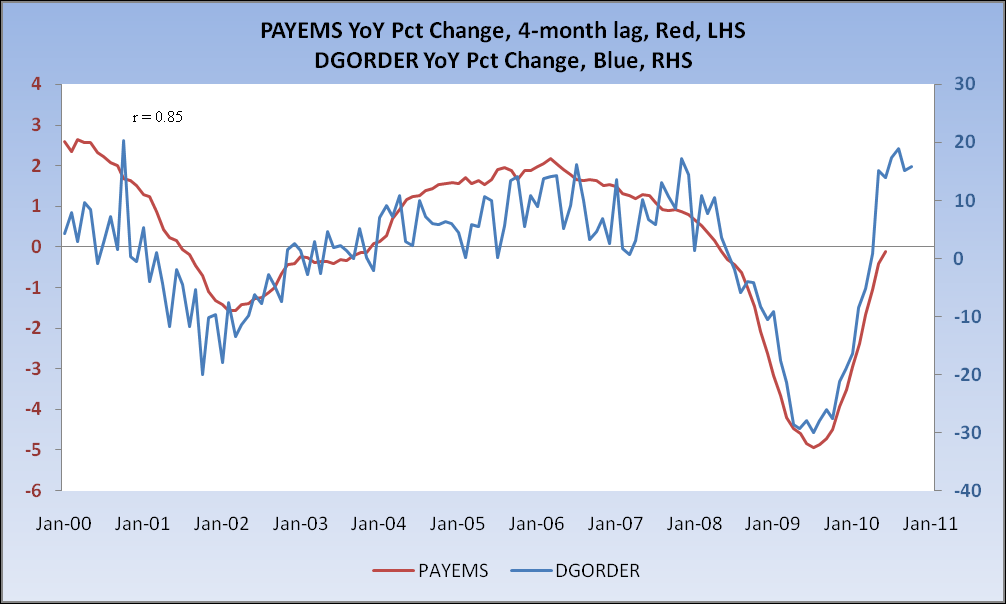
With that in mind, it was off to the drawing board to see what the Durable Goods release might tell me.  This is what I found:

>
(Data Source: St. Louis Fed)

>
Durable Goods and Nonfarm Payrolls — both on a year-over-year percentage change basis — have a correlation of 0.85 when payrolls are lagged by four months.  Now, the year-over-year change in Durables probably peaked a couple of months ago at 19% (a very rarified level, to be sure).  So, to reiterate another point I’ve made both here and elsewhere, comps are going to start getting harder and many metrics are looking decidedly more late-cycle-ish than early-cycle-ish.  I fear the hour is growing late and we’re rapidly running out of time as the labor market continues to struggle.

And I see nothing stimulative on the horizon as far as employment goes.  I’ll note that next month’s YoY Durables comp is up against a relatively strong number, so look for a sharp decline — a 5% month-over-month gain next month will still bring the year-over-year down to 13.3%, and I don’t think anyone’s looking for 5%.

That’s all sans revisions, of course.  I wouldn’t be surprised to see the YoY gain drop to roughly 10%, and it’ll get harder from there . . .

Comments

Please use the comments to demonstrate your own ignorance, unfamiliarity with empirical data, ability to repeat discredited memes, and lack of respect for scientific knowledge. Also, be sure to create straw men and argue against things I have neither said nor even implied. Any irrelevancies you can mention will also be appreciated. Lastly, kindly forgo all civility in your discourse . . . you are, after all, anonymous.

27 Responses to “Can You Correlate?”

  1. Sircornflakes Says:

    And yet the equity mkts take little notice.

  2. Barry Ritholtz Says:

    They do eventually . . . there are other factors that often overcome fundamentals. These days, it has been all about liquidty

  3. Mark E Hoffer Says:

    “…the hour is growing late and we’re rapidly running out of time as the labor market continues to struggle.

    And I see nothing stimulative on the horizon as far as employment goes…” –Invictus, above

    Past the best efforts of the MSM ‘spin cycles’, that’s all there is to see.

    There are no substantive Policy efforts, Zandi’s BS?Agitprop! about the ‘Stimulus’, notwithstanding, coming from D.C..

    and, for those who may have forgotten: “It’s not the Rates, it’s the Rules.”

    http://www.thefreedictionary.com/notwithstanding

    BR,

    as an aside, you’ve done wonders for thefreedictionary’s SEO ‘chops’, I hope they appreciate it~

  4. tawm Says:

    I think you need to take into account the qualitative characteristics of jobs created / lost. The sheer magnitude of the loss of long-term (multi-year, potential career), full benefits, well-paid, non-union corporate white collar jobs is staggering. These are the kind of jobs whose employees support(ed) countless communities via taxes, religious institution and community organization membership, volunteerism, school support and so on. These jobs have disappeared by the millions (who in their right mind would bear the costs of: regulations, liability, unionization, education, medical and other benefits etc. –salary is the least!) The destruction of the U.S. middle class is ongoing, regardless of the stats.

    ~~~

    BR: Your comment is laden with nonsense buzzwords, unproven assumptions, and general political talking points, but fails to make any logical sense.

    There are record amounts of profits from companies that know how to compete in the marketplace. To claim that that anyone who does business in America is not “in their right mind” is simply absurd. Ideologues such as yourself seem to miss the opportunities because you are wearing partisan blinders.

    You guys all look like this to me:

    Perhaps there is a more suitable outlet for your political perspectives than an investing blog.

  5. NMR Says:

    To paraphrase someone or other “It’s the demand, stupid”…..and as you say Barry, it’s late in the day

  6. dead hobo Says:

    BR is right. Liquidity and artificial stimulus has distorted these and other statistics. You need to either add a third dimension that includes the relevant liquidity stimulus or wait until the artificial stimulus washes away over time.

    Traditional metrics for evaluating the labor markets are probably the best leading indicator for other areas, such as durable goods. Are real temps being hired and transitioning into permanent jobs? Are wages rising? Are hours worked rising?

    Trickle down economics had become such a fraudulent fad over the years that its concepts are implicit in much analysis. You can’t book employment by pumping durables. At best, people just say “thanks for the gift” and then hunker back down. You need to boost durables by boosting employment and you need permanent good jobs for that. The Fed is the failure in this regard because lending begets investment and investment begets jobs. It apparently thinks that if banks exist then the economy prospers, and then gets befuddled and hides out with crypto-speak and non-responsive answers when asked about the relationship between banks and lending and job creation.

    Credit is being used to finance the massive federal deficit. It’s absurd to claim in knee-jerk fashion that “china is buying the debt” as if a) it doesn’t count if China buys it, b) China is really buying it c) a billion happy gleeful Chinamen live to buy US debt. In reality, creative and probably secretive debt financing schemes are being used to finance this US debt and, as the text books claim, CROWD OUT PRIVATE LENDING.

    The current slowdown is nothing more than a direct function of public debt and deficit financing of trillion dollar annual deficits. It’s not going to stop until money starts getting into small business borrowers and a foundation is built that supports the top of the economy. This is the exact opposite of trickle down economics. It’s also a lot harder and is unpopular in many respects because it’s not an easy answer to a difficult question.

  7. RW Says:

    If it is true that low employment and low demand are linked and that is the situation we are in now as Invictus illustrates then it cannot also be true that public borrowing is crowding out private lending, what must be true is that private enterprise does not want to borrow and, eo ipso, does not want to spend.

    We are against the zero interest rate bound and this is a liquidity trap, all else logically follows and is verified by our current economic reality: Businesses are building cash (or buying shares) because expanding into a demand collapse makes no sense and balance sheets are beginning to bulge as a result but in the absence of an increase in consumption (or exports), earnings will shrink, probably rather quickly when they do.

    Investing on this scenario has been quite profitable the past few years and the loss of political will to take up the slack with public spending makes it highly probable the pattern will play out to the bitter end.

  8. dead hobo Says:

    RW, there you go with trickle down without realizing it.

    1) Big Business will spend when it sees a reason to. Customers will be the reason. Customers come from all over the place and there is far far more small business than big business. Small business does not have cash piles. They rely on borrowed money and main street customers. Banks are said to be holding back on lending to main street significantly. If you stimulate lending, you stimulate small business, which stimulates jobs, which activates big business.

    2) We’re in a liquidity trap mostly because there are few lenders, not few borrowers. Odd, but logically true.

    3) Investments did well because of public money finding its way into markets. It was just a wealth transfer and a stimulus measure. It failed because nothing permanent resulted. It was also counter productive because it made the markets look shady and manipulated. My stash won’t go near the markets until QE2 arrives or a real foundation appears that is not trickle down related in any way.

    4) If the markets looked more honest, perhaps more cash would be flowing there and lending in creative ways.

    5) When govt annually needs $1t in new borrowings for each of the next several years PLUS extra $t in refinancing, then you have crowding out. The only thing to argue about is how much.

  9. dead hobo Says:

    BR said:

    You guys all look like this to me:

    reply:
    ————
    Except for the parts that relate to anything involving current events and actually looking anything up for any purpose, you described a couple of my relatives perfectly. My relatives don’t go near anything that might require effort and learning. Rush, Glen Beck, and probably a couple of other are all the education they get. I’m being serious. They’re just too busy to ‘spend all day’ to look things up on the internet. Aggressive ignorance is here to stay.

  10. ashpelham2 Says:

    I believe that we are giving the Fed too much credit for it’s ability to spur creation through it’s policies. While demand can be pulled forward to pushed backward, I don’t think they really can create demand where there is no motivation to buy. Low interest rates created demand in mortgages and refis from 2003-2006, but caused investors to seek return in places much more risky than real estate because fixed income investments didn’t provide that. The creation of dangerous derivatives resulted, and then exploded, undoing all of the artificial stimulus provided in the first place.

    Artificial, I say. And that is what they don’t have the power to do anymore. Powers other than the Fed created the home buyer’s credits of the past year, and that PULLED forward demand, which left a whole we are in now.

    It’s going to take something new and revolutionary to create real demand, which should lead to real jobs and rebuild an economic and tax base again.

  11. ashpelham2 Says:

    Edit: “which left a HOLE”. Freudian slip.

  12. Mark E Hoffer Says:

    in bombastic style, as per usual, Martin Weiss lays out his view of the ‘Economy’–such as it is..

    http://www.moneyandmarkets.com/four-shocking-bombshells-bernanke-did-not-tell-congress-about-last-week-39735

    much, in keeping w: “…nothing stimulative on the horizon as far as employment goes…” , and then some..
    ~~
    and W, OT: if We would care to something constructive w/ Carbon (as opposed to allowing Oz use it to give Us ‘Night Sweats’..)

    “Scientists have observed that a new paper material, known as graphene, is resistant to bacteria. Graphene could be used in an array of items; such as antibacterial bandages, food packaging and odor fighting shoes.

    Graphene is an atom thin sheet of carbon, it was being tested for uses in solar cells, computer chips and sensors. However, testing has been broadened to view its interaction with living cells.

    Testing showed that bacteria was unable to grow on the graphene oxide, yet human cells appeared unaffected.

    Considering graphene’s ability to fight bacteria and its relatively low production cost, it is likely that this material will find its way into households and hospitals in the near future…”
    for starters..
    http://refreshingnews9.blogspot.com/2010/07/new-material-immune-to-infections.html

  13. Bruman Says:

    Barry, tawm’s post was littered with too many adjectives and was hard to read, but I think the basic point (once you catch it) is good. I enjoyed your graphic, and tawm definitely needs to figure out how to write with fewer buzzwords, but I did think you were a little harsh on him.

    There used to be many jobs where an average American could work and reasonably expect to support a family and live a more-or-less middle class life, with a vacation now and then, an occasional luxury on special occasions, health insurance, and some security that old age wouldn’t be spent in poverty. Not only that, but these jobs formed a decent taxable base for government at various levels. These jobs have been eroding for decades as the world has globalized and outsourced, and there seems to be no end to it for the average American. That was tawm’s point.

    Continuing the thought line, as the insecurity of the working class has increased, many of us have relied on debt to keep us afloat and provide the security that used to have been part of a social contract between employers, government, and workers. We paid higher health premiums, we took out loans based on our houses, and found that there were people willing to lend to us because of the magic of securitization.

    It’s also true that the increasing gap between rich and poor, made even more obvious by the dissemination of television, made many of us more eager to “keep up with the Joneses.” The fact that the Joneses were indebted up to their ears was invisible to us, and their opulence made other ordinary folks feel that they were somehow losers in the game of life, and so they levered up.

    My biggest worry is that we may have one or two or even three entire generations of people who have grown up having learned lessons about how to manage risk and debt that are simply not relevant for the coming decade or two. It’s like we’re all teenagers again and have to relearn how to manage money… except it will be more difficult because not only do we have to learn new things, we have to forget old things.

    As jobs moved overseas and global competition drove down traditional wages, many economists pointed to education as the way to build a more flexible and productive labor force. Being a bit of a nerd myself, I always liked that emphasis, but I always had this sneaking suspicion in the back of my mind: “What if education isn’t enough.” What if we’re going to end up like Eastern Europe after 1992, with tons of educated people and essentially no real work for them. It still keeps me up at night, among other things.

  14. peter north Says:

    @Invictus: Another thought provoking post. Thanks and keep ‘em coming!

    @dead hobo: I like your idea about adding a third dimension that reflects the liquidity angle. Not sure the best way to do it, but the Fed Funds rate/ZIRP seems a likely candidate. To my eye, BB et al are so worried about a cascade event, that states, munis and high profile corporates will be backstopped one way or another. Given that, ZIRP seems likely to be with us for a while.

    This is such a confusing time for me… Maybe it was always this way, but I vaguely remember a time when I felt confident that analyzing securities strictly on their fundamentals (with a little attention to relevant macro factors) would usually be rewarded. Now the correlations are so high, and the macro fundamentals so ugly, and the liquidity response so massive, I am baffled. What is the smart play?

  15. Invictus Says:

    @peter north

    Thank you. Appreciate the nod. Will continue to see what the data say and report accordingly.

    BTW, big fan of your work.

    ;-)

  16. dead hobo Says:

    peter north Says:
    July 29th, 2010 at 11:38 am

    I am baffled. What is the smart play?

    reply:
    ———-
    Are you speculating for fun and enjoyment with hobby money? Then have fun with it. Do crazy things and be fearless.

    Do you need the savings for important purposes? If so, then, whatever you do, make sure you can get it all back when you need it. Never invest in anything you don’t understand. Assume everyone you deal with is probably crooked, but not to everyone all the time.

  17. tawm Says:

    Sorry, Barry. You work in Financial circles and obviously do not see the loss of white collar jobs. However, I as a corporate employee — still trying to hang on — and a member of the middle class not in NYC, see it in spades. You can quote all the stats you want, but the widespread disappearance of solid, corporate-type jobs that support the middle class is not ideology.

    Yes these changes pose opportunities for tactical investments following short-term profits, but they pose serious threats to our overall economy and society.

    ~~~

    BR: Invictus (who works at a bulge bracket firm) wrote this, not me.
    But — WTF? — Wall Street is 25% smaller in terms of white collar jobs. Trust me, we see it…

  18. Transor Z Says:

    Interesting. Here’s what nags me about using a four-month shift, though. Employment as lagging or coincident indicator during a credit/asset bubble crisis?

  19. dead hobo Says:

    Transor Z Says:
    July 29th, 2010 at 12:16 pm

    Interesting. Here’s what nags me about using a four-month shift, though. Employment as lagging or coincident indicator during a credit/asset bubble crisis?

    reply:
    ———-
    Sorry to monopolize this one.

    Think about it.

    Bottom Up:
    ———————
    unmet demand or new idea –> Lending –> orders –>. productivity –> inventory –> employment —> spending –> loop

    Trickle Down:
    ———————–
    Stimulus –> orders –> spending —> done

  20. Invictus Says:

    @Transor Z

    I appreciate your concern. In effect, I believe you’re saying, “This time is different,” a sentiment with which I agree 100 percent. However, I don’t think recognizing that fact should lead to a disregard for data analysis because the last time we were “here” was 80 years ago (not that you wrote that, of course, but it seems to be the natural extrapolation of your comment). It’s a tough call, I’ll grant you that, but given my interest in slicing and dicing, I’ll likely continue to see what the data say and report back. We can then have a lively discussion/debate about what it all means (if anything).

  21. Market Talk » Blog Archive » Another Economic-Growth Post Says:

    [...] see nothing stimulative on the horizon as far as employment goes,” Invictus writes at The Big Picture. He notes that the durable-goods report is very closely correlated to the [...]

  22. NMR Says:

    “what must be true is that private enterprise does not want to borrow and, eo ipso, does not want to spend.”

    Why would they? There’s basically loads of unused capacity in the economy.

  23. Casual Onlooker Says:

    There are some interesting points made here. One thing that should bear special attention is “nothing new on the horizon”. I think that is a fundamental point, and one that hasn’t been seriously looked into for quite a time.

    In terms of this I was reflecting back on the standard of living now verses when I was a kid in the 70‘s. When you think about it, what did you spend your money on then? There were no big screen tv’s, no cell phones, no Internet, no video games, no cable tv, etc. A dollar went a lot further, you had less to spend it on. Today though, most of this list is considered part of everyday life, something we must have.

    The development of this stuff that we all must have now also helped to build the economy, it gave us things to build, new jobs that didn’t exist before. None of this stuff though was developed in a vacuum, it all came about through investment and development of technologies, and morphed into ways that weren’t envisioned initially. The Internet came into being because the Department of Defence and some major Universities wanted to communicate easier, a response to the launching of Sputnik, and the development of DARPA, a precursor to the Internet. The development of cell phones were the result of many convergent technologies, including some basic research out of Bell Labs.

    Yet nothing new seems to be in the pipes now, why?

    For the past few decades there has been an increasing attack on intellectualism, and a decreasing level of support for basic research and development. Can anyone now think of a modern day equivalent to Bell Labs, or the innovative research that went on at Xerox Palo Alto facility? It takes decades of basic research to develop the innovations that produced stuff we now can’t live without. Crisis often spurs society to look into innovative solutions. Take for example the innovations that came out of the space race, pushed on by the fear that the Soviet Union was going to overtake us.

    The only crisis’s I see looming on the horizon are environmental. Crisis’s like the BP oil spill, and lingering effects of climate shift may spur on new development. But still the backlash that has developed over the years against anything intellectual or government based leaves concern that even these crisis’s will not spur innovation, because the denial-ism, and the status-quo crowd will weaken the urgency of each crisis.

    I wish I knew a solution. For me I would love to see a research and innovation based economy, but my optimism is waning.

  24. JesseLivermore Says:

    Are you kidding me? What this graph says is, we’re about to have absolutely PHENOMENAL payroll growth over the next four months. I don’t know if durable goods has “peaked” – it’s a noisy data set. But even if it goes down from here, the payroll numbers will have the markets expecting a V-shaped recovery.

  25. Market Talk » Blog Archive » Links 7/29/2010 Says:

    [...] year-over-year change in durables probably peaked a couple of months ago at 19%,” Invictus writes at The Big Picture, noting comps are going to start getting harder to beat. “I fear the hour [...]

  26. Invictus Says:

    @Jesse

    Could you elaborate? Unless you were being sarcastic, in which case my bad.

  27. soupking Says:

    Can I correlate? Well…

    If you want to look at job growth I can send a screen shot of my email trash box. It’s filled with local web development, graphics, and production jobs.

    Maybe somebody will fill these jobs and buy some of this crap.

    Is that stat, fundamental? I don’t know but I like to invest storage because America loves to pump out stuff and consumers don’t know what to do with it. We just got a treadmill. I hope that’s durable. I barely have room for that anyway. I had to get out the measuring tape.

    I’ll say another thing. These “jobs” aren’t really jobs cuz they’re though recruiters which all 30 something jobs I have in my email box all report to one employer via w-2. But they’re not salary. They don’t pay insurance and a lot of it isn’t necessarily fulltime. HOWEVER, people are working and getting paid. Last year was nothing but tumbleweeds in my email.

    This will stand for a long time until employers feel secure about healthcare or outlook or whatever, give it a name. Which many still don’t. I can tell. I just can. I check my email box every day and there’s not a ton of fulltime out there. But I hit delete about on average 20 times a week involving work that doesn’t apply to me.

    You all have a great day/night.

75 queries. 0.375 seconds.