
Herbert Gintis: “Meltdown” Review
No Empirical Basis for the Authors’ Bizarre Claims
Herbert Gintis specializes in Game Theory and Behavioral Sciences. He is the author of such books as The Bounds of Reason: Game Theory and the Unification of the Behavioral Sciences and Game Theory Evolving: A Problem-Centered Introduction to Modeling Strategic Interaction. He has a B. A. in Mathematics, University of Pennsylvania, an M. A. in Mathematics and a Ph.D. in Economics, each from Harvard University.
~~~
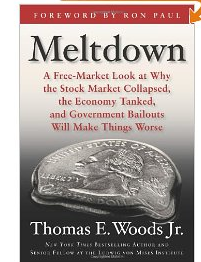
This review is of: Meltdown: A Free-Market Look at Why the Stock Market Collapsed, the Economy Tanked, and Government Bailouts Will Make Things Worse (Hardcover)
The thesis of this slim volume is that “The current crisis was caused not by the free market but by the government’s intervention in the market” (2) Author Thomas E. Woods argues that “Fannie Mae and Freddy Mac, government-sponsored enterprises (GSEs) that enjoy various government privileges alongside their special tax and regulatory breaks, were able to draw far more resources into the housing sector than would have been possible on the free market.” (2) In addition, says Woods, “the greatest single government intervention in the economy, and the institution whose fingerprints are all over our current
mess [is] America’s central bank, the Federal Reserve System.” (2-3) Woods holds that Federal Reserve monetary policy artificially fosters high-level economic activity by maintaining artificially low interest rates, thus encouraging unsustainable credit expansions, the long-run effects of which are financial bubbles such as that of 2007. Moreover, instead of reacting to the financial crisis by allowing the free market to restore a normal interest rate structure, the Obama administration bailed out the financial sector by further flooding the market with artificially-induced liquidity, thus ensuring the perpetration of the crisis. They took this tack, says Woods, because the administration is in the pay of the securities and investment industry: “Congressmen who voted in favor of the bailout when it appeared before the House on September 29 had received 54 percent more money in campaign contributions from banks and securities firms than had those who voted against it.” (5)
Woods acknowledges that not only the political influence of the securities and investment industry, but also dominant macroeconomic monetary theory, is involved in the perpetration of government policies that make financial crises inevitable. By contrast, Woods holds that the Austrian School of economic thought, founded by Ludwig von Mises and Friedrich von Hayek and others in the late nineteenth and early twentieth century, correctly predicted the sad events of 2007: “perhaps 10 or 12 of the country’s 15,000 professional economists saw the economic crisis coming… but hundreds of economists who belong to Mises’ Austrian School of economic thought sure saw it… And the primary culprit, from their point of view, is the Federal Reserve.” (8)
Woods’ recommendations for preventing future distress situations in the financial sector include setting a policy of non-intervention (“Let them go bankrupt”, p. 147), abolishing Fannie Mae, Freddy Mac and other government-sponsored enterprises in the housing market, ending government manipulation of the money supply and either abolishing the Federal Reserve or seriously restricting its latitude for regulatory intervention.
How are we to assess Thomas Woods’ claims? First, Woods is completely disingenuous and entirely misleading in suggesting that “hundreds” of Austrian-school economists foresaw the events of 2007. The truth is that Austrian school economists have a theory that says that excessive state intervention in interest rate formation leads to financial crises and thence to economic downturns. But they did not predict this crisis. Moreover, there have been periodic financial crises in American economic history, and only a fool would predict that we have seen the last of them (although Federal Reserve chairman asserted that he was completely dumbfounded by the crisis of 2007, and hence must have believed that credit crises were consigned to the history books). In this sense, any reasonable economists would have said in 2006 that there will be a financial crisis at some time in the future—which is neither more nor less than what the Austrians might have said.
Second, Woods’ implication of the GSEs in the subprime meltdown is seriously overdrawn. It is based on the notion that the government has implicitly guaranteed stockholders investments in the GSEs, putting them in a no-lose situation in which they can take great risks with subprime mortgages and reap the profits when things go well, but can offload their losses to the taxpayer when things go bad. However, Fannie Mae and Freddie Mac stockholders have been clobbered by the financial meltdown, and stock prices in these two institutions have fallen to near zero. Stockholders could not have plausibly expected that their stock values would be immune from steep decline.
Moreover, Federal regulations placed serious restraints on the ability of the GSEs to assume high-risk debt. Indeed, by definition these GSEs did not engage in subprime lending because their legal statutes prohibited them from issuing mortgages without substantial down payments and closely validated assurances concerning family income and wealth. Indeed, Fannie Mae and Freddie Mac began to recede from the forefront of mortgage lending when the housing bubble emerged in the years after 2003. Fannie Mae and Freddie Mac executives panicked when their positions in mortgage markets began to deteriorate, and they introduce questionably legal procedures (“expanded approval” for Fannie Mae and “A minus” for Freddie Mac) to recapture market share. But these efforts were basically unsuccessful because the GSE lenders were saddled with fixed-rate loan structures. The share of GSEs in the mortgage market faded rapidly in the latter years of the housing bubble.
Third, there is absolutely no empirical evidence suggesting that Woods’ policy alternatives might work. There is considerable debate concerning the nature of credit crunches and the Austrian school story is perhaps in the running in explaining them (most economists think the Austrian explanation is bizarre and wrong-headed—Paul Krugman once compared it to the phlogiston theory in chemistry), but there is no support for the notion that an advanced capitalist economy would do better adhering to the gold standard and foregoing active monetary intervention. Moreover, there is widespread opinion among monetary economists, based on a century of experience in financial regulation, that an economic downturn is always a period of excess demand for liquidity, that the financial sector cannot supply such liquidity in a downturn, so the best monetary policy is to flood the economy with liquidity, to whatever degree is required to satisfy the demands of industry. This of course flies in the face of the Austrian theory that it is an excess of liquidity that leads to the downturn, but I believe the historical experience supports the conventional wisdom over the Austrian school.
The Austrian school has had many years to provide the evidence in favor of its model of the free market economy, and it has failed abjectly to do so. The Austrian school founders were notorious for their contempt for empirical evidence, claiming that economic principles are praxeological–self-evident and purely logical in principle, but subjective and highly complex in the human individual, and hence inaccessible to empirical analysis. This argument has little merit, in my estimation—I spend a good part of my time gathering and analyzing evidence concerning human (and other animal) behavior so as to better understand social dynamics and the realm of the possible in social policy. What the Austrians consider logical appears to the rest of the world (and most assuredly to myself) as the ponderous prejudices of free-market fundamentalists for whom science based on evidence is replaced by faith based on wishful thinking.
The lack of evidence for the Austrian theory does not mean that it is wrong. There is little evidence in favor of any of the competing macroeconomic theories (Keynesian and rational expectations schools being the most prominent). Indeed, to my mind these are not theories at all, but rather toy models so severely stripped-down from the complex reality of a market system as to bear no relationship whatever to the reality they purport to model. Of course, traditional macroeconomists do care intensely about empirically verifying their models, but they all are very poor predictors, rarely doing any better than simple extrapolations from the recent past.
The fact is that the evidence does not support any of the alternative macro models out there, which is why the Austrian policy prescriptions could possibly work. The fact is that they have never been tried. All modern economies use fiat money, have extensive financial controls, and intervene regularly in the operation of the market system. I prefer the standard approaches to monetary policy because they have worked in the past, and only a near-fanatical belief system, such as that cherished by the Austrian school, could believe that a free-market system without government intervention might work in the future.
I am often asked why macroeconomic theory is in such an awful state. The answer is simple. The basic model of the market economy was laid out by Leon Walras in the 1870′s, and its equilibrium properties were well established by the mid-1960′s. However, no one has succeeded in establishing its dynamical properties out of equilibrium. But macroeconomic theory is about dynamics, not equilibrium, and hence macroeconomics has managed to subsist only by ignoring general equilibrium in favor of toy models with a few actors and a couple of goods. Macroeconomics exists today because we desperately need macro models for policy purposes, so we invent toy models with zero predictive value that allow us to tell reasonable policy stories, the cogency of which are based on historical experience, not theory.
I think it likely that macroeconomics will not become scientifically presentable until we realize that a market economy is a complex dynamic nonlinear system, and we start to use the techniques of complexity analysis to model it. I present my arguments in Herbert Gintis, “The Dynamics of General Equilibrium”, Economic Journal 117 (2007):1289-1309.
~~~
Amazon review reproduced with permission of author.


Tweet
Facebook
Reddit
Digg this!


July 19th, 2010 at 6:40 pm
I absolutely agree with the author on the basic premise; the government took a measure of risk away from the banks by pseudo guaranteeing the mortgage debt, so the banks wrote more loans than they should have, and to less credit worthy borrowers to boot. These additional loans given to unqualified applicants increased the prices for houses causing a bubble. The banks have 11 to 1 leverage with collateral that is now declining in price at a 11 to 1 rate causing the current credit contraction. Money = debt and debt is shrinking so the government offset this by creating more government debt. This government debt (primer) failed to start the economic pump, so now they must decide if they try another round or hunker down and watch everything compress in like a sub too deep in the ocean. Summary: Your 401K will go the way of social security if you don’t keep close tabs on it.
July 19th, 2010 at 7:01 pm
Now if only you there was some empirical evidence, instead of some squishy thinking that ignored way too many facts…
July 19th, 2010 at 7:20 pm
Odd review, because at least as I see it, complexity analysis is the way that would unify the Keynesian, Austrian,and Minsky-type approaches.
July 19th, 2010 at 7:26 pm
To sum up this review: “you need a PhD in Economics to have a theory about macroeconomics. Otherwise, you are just a dumbass, unlike me.”
July 19th, 2010 at 7:32 pm
BR’s “Now if only you there was some empirical evidence, instead of some squishy thinking that ignored way too many facts…”
A cherry picker claiming another cherry picker is squishy….
QED
July 19th, 2010 at 9:24 pm
Barry:
Can you give me empirical evidence to prove empirical evidence? That’s kind of what you are saying.
Like many critics of Austrian theory this professor doesn’t have a clue about it. He may have read about it but he doesn’t understand it and his comments about it make that pretty obvious (i.e., Walras being its fountainhead). While I would hope you would surprise me, I’m guessing you’ve never studied it either. Anyone who quotes Krugman on anything, as does this critic, would be suspect anyway. I can guarantee you that Krugman has no idea what Austrian theory is. So, until you can claim knowledge of it, please avoid the term “squishy thinking” in this context. The problem with Austrian theory is that it’s difficult stuff which may deter economists like Prof. Gintis. I enjoyed Meltdown, and I enjoyed Bailout Nation too.
July 19th, 2010 at 10:07 pm
Thanks for the book reference, I should enjoy reading this one.
July 19th, 2010 at 11:03 pm
As long as you don’t mind being misinformed — be sure to use his intellectual frmaework for your future investments
July 20th, 2010 at 3:03 am
Talk about misrepresenting reality. Mr. Gintis’ claim that the austrians did not predict the crisis proves he has not bothered to learn the theory that is the basis of the book he is reviewing. That is poor proffesional judgement and highly disrespectful.
You have to be quite slow or flat out blind if you can not understand the basic dynamics of a free market and the adverse effects of government regulation.
Gintis is trying to toot his own horn and is quite unsuccessful at it.
I am a student of the keynesian school as most economists are, and the flaws were apparent to me. Only after my own research into alternatives did I stumble upon the Austrian School and in my mind there were no question that the austrians had it right.
Woods vs. Gintis – Woods wins hands down.
~~~
BR: The Austrians have been predicting a crisis for decade! That one eventually came along — and caused by something other than they forecast — hardly garners them credit for the prediction.
PS: Why do I doubt you are a Keynesian . . . ?
July 20th, 2010 at 7:56 am
@ BR; Not trying to float my own boat here, I knew in 2002, real property was way over inflated and due for a correction. I didn’t know when it would deflate, I knew enough to stay out of the real estate market.
My premise was simple: The burden on property was/is extremely beyond income in the commercial sector, and beyond belief in the residential sector.
I couldn’t buy squat with 100K cash down and make the mortgage payments (using the simple formulas that used to be standard practices in determining burden) too.
So, If I knew it, why didn’t anyone else know it?
July 20th, 2010 at 8:19 am
Sometimes the evidence is clearly empirical, and I do not need degrees in math and economics to see it! I do not like heard mentality either, especially where politicians get involved
July 20th, 2010 at 8:20 am
herd
July 20th, 2010 at 8:31 am
If you would like to take empirical data one step further, look at the property values in minority hoods and compare them to the property values in the Anglo hoods: You should find the Anglo values much more surreal.
July 20th, 2010 at 9:30 am
@ BR:
I have studied Keynes, but I am no Keynesian. My point was that I distanced myself from that way of thinking after learning the mechanics of the theory.
Are you saying that Mike Shedlock’s recession call was wrong and that he had been saying it for a decade? I disagree.
Are you saying Peter Schiff’s recession call was wrong and that he had been saying it for a decade? I disagree.
(Though I do not agree with his inflation call, at least short term).
What about Ron Paul’s testimony to congress in 2003 regarding the soundness of the GSEs?
And the list of other eminent austrian economists that were right goes on and on.
The reason Austrians have been bearish is because they understand how manipulation of interest affects the economy. That in conjunction with efforts like the Bush government’s move to get everyone houses and Fannie/freddie policy clearly was unsustainable.
You claim they have been saying it for so long it had to come true eventually. I see no problem here. That is because Austrians always have said that the FED has the ability to “reflate the bubble” up to a certain point and kick the can down the road, but they understood that this can only go on for so long. When the problem is big enough it will burst. That was based on proper analysis based on facts, not just saying “I think we will crash sometime this decade”.
What cause of the crisis do you see that you claim austrians did not?
Recommended Reading List courtesy of Mike Shedlock
* Economics in One Lesson: The Shortest and Surest Way to Understand Basic Economics by Henry Hazlit
* Economics for Real People by Gene Callahan
* What Has Government Done to Our Money? and The Case for a 100 Percent Gold Dollar by Murray N. Rothbard
July 20th, 2010 at 9:40 am
Many thanks for posting that review! He scorched the author like a city sidewalk in July 2010.
That book don’t even make it as summer fiction.
Nobody needs a PhD in Math, Economics or anything else to spot the untruths, no matter how often they are repeated: Fannie/Freddy were shutout of the crooked game.
The Wall Street geniuses still “doing gods work” are counting on collective amnesia as well as [insert favorite euphemism for world's oldest profession] books like this one.
July 20th, 2010 at 9:51 am
Carse
> If you would like to take empirical data one step further, look at the property values in minority hoods > and compare them to the property values in the Anglo hoods: You should find the Anglo values much > more surreal.
You are right. Also, I read in the NY Times that mortgages over a million bucks were much more likely to be in default than the mortgages of us hoi polloi:
http://www.nytimes.com/2010/07/09/business/economy/09rich.html
I have suspected for a long time that “moral hazard” often has a lot to do with working stiffs catching a fair shake instead of the more usual shaft.
Jim
July 20th, 2010 at 10:23 am
Well, jimc1004, I didn’t say that all property in Anglo hoods are owned by Anglos! As a matter of fact it’s more about location, location, location than based on skin color. Now days to live in a safe hood comes at a premium. And, to live near good drinking water comes at a great cost.
July 20th, 2010 at 8:23 pm
Barry:
You exaggerate, of course. I’m not talking about Mark Faber et al. I’m not talking about the broken clock being right twice a day. And I’m not talking about stock analysis. But, you’ve got to admit, the economic prognostications from the “empirical” research of the vast majority of economists was dead wrong leading up to the crash. You’ve got to question the validity of their foundations to honest.
Again, please don’t castigate Austrian theory until you understand it. I’ve studied Keynes and I’ve studied Neo-classisists (Friedman) so at least I can claim to be able to make the argument.
Thanks.
July 20th, 2010 at 9:06 pm
The very last paragraph sums up what the author believes we need to do.
“I think it likely that macroeconomics will not become scientifically presentable until we realize that a market economy is a complex dynamic nonlinear system, and we start to use the techniques of complexity analysis to model it. I present my arguments in Herbert Gintis, “The Dynamics of General Equilibrium”, Economic Journal 117 (2007):1289-1309.”
I get it, the evidence is not presentable because economists do not understand that they need to great dynamic models that are more complex. . Whew, now that we know that we can have all of our economist stop building those “linear” models and get to work creating dynamic super models that will keep the economy in less volatile state.
Didn’t all the countries that had housing booms have similar versions of Fannie and Freddie in some form (tax break’s, FHA loans etc.)? I am not saying that Fannie and Freddie caused the crisis solely but the pushed encouraged malinvestment along with articially low interest rates.
Gintis claims that there is little evidence out there that the Austrian theory works however I do not concur on that point. There is a ton of evidence out there about GNP growth (or the equivalent there of) under the gold standard going back hundreds of years. See Murray Rothbard’s, “A History of Money and Banking in the US, Part one, pg 159, The Gold Standard Era With the National Banking System. Despite what the history books say, it was one of the most prosperous times for this country. Low unemployment, falling prices, rising real national product (3.7% per annum), and skyrocketing productivity.
Mr. Hickey, please chime in. I think, at least you must have cracked open Economics in One Lesson or The Theory of Money and Credit, or one of my personal favorites, the introduction the American’s Great Depression (written by Joe Salerno).
July 20th, 2010 at 9:29 pm
[...] 7/19/2010 Barry Ritholtz, click here published a scathing review of Tom Woods recent book, Meltdown, by Prof. Prof. Herbert Gintis which briefly details why austrians predicted the crash and also why the believe they know why it [...]
July 21st, 2010 at 8:59 am
@ MisesBeliever The problem in a nut shell is mostly a “willful suspension of disbelief.” I believe this is mostly what herd mentality is all about.
we must all consider that government is always a third party of interest in any free economic theory. @ Friedman, and Hayek, where both weighted government interests heavily in determining economic outcomes.
While advocating laissez-faire views, it is inevitable that political activists prefer a more involved method.
No one could convince me the deck was not politically stacked.
July 22nd, 2010 at 11:09 am
Woods is right and the reviewer is wrong. The Austrians were very vocal about the bubbles that the Fed was creating in the IT and housing markets and predicted that we would have a crisis once it was no longer possible to prop up the bubbles. They clearly saw the danger of the GSEs and the privileged positions of the rating agencies were creating. People like Peter Schiff, Ron Paul, and Marc Faber were ridiculed for making their dire predictions and for pointing to the obvious housing bubble as the financial press was gushing and calling for a continued love affair with housing. Now that the Austrians have been proven right the mainstream economists and financial analysts who were wrong are trying to downplay the episode.
As far as I am concerned it does not matter who the readers believe because the markets will reward those who are right and who have the courage to go with their convictions. I have sided with the Austrians and made my bet on a decline of the purchasing power of fiat currencies and the failure of interventionism. So far, my bets have paid off very well and I have been able to sleep very well. I do not believe that those that took the opposite position can say the same.
~~~
BR: Recognize that Woods is in the blame Fannie crowd.
I have long shown evidence and data of the impact of the Fed, including both causation and correlation.
I patiently await empirical data from those who want to blame F&F or the CRA or the Clinton tax cuts or whatever.