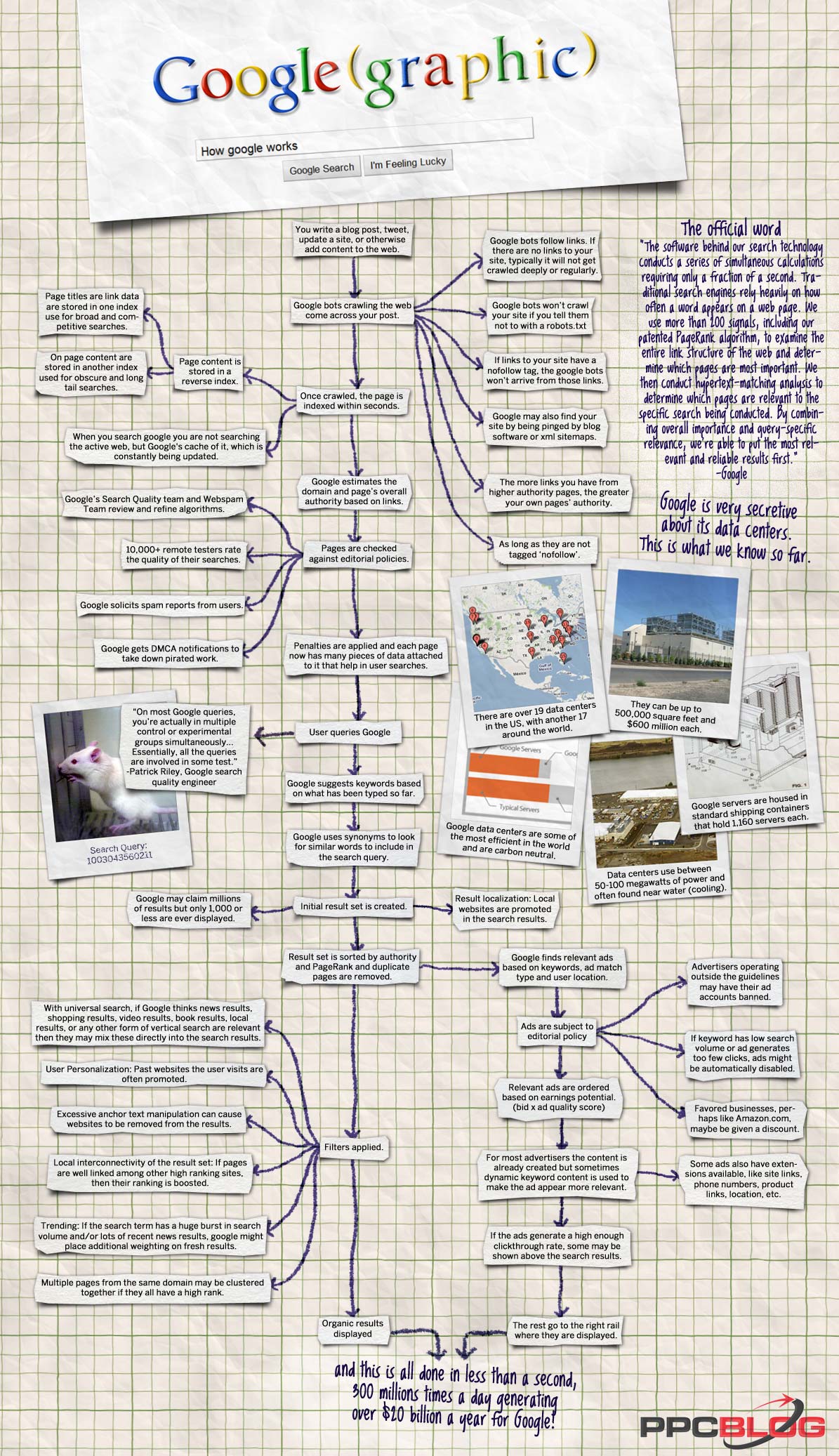
How Google Works

Email this post Print this post
By Barry Ritholtz - July 4th, 2010, 3:00PM

Weekend chart porn, via PPC Blog:

>

Comments

Please use the comments to demonstrate your own ignorance, unfamiliarity with empirical data, ability to repeat discredited memes, and lack of respect for scientific knowledge. Also, be sure to create straw men and argue against things I have neither said nor even implied. Any irrelevancies you can mention will also be appreciated. Lastly, kindly forgo all civility in your discourse . . . you are, after all, anonymous.

8 Responses to “How Google Works”

  1. DL Says:

    Interesting info.

    One thing I’ve wondered about is how google search differs (if at all) from yahoo or microsoft web search.

  2. Mike in Nola Says:

    That’s all bs, it’s the tubes, man.

    DL: Generalizing, I’d say that Google has tended to concentrate on the quantity of results. Bing seems to be aiming a more contextually useful results, although they are smaller in number. Bing’s aim was illustrated in its TV ads, e.g. http://www.youtube.com/watch?v=MN28Ad3TNrQ It doesn’t always succeed, but it’s generally closer.

    I tend to use bing if I have a pretty good idea of what I’m looking for, like a business’s office address whereas I use Google for needle-in-a haystack kind of thing where I steel myself to looking through page after page of irrelevancies to find the result I’m looking for.. Used google last week when I was shopping for a washer and dryer. Just put in the model number and and got a google web page that had links to reviews from a number of different sites.

    MS also seems to be pushing services through bing. The travel engine is fairly sophisticated. It can be used to shop for music and entertainment.

    I have noticed that google seems to have changed its algorithm somewhat to counter bing and is giving more useful results sometimes.

    Have to admit I haven’t used Yahoo search in quite awhile.

  3. Chief Tomahawk Says:

    Looks like an efficient use of capital as opposed to the recent credit bubble’s dreadful misallocation …

  4. bman Says:

    Nice to see a company that actually does something useful for the pennys they skim off us each day.

    And I’ll have to say the ads are not bad. Anyone else ever get annoyed at the ads on weather.com?

  5. seobook Says:

    >One thing I’ve wondered about is how google search differs (if at all) from yahoo or microsoft web search.<

    They differ significantly. Google focuses much more on result localization (they have huge marketshare in many international markets and that gives them a lot more data to work with), uses more aggressive & granular word relationships, and is generally better at discounting some forms of manipulative links. Google's biggest issue from a relevancy standpoint is overweighting domain authority, which lead to the rise of content mill publishing business models (eHow, Associated Content, etc.)

    But recently Google has been looking to require more to rank on some of the longer tail keywords that those sites were arbitraging. I also suspect that as micropayments rise and Google gets their ebook deals set up that those content formats will see additional exposure on the regular search results, further crowding out some of the old regular results…and making it that much more important to rank #1 or #2 if you want to get any decent traffic from the ranking.

    And the above vertical data-sets will be one of the major points of differentiation going forward. Just recently Google bought ITA … which gives them a huge relevant data set for vertical search in the travel space.

    Yahoo! just had a really batched update. Spammy forum profile pages (like usernames "cheap viagra") ranking, virtually no relevant localization, ranking the wrong pages (like ranking the "Alaska" page on a "Kentucky" query on a website that has a page for each location). It is no surprise that Yahoo! is the one bowing out of web search :D

    Within about 2 or 3 months the Yahoo! results should be powered by Bing. They are already testing using Bing results internally.

    I suspect Bing's relevancy algorithms will advance fairly quickly after they power Yahoo!, because many people will start targeting Bing more aggressively. Right now some of the things that Bing does differently than Google are fairly frequent inline suggestions of secondary keywords (and the associated results)…so you search for "credit cards", and after 5 or so results they list "types of credit cards" and then the top few sites for that keyword. Bing also tends to like fresh links *a lot* … so if you want to rank there it helps to pace out getting the links over time. Whereas with Google I think to some degree you can have a somewhat stale link profile and still rank ok.

  6. seobook Says:

    Great point Mike about Bing being less good at the longtail searches. They sorta admitted to that being a shortcoming publicly here
    traffick.com/2010/03/yusuf-mehdis-too-candid-comments-about.asp

  7. scepticus Says:

    BR et al,

    Holiday eye candy for you. Please watch this animation, you’ll really like it. Its very clever, whether or not you agree with the content.

    http://www.citywire.co.uk/money/the-crises-of-capitalism-and-their-inescapable-conclusion/a411421

    Long live America!

    ~~~

    BR: We posted this last week
    http://www.ritholtz.com/blog/2010/06/crises-of-capitalism/

  8. Reinko Says:

    Somewhere in the upper left corner of the picture you read:

    10.000+ remote testers rate the quality of their searches…

    That is correct; a brother of mine did work like that a few years ago. He got long lists of search phrases and he had to rate websites about how relevant they were.
    It was rated on an ordinal scale from ‘very good fit’ to ‘not rate able’.

    But that was years ago, in that time it was more or less a secret the money came from Google. After all Google collected it’s IPO money on the belief it were the superior algorithms that did the trick…

61 queries. 0.314 seconds.