
Slowing Growth or Recession ?

Email this post Print this post
By Barry Ritholtz - July 1st, 2010, 3:00PM

There seems to be some misunderstanding as to my economic viewpoints beyond the usual recession/expansion, bull/bear, black/white dichotomies. Allow me to clarify:

>

The Recovery that we have seen has been uneven, with the Economy best described as “lumpy.”  Pockets of growth not evenly distributed; lots of Fed and Treasury largesse driving activity.

Corporate (non-fin) balance sheets are cash rich and debt free, earnings are strong.  The bright spots are Manufacturing and Industrials; On the other hand, Retail (except Autos) Housing, Finance, Materials are weak or weakening.

But overhangs of another leg down in Housing and weak job creation make it unlikely we will see any more 3-4% GDP over the next few Qs. And as we have noted for nearly a year now, record low hours worked means Employers can expand production without any new hires — they simply add hours to workers who gratefully will accept them.

Based on the economic data, what we see now is for economic growth to slow — right now, we project the next few Qs of GDP to be in a 1.5 – 2.5% range. We do not rule out a double dip or a recession in 2012 — we simply do not have sufficient evidence to draw that conclusion.

Why? Recoveries typically surge once pent up consumer demand rushes into the early stages of a bounce. That surge eventually fades. As it does, a simple slow down and a recession look all but indistinguishable in the data for the first 6 to 12 months or longer. We are in that period now, and cannot differentiate between the two — yet.

So now, all we can say with any degree of confidence is that we see growth slowing, and await more data prior to making a recession call . . .

>

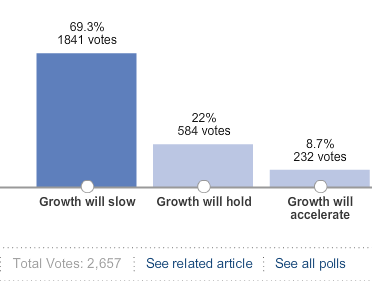
WSJ Poll: What will happen to the U.S. economy during the second half of 2010?
Comments

Please use the comments to demonstrate your own ignorance, unfamiliarity with empirical data, ability to repeat discredited memes, and lack of respect for scientific knowledge. Also, be sure to create straw men and argue against things I have neither said nor even implied. Any irrelevancies you can mention will also be appreciated. Lastly, kindly forgo all civility in your discourse . . . you are, after all, anonymous.

66 Responses to “Slowing Growth or Recession ?”

  1. Barry Ritholtz Says:

    The difference between slowing growth and a recession is like the difference between Mariano Rivera’s fast ball and cutter: You cant tell until its too late

  2. TakBak04 Says:

    I like this comment from consumer indexes… : -)

    ——

    “Walking Pneumonia” Contraction Ahead: The Information Missing from the BEA Q1 GDP Report”

    As you can see from the above chart the current consumer “demand” contraction event is unique: if there is a “second dip” it may very well be unlike anything we have seen recently. Instead of a “call-911″ type of event in 2008 or the “hiccup” witnessed in 2006, we may be seeing a “walking pneumonia” type of contraction that has legs.

    The indexes themselves can be found at http://www.consumerindexes.com.

  3. dead hobo Says:

    BR Observed:

    Why? Recoveries typically surge once pent up consumer demand rushes into the early stages of a bounce. That surge eventually fades. As it does, a simple slow down and a recession look all but indistinguishable in the data for the first 6 to 12 months or longer. We are in that period now, and cannot differentiate between the two — yet.

    reply:
    ———-
    The stock market was pretty active.

    The economy didn’t really surge that much. If you didn’t have the GDP statistics to look at, you would have missed it if you blinked. And maybe if you didn’t blink. So this is only the slow down part, possibly. Tell me, how do you slow down from invisible growth? The absence of $1.5T total Fed stimulus of a few hundred billion in deficit spending might be noticed in the coming months. You know, for all that cash, we didn’t get much to show for it. Yet. I’m sure we’ll see something real soon now if we keep our eyes open. Look sharp and post in this space if you see something.

  4. call me ahab Says:

    wow- 8.7% think growth will accelerate in the 2nd half-

    now that’s wacky-

    and BR- c’mon man- quit being so equivocal- you must have an opinion? For instance- I think the Chicago Bears have a good chance to make the playoffs this year-

    but maybe I should wait until the 10th week or so- when more of the data is in- before making that call-

    you sound like a pointy head

  5. Detroit Dan Says:

    I agree with the dead hobo. We just had a once in 100 year credit crash, and people act like it’s an ordinary recession. As the stimulus fades, the default position is back to recession. Throw in Europe, China, housing, falling stock prices, and Republican obstructionism, and you’ve got a perfect storm, I’m afraid.

    But I’m a permabull — on U.S. Treasuries…

  6. SwimUpstreamToWealth Says:

    Concur with dead hobo – pretty anemic numbers considering the fiscal and monetary stimulus along with a consumer bounce. I expect autos to start dragging again once the 0% financing and huge rebates disappear, which they will. This was a contributing factor to their problems in 2008 and 2009.

    It just seems we are on the Japanese roller coaster. We get some stimulus; hope and optimism emerge; stimulus fades and markets/economy sinks again. Wash, rinse, repeat. Three fourths of the Japanese economic quarters showed positive GDP growth since 1990, but they are still facing an untenable debt situation and economic funk.

  7. kstills Says:

    We’ve only seen one quarter of GDP growth above 3.5% in two years.

    Don’t go too far out on that limb there…..

  8. Chief Tomahawk Says:

    My gold position is getting squishied today…

  9. dead hobo Says:

    Let’s run a thought experiment. I’m serious. Please contribute. This is on point for this topic.

    The Fed just printed and spent $1.5T and the Federal government spent hundreds of billions of dollars, possibly over a trillion dollars, to fiscally stimulate the economy and to use TARP to save the financial world. This is old history. It is assumed we are all better off for these efforts. Real and faux economists say we are beneficiaries of a massive rescue.

    But wait.

    Assume a time and place where no rescue happened. $1.5T was not printed and $999+Billion was not deficit spent. How different would the world look as of today without a rescue? Really look. Not how the propaganda and economists state it would have looked.

    At this time a couple of years down the road, how different would the landscape really appear if there was NO bailout? All opinions matter in this experiment. Please speak up.

  10. constantnormal Says:

    I appreciate your attempts to clarify. Allow me to try as well.

    Let’s suppose we have an “ordinary” recession, wherein supply gets ahead of demand, and we accumulate inventories that are in excess of what the economy can reasonably support. We then have the classical “inventory recession”, wherein not only are inventories liquidated, but changes are made to the systems that produced the excess inventories.

    This was (or is, depending on your preference) not an inventory recession. The things that lead to this economic calamity are well-described in your book.

    But where are the corrective measures to ensure that we do not repeat the exact same path? Until such actions are taken, I cannot accept that we are in any sort of lasting “recovery”, weak/small/whatever.

    Pretty much all of the things that lead us to this point remain in play: excess leverage, duplicity and fraud in most of the financial industry, an obscene concentration of wealth/power in just a handful of companies, which have management that is not particularly bright, and certainly are not up to the task of managing such ginormous and far-ranging enterprises. The Glass-Steagall separations between investment banking and consumer banking remain gone, and the financial industry continues to operate without any visible external controls/restraint/oversight.

    So we have lost a ton of value from the economy, and are positioned for the banksters to lose even more, passing it along to the government until the system cannot take any more. I don’t believe that anyone can claim that the banksters have “learned their lesson” — the only lesson that has been learned is that their investment in lobbyists has paid off, and the government (taxpayers) will continue to absorb the losses from their mistakes.

    This hardly appears like any sort of recovery — of whatever degree of strength — to me. After sufficient pain has been experienced, I do expect changes to be forthcoming — at least that is the pattern from the 1930s, and it took several years of severe economic weakness then (just like what we are seeing today, except moreso) before changes were finally produced.

    One can even look to the Japanese system, and see that corrective changes may NEVER come, with the economy trending lower over time, with no end in sight.

    YMMV.

  11. Detroit Dan Says:

    A few observations on Japan:
    1. Their deflation occurred while the rest of the world was inflating, so that eased their pain.
    2. Their unemployment is much less than ours, and they have universal health insurance. So they’re not doing so bad.
    3. Their debt situation is tenable. No bond vigilantes in sight…

  12. ACS Says:

    Yes the Fed created a lot of money but how much did the private sector destroy in housing and housing related “investments”? How much more will be destroyed when those “assets” are finally marked to reality. The economy has to undo decades of misallocation. Too much of the growth was based on selling imported junk to free spending consumers using home equity or credit to live beyond their means or the proliferation of exotic financial instruments of dubious value. Too little was based on actually making things that people here, and especially abroad, want to buy. Getting back to a non slow-suicidal economy will be long and painful and will eventually require saying no to a lot of promises made for political expediency or raw vote buying. We’ll be lucky if we get away with a mere recession or two or three.

  13. constantnormal Says:

    Metaphorically …

    When a patient arrives in the ER with blood pumping from a gunshot would, they do not merely clean the wound and hang a series of bags of blood to replenish what was lost, then move the patient on to the “recovery room”.

  14. constantnormal Says:

    I should have made clear in my last example, my hypothetical patient in the “recovery room” is still pumping blood onto the floor.

  15. JustinTheSkeptic Says:

    Yea, C’mon Man! What ever happen to your go out on a limb and tell us what’s out there amongst the forest and the trees. Tea-reading is always a good excercise because it puts market prediction in its proper place – somewhere between fortune teller, and savant. My prediction is that we bump along here until, people start to realize how really awful things are. Corporations can still have lots of cash, but it takes people with cash to buy their products. Whatever happen to, “the consumer is 2/3 of the economy,” crowd? We don’t here from them much now, because it doesn’t fit into their bull market scenario.

  16. Detroit Dan Says:

    dead hobo,

    I was worried about the money market funds if there would not have been a bailout. It would have been catastrophic, in my opinion. My life savings could have been wiped out, even though I had my money in the most conservative of the options offered in my 401k. Unemployment would probably be much higher as the failure of short term deposits such as money market funds would have cascaded throughout the global economy. It would have been hell.

  17. Robespierre Says:

    BR:

    “Retail (except Autos) are weak or weakening.”

    Really?
    “Based on an estimate from Autodata Corp, light vehicle sales were at a 11.08 million SAAR in June. That is up 14% from June 2009 (when sales were very low), and down 4.6% from the May sales rate.”
    “Auto sales have recovered from the low levels of early 2009, but are below the lowest point of the ’90/’91 recession (even with a larger number of registered drivers).

    This was below most forecasts of around 11.4 million SAAR.”

    http://www.calculatedriskblog.com/

  18. constantnormal Says:

    @Detroit Dan 3:58 pm

    What makes you think it is any different today?

    And I believe that the government backing of the money market funds has been removed — although, even in the worst of the 2008 chaos, no money market fund even needed to draw upon government guarantees (except perhaps psychically). And even if a money market fund or two have broken the buck, we’re talking about losing only a nickel or so out of your dollar.

    When the next wave comes, it will not be Lehman Bros paper or Fannie & Freddie paper that is at risk, it will be short-term Treasuries. That’s why we need corrective actions TODAY, to avoid ever getting to that point.

    Catastrophe is still very much an option.

  19. constantnormal Says:

    @BR … “lots of Fed and Treasury largesse driving activity”

    Where, outside of a half-dozen banksters? GM’s recent sales are only 10% better than they were a year ago when they were in bankruptcy and most people were scared to death to commit cash/debt to a car purchase. AIG? Fannie? Freddie?

    Small businesses remain strapped for working credit, reducing the single largest driver of employment in the nation.

    I see not any activity outside of the Boyz on da Street that Uncle Sam is supporting.

    OK, I guess that we are sending a boatload of cash to the weapons industry.

    ~~~

    BR: TARP, QE, RMBS purchases, Stimulus, etc.

  20. Transor Z Says:

    @DH:

    Two years removed, there would have been criminal indictments against top execs at Wall Street firms around the world. I’d be living with my family in Europe.

  21. Detroit Dan Says:

    @constantnormal

    Thanks for the feedback. I think the banks are in much better shape today, liquidity-wise, but I’m no expert in this area…

  22. Chief Tomahawk Says:

    To those looking for some insight: Barry’s Fusion IQ service is presently offering a free 30-day trial. The tea leaves over there may be sending smoke signals at present.

  23. Barry Ritholtz Says:

    Thanks for the plug, Chief.

    Here’s an update: The number of stocks on a sell signal spiked earlier this week (this is as of Weds close)

  24. How the Common Man Sees It Says:

    Assume a time and place where no rescue happened. $1.5T was not printed and $999+Billion was not deficit spent. How different would the world look as of today without a rescue? Really look. Not how the propaganda and economists state it would have looked.

    America would have fallen down the rabbit hole instead of having it plugged full of paper for them to stumble across. At this point in time I’d say that the US would probably just be starting to climb the far wall of the deep hole they would have fallen into. Prices probably would be about 20% lower but at a place where economic activity would now be starting on healthier legs. Bankruptcy and cash would be kings. Former debt slave/speculators would be swearing off debt forever and teaching it to their kids (the real thing the financial industry fears) the hard but most effective way

    Politicians would truly be dreading the upcoming elections instead of thinking now how they can talk their way out of getting fired. A version of financial reform would be a lot closer to what Barry had in mind than what we are seeing today

  25. insaneclownposse Says:

    I think you should put autos in the weak category along with the rest of retail. Calculated Risk has a post today – http://www.calculatedriskblog.com/ – about auto sales . The current levels are below those of the 1990-1991 recession! That is a far cry from strong or even mediocre. Those sales plain suck!

    There is no sustainable economic recovery in the U.S. There was a big stock market bounce that has now blown up but that is about it.

  26. Barry Ritholtz Says:

    Well, there goes autos:

    Autodata estimates that the final auto SAAR June figure was 11.1mm vs bloomberg estimate of 11.4mm. It would be the lowest since Feb.

  27. Detroit Dan Says:

    I agree with Common Man’s view. Asset prices have to go lower (except for Treasury bonds)….

  28. constantnormal Says:

    @Detroit Dan — liquidity was never the banks problem, it was a matter of solvency. That was postponed by abandoning the mark-to-market accounting rule, which resulted in the banks being allowed to treat busted mortgages as if they would recover everything.

    Bring back the mark-to-market rule, and the banks will be right back in the soup — or just wait until the loans come due and MUST be written down. Which is why the banks are frantically making money trading, to use as a backstop against the inevitable writedowns.

    The financial system remains broken, so long as the toxic debt remains. We can hide it, but it’s still busted, just as the wizard in Oz was really powerless. We don’t want people looking behind the curtain!

  29. constantnormal Says:

    @BR — this is a really good topic. You oughta recycle it every couple of weeks.

  30. Transor Z Says:

    I think I’m going to have to bite the bullet and slog through “This Time It’s Different.” Good reviews but I’ve been intimidated because so many have said it’s dense.

  31. Market Talk » Blog Archive » Links 7/1/2010 Says:

    [...] we see growth slowing, and await more data prior to making a recession call,” Barry Ritholtz says at The Big [...]

  32. Chief Tomahawk Says:

    You’re welcome, BR!

    I was just reading another site which has identified a “bearish flag” in oil, possibly indicating a 1-3 month selloff in oil. I’d be all for that! Watch the travel deals available for September if oil breaks below $50…

  33. louis Says:

    Let’s not forget the one’s that say they are saving us are the same one’s who could not figure out how sleazy the subprime thing was. They still have done nothing to fix the original problem. The market recovery feels like it was a virtual recovery. I can’t trust it for some reason. When you look back at what has been done to keep us from another depression, does it feel like anything really was done? Is anyone really optimistic at this point? I mean we still have the driver’s who wrecked the car behind the wheel.

  34. franklin411 Says:

    @common
    Hobo makes an excellent point. From 1929-1931, the Masters of the Universe absolutely refused to make any expenditures for relief during the Great Depression. A number of liberal Republicans managed to creak the Federal wallet open for a few small, grossly insufficient relief programs for starving farmers, but even that was a hard-won gain. They originally wanted it to be a grant program to help prevent farm starvation during the Dust Bowl, but Hoover refused to create a “dole” and instead it became a loan program.

    The result?

    By 1933, America was on the verge of a revolution fueled by starvation. Serious people–senators, journalists, corporate leaders–were gripped with fear that the people were ready to take to the streets, a la 1790s Paris.

    It could have happened here, except we decided to deficit spend. Not enough to stimulate a vigorous recovery; not enough to really satisfy anyone. But the alternative is far uglier than 2% GDP growth. Failing to deficit spend might have led to a repeat of 1929-1933, and I have little confidence that Americans ca 2010 would be as level headed as their grandparents were from 1933-1945. Americans are not revolutionaries by nature, but there is a point at which every man and every woman is willing to kill: to feed their starving children.

  35. rootless cosmopolitan Says:

    Barry,

    Here’s an update: The number of stocks on a sell signal spiked earlier this week (this is as of Weds close)

    I’m curious. What is the average return from buy to sell for these stocks? And what is the average holding time from buy to sell? Thanks.

  36. call me ahab Says:

    F411-

    yaaaaawwnnnn . . .now I am so sleepy

    Detroit Dan-

    if the Fed can print money through QE- who say’s it can’t be used to make your money market account whole?

    it’s just paper right?

  37. mgkurilla Says:

    Barry,

    Recession yes or no is not the issue. The real question is whether growth will be sufficient to reduce unemployment and how quickly it comes down. If unemployment stays elevated, especially near or above 10%, any minimal positive growth will still continue to feel like a recession.

    Rather than focusing on plus/minus for GDP, the real issue should the of growth necessary to support an expanding population and maintenance of standard of living. A +1% versus a -1% GDP is onyl a matter of degree as to how bad it is.

  38. John Clarke Says:

    In light of some of the excellent posts above I suppose the next obvious question is “When does Q.E. Part II begin”?? Further government subsidies/bailouts/extensions of unemployment benefits are no longer looking as politically attractive.
    The chart of the S&P is not looking pretty with the 50 day about to cross over the 200 day.
    Maybe we get a lift in the major stock indexes as we head into earnings but I think this will only represent an opportunity to get into cash or bonds, (…unless of course we get Q.E. Part II).

  39. call me ahab Says:

    How different would the world look as of today without a rescue

    armageddon, nuclear explosions, the world in flames?

    or possibly- no soft serve ice cream (in the flavor I want)

  40. rootless cosmopolitan Says:

    @franklin411:

    Americans are not revolutionaries by nature, but there is a point at which every man and every woman is willing to kill: to feed their starving children.

    And why have the bondholders of financial institutions had to be bailed out by throwing trillions at them, instead of allowing an orderly debt restructuring and letting the bond holders take a haircut for their bad investments? So that these bond holder’s children didn’t have to starve and the owning and investing class didn’t go on a killing rampage?

  41. Bob_in_MA Says:

    Barry is absolutely wrong about this: “Corporate (non-fin) balance sheets are cash rich and debt free,”

    He’s repeated this mantra for years now, but never looked at the data that shows corporate (non-fin) debt is over 50% of GDP. In 1998, it was 43%, in 1978 it was 31%.

    “Debt free” compared to when?

  42. constantnormal Says:

    @Transor Z 5:05 pm

    you can read the abbreviated version from the research summary pdf:

    http://citeseerx.ist.psu.edu/viewdoc/download?doi=10.1.1.156.3561&rep=rep1&type=pdf

    It’s 124 pages, but everything after page 86 is supporting documentation.

  43. Cynic_FA Says:

    @constantnormal Says:

    “liquidity was never the banks problem, it was a matter of solvency” I don’t think sooooo!

    I think you got it exactly backwards. Banks print money over the long term so solvency takes care of itself. The Financial Crisis was a crisis of liquidity and confidence as evidenced by Detroit Dan and a million other lemmings lining up at banks to take money out of the money market funds. The crisis was all about liquidity. Evidence: the spike in libor rates after collpase of Fannie, Freddie, AIG, Lehman. All of the banks were out of cash and none of the banks would lend to other banks. The Fed was the primary source for rolling commercial paper. The crisis was all about liquidity and no confidence.

    This is a critical lesson, because the Achilles Heel of the world financial system is liquidity and confidence. If the doom posted on these pages come to be it will be because the markets once again refuse to roll the short term debt of financial institutions and the PIIGS.

    Will Greece be illiquid or insolvent when the auction fails? Will CitiGroup and AIG be illiquid or insolvent when the Treasury finally pulls the plug? Who cares you say! Illiquid I say. Liquidity is the cash to pay this month’s bills. Insolvent is just a fancy way of saying long term financial disaster, but Greece – Citi – AIG – California – passed that milestone ages ago. When they don’t have the cash to pay this month’s bills; when they are illiquid; when Bernanke and Congress don’t kick in another $20 Billion that is when you will be debating the merits of investing in gold or “Guns and Ammo”

  44. constantnormal Says:

    How different would the world look as of today without a rescue

    Back in the mid-70s, a whole buncha names changes on Wall Street, with (as I recall it) close to half the established names disappearing. We could have been looking at a similar thing today, with no GS, no BoA, no Citi, (etc).

    The total loss would have been the same as what we experienced — it’s just that we smeared those losses across all of the economy evenly, and back in the 70′s the Wall Street firms that disappeared paid the price first, absorbing as much of the losses as they could, with what was left being smeared across the the economy in pretty much the same manner as today.

    It seems only reasonable that the corporations at the steering wheel suffer the most, but their lobbyists have ensured that they suffered the LEAST.

    I think the different path would have been a whole lot better after the fact, although it might (or might not, we will never know) have been more exciting at the core of the event.

  45. Init4good Says:

    How different would the world look as of today without a rescue??

    Big banks holding bad mortgages would be out of “business.” Unemployment would be much worse than now claimed. Smaller banks would vastly increase deposits/assets held. Housing would be much lower than today, maybe by another 30-40% and anyone with any extra cash would be buying more by now, after experiencing a trauma.

    We have not solved anything- we are in suspended animation. Yet, things would have started to look better by now, as the boomer’s kids would be staying home and saving money for their first houses. The prices of almost everything (including stocks) would be down by 40% – bad but survivable.

  46. constantnormal Says:

    @Cynic — we will have to disagree on this one … the credit crisis occurred because nobody would lend money to each other — especially the big banks — because they had no assurance whether or not they would be paid back, not due to any lack of liquidity.

    And the reason that they were afraid they might not be paid back, was that nobody believed that their fellow banksters were not holding a fistful of busted debt as collateral. That’s that mark-to-make-believe accomplished, allowing banks to lie to each other about their ability to pay back their borrowing, due to adequate-but-phony reserves.

    The argument that banks can print money to deal with insolvency should mean that bankruptcies never occur, but in point of fact, they happen all the time — even among nations.

  47. constantnormal Says:

    @rootless cosmopolitan 5:40 pm

    I think that the “owning and investing class” have “people” to do that for them.

  48. willid3 Says:

    Assume a time and place where no rescue happened. $1.5T was not printed and $999+Billion was not deficit spent. How different would the world look as of today without a rescue? Really look. Not how the propaganda and economists state it would have looked.

    well lets see instead of 17-19% UE, we have 30-40% UE?
    instead of some semblance of a recovery, recovery isn’t even on the horizon …in 30 years?
    the possibility that enough people have decided that capitalism is a broken unreliable system and has to be replaced. after all, the regular people aren’t getting any benefit from it, only the moneyed elite?
    and the potential for revolution to replace democracy as another failed system?
    considering that people today have a lot less tolerance for failure and little to no patience, the above are not out of the question. as it almost happened after the GD. and they were a lot more patient. but they also got a lot more support from their government when it figured out just how close to the edge it was unlike today. its little wonder too, as when every one in governments head is on the block, they get very focused on fixing problems. unlike today

  49. constantnormal Says:

    insolvent vs illiquid

    one is insolvent when one is unable to manage to service one’s debt (can’t pay the interest, outgo is greater than income+credit), one is illiquid when one cannot gain access to credit.

    E.g., one is insolvent when one’s bank account is empty, and the credit cards have been frozen and one receives a bill of any amount.

    One is illiquid when one has plenty of money in the bank, but has left their checkbook at home and their credit card is declined.

    Illiquidity can be repaired, credit can be healed, depending upon how badly it is damaged. Insolvency requires a fiscal amputation, anything else is fraud. We got fraud.

  50. TakBak04 Says:

    @Detroit Dan Says:
    July 1st, 2010 at 3:58 pm

    dead hobo,

    I was worried about the money market funds if there would not have been a bailout. It would have been catastrophic, in my opinion. My life savings could have been wiped out, even though I had my money in the most conservative of the options offered in my 401k. Unemployment would probably be much higher as the failure of short term deposits such as money market funds would have cascaded throughout the global economy. It would have been hell.

    ———–

    Sadly a Big MM Fund did “Break the Buck” and lots of folks couldn’t get their money out for awhile…. It got saved in the end (probably with the Tax Payer Funding) but…it was close to going under:

    —-
    Money market fund ‘breaks the buck’ on Lehman IOUs
    September 16, 2008 | 4:37 pm

    The credit crisis has taken a new and dangerous turn: Shares of a large money market mutual fund have “broken the buck” — fallen below the standard $1 a share — because of losses on IOUs from brokerage Lehman Bros. Holdings Inc.

    The Reserve Primary Fund in New York, which had $65 billion in assets at the end of August, said it cut its share price to 97 cents after marking down the value of $785 million in Lehman debt securities, following the brokerage’s filing for bankruptcy court protection on Monday. Read the fund’s statement here.

    The Reserve Primary Fund’s situation apparently was exacerbated as big investors have fled in the last two days, forcing the fund to sell other securities. Assets have dived by more than 60% since Sunday, Bloomberg News reported.

    The fund, apparently seeking to dissuade other investors from leaving while it sorts out the situation with its Lehman IOUs, today said it would take up to seven days to meet investors’ redemption requests. Normally, money funds redeem investors’ shares immediately on request.

    Fimoneyfund17 The fund also said it had valued the Lehman IOUs at zero for the moment. That, too, could be a move to discourage redemptions, because it’s conceivable the securities have some value.
    http://latimesblogs.latimes.com/money_co/2008/09/the-credit-cris.html

  51. TakBak04 Says:

    @Init4good Says:
    July 1st, 2010 at 6:10 pm

    How different would the world look as of today without a rescue??

    Big banks holding bad mortgages would be out of “business.” Unemployment would be much worse than now claimed. Smaller banks would vastly increase deposits/assets held. Housing would be much lower than today, maybe by another 30-40% and anyone with any extra cash would be buying more by now, after experiencing a trauma.

    We have not solved anything- we are in suspended animation. Yet, things would have started to look better by now, as the boomer’s kids would be staying home and saving money for their first houses. The prices of almost everything (including stocks) would be down by 40% – bad but survivable.

    ———

    Agree in most part with what you say. But, without some “Bail Out” to stabilize the system we would have been in terrible shape (as some other commenters who are pro-bailout) have stated.

    Still the Bailouts went to some of the most unsavory characters…and instead of just targeting the stabilization of the system …the Bailout rewarded the very same folks who brought the crisis to the Average American in the first place. It was a MAJOR HUSTLE…by Paulson & Buddies who conned House and Senate (or maybe they knew it was coming and ready and waiting) but still it was very “low” what they all did. Now Average American Savers and folks who never participated in any of the Hooplah with Housing Bubble are paying the price to help everyone else. It really wasn’t a “fair” trade off.

  52. TakBak04 Says:

    Chief Tomahawk Says:
    July 1st, 2010 at 3:46 pm

    My gold position is getting squishied today…

    ——-

    CNBC’s “Fast Money” group tonight said “A Big Hedge Fund Player” sold out of their Gold Position.

    If that makes you feel better…….

  53. Robespierre Says:

    @Cynic_FA Says:

    “The crisis was all about liquidity. Evidence: the spike in libor rates after collpase of Fannie, Freddie, AIG, Lehman. All of the banks were out of cash and none of the banks would lend to other banks. The Fed was the primary source for rolling commercial paper. The crisis was all about liquidity and no confidence.”

    You are really not much of a cynic. Banks had money (some of them). The reason they refused to lend to each other was that they knew that since they were lying about their own solvency then the other banks for sure were laying too. This was about a thief knowing that he should never trust the other thief. The Fed basically came in and said give me your crap (but don’t tell me is crap) and I’ll give you all the money you want. Why do you think refuses to let the public see what they took as collateral?

  54. Transor Z Says:

    @cn: Thank you for the links (both of them). I bought the book off Amazon but will read the .pdf in the meantime.

  55. Transor Z Says:

    Here’s my nominee for Ben Bernanke’s replacement. And no, it’s not that Kartik Athreya guy. All I’m going to say is… Shapow! I believe this kid is a QE savant.

    http://www.youtube.com/watch?v=vRv-yNAriag&feature=player_embedded#!

  56. call me ahab Says:

    TZ-

    dude- that video was definitely in need of sub-titles-

    all I caught was “shapow”

    but he does seem to understand money-

    even it’s only $100 bills- lol

  57. VennData Says:

    America will collapse into a pile of rubble not fit for even the tiniest of mammals to consume.

    Run for the hills. Buy as much gold as you can and hide from Obama’s black helicopters… er… a… Clinton’s black helicopters.

    Remember how right the GOP were to tell us about Clinton’s black helicopters mowing us down? How Obama would take our guns? How Carter would mean we will be Soviets? How they will all take our gold? How Barney Frank will make us all gay? Remember?

    Remember? Remember? It’s all happening again only worse! I can’t find my gold! I can’t find my gun!

  58. Cynic_FA Says:

    Illiquid or Insolvent?

    @constantnormal says “Insolvency requires a fiscal amputation, anything else is fraud. We got fraud.”

    Maybe we actually agree just talk different – like the argument about mature versus established GDP recovery.
    I said
    “Insolvent is just a fancy way of saying long term financial disaster, but Greece – Citi – AIG – California – passed that milestone ages ago.” We both agree that the major financial institutions were insolvent, i.e. long term financial disaster. I said the reason it became a crisis is that they could not write, or kite, another check to pay this month’s bills.

    @Robespierre Says: “they knew that since they were lying about their own solvency then the other banks for sure were laying too.” Also agreed.

    Where is the Cynic in me? I do not think the solvency problem has been fixed, I think the solvency problem with sovereign debt (see Constantnormal 5:52 PM for link to Rheinhart & Rogoff) is much much worse since 2008. Like BR would say, we are deep in the “Extend and Pretend” mode. Insolvency has not gone away, illiquidity has gone away under the $1.5T flood of Federal Reserve.

    The solvency problem is the underlying disease. The liquidity problem, the inability to roll short term paper and pay this month’s bills is the spike in the death rate. All the perma bears here quoting Hussman and Rheinhart/Rogoff; It is the next liquidity crisis to watch for – The next great spike in the death rate.

    By death rate I refer to – Bear Stearns, Countrywide, IndyMac, Fannie, Freddie, AIG, Lehman, Merrill Lynch, 140 FDIC bank failures in 2009. What will be the 2011 Death Toll?

  59. nycequityanalyst Says:

    Interesting analysis… Here’s Goldman’s take on the S&P. Cute chart:
    http://www.wallstmemo.com/news/2010/7/1/goldman-sachs-sees-sp-headed-higher.html

  60. Graphite Says:

    @Bob_in_MA July 1st, 2010 at 5:51 pm

    Agreed, the first word that popped through my head when I read the corporations are “cash rich and debt free” was “MALARKEY!”

    This is sort of like when he posts that investor liquidity levels chart and notes that liquidity is now higher than the mean of the past 20 years … which just happen to be an era rife with bubbles and thus one of the worst sampling periods imaginable.

  61. azerosumgame Says:

    I agree with Bob_in_MA Says, I don’t understand the statement that corporations are debt-free. Could someone make this case with data?

    There was a good FT chart recently which shows that corporate cash to debt is well below that in the 50′s and 60′s and at the same level its been around since 1970 (http://www.ft.com/cms/s/0/7083471e-7efb-11df-8398-00144feabdc0.html or http://www.tradersnarrative.com/is-the-massive-corporate-cash-stash-bullish-or-bearish-4304.html). The Economist’s recent briefing in debt has a nice chart showing how corporate credit ratings have been trending down over time, presumably reflecting a deterioration in balance sheets (http://www.economist.com/node/16397174). And you can corroborate the fact that there is nothing historically healthy about corporate balance sheets at the Federal Reserve (http://www.federalreserve.gov/releases/z1/Current/) yourself. Seems like corporations just look better relative to households and government, not relative to what they have been like in the past.

    So what am I missing?

  62. How the Common Man Sees It Says:

    I think the Argentine or Russian economic crises would be the closest example of what would have happened to America had they not papered over their mistakes. Yes, there was struggle in both those countries and Russia resorted to a barter system for a short time but they got through.

    As for gold, don’t believe the excuse of the day. Gold is back to its usual summer vacation pattern. The downspike today is typical of its seasonal trade and it could be argued that now is the best time of the year to buy as this is traditionally gold’s seasonal low point

    Don’t show anybody this:

    http://spectrumcommodities.com/education/commodity/charts/gc.html

  63. How the Common Man Sees It Says:

    @VD Says: July 1st, 2010 at 9:20 pm

    That only has to happen once. How to you know, using an economic tradeoff argument, that the reason it hasn’t happened yet is because so many Americans have prepared for it? It is kind of like the theory behind nuclear deterrence

  64. shakedown street Says:

    I read his blog religiously, but…

    BR said: “Based on the economic data, what we see now is for economic growth to slow — right now, we project the next few Qs of GDP to be in a 1.5 – 2.5% range. We do not rule out a double dip or a recession in 2012 — we simply do not have sufficient evidence to draw that conclusion”.

    Greenspan said: “What we’re looking at is an invisible wall, which we’ve run into here. Which, essentially, as far as I can see, is a typical pause that occurs in an economic recovery,” Greenspan said.

    Is there a similarity or is it the G & Tees…?

  65. Media Appearance: The Kudlow Report (7/1/10) | The Big Picture Says:

    [...] « Slowing Growth or Recession ? NFP Preview – Handicapping Friday’s Jobs Report [...]

  66. Ted Kavadas Says:

    BR,

    RE: “Based on the economic data, what we see now is for economic growth to slow — right now, we project the next few Qs of GDP to be in a 1.5 – 2.5% range. We do not rule out a double dip or a recession in 2012 — we simply do not have sufficient evidence to draw that conclusion.”

    The 1.5-2.5% range you mention appears to be slightly below the consensus of economists, based upon a variety of sources (WSJ Economic Survey, Livingtston, etc.)

    What I find interesting is that everyone seems to believe that we are in a recovery, and a “Double-Dip” is unlikely – but the worst-case scenario.

    My analysis of our economic situation is quite a bit different, unfortunately. I think we need to seriously consider other alternatives on the downside, due to a variety of factors. Here is a recent post on the subject:

    http://www.economicgreenfield.com/2010/06/29/is-this-a-depression/

105 queries. 0.511 seconds.
