A Closer Look at the Bush Tax Cuts
The Bush Tax cuts seem to be dominating the debate about deficits and stimulus.
I found two recent MSM articles (with graphics!) quite informative.
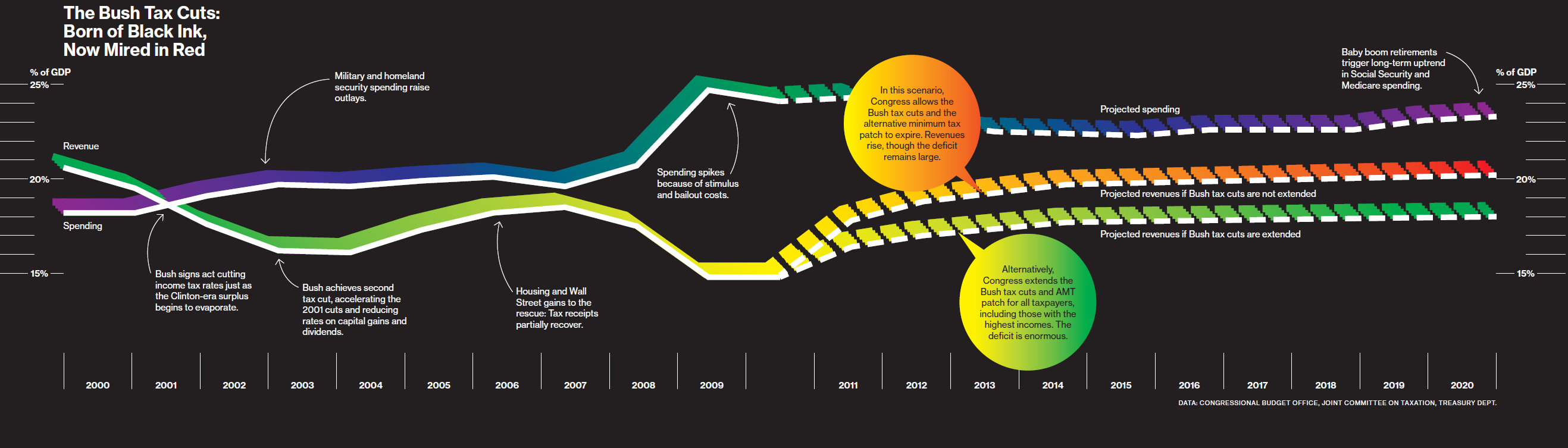
From Bloomberg BusinessWeek, we see this ginormous graphic from the article The Wisdom and Folly of the Bush Tax Cuts. The full graphic is informative as to the longer term impact of the Bush Tax cuts, which will cost the Treasury Department $238 billion in 2011.
>
>
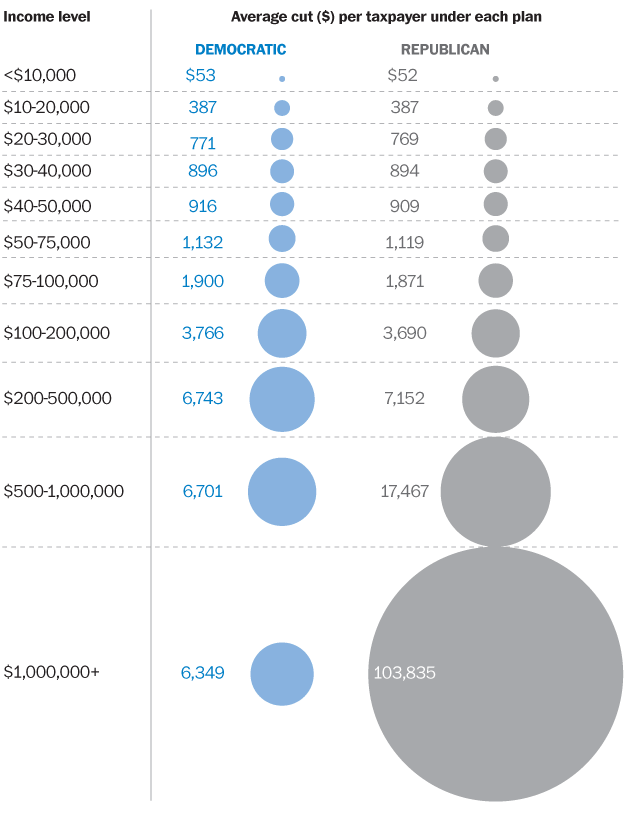
Extending the cut on the top rate adds to the deficit by about $36 billion next year, according to the nonpartisan Joint Committee on Taxation (more in the ensuing years). And of that top bracket, households earning more than $1 million a year gain nearly $31 of the $36 billion in tax cuts.
The graphic from Joint Committee on Taxation (published in the Washington Post) is quite telling:
>
Sources:
GOP plan to extend tax cuts for rich adds $36 billion to deficit, panel finds
Lori Montgomery
Washington Post, August 12, 2010
http://www.washingtonpost.com/wp-dyn/content/story/2010/08/12/ST2010081200375.htm
The Wisdom and Folly of the Bush Tax Cuts
Peter Coy
Bloomberg BusinessWeek, August 5, 2010
http://www.businessweek.com/magazine/content/10_33/b4191056654282.htm



Tweet
Facebook
Reddit
Digg this!


August 13th, 2010 at 11:59 am
The problem with George W Bush’s budget was that tax cuts and spending were not thought of together. It was irresponsible to decrease taxes and increase spending.
That said,I feel the current discussion is not so much economic but political. The people most arguing against the Bush tax cuts simply do not fee the upper income deserves the rewards of their labor and likewise are of the opininon the lower brackets deserve to be subsidized. Those arguing against Bush Tax cut extensions have no problem with increased spending of which we have had quite a bit of.
It’s unfortunate we are not having a different discussion, which is to reduce subsidies to corporations and private citizens which only introduce inefficiencies and distortions into our economy and make us as a nation uncompetitive. We should be looking to reduce our budget deficit and eventually lower net effective tax rates.
August 13th, 2010 at 12:08 pm
GOP plan is great for those making over 1/2 million per year. Pretty much like all the other plans coming out of the GOP. Someone once said: “you have to be a millionaire or a moron to vote for the GOP candidate”. At that time I thought he was be a little harsh.
August 13th, 2010 at 12:17 pm
well- they were so supposed to be temporary- right? So let’s stop the nonsense about continuation- because it will never be the right time to let the “temporary cuts” expire as far as the GOP is concerned. If the question is if it will be a drag on the economy- put the money elsewhere in the economy that may prove stimulative-
where that may be is open for debate
August 13th, 2010 at 12:18 pm
The biggest problem was reducing the number of tax brackets. That lumped those making six-sigma incomes, in with those making $250K/yr or so. When that was done, all the arguments for “not taxing the small business guy” becomes a political hot potato, securing reasonably low rates for those at the very high end of the income spectrum. I fail to understand how so many fail to recognize how debate is “steered” in this country into situations past what the real issues are. I can’t even believe there is a debate about “earned interest” being taxed as capital gains. I would like to call the money I receive from my clients something else so it can be classified as capital gains as well, but I guess I don’t stuff enough money into law makers back pockets.
August 13th, 2010 at 12:19 pm
dan10400
That was James Surowiecki argument for a new $1M tax bracketL
Soak The Very, Very Rich
Aug 16, 2010
August 13th, 2010 at 12:25 pm
“The nonpartisan Committee on Taxation”. Isn’t that the ultimate oxymoron? Any time you’ve got the word “nonpartisan” in the same sentence as “taxation”, you’ve got a contradiction in terms.
My view is that anyone who wants to weigh in on this issue of the “cost” of tax cuts should really provide two separate numbers: (a) the total IRS revenue that would result based on “static” assumptions (i.e., no change in behavior on the part of anyone), and (b) the total IRS revenues (from all sources, individual and corporate) that would result based on the assumption that those targeted by the tax increases (or decreases) will indeed change their behavior.
There’s probably a fair amount of agreement as to what the numbers should be based on “static” assumptions. Where the disagreement comes in is what the number should be based on behavioral changes.
But in any case, where a person comes out with respect to both of those numbers (and not just one of them) says a lot about their views on taxes in general.
August 13th, 2010 at 12:33 pm
Personally I think we should make the 10% and 15% bracket permanent. That will give everybody paying taxes a break, and approximately the same brake will be given to everybody (more consumer bang for the bucks). The 25% bracket should be extended for 5 years to stimulate the economy. The benefits of extending the next bracket for 2 years are debatable, but that is about it. A new 45% bracket for income over 1 million is called for, but has to be introduced and “sold” to the public with great care. Bring that to the floor and let the GOPsters vote it down – because buh-hu the millionaires can’t afford it, so better to raise taxes on everybody – then we see you at the November elections.
August 13th, 2010 at 12:36 pm
@Sechel, who says this
You are correct. But it is you yourself who are being political when you incorrectly frame the argument to suit your own political agenda.
The “people most arguing against the Bush tax cuts” ARE NOT DOING SO because (as you say) they “do not feel the upper income deserves the rewards of their labor.” That is proposterous. When you speak of upper income you should check out a recent New Yorker article by James Surowiecki, called Soak the Very Very Rick. I quote:
Source: http://www.newyorker.com/talk/financial/2010/08/16/100816ta_talk_surowiecki.
You got that.
Tell what “rewards of labor” are accruing to 2nd through 4th Generation trust fund kids who have assets worth more than 100 million dollars?
You want to portray this issue into the same old “tax and spend” dogma and that the very rich need tax breaks because they worked hard and deserved their money. Government spends money, and that has been the role of government for the last 300 years. The fact is that government spending is an important component of our economy and our societal well-being. Ask anyone who has a job and pays bills, you can’t cut your way to solvency when your revenues are decreasing.The percentage increase of government spending is not the behemoth that is creating a fiscal crisis. It’s the tax system.
Besides if the problem you have is really about increased spending, then how come you don’t even mention the privatization explosion of unaccountable cost over-runs in the various departments of the government, such as military contractors. How come you are concerned about the thousands of businesses who use Cayman Island P.O. Boxes to divert their fair share of taxes.
August 13th, 2010 at 12:39 pm
I want tax cuts, but those spend thrifts in Washington need to cut the deficit.
…and I want Social Security and Medicare, the best military in the world… I want the medical, financial protection of our brave Veterans, and I certainly want the US gov’t to make good on all the T-bonds that provide the foundation for the US as having the world’s reserve currency …especially those bonds I own personally and the ones in my pension plan, the pension plans for the companies I invest in and of course, the ones owned by the various insurance companies with which I have policies. and the roads, the bridges, the Coast Guard, the FBI to protect us from domestic terror… and the court system…
…but I don’t see why those fat cats just don’t cut spending.
August 13th, 2010 at 12:41 pm
#1 — Spending has to be addressed, with either plan there is a budget gap ….
The bush tax cuts were put in place as a temporary measure with sunset provisions (mandated term) for the very reason we are witnessing today in that congress does not have the will or discipline to follow their own plans. Now, today we are certainly in a situation that was not envisioned back in 2001 so the idea of extending the tax cuts to the folks that are hurting, middle class, and to sun set the cuts to the wealthy is warranted. (OK if 250K cut line is the big debate then change the cut line, make it 500K or 1M)
Also go after the Rich tax evaders — From the article: Telling Swiss secrets: 222 billionaires …
–When you consider that the U.S. Treasury loses up to $100 billion a year in offshore tax fraud alone,
http://www.globalpost.com/dispatch/europe/100724/swiss-banking-secrecy-billionaires
add that 100B to the 36B from the top 1% then that is some major contribution
***
other tax policy that should be addressed:
Alt min should be adjusted to inflation — retrospectively.
Estate tax should be reformed to address after tax ‘wealth’ – capital gains — no basis resets, tax capital gains at CG rates when they are realized.
August 13th, 2010 at 12:42 pm
Tax cuts that go to the lower 99% of individual incomes (roughly less than $120,000) will almost all get spend or used by small businessses. Tax cuts that go to the upper 1% (and especially the upper 0.1%) do not get spend, and most of it gets saved — used to purchase stock, bond, and asset portfolios.
The upper 1% had its median income triple over the last 10 years thanks to the Bush tax cuts.
Did the jobs available triple over that time? How come? I thought trickle down economics meant giving the upper 1% would create investment and jobs?
It didn’t for the very simple reason that the upper 1% are only using their economic gains to fuel further economic gain … their own, often at the expense of everyone else who lives in the lower 99%.
August 13th, 2010 at 12:47 pm
Nothing wrong with tax cuts — as long as spending cuts are bigger.
And that means not starting any more wars and ending the fake ones, like the “war on drugs”, the “war on poverty”, and the “war on terror”. And getting the federal government out of education, housing, community development, stimulus funding, fitness, tobacco, and all the other stuff more appropriately left ungoverned or at least governed at the local level.
August 13th, 2010 at 12:49 pm
We need to revert to the tax scheme we had in the ’60s — the golden age of the middle class:
http://www.truthandpolitics.org/top-rates.php
August 13th, 2010 at 12:51 pm
radioman @ 12:47
That makes a lot of sense to me.
August 13th, 2010 at 12:52 pm
Napster, the changes in income distribution in this country is a complex issue. It’s not clear to me it’s as simple as you say. We need the economy to grow and promote opportunity and prosperity, not simply redistribute a declining pie
We need a flat tax and policies that promote economic growth and opportunity for all.
August 13th, 2010 at 12:54 pm
The US is spending an inordinate amount to keep the wealthy wealthy, so they ought to be charged for the service.
August 13th, 2010 at 1:00 pm
There are over 40 million people in the United States on food stamps and and that number is growing….that’s a problem. Trickle down economics is a great fantasy until it turns into a nightmare. (oh, that will never happen here….)
Sooner or later the mega rewards given to the top at the expense of the bottom causes resentment, followed by social unrest, which leads to violence, which leads to a break down in law and order which leads to more violence. And then everyone acts surprised the peasants had the audacity to revolt.
It’s not like history books aren’t filled with bloody examples of just what happens when the bottom half of society goes hungry.
August 13th, 2010 at 1:02 pm
Since the GOP controlled both houses of Congress and the White House when the Bush tax cuts were signed into law, if they didn’t want them to expire in ten years, then why in the hell did they write the law the way they wrote it?
Also, the key talking point by advocates for extending the Bush tax cuts to the top 2% is that it “will hurt small business”….Here’s a rebuttal of that meme from the non-partisan Tax Policy Center:
August 13th, 2010 at 1:03 pm
@napster Says:
wow – both barrels … I totally agree with your vitriol and the New Yorker article which shines the Tiffany light on the rich, very rich and very, very rich who like (pay) to keep this information in the shadows.
Instead of adding more brackets and complexity into the wheel barrow load of tax code, we should scrape the current system and go to a simpler consumption tax — http://www.fairtax.org
August 13th, 2010 at 1:04 pm
@Sachel: I know weazle words when I see them.
You speak vaguely of “growing” and economy and “promote opportunity and prosperity” without any attempt to provide some substantive, quantitative-based ideas to achieve those high-sounding, flowery phrases. Your assumption that a flat tax will “promote economic growth and opportunity for all” has no validity or even proof.
I never said anything was “simple.” What I did say was that your characterization of the debate was not politically driven and not at all related to the actual debate. What isn’t clear to you is how obvious it is.
August 13th, 2010 at 1:05 pm
Akk. I meant: What I did say was that your characterization of the debate was politically driven and not at all related to the actual debate. What isn’t clear to you is how obvious it is.
August 13th, 2010 at 1:07 pm
Also, the changes in income distribution is not a complex issue all. The first paragraph of the quote from James Surowiecki above is sufficient.
You just want to pretend this is hard and complex in order to promote your own simplistic agenda.
August 13th, 2010 at 1:09 pm
I hope the GOP plan prevails due to overwhelming support of those people making less than 100k, so I can LMAO when the GOP slashes entitlements and kills the death tax. I love a good tragedy!
I love the layout of the Washington Post graphic, ten circles of hell…
August 13th, 2010 at 1:25 pm
tagyoureit,
Entitlements are going to get “slashed” eventually, no matter who’s running the show.
August 13th, 2010 at 1:27 pm
radioman:
So you want us all to end up like Texas? Or have you not heard about the State Board of Education lately?
August 13th, 2010 at 1:39 pm
For all their voting against stimulus the irony is that deficit funded tax cuts are essentially the same damn thing. It’s stuff like this that lends credence to the argument that there’s really no choice in terms of political parties.
And to the extent that the Republican Party or the Tea Party supports tax cuts with out corresponding spending cuts to pay for them they’re being intellectually dishonest in terms of calling themselves fiscal conservatives.
August 13th, 2010 at 1:46 pm
“So you want us all to end up like Texas? Or have you not heard about the State Board of Education lately?”
I’ve lived in Texas and done contract work all over the US and honestly Texas actually feels a lot more modern and even “progressive” than a lot of places in the US. So much of the development there is brand new and the capitol, Austin, is actually one of the most liberal and educated cities in the country (but, refreshingly, without the cloying bureaucracy). Even economically Texas is one of the few relative bright spots in the nation. Sure there’s some backwards thinkers there but overall it’s one of the best places I’ve lived and worked except for being unbearably hot in the summers (I actually prefer places like Cleveland in the winter than Texas in the summer). Admittedly it’s a huge place and I haven’t been everywhere but the nice places (like North and West Austin) are very nice places to be.
August 13th, 2010 at 2:09 pm
Why not compromise and implement the Clinton top rate for those earning more than $750,000? Why get stuck in the old when you can make both sides happy and help reduce the deficit?
August 13th, 2010 at 2:12 pm
The problem with taxes is that they are not designed to raise revenue efficiently but rather to do social engineering or to make it possible for Congress to collect campaign contributions from special interests. The current system is insane and that is just how the politicians like it. The REAL problem is not taxes but spending and that has as much chance of being cut as the tax system has of being replaced by something sane.
August 13th, 2010 at 2:17 pm
@DL – Agreed, but if it’s the GOP it’s ‘tragic’ if it’s Dem, it’s ‘comedic’. Either way an entertaining final act, enjoy the show! Someone making 40k can put the extra $2 of tax rebate in an IRA.
August 13th, 2010 at 2:31 pm
The Bush tax cuts yielded the jobless recovery and three trillion in debt. They did not prevent the current recession and have mitigated its severity only through their Keynesian fiscal effects. Thus it would seem that their continuance is detrimental to overall sustained growth. It would be far better to exempt the first $25,000 of wages from the payroll tax and raise the standard deduction to $15,000/$30,000. This would add money from the bottom up.
August 13th, 2010 at 2:31 pm
The post WWII decade with the highest average year-to-year growth in GDP (1971-1980) had a top marginal tax rate of 70% and a top marginal rate on earned income of 50%. I’m just saying…
August 13th, 2010 at 2:47 pm
Correct me if I’m wrong here, but it seems to me that the rich have had their turn. The unemployed seem to be getting their share with the social programs. How about tax cuts for the middle and upper-middle class?
If you were going to make a tax cut for these troubled times, tax cuts targeting this group seem to make the most sense as it:
• repairs middle class balance sheets (direct support to housing prices and turnover)
• immediately boosts consumption (these folks are the big spenders of our economy)
• leads to an increase in jobs (to support said increase in consumption)
• increases investment (isn’t this the base for many of our small business entrepreneurs?)
Deliver spending power to those who will use it, and then give them stability and confidence that will target less hoarding. Plain & simple.
August 13th, 2010 at 3:03 pm
As far as 2011 is concerned, the “fat cats” have probably moved a lot of their income into 2010. And in 2012, the fat cats may try to move income into 2013 in the hope that Obama loses the election.
Even if Obama gets the tax increases that he so longs for, it remains to be seen how much money he can really squeeze out of the fat cats, prior to the 2012 election.
August 13th, 2010 at 3:25 pm
This debate is not complete without looking at the regressive nature of income taxes at high levels. The very rich (over $2 million/yr)
http://www.taxanalysts.com/www/features.nsf/Articles/C214B4EF383FC6C08525768C00615578?OpenDocument
Can someone also point out research on the question of whether or not the rich create wealth? This is the fundamental basis of conservative economic policy and I would like to know how much empirical data there is addressing this one way or the other.
August 13th, 2010 at 3:33 pm
We’ve provided enormous tax relief for the extremely wealthy in America for the past ten years. In fact this year, 2010, we will collect no estate taxes and the multi-generational wealthy whose income is largely from dividends and capital gains are at 15% I think (a rate considerably lower than that for a couple earning $200,000 a year.)
My question is: WTF did it buy us? If it was such a good idea why do we have 9.5% unemployment? Why have my investments done essentially nothing for a decade? In what universe is this evidence that massive tax cuts for the rich are beneficial for the economy?
I don’t begrudge anyone his wealth, but the wealthiest 2 % of the U.S. population owns well over half of the wealth. They have a lot more to lose if we get conquered by the Venezuelans.
August 13th, 2010 at 3:35 pm
consider the tax cuts and investment in jobs and did the economy bloom under them?
I think we can look at the statistics for the years after the tax cuts and see how they did?
i am sure we had the biggest jump in jobs right after all that was supposed to be a big selling point? um no
and i am sure incomes for every body went up right?
um. no
well the economy did really well right? um no. we can tell almost all of the econo0mic growth was fueled by only one thing easy credit. from wall street.
otherwise it was just a marvelous tax code change
August 13th, 2010 at 4:20 pm
The folks at the top bought themselves the tax and regulatory system they wanted based on the notion that a ‘rising tide’ etc.,
In return they gave us an economy where 80% of the workforce can produce enough for 100% of the population and median incomes have been almost stagnant for decades.
This is the system they lobbied for and they need to share the burden when things go badly.
August 13th, 2010 at 4:34 pm
“The unemployed seem to be getting their share with the social programs.”
That’s a strange statement; care to expound?
August 13th, 2010 at 5:24 pm
Apinak Says: Can someone also point out research on the question of whether or not the rich create wealth?
—– Reply
Boy, this would spawn a long blog thread in itself and it depends on the definition of wealth. Perhaps the better metric would be how much societal value is created, not just wealth.
Virtually every indicator points to the number one priority of the rich is to accumulate wealth — rich -> very rich -> very very rich -> filthy stinkin rich -> I want to be a billionaire rich -> Billionaire (Is the next mission to become the first trillion-aire ?)
Not likely to find many of the rich actually creating wealth, but they do fund the ability to generate value and wealth (investing in business, run and manage business etc …) but by themselves they do not create wealth.
Most everyone aspires to a world were you can innovate, work hard and have the opportunity to generate more and more income and to accumulate ‘wealth’ – where the capitalism ideal breaks down is when too much is extracted from the wealth producing engines by too few, leaving too few crumbs to those who actually execute to produce value. After all we know what happens to the aristocrats and oligarchs …
August 13th, 2010 at 5:28 pm
And the award to the person who has been living longest in an alternate universe goes to SECHEL
come on down!
“upper income deserves the rewards of their labor.”
“UPPER INCOME” – “LABOR” Funny, funny stuff.
August 13th, 2010 at 5:52 pm
I’ve often wondered if the very wealthy spent more of their money locally and on goods manufactured by Americans, what would the net effects be? Is there any (good) data on such a thing?
August 13th, 2010 at 9:48 pm
johnnywalker Says: The post WWII decade with the highest average year-to-year growth in GDP (1971-1980) had a top marginal tax rate of 70% and a top marginal rate on earned income of 50%. I’m just saying…
johnnywalker, the seventies were actually a time of stifling stagflation and the fruits of the increased GDP would have been hard to notice. Your argument is, shall we say…on the rocks? :) He he. I actually believe that higher taxes would result in a positive contribution to GDP from increased government spending as opposed to private saving, but with a screenname like johnnywalker and a comment like that, I had to step in.
August 14th, 2010 at 12:01 am
Greenspan Calls for Repeal of All the Bush Tax Cuts
It was not enough, it seems, for Alan Greenspan, the former Federal Reserve chairman and a self-described lifelong Republican libertarian, to call for stringent government regulation of giant banks, as he did a few months ago.
Now Mr. Greenspan is wading into the most fierce economic policy debate in Washington — what to do with the tax cuts adopted, in large part because of his implicit backing, under President George W. Bush — with a position not only contrary to Republican orthodoxy, but decidedly to the left of President Obama.
Rather than keeping tax rates steady for all but the wealthiest Americans, as the White House wants, Mr. Greenspan is calling for the complete repeal of the 2001 and 2003 tax cuts, brushing aside the arguments of Republicans and even a few Democrats that doing so could threaten the already shaky economic recovery.
“I’m in favor of tax cuts, but not with borrowed money,” Mr. Greenspan, 84, said Friday in a telephone interview. “Our choices right now are not between good and better; they’re between bad and worse. The problem we now face is the most extraordinary financial crisis that I have ever seen or read about.”
Mr. Greenspan, who led the Fed for 18 years until he retired in 2006, warns that without drastic action to increase federal revenue and reduce the long-term growth in health care costs, bond investors could make a run on Treasury securities, driving up the nation’s borrowing costs and leading to another global economic crisis. This is not the first time Mr. Greenspan has urged fiscal restraint; he warned in 2008 that the country could not afford the tax cuts proposed by Senator John McCain, the Republican presidential candidate. But his sweeping call for rescinding the Bush tax cuts, which he has articulated in a recent appearance on “Meet the Press” and an interview with The Financial Times, among other settings, has rankled former colleagues.
August 14th, 2010 at 1:15 am
“Government spends money, and that has been the role of government for the last 300 years. The fact is that government spending is an important component of our economy and our societal well-being. Ask anyone who has a job and pays bills, you can’t cut your way to solvency when your revenues are decreasing.The percentage increase of government spending is not the behemoth that is creating a fiscal crisis. It’s the tax system.”
I almost barfed up my green tea and Oreo cookies. Are you serious? If this is the reasoning of wall street investor types, it’s time to move to New Zealand.
Listen bud, I don’t work hard to give my money to your government so it can be a spending machine. Ask anyone who has a clue that you don’t start spending money when your revenues are decreasing. My taxes are a expense item on my P&L. Not sure how your accounting works. And, I don’t care if the dentist pays the same percentage as lebron…that’s why it’s a percentage. Anytime the government spends money to boost the economy it’s artificial and ends up making someone rich that didn’t deserve it. Wake up. Lower my taxes, put more responsibility on me to take care of my family, provide a basic safety net for the unfortunate folks, and then get out of my life. Go to Holland or wherever else if you want to tax people 50 to 75% of their earnings. To say taxes are the problem when your government wastes money and spends money to no reasonable end, is the most loony thing I have heard.
August 14th, 2010 at 7:52 am
Well, it is quite easy to see where the Republican’s priorities are, although the Democrats aren’t any better. Still for someone who always touts the working class, they sure seem to love rich corporations…
August 14th, 2010 at 7:58 am
Well, this is a rich topic — filled with astute views and comments.
Here’s a simplistic contribution, which is purely qualitative, reflecting little of the rigor demonstrated in many of the posts above…
Seems to me that with the stratification of wealth and income generation, we desperately need new labeling. As noted above “The Middle Class” — whatever that is, measured either by proportionate income or relative tax payments — is simply not in the “Middle” anymore. And this trend is acclerating, putting enormous financuial pressure on “The Middle” — compromising spending power in this vast societal segment.
So much so that today — the difference between being “Middle Class” (and even “Upper Middle Class”) VERSUS being “Very Rich” is so large, so big, that it distorts understanding. And promotes discord.
The actual dollar variances at work here are just too large: we’re talking 10X, 20X — even 100′sX –multiples on some of these income brackets.
So, the way it appears here is that the “Actual Middle” is way higher than what we’ve been conditioned/educated/informed to believe.
.
August 14th, 2010 at 8:08 am
Surprisingly civil and intelligent discussion of taxes.
I am not even seeing the usual Cato/AEI showing up in moderated comments
Are all the crazies away for the weekend already?
August 16th, 2010 at 11:41 am
Napster,
What would be good (or fair) taxation in your opinion?
August 18th, 2010 at 5:31 pm
[...] found the Washington Post chart (mentioned here) much more [...]
August 21st, 2010 at 3:22 am
[...] On Facebook, Ed Lowry Posted: A Closer Look at the Bush Tax Cuts | The Big Picture [...]